
Sonic Borders Virtual Panel: Theo Cateforis’s “No Control, or: How I Learned to Start Worrying about Sound” from IASPM-US
DOI: https://doi.org/10.59350/nc75e-gd545
In high school I was that guy. The one who spent every spare penny at the local record stores. The one who would make you a mixtape or tape a whole album to cassette for you. The one who would host listening parties around the stereo in his parents’ living room. Listening to music was a social activity, but it was also, I now recognize, a form of control. It was important, for instance, that I held those listening parties at my house because I was familiar with my records and stereo system, and I knew exactly how the music would sound. There would be no surprises. Likewise, to make a mixtape meant not only arranging a selection of songs, but ensuring that the recording levels and overall sound flowed from one song to the next. A good mixtape revealed not only an intimate knowledge of one’s record collection, but also the mastery of one’s tape deck.
My days of making mixtapes are long behind me, but I do construct course syllabi with a generous heap of listening assignments that function more or less the same way. And while I no longer host listening parties at my house, I do get to gather with my students every week in the classroom to listen closely to recordings. I guess the main difference is that I never gave my high school friends an exam testing them on what they had heard.
I am unsure if I gravitated toward musicology, and eventually popular music studies, as a way of validating or justifying my record collecting, but whatever the case may be recordings are central to the work that I do in my profession. I would like to think that the control that I wield over my collection is not as extreme as this memorable figure from Alan Zweig’s seminal documentary Vinyl, but if it is, I hope someone will tell me before I end up in an episode of Academic Hoarders (no, there is no such show, which is a true missed opportunity).
There are many ways that we exhibit our command of recordings in popular music studies. When we do musical analysis, for example, we control the recording through our use of descriptive language (as Barry Shank does with his wonderful break down of PSY’s “Gangnam Style” http://iaspm-us.net/sonic-borders-virtual-panel-barry-shank-on-popular-music-studies/ in the previous entry on this panel), we make transcriptions to cement soundwaves into notation, and we explain the significance of harmonic progressions and kick drum beats. Such analyses can seem especially authoritative when they focus on the music’s quantitative properties: its pitch and rhythmic structures. When we invoke sound, however, we generally do so in a more qualitative sense. It is the domain of timbre, texture, or in Barthes’s famous formulation “the grain of the voice,” for which there exists no sufficiently systematic explanation.
To be sure, pitches and rhythms are sounds, but in the vernacular or common parlance of popular music (the context I will take from this point on), sound generally refers to something else. Sound is the instrumental tone, performance style, or as Albin Zak deftly illustrates in I Don’t Sound like Nobody [link], the arrangements and production techniques that distinguish artists and their recordings from one another. Phil Spector’s Wall of Sound is, of course, a classic example. Sound in Spector’s recordings emerges from a blurry thickness of instrumental and vocal layerings, the ambient room space of Gold Star Studios and the reverberations of its echo chamber. Spector obsessively fought to control that sound, and that obsession is inseparable from his recordings’ sonic identity.
Producers are far from the only ones who anxiously fret over sound. As the past two decades have witnessed a deluge of CD reissues and remasters and a tendency toward increasingly louder recordings, music fans and recording engineers alike have increasingly voiced their concerns about the compromised quality of sound recordings. The “Loudness War,” as it has come to be called, is an impassioned rebuttal against the music industry’s attempts to define and control popular music’s sound. There are hundreds of clips on YouTube, such as this one (http://www.youtube.com/watch?v=3Gmex_4hreQ), that use audio samples to illustrate the terms of this contested terrain. And anytime a classic album reappears in a new deluxe form, fans are sure to weigh in on the sound quality (see, for example, the angry customer reviews accompanying Geffen’s “screwed up” 20th Anniversary release of Nirvana’s Nevermind http://www.amazon.com/Nevermind-2-CD-Deluxe-Nirvana/dp/B0057GYOA4/ref=sr_1_1?s=music&ie=UTF8&qid=1360492077&sr=1-1&keywords=nirvana+nevermind+deluxe).
I keep a keen eye on these debates, and not just as a music fan but as an educator who wants to select the most appropriate and representative recordings to load onto my Blackboard course page. The sound of these recordings is crucial, certainly for aesthetic reasons, but also because it is interwoven with the larger points, stories, and themes that I wish to communicate in the classroom. There have been times, however, when the sound and my stories refuse to synchronize, when I find myself in the middle of a lecture with a recording that throws a wrench into my carefully constructed lesson plan. Such moments can reveal just how relative sound is to what we expect or want to hear in the recording.
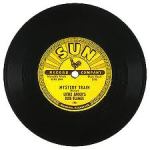
Consider Elvis Presley’s 1955 recording of “Mystery Train” for Sun Records, a song that I periodically teach in my History of Rock survey. The sound of “Mystery Train” is essential to the song’s significance. Producer Sam Phillips’ legendary “slapback echo” (aided by guitarist Scotty Moore’s newly acquired Echosonic amplifier) adds a spacious textural delay that converts the trio of musicians into a ghostly chugging train. Phillips’ innovative recording technique not only lends a poetic resonance to Presley’s vocals, it also serves a specific purpose within the narrative that I weave in my rock history class. It represents a moment of DIY recording studio ingenuity—a hallmark of small labels like Sun—and thus serves to distinguish the indies from the major labels whose domination they were beginning to threaten. It matters greatly that RCA tried to replicate that sound with Presley’s debut single “Heartbreak Hotel,” and failed.
When I taught “Mystery Train” in class a couple weeks back, I began by giving the students the background of Presley’s indie years and explaining the importance of the slapback echo. They were primed to listen for it. I decided to play them the version on the course website (the one they could access when listening on their own). But something did not sound right. One of the recording’s most alluring sonic properties is the patterns of propulsive rhythmic clicks that mysteriously emerge from the echoic aftershocks of the strumming string trio. On this particular day, those clicks did not sound at all mysterious. Rather they sounded like someone banging together two drumsticks. I always come to class equipped with a CD copy in case of some computer malfunction, and so I quickly apologized to the students and promised them a better realization of the slapback echo as I cued up the Sunrise Presley anthology. But the CD was just as bad, even worse actually. The clicks—now suffocatingly dry and wooden—sounded completely separated from the rest of the instrumental texture; I was struggling to explain how one could locate those clicks as part of the song’s recording process I had prompted the students to listen for just moments ago. I had a sinking feeling, like a used car salesman after a poor pitch, realizing a potential customer is about to leave the lot.
So, where did I go wrong? How did I manage to lose control? The answer occurred to me later that day. I recalled that when I was prepping for my class, I had been on the computer browsing YouTube and had decided to pull up a recording clip of “Mystery Train” from there just to get the song in my ear. The video that I chose was one where some fan had made a digital transfer from a “near mint” copy of the 1955 Sun 78 release (http://www.youtube.com/watch?v=XA5HErVE9oI). Listening to the clip a second time, I now heard how the rhythmic clicks were enmeshed in the texture, part of an all-consuming glorious wash of sound. When I had casually listened to the clip the first time around, I had unknowingly created a specific context for how I imagined and wanted slapback echo to sound, one that I could not reproduce in the classroom.
My point in sharing this anecdote is not to suggest that I have finally located the authentic “Mystery Train” sound. Rather, it is to acknowledge that in popular music studies, the main objects of our study, recorded songs, exist in liminal spaces, floating between different media, re-imaginations, and varying channels of communication. In my class I attempted to deploy the sound of “Mystery Train” as part of a strategic argument within the history of rock; I needed it to sound a certain way, but the song eluded my control. For those of us who interpret, analyze, and seek meaning in popular music, we constantly seek to control its sound. We often assume that our experience of popular music’s sound is a shared one, but sound can be more slippery than that. We can suggest and argue for ways of hearing, but those propositions come with no guarantees.
–Theo Cateforis–

Sonic Borders Schedule
1/21 – Liana Silva, Sounding Out! – “I’m on My New York Sh*t”: Jean Grae’s Sonic Claims on the City
1/28 – Regina Bradley, Sounding Out! – I Like the Way You Rhyme, Boy: Hip Hop Sensibility and Racial Trauma in Django Unchained
2/4 – Marcus Boon, Sounding Out! – One Nation Under a Groove?: Music, Sonic Borders, and the Politics of Vibration
2/6 – Barry Shank, IASPM-US – “On Popular Music Studies”
2/11 – Tavia Nyong’o, Sounding Out! – “Freedom Back: Sounding Black Feminist History, Courtesy the Artists”
2/13 – Theo Cateforis, IASPM-US – “No Control, or: How I Learned to Start Worrying About Sound”
2/18 – Tara Betts, Sounding Out!
2/20 – Shana L. Redmond, IASPM-US
2/25 – Art Jones, Sounding Out!
2/27 – Devon Powers, IASPM-US
—
Share this:

Sonic Borders Virtual Panel: Barry Shank’s “On Popular Music Studies” from IASPM-US

DOI: https://doi.org/10.59350/js5jc-4hk17
There are no generic limits to popular music studies. It is defined by its methods, not its objects. Popular music studies approaches the popular through music. In this way, it can be distinguished from sound studies, ethnomusicology and other neighboring fields. But this definition requires that we understand the meanings of those keywords—music and the popular.
Music is what we hear when we are engaged in musical listening. Musical listening is not equivalent to that rarified practice known as “structural listening.” Musical listening is common and everyday. It is what happens when anyone discriminates between music and noise. The ability to make that judgment, to discern the patterning of sound and to assent to the potential pleasure in those patterns, is the fundamental aesthetic judgment. Once that judgment is made, the sound—any sound at all—has become music.
In a documentary shot in 1991, John Cage makes a cogent distinction between music and sound. He said that when he listens to music, he feels as though someone is talking to him, talking about their feelings and their ideas about relationships. https://www.youtube.com/watch?v=pcHnL7aS64Y He prefers, he said, to listen to traffic. No one is talking to him when he is listening to traffic. He is only listening to sound being active, moving up and down, getting louder and quieter, longer and shorter. Cage does not need sound to talk to him; its active being is enough. Although Cage uses this thought to dismiss musical listening, the distinction he makes is helpful. Cage appreciates the activity of the sound itself. Musical listening, on the other hand, is an activity that transforms sound into a meaningful and feelingful structure. Musical listening does not allow sound to be itself. It forces sound into a web of interconnected thoughts and affects. Musical listening does not happen by itself; it is the consequence of an intention. A person must become a listening subject and, when they do so, they open themselves up to music’s effects. When engaged in musical listening, we are not trying to hear what it says but to feel the affects that it spreads. Any time a person listens musically, that person becomes aware of the commonality of being, of the shared nature of subjectivity.
The popular is what emerges when individuals seek out their commonality. This is an evanescent process, consisting of fleeting moments that seek sustaining structures. We become aware of the popular when we recognize that our identity is divided and multiple, always a node in interlocking networks of affect and meaning. The act of musical listening enables us to confront complex and mobile structures of impermanent relationships—the sonic interweaving of tones and beats, upper harmonics and contrasting timbres—that model the experience of belonging to a community not of unity but of difference. Each moment of the popular has its feel, its set of characteristic affects, what we sense when we know we are among our own. Yet this popular is not unified by categories of identity or political ideologies. It is not a group characterized by sameness, but rather difference.
We all know this feeling: the joy of mutual recognition that leaps within us during moments of dance floor communion, when the dj or the musicians hit it. (http://thecombatjackshow.com/wp-content/uploads/2010/03/ParadiseGarage-Nov19815.jpg) We also know this feeling: the profound disappointment that comes over us when later conversation with our dance floor compatriots reveals vast gulfs of mutual incomprehension. Even the sense of the common that is brought into being by a traditional political song like “We Shall Overcome” is a collective in conflict. Those famous photographs of Dylan, Baez, the Freedom Singers and Peter Paul and Mary, singing from the Newport stage (http://blogs.citypages.com/pscholtes/images/We%20Shall%20Overcome%20at%20Newport.jpg) as well as of young civil rights activists crossing arms and singing along together (http://newsreel.org/titleimages/WE-SHALL-OVERCOME.jpg) capture moments of shared affect, not moments of identical political motives or goals. Popular music creates a sensuous confirmation of a feeling of belonging. At times it is capable of producing that belonging, even in the face of profound and overt disagreement. Its pleasures are the pleasures of shared presence, of the multiplicity of being. Popular music studies works through musical listening to apprehend the affects that constitute the popular. It is a method of analyzing auditory pleasure in order to uncover the shared ground of that pleasure.
For example, Psy’s “Gangnam Style” video has been viewed nearly 1.25 billion times. (http://www.youtube.com/user/officialpsy) It has generated hundreds of copies and parodies. The original video is a parody in itself. A big part of its appeal lies in Psy’s irrepressible and incessant demand for pleasure while surrounded by example after example of his improper decorum. Psy is out of place in the Gangnam district. He sprawls drunkenly in a children’s playground. His equestrian imitation is ludicrous. He dances awkwardly through an outdoor yoga class and rises from the bottom of a private hot tub, rippling shock waves out from his presence. “Gangnam Style’s” improper demand for pleasure is produced musically by dirty-timbred synthesizers whose interlocking lines highlight their electronic origins. Indeed, those swooping blatantly artificial synthesizers never hit a note straight on. Most, rather, are approached from below, creating a tonal “whoop” that forces an improper rise from dancing bodies. The song’s demand for pleasure is supported by the low pulsing four on the floor “kick” that continues throughout the entire track. Stopping only at the end of bridge where its temporary cessation opens the room for Psy to restate the hook, that kick pushes the dancing crowd into waves of shared demand. Annoying but also reassuring, that kick is the only pitch in the backing track that is hit directly every time. Even in the midst of destabilizing waves that surround and saturate the listener with the impulse to rise up or be left behind, popular demand never stops. While this demand is out of place, its insistence refuses to be shamed. Its steadiness is also its unruliness.
In our current moment, any demand for pleasure seems out of place. It is as though there are no non-guilty pleasures. The capitalist imperative to work, to compete, to win or else to be left behind has stripped daily life of small rewards. The attention we pay to our children is now an investment in their future. Classroom time is no longer an opportunity for careful cultural analysis but must be approached as a training ground for corporate leaders. Even going out to clubs must be legitimated as a necessary blowing off of steam that reinvigorates you for the next day’s work. If we are not among the hyper rich, we have no legitimate pleasures. We haven’t yet earned the right to them. And yet, we refuse to stop demanding them. The music of “Gangnam Style” captures the affect of our time. Bouncing along on an imaginary horse, waving our invisible ropes in the air, we insist on our right to purposeless pleasure even in the heart of the machine.
–Barry Shank–
Sonic Borders Schedule
1/21 – Liana Silva, Sounding Out! – “I’m on My New York Sh*t”: Jean Grae’s Sonic Claims on the City
1/28 – Regina Bradley, Sounding Out! – I Like the Way You Rhyme, Boy: Hip Hop Sensibility and Racial Trauma in Django Unchained
2/4 – Marcus Boon, Sounding Out! – One Nation Under a Groove?: Music, Sonic Borders, and the Politics of Vibration
2/6 – Barry Shank, IASPM-US – “On Popular Music Studies”
2/11 – Tavia Nyong’o, Sounding Out!
2/13 – Theo Cateforis, IASPM-US
2/18 – Tara Betts, Sounding Out!
2/20 – Shana L. Redmond, IASPM-US
2/25 – Art Jones, Sounding Out!
2/27 – Devon Powers, IASPM-US
—
Share this:




Current Top Posts





April 2021

January 2020

November 2019

October 2019

August 2019

April 2014

November 2017

March 2015

December 2017

October 2015


Recent Comments