
‘A Clateryng of Knokkes’: Multimodality and Performativity in “The Blacksmith’s Lament”

 Each of the essays in this month’s “Medieval Sound” forum focuses on sound as it, according to Steve Goodman’s essay “The Ontology of Vibrational Force,” in The Sound Studies Reader, “comes to the rescue of thought rather than the inverse, forcing it to vibrate, loosening up its organized or petrified body (70). These investigations into medieval sound lend themselves to a variety of presentation methods loosening up the “petrified body” of academic presentation. Each essay challenges concepts of how to hear the Middle Ages and how the sounds of the Middle Ages continue to echo in our own soundscapes.
The posts in this series begins an ongoing conversation about medieval sound in Sounding Out!. Our opening gambit in April 2016, “Multimodality and Lyric Sound,” reframes how we consider the lyric from England to Spain, from the twelfth through the sixteenth centuries, pushing ideas of openness, flexibility, and productive creativity. We will post several follow-ups throughout the rest of 2016 focusing on “Remediating Medieval Sound.” And, HEAR YE!, in April 2017, look for a second series on Aural Ecologies of noise! –Guest Editors Dorothy Kim and Christopher Roman
–
The “Blacksmith’s Lament” is late medieval alliterative poem that rails against the disruptive, urban sounds of blacksmiths working late into the night. Catalogued by Rossell Hope Robbins in his 1955 Secular Lyrics of the XIV and XV Centuries, and now broadly anthologized, the poem is a 15th century addendum to a largely 13th century Norwich cathedral priory manuscript, now BL Arundel 292. The manuscript is comprised of Latin, French, Anglo-Norman and Middle English texts, and contains bestiaries, prayers, sermons, romances, prophecies, riddles and alliterative poems. As such, Arundel 292 might be categorized as a miscellany, what Ralph Hanna argues in “Miscellenaity and Vernacularity: Conditions of Literary Production in Late Medieval England,” is a kind of bespoke production that “represent[s] defiantly individual impulses—appropriations of works for the use of particular persons in particular situations” (37). Because each text included in a miscellany reflects one person’s desire to inscribe and compile, there are no “customary generic markers;” instead one finds a rich admixture of hands, images, texts, styles, forms, languages, and histories (Hanna 37). I argue that the inclusion of “Blacksmiths” in this miscellany is congruent with the poem’s own odd relationship to sound. In its multimodal blending of the onomatopoetic and the lyric as well as its consideration of manual labor, the “Blacksmith’s Lament” can be understood as an instantiation of specifically masculine medieval identity.
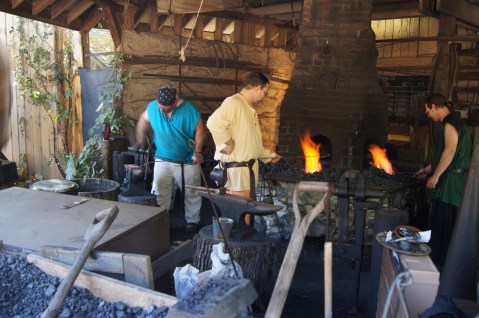
Modern medieval masculinity. Image by David Williss @Flickr CC BY.
Multimodality, Presentism and the Medieval Miscellany
The theoretical concept of multimodality is rooted in late 20th-century critique of semiotic systems. As the New London Group argued in “A Pedagogy of Multiliteracies: Designing Social Futures,” “effective citizenship and productive work” in the late 20th and early 21st centuries “now require that we interact effectively using multiple languages, multiple Englishes, and communication patterns that more frequently cross cultural, community and national boundaries” and that we the best way to do so is via methods that accommodate more than mere text (62-64). This engagement with the multiple modes of text, image, and video, among others, makes multimodality an ideal critical tool with which to analyze complex, hybrid compositions.
However, many theories of multimodality privilege a historical lens primarily afforded by 20th and 21st century literacy, dependent as it is on reading and looking (at screens or pages) as opposed to listening (to human voices). Indeed, Jeff Bezemer and Gunther Kress have observed in “Writing Multimodal Texts: A Social Semiotic Account of Designs for Learning” that because images predominate in 21st-century culture, textual “writing is now no longer the central mode of representation in learning materials” (166). In short, writing and images work in tandem to educate. Yet even though they note the different modes of text and image, Bezemer and Kress do not interrogate the fact that both depend on a single sensory ability: sight. Whether or not images have supplanted printed text in pedagogical documents, this assumption of the centrality of visuality as the singular mode of representation—in learning materials and elsewhere—is itself an historical phenomenon—as Walter Ong discusses in Orality and Literacy: The Technologizing of the Word—one dependent on the technology and dominance of print itself.
People do not depend only on seeing and reading text. They might also participate actively in “listening communities,” wherein one visually literate person reads aloud a text to a group who listens, ruminates over, and perhaps memorizes that text. Medieval “reading” is in fact an aural practice of recitation, memorization and listening as well as textual examination, a hybrid practice dating to the beginning of the medieval. Evidence of this hybrid practice can be found in the opening folio of Corpus Christi MS 61, which features Chaucer reciting Troilus and Criseyde to a royal audience. Studded with images and illuminations, musical notation and marginalia, medieval manuscripts often offer a complex multimodal relationship between graphics and written text, color and music, the visual and the aural.

An example of an illuminated manuscript. Image by Richard White @Flickr CC BY-NC-ND.
Long before print or digital media, “reading” manuscripts required a sophisticated multimodal form of interpretation. Arundel 292 is minimally illuminated, but it too must be understood as a flexible, multimodal form composed for a mouth reading aloud the words on the folio page as well as a group of listeners receiving those words. It offers a heterogeneity that mixes languages, genres, images, hands and modes. Indeed, there is little about this miscellaneous manuscript that might be categorized as using exclusively what Kress defines as “formalized, monolingual, monocultural, and rule-governed forms of language,” given its multilingual, multicultural, multi-genre variety of language forms, none of which take precedence over any other.
Onomatopoeia and the Medieval Lyric
The dependence of poetry upon aural and oral performance complicates the relationship between writing, sound, the body, and the intentionality of “design,” or the deliberate visual arrangement of words, images, and ideas. Like other time-bound, performative aesthetic genres such as music, dance, or theater, poetry exists in the moment of its performance as much as it does on the fixed, static page and only peripherally occupies the written mode. Ancient poetry has been preserved by manuscript and print technology, but the roots of the genre include both oral recitation and memorization. Because it depends simultaneously upon the modes of reading, writing and recitation, both historically and into the present day, poetry might be considered quintessentially multimodal. This is particularly true for medieval poetry, given its use of sound-dependent effects such as alliteration, assonance, consonance, onomatopoeia, meter and rhyme.

Figure 2 is BS MS Arundel 292, reproduced with permission from the British Library
Edmund Reiss has argued that “Blacksmiths” is the “earliest sustained onomatopoetic effort extant in English” in The Art of the Middle English Lyric: Essays in Criticism (167). But for an onomatopoetic poem that so carefully represents in language the sounds of men engaged in physical labor—from their “clateryng of knockes,” to the ringing exertion of iron on iron heard in “tik.tak.hic.hac.tiket.taket.tyk.tak/ lus.bus.lus.das” and the “stark strokes thei stryken on a stelyd stokke”—”Blacksmiths” is surprisingly unconcerned with its own visual appearance on the page. One turns the page in Arundel 292 and suddenly there is a neat chunk of prose with no other visual indication other than faint hashmark that one is looking at poetry. This is not unusual, for as Ardis Butterfield has recently observed in “Why Medieval Lyric?”, in many manuscripts containing lyric poetry or its traces, “there is no visual fanfare; nothing marks [the poetry] out” (322). Medieval scribes instead often use scripture continua—continuous script—to record the lyric, and “Blacksmiths” is no exception (Fig. 1). In short, “Blacksmiths” looks like prose, but sounds like poetry. Its insistent use of alliterative onomatopoeia, furthermore, suggests the poem might gain performative shape if addressed to both the mouth and the ear.
An aurally derived verbal pleasure, onomatopoeia exemplifies poetry’s general obsession with sound and performativity as it depends on the representational delight of hearing sounds that are the very things that they sound like. Onomatopoeia forces us into a strange ontological space in which a word is at once both signifier and sign. The bee buzzes, in other words; it has no other voice than the sound it creates, and we have no other way to describe that sound but to do so literally. This can produce the sounds of children’s babble as well as the more figurative pleasures found in “Blacksmiths.” The mimetic allure of using words that create the very sound of their own meaning is in many ways embedded in language itself. “Blacksmiths” calls our attention to sound, noise and listening, forcing further reflection upon the relationship between what is textually recorded and what is performed.
Blacksmithing and Masculine Poetic Labor
Salter argues persuasively in “A Complaint Against Blacksmiths” that the poem’s appearance in a priory cathedral manuscript suggests that the speaker’s resistance to blacksmithing may be the result of “older religious attitudes” about night labor and rioting (200). But given the fact that “Blacksmiths” is a poem concerned with labor likely written by a man about other men, I wonder if there is room as well for an additional consideration for the discourses of gender and labor that so consumed the late medieval period and how the poem interrogates these notions. While Salter resists categorizing the poem into any clear genre, noting that the poem is so realistic that it is frequently used as historical evidence [note], “Blacksmiths” draws attention to the lyric experiences and emotional expression of a presumably masculine first person speaker and in so doing might be categorized, as Robbins does, as a lyric.

Beyond a single, reflexive pronoun, “me,” we know nothing about the poet except the evidence of his poetic making—the poem itself. In the poem, there are two literary skills at work. There is narrative exposition and description and there is onomatopoetic mimicry. Both are dependent on verbal artistry and are held together by the tensile patternings of alliteration. Narratively speaking, the poem identifies the blacksmiths by what they look like and what they wield. They are “swarte, smekyd” and “smateryd with smoke,” swarthy dirty men who “spitten and spraulyn and spellyn many spelles,” and “gnauen and gnacchen thei gronys togedyr.” They are addressed pejoratively as “knauene,” and “cammede,” pug nosed knaves, who “blowen here bellewys that al here brayn brestes.” These alliterative lines represent the work of the forge as rhythmic, repetitive, harshly sibilant. Brains might get hyperbolically blown out in blowing the fires needed to produce metal goods, and dissonance is created by the groans and cries and tooth-gnashing of the workmen. The edge of the human blurs into the flame of the forge. Men use “hard” and “heavy hamerys” and “her schankes ben schakeled for the fere flunderys;” they work so long standing near the forge it seems that their ankles are shackled to the sparks. As those fiery images suggests, there is a nightmarish element to the poem. The speaker laments: “sweche dolful a dreme the deuyl it to dryue.” And he uses that infinitive “to dryue” when he begins the poem; the workmen might “dryue me to death with den of here dyntes.” The heavy repetition of the “d” in these lines mirrors the thudding of hammers on hot metal.

Image borrowed from Hasib Wahab @Flickr CC BY-NC-ND.
It is only in the second line of the text that the speaker identifies himself. He is “me,” an “I” making a poem and speaking to an implied addressee. And in his use of the first person, he might be understood as having engaged in what A.C. Spearing has called “self-pointing,” those moments in late medieval poetry where the poet identifies himself as a poet, in a meta-commentary on vernacular poetry and its performance. Obviously, the poet does not state his profession in this line. But the fact that he speaks in the first person is significant. His is the voice, and the descriptive rage, that drives the poem. Further, the alliterative matrix of the poem’s lines unmistakably reminds us that this is a poem, a work of art, a made thing. The repetition of alliteration is a bending of ordinary language into something clearly and pointedly artificial, a rhythmic joinery that is obviously not prose, and it requires a certain sonic attention. The speaker expresses his frustration in a pattern of sibilants, voiceless palatal consonants and voiced palatal g’s, as well as hard stops at dental and palatal phonemes. Indeed, the poem mimics the sounds of the smith’s labors, placing their calls and cries and bellows within the poem. The smiths “kongons cryen after col col,” and “huf puf seyth that on haf paf that other.” The poem is ostensibly about the speaker being awoken by the night labor of “Blacksmiths.” “Such noys on nyghtes ne herd men neuer,” he says, hyperbolically. In describing this never-before-experienced problem, the speaker creates a smithing cacophony so loud that it overwhelms his own voice.


Image borrowed from Hans Splinter @Flickr CC BY.
The smiths are so loud, so noxious, and I would argue, so much more manly, that they threaten to hijack the poem itself. It is through this sleight of hand, wherein the labors of blacksmithing obscure the poet-cleric’s own small voice, that the speaker makes his implicit argument about masculinity, poetry, and labor. As Kellie Robertson has argued, late medieval writing is concerned with the common profit. Some forms of labor contribute to the common profit while others do not. For the most part, profitable labor is material; it produces actual goods that can be used and sold. And profitable medieval English labor is gendered as almost exclusively masculine, as only men can be masters and authorities. Only men are blacksmiths, and only men are priory scribes. Yet the practice of blacksmithing cannot be separated from materiality. The blacksmiths, however badly skilled the speaker may declaim they are, produce goods to be used for vital purposes. The newly-shod horse will pull the cultour through the fields; the sharp scythe will bring in the harvest; the knife will butcher animals. Moreover, the labor of the blacksmiths is productive even if it is done at night. It can be done as the work demands, all night long if necessary to finish the job. But the clerical poet cannot do scribal work at night without serious consequence. His labor—copying, scraping, blotting, correcting, reading, blotting— depends on daylight, silence, and decent sleep.
The clerical poet, like the speaker of “Blacksmiths,” is engaged in “immaterial labor,” to use Italian Marxist Maurizio Lazzarato’s term, which, as he explains in Radical Thought in Italy: A Potential Politics is “labor that produces the informational and cultural content of the commodity” (133). Clerical poetic labor is abstract, one of inscription, composition and performance. Within the material economy of the later middle ages, poetic labor produces nothing of concrete value. Making, inscribing and reciting poetry, in the words of Harry Bailly, “doost noght elles but despendest tyme” (VII.931). “Blacksmiths” thus asks: what does it mean to make poems—immaterial, multimodal, performative things that are not things at all—from within society where material production is consonant with masculine virility?
The sequestered clerical maker and scribe, scratching away in the silent priory, might have been furious over being disrupted by the athletic, kinesthetic activities of the blacksmiths. The poem might be read as a kind of homosocial lament about what men’s work is and what it means. To write is to not engage in more busily productive, material labor, and the anxiety around what writing is and what it does can also be seen throughout late medieval poetry. The workers make noise and heat deep into the night, producing metal goods. But the maker of the “Blacksmiths” offers a poem that represents the “Blacksmiths”’ loud labor and that also serves as evidence of his own “travaillous stillness,” in the words of Hoccleve (RoP l.1013). In doing so, he calls attention to his own skill as a maker of verse. His labor, however immaterial, can verbally represent noise and sweat and physicality. His prosopoeia is a contribution to the common profit, in that he can make you see and hear the blacksmiths long after their hammers have been laid away. And his hastily composed poem has outlasted even the best-made medieval horseshoe.

Image borrowed from Peter Grima @Flickr CC BY-SA.
To conclude, I’d like to point out that it is no wonder that “Blacksmiths” is set in the dark, and that the speaker himself cannot see his tormentors but only hear them. Because it is out of this darkness that the speaker can name, and in doing so—as Daniel Tiffany observes in Infidel Poetics: Riddles, Nightlife and Substance (97)—call attention to his own aesthetic power. As Martin Heidegger has argued in Poetry, Language, Thought (73), naming is “the lighting of what is,” and I wonder if verbal naming is in itself a wonderful kind of literary power. To name is to point out to another, to claim, to damn. To point out, however obliquely, who you might be and how your work might be remembered.
—
Featured image “Succor” by Walter A. Aue @Flickr CC BY-NC-ND.
—
Katharine Jager is a poet and medieval scholar. She is associate professor of English at the University of Houston-Downtown, where she teaches medieval studies, creative writing, literature, and composition. Recent publications include essays on aesthetics in Chaucer’s Sir Thopas (Medieval Perspectives) and masculine speech acts in Sir Gawain and the Green Knight (Medieval Feminist Forum, forthcoming); and poetry in such journals as Found Magazine, Friends Journal, The Gettysburg Review, Commonweal and the anthology on the religious lyric Before the Door of God (Yale University Press). She was for many years co-author with Jessica Barr of the Chaucer chapter for the Year’s Work in English Studies (Oxford), and is currently editing the interdisciplinary volume Vernacular Aesthetics in the Later Middle Ages: Politics, Performativity, and Reception from Literature to Music, to which she is also contributing an essay on lyric aesthetics, manuscript placement and the texts of 1381 (Palgrave’s New Middle Ages series, forthcoming).
—
 REWIND! . . .If you liked this post, you may also dig:
SO! Podcast #45: Immersion and Synesthesia in Role-Playing Games–Nick Mizer
“HOW YOU SOUND??”: The Poet’s Voice, Aura, and the Challenge of Listening to Poetry–John Hyland
Pretty, Fast, and Loud: The Audible Ali–Tara Betts
Share this:

A Medieval Music Box: the Cantigas de Santa María as Sound Technology in the Age of Alfonso X

Each of the essays in this month’s “Medieval Sound” forum focuses on sound as it, according to Steve Goodman’s essay “The Ontology of Vibrational Force,” in The Sound Studies Reader, “comes to the rescue of thought rather than the inverse, forcing it to vibrate, loosening up its organized or petrified body (70). These investigations into medieval sound lend themselves to a variety of presentation methods loosening up the “petrified body” of academic presentation. Each essay challenges concepts of how to hear the Middle Ages and how the sounds of the Middle Ages continue to echo in our own soundscapes.
The posts in this series begins an ongoing conversation about medieval sound in Sounding Out!. Our opening gambit in April 2016, “Multimodality and Lyric Sound,” reframes how we consider the lyric from England to Spain, from the twelfth through the sixteenth centuries, pushing ideas of openness, flexibility, and productive creativity. We will post several follow-ups throughout the rest of 2016 focusing on “Remediating Medieval Sound.” And, HEAR YE!, in April 2017, look for a second series on Aural Ecologies of noise! –Guest Editors Dorothy Kim and Christopher Roman
–
At a first glance, one might think the sounds of the Middles Ages unrecoverable from the fragmented yet abundant ruins of the past. The voices, noises, melodies seem lost to the present, casting the efforts to reconstruct matters of medieval sound as speculation. However, medieval peoples actually preserved copious traces of their efforts to produce the thing closest to contemporary sound recordings: comments, writings, treatises, music notation, verbal descriptions, music instruments and even architectural design in the name of sound. Testaments of such efforts– forgotten amplifiers resisting time’s erasure–appear in the form of one of the greatest and revolutionary accomplishments of the ten centuries comprising the Middle Ages: the development of the codex. Coupled with the meticulous treatment of writing, the codex ushered in a number of innovations slowly introduced in matters of script, binding, development of materials, the re-thinking of the function and design of the library, and others. During this expansive time, the topic of memory was linked to writing and its repositories as supportive instruments in an active way (Carruthers). Key to our discussion here, these developments greatly assisted melody, rhythm, the production of music in general, particularly through the slow creation of the written devices and symbols that eventually turned into music notation.
Alfonso X, King of Castile in the 13th century, set to participate in the stream of cultural reflections and productions about music and sound in the Middle Ages. One of his main works, the Cantigas de Santa María (sourced from here and here), is an awe-inspiring cultural monument, not only for its representation of monarchical values in Castile, but because it provides evidence of all of the efforts toward the careful attention to writing and music, and their links to matters of religious devotion. Among the topics carefully interwoven in the visual, written and musical registers of the Cantigas is a depiction of the culture of the kingdom of Castile and the Iberian Peninsula in the 13th century. Alfonso’s representations of Christians, Jews and Moors as part of the population affected by the presence and constant intervention of the Virgin sets his codices apart as unique examples of what some critics have proposed to see as the world of convivencia, a form of social organization in which collaboration and tolerance between peoples belonging to different cultural frames took place (Américo Castro).

A depiction of Alfonso’s scriptorium.
The Cantigas de Santa María is better defined as the cluster of four extant manuscripts, written in Galician-Portuguese, that display similar functions, design, topics, and organization (Fernández). As a whole, the Cantigas is the concerted effort to produce a body of materials for devotion to the Virgin Mary on behalf of King Alfonso, a multimedia, multidimensional, and a discursively multivalent groups of codices or manuscripts each organized in what John E. Keller calls the threefold method: lyrics/poetry, miniatures, and music notation. Of the extant codices, the Codex that is best known for being the most finished—as well as for the richness of the work of miniatures—is the Codex Rico, the basic codex from which I use examples in this article.
While there are plenty of critical comments and approaches to the Cantigas in terms of its poetic composition and content, as well as its miniatures or illustrations, the most puzzling element of its study remains its “sound.” There have been several efforts to analyze the music notation and tradition in the Cantigas from different viewpoints. Julián Ribera and Higinio Anglés, for example, attempted to produce a transcription of its music notation. Others, such as Hendrik van der Werf, made great efforts to analyze the particularities of the music notation and the interpretation of rhythm. However, musicologists maintain that we still need better working tools to interpret the music with full consideration of the information in the codices, as well as the points of contact and variations of music and lyrics from one of the codices to the other (Ferreira). As we work toward coordinating such a project, we still have several elements to work with to hear and interpret sound in the Cantigas.
To listen to the Cantigas, the reader/spectator/listener can begin by addressing the codices’ composition and construction. The texts not only offer a vast repertory of songs with music notation, but they also make use of miniatures to comment on the topics of sound and music. The codices are self-reflexive, which means that they make constant reference to their own construction and production. In this way, the texts challenge the reader/spectator/listener to consider the multiple layers of construction and meaning. For example, consider the definitions and views of sound and music exposed by the Cantigas. Here, the word “cantiga” is usually understood as either a song or short poem set to music, mostly about love, following the vocabulary of medieval courtly tradition (Parkinson). By the 12th century, the kingdoms to the north of the Iberian Peninsula had developed a lyrical form associated with courtly tradition known as the Cantigas d’amigo, written in Galician Portuguese, and linked to the troubadour tradition. The Cantigas appear to follow this tradition directly, suggesting the title references the form as well as the content of its lyrics. Therefore, the title Cantigas refers to the poetical conventions structuring the expression of devotion to a lady—most of the poems follow a particular structure of stanzas followed by a refrain—and it also signals the sound of such devotion.

A codex. Image borrowed from e-codices @Flickr CC BY-NC.
So how to describe the sound of the cantigas? What would the medieval reader/spectator of the codex understand just by looking at the music notation, poetic structures, illustrations and miracles about the role of sound, music, and voice as well?
For one thing, the miracles, miniatures or illustrations—as well as the music notation from one cantiga to the other—supply an excess of information. The codices present Jewish characters, heavy hints of the influence of Hispanic-Arabic poetic and music traditions (such as “rhythmic patterns from the muwashshah,” according to Manuel Pedro Ferreira, miracles from the Provençal tradition, Galician-Portuguese poetic structures and music, troubadour topics, the identification of melodies from secular traditions, profane music, and religious motifs. All of these together suggest that the reader/spectator/listener of the cantigas would have been expected to know at least a little of each of these elements.
The contemporary identification of these layers of information has led Cantigas scholars to hypothesize on the possible performance of its music. Research shows agreement on the folowing: the expression of clear melodic lines; the use of mensural notation (the system for European vocal polyphonic music used from the later part of the 13th century until about 1600); the interpretation of rhythm depending on the poetic structure and melodies of each poem; the use of melismas—runs of notes made from one syllable—and their function in performance; and the impossibility of interpreting the use of pitch. This last feature renders any attempt to reconstruct and perform the full range of the codices’ music virtually impossible. Any contemporary performance works as an exercise of imagination, an active effort to fill in the blanks of what may be described as an ambitious and extensive archive of and about music in the Iberian Peninsula of the 13th century.

Cantiga 8.
In the meantime, prospective listeners of the Cantigas’ music may still reflect on how it comments and represents the function of music and sound: from love and religious devotion, to entertainment, spiritual transformation. Its authors represent music as both skill and gift. Furthermore, as the following brief and striking examples show, many other sounds are encoded in the texts: voices, screams, streams, demands, prayer and cries. Cantiga 8 is about a Minstrel from Rocamadour who dedicates his songs to a statue of the Virgin Mary (fols. 15r-15v). He prays to her that she may give him a candle from the church. The Virgin is so pleased with his dedication that she makes a candle to rest on his “viola” (fiddle). A monk, unbelieving of the miracle, takes the candle away and accuses the minstrel of using magic. The miracle takes place for a second time, causing the monk to repent and join the minstrel and others in devotion. This may seem like a simple story of the values of faith communities, however the Cantigas underscores the role sound plays in devotion, through the minstrel’s voice and performance with his music instrument:
“que mui ben cantar sabía / e mui mellor vïolar ( fol. 15r, line 10).
(“…as he knew how to sing very well / and to fiddle even better”)
Moreover, the disbelieving monk is described as having understood his error as “aqueste miragre viu” (by “seeing” this miracle) and “entendeu que muit errara,” which may be translated as “understanding that he was in error.” However, in Portuguese, the verb “entender” (to understand) is also associated with the notion of understanding through auditory perception.

Cantiga 89.
Another example of the role of sound in Alfonso’s project is found in Cantiga 89 (fols. 130r-131r). This cantiga is about a Jewish woman who experiences a difficult childbirth. In the middle of the delivery of her baby, she hears a voice asking her to pray to the Virgin. As she moans and cries, she finds the strength to pray aloud to request the Virgin’s help. The poem stresses the quality of the sound of the laboring woman in the description of her suffering:
“Ela assi jazendo / que era mais morta ca viva / braadand’e gemendo/ echamando / sse mui cativa, / con tan gran door esquiva” (fol. 130v, lines 20-25).
(As she lay in this condition/ for she was more dead than alive / screaming and moaning / calling herself unfortunate / with great pain).
The Virgin helps the Jewish woman, who decides to convert to Christianity at the end of the cantiga. The text underscores the role of voice in both the spiritual intervention of the Virgin, but also in the human experience of pain and prayer.
Lastly, Cantiga 103, is about a monk who listened to a bird’s song for three hundred years (fols. 147v-148v). The monk asks the Virgin to let him glimpse paradise before dying. After hearing his prayer, however, the Virgin grants him not a view of paradise, but the sensation of its sounds:
“Tan toste que acababa ouv’o o mong’ a oraçon, / oyu ha passarinna cantar log’ en tan bon son, / que sse escaeceu seendo e catando sempr/ alá” ( fol. 148r, lines 23-25).
(“As soon as he finished his prayer / he heard a small bird sing with such a nice song / that he forgot about everything else remaining in the place forever”)
Three hundred years pass, and suddenly the monk remembers to return to his monastery. He finds everything there transformed. After telling his story, everyone shares the wonder of the miracle praising the Virgin. This text suggests a different appreciation of “paradise” not through the notion of “vision” but through aurality, the description of the spiritual well being as a sonic experience.
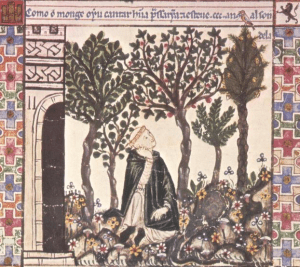
Cantiga 103.
This small sampling from cantigas underscores the value of voice, noise, and music as part of human experience, as central in the experience of religious devotion, and as transformative for the communities represented in the codices. King Alfonso strove to create a library containing all the knowledge available to his world. Additionally, he strove to participate actively in—and innovate—contemporary forms of knowledge production. In many ways, the Cantigas, function as a music box, its folios documenting multiple forms of sonic information, making available the experiences, values, soundscapes, and medieval ways of hearing/listening, or the aurality of the Middle Ages.
—
Featured image “girl laugh #10” by danor sutrazman @Flickr CC BY.
—
Marla Pagán-Mattos earned her doctorate in Comparative Literature and Literary Theory at the University of Pennsylvania. Her research interests include medieval literature, Iberian medieval history and literature, literary theory, and sound culture. She has taught at the University of Pennsylvania, Haverford College, and is currently teaching in the Department of Comparative Literature at the University of Puerto Rico.
—
REWIND! . . .If you liked this post, you may also dig:
Introduction: Medieval Sound–Dorothy Kim and Christopher Roman
“Playing the Medieval Lyric”: Remixing, Sampling and Remediating “Head Like a Hole” and “Call Me Maybe”–Dorothy Kim
Mouthing the Passion: Richard Rolle’s Soundscapes–Christopher Roman
Share this:


Current Top Posts





April 2021

January 2020

November 2019

October 2019

August 2019

April 2014

November 2017

March 2015

December 2017

October 2015
 Sounding Out!
Recent Comments