
Papa Sangre and the Construction of Immersion in Audio Games
 Editor’s Note: Welcome to Sounding Out!‘s fall forum titled “Sound and Play,” where we ask how sound studies, as a discipline, can help us to think through several canonical perspectives on play. While Johan Huizinga had once argued that play is the primeval foundation from which all culture has sprung, it is important to ask where sound fits into this construction of culture; does it too have the potential to liberate or re-entrench our social worlds? SO!’s new regular contributor Enongo Lumumba-Kasongo notes how audio games, like Papa Sangre, often use sound as a gimmick to engage players, and considers the politics of this feint. For whom are audio games immersive, and how does the experience serve to further marginalize certain people or disadvantaged groups?–AT
—
Immersion is a problem at the heart of sound studies. As Frances Dyson (2009) suggests in Sounding New Media, “Sound is the immersive medium par excellence. Three dimensional, interactive and synesthetic, perceived in the here and now of an embodied space, sound returns to the listener the very same qualities that media mediates…Sound surrounds” (4). Alternately, in the context of games studies (a field that is increasingly engaged with sound studies), issues of sound and immersion have most recently been addressed in terms of instrumental potentialities, historical developments, and technical constraints. Some notable examples include Sander Huiberts’ (2010) M.A. thesis entitled “Captivating Sound: The Role of Audio Immersion for Computer Games,” in which he details technical and philosophical frames of immersion as they relate to the audio of a variety of computer games, and an article by Aaron Oldenburg (2013) entitled “Sonic Mechanics: Audio as Gameplay,” in which he situates the immersive aspects of audio-gameplay within contemporaneous experimental art movements. This research provokes the question: How do those who develop these games construct the idea of immersion through game design and what does this mean for users who challenge this construct? Specifically I would like to challenge Dyson’s claim that sound really is “the immersive medium par excellence” by considering how the concept of immersion in audio-based gameplay can be tied to privileged notions of character and game development.
 In order to investigate this problem, I decided to play an audio game and document my daily experiences on a WordPress blog. Based on its simulation of 3D audio Papa Sangre was the first game that came to mind. I also selected the game because of its accessibility; unlike the audio game Deep Sea, which is celebrated for its immersive capacities but is only playable by request at The Museum of Art and Digital Entertainment, Papa Sangre is purchasable as an app for $2.99 and can be played on an iPhone, iPad or iPod. Papa Sangre helps us to consider new possibilities for what is meant by virtual space and it serves as a useful tool for pushing back against essentialisms of “immersion” when talking sound and virtual space.
Papa Sangre is comprised of 25 levels, the completion of which leads player incrementally closer towards the palace of Papa Sangre, a man who has kidnapped a close friend of the protagonist. The game boasts real time binaural audio, meaning that the game’s diegetic sounds (sounds that the character in the game world can “hear”) pan across the player’s headphones in relation to the movement of the game’s protagonist. The objective of each level is to locate and collect musical notes that are scattered through the game’s many topographies while avoiding any number of enemies and obstacles, of course.
.
A commercial success, Papa Sangre has been named “Game of the Week” by Apple, received a 9/10 rating from IGN, a top review from 148apps, and many positive reviews from fans. Gamezebo concludes an extremely positive review of Papa Sangre by calling it “a completely unique experience. It’s tense and horrifying and never lets you relax. By focusing on one aspect of the game so thoroughly, the developers have managed to create something that does one thing really, really well…Just make sure to play with the lights on.” This commercial attention has yielded academic feedback as well. In a paper entitled “Towards an analysis of Papa Sangre, an audio-only game for the iPhone/iPad,” Andrew Hugill (2012) celebrates games like Papa Sangre for providing “an excellent opportunity for the development of a new framework for electroacoustic music analysis.” Despite such attention–and perhaps because of it–I argue that Papa Sangre deserves a critical second listen.
Between February and April of 2012, I played Papa Sangre several times a day and detailed the auditory environments of the game in my blog posts. However, by the time I reached the final level, I still wasn’t sure how to answer my initial question. Had Papa Sangre really engendered a novel experience or it could simply be thought of as a video game with no video? I noted in my final post:
I am realizing that what makes the audio gaming experience seem so different from the experience of playing video games is the perception that the virtual space, the game itself, only exists through me. The “space” filled by the levels and characters within the game only exists between my ears after it is projected through the headphones and then I extend this world through my limbs to my extremities, which feeds back into the game through the touch screen interface, moving in a loop like an electric current…Headphones are truly a necessity in order to beat the game, and in putting them on, the user becomes the engine through which the game comes to life…When I play video games, even the ones that utilize a first-person perspective, I feel like the game space exists outside of me, or rather ahead of me, and it is through the controller that I am able to project my limbs forward into the game world, which in turn structures how I orient my body. Video game spaces of course, do not exist outside of me, as I need my eyes and ears to interpret the light waves and sound waves that travel back from the screen, but I suppose what matters here is not what is actually happening, but how what is happening is perceived by the user. Audio games have the potential to engender completely different gaming experiences because they make the user feel like he or she is the platform through which the game-space is actualized.
Upon further reflection, however, I recognize that Papa Sangre creates an environment designed to be immersive only to certain kinds of users. A close reading of Papa Sangre reveals bias against both female and disabled players.
Take Papa Sangre’s problematic relationship with blindness. The protagonist is not a visually impaired individual operating in a horrifying new world, but rather a sighted individual who is thrust into a world that is horrifying by virtue of its darkness. The first level of the game is simply entitled “In the Dark.” When the female guide first appears to the protagonist in that same level, she states:
Here you are in the land of the dead, the realm ruled by Papa Sangre…In this underworld it is pitch dark. You cannot see a thing; you can’t even see me, a fluttery watery thing here to help you. But you can listen and move…You must learn how to see with your ears. You will need these powers to save the soul in peril and make your way to the light.
Note the conversation between 3:19 and 3:56.
The game envisions an audience who find blindness to be necessarily terrifying. By equating an inability to see with death and fear, developers are intensifying popular horror genre tropes that diminish the lived experiences of those with visual impairments and unquestioningly present blindness as a problem to overcome. Rather than challenging the relationship between blindness and vulnerability that horror-game developers fetishize, Papa Sangre misses the opportunity to present a visually impaired protagonist who is not crippled by his or her disability.

Disconcertingly, audio games have been tied to game accessibility efforts by developers and players alike for many years. In a 2008 interview Kenji Eno, founder of WARP (a company that specialized in audio games in the late 90s), claimed his interactions with visually impaired gamers yielded a desire to produce audio games. Similarly forums like audiogames.net showcase users and developers interested in games that cater to gamers with impaired vision.
In terms of its actual game-play, PapaSangre is navigable without visual cues. After playing the game for just two weeks I was able to explore each level with my eyes closed. Still, the ease with which gamers can play the game without looking at the screen does not negate the tension caused by recycled depictions of disability that are in many ways built into storyline’s foundation.
 The game also fails to engage gender in any complexity. Although the main character’s appearance is never shown, the protagonist is aurally gendered male. Most notable are the deep grunting noises made when he falls to the ground. For me, this acted as a barrier to imagining a fully embodied virtual experience. Those deep grunts revealed many assumptions the designers must have considered about the imagined and perhaps intended audience of the game. While lack of diversity is certainly an issue at the heart of all entertainment media, Papa Sangre‘s oversight directly contradicts the message of the game, wherein the putative goal is to experience an environment that enhances one’s sense of self within the virtual space.
On October 31st, 2013, Somethin’ Else will release Papa Sangre II. A quick look at the trailer suggests that the developers’ have not changed the formula. The 46-second clip warns that the game is “powered by your fear” after noting, “This Halloween, you are dead.”
.
It appears that an inability to see is still deeply connected with notions of fear and death in the game’s sequel. This does not have to be the case. Why not design a game where impairment is not framed as a hindrance or source of fear? Why not build a game with the option to choose between different sounding voice actors and actresses? Despite its popularity, however, Papa Sangre is by no means representative of general trends across the spectrum of audio-based game design. Oldenburg (2013) points out that over the past decade many independent game developers have been designing experimental “blind games” that eschew themes and representations found in popular video games in favor of the abstract relationships between diegetic sound and in-game movement.
Whether or not they eventually consider the social politics of gaming, Papa Sangre’s developers already send a clear message to all gamers by hardwiring disability and gender into both versions of the game while promoting a limited image of “immersion.” Hopefully as game designers Somethin’ Else grow in popularity and prestige, future developers that use the “Papa Engine” will be more cognizant of the privilege and discrimination embedded in the sonic cues of its framework. Until then, if you are not a sighted male gamer, you must prepare yourself to be immersed in constant aural cues that this experience, like so many others, was not designed with you in mind.
—
Enongo Lumumba-Kasongo is a PhD student in the Department of Science and Technology Studies at Cornell University. Since completing a senior thesis on digital music software, tacit knowledge, and gender under the guidance of Trevor Pinch, she has become interested in pursuing research in the emergent field of sound studies. She hopes to combine her passion for music with her academic interests in technological systems, bodies, politics and practices that construct and are constructed by sound. More specifically she would like to examine the politics surrounding low-income community studios, as well as the uses of sound in (or as) electronic games. In her free time she produces hip hop beats and raps under the moniker Sammus (based on the video game character, Samus Aran, from the popular Metroid franchise).
—
 REWIND! . . .If you liked this post, you may also dig:
Goalball: Sport, Silence, and Spectatorship— Melissa Helquist
Playing with Bits, Pieces, and Lightning Bolts: An Interview With Sound Artist Andrea Parkins— Maile Colbert
Video Gaming and the Sonic Feedback of Surviellance: Bastion and the Stanley Parable— Aaron Trammell
Share this:

Playing with Bits, Pieces, and Lightning Bolts: An Interview with Sound Artist Andrea Parkins
Editor’s Note: Welcome to Sounding Out!‘s fall series titled “Sound and Play,” where we ask how sound studies, as a discipline, can help us to think through several canonical perspectives on play. While Johan Huizinga had once argued that play is the primeval foundation from which all culture has sprung, it is important to ask where sound fits into this construction of culture; does it too have the potential to liberate or re-entrench our social worlds? SO!’s regular contributor Maile Colbert interviews sound artist Andrea Parkins and gets her to talk about her creative process, and the experience of playing with sound, composition, and instruments.–AT
—
In 2003, working towards my graduate degree in Integrated Media at California Institute for the Arts, I met and worked with a visiting artist by the name of Andrea Parkins, with whom I became a friend and colleague. Although I’ve been familiar with her work for more than a decade, every time I see Andrea perform my mind is blown. And, every time we discuss her practice, her methodology, and her thoughts on art and work, I’m always compelled and inspired in my own practice as a sound artist. In particular, I am impressed by her insights on the relationship between art, play, and the act of improvisation. The interview that follows is both a sampling of the conversations we have been gifted with throughout the years and a rare opportunity to listen in to the creative process of a working sound artist.
1. Hi Andrea, how are you today? What are you in the middle of?
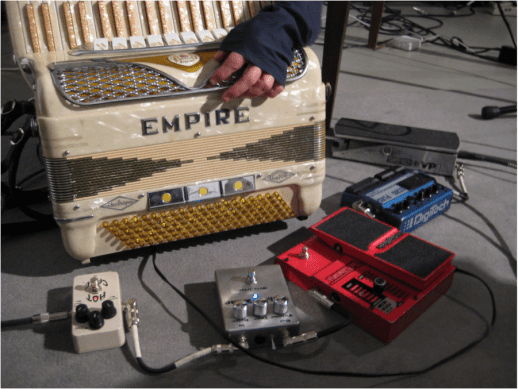
I’m well – working on a number of different projects at the moment, including preparing for a residency at Q-02: workspace for experimental music and sound art, in Brussels, where I’m going to be working on a new multi-diffusion sound piece, addressing the interaction of moving objects with human gesture in idiosyncratic acoustical spaces. I’m also working on some new recordings – one is a catalogue of short pieces, combining electric accordion-generated feedback with processed field recordings; and another incorporates 15 short object-based electronic pieces into a live ensemble work.
2. Can you describe your entrance into the world of sound and music?
I grew up in Western Pennsylvania, acutely aware of the drones and sonic events in the surrounding rural landscape. At the same time my early experience of sound through my teens resided in realm of the “musical” and the social; it connoted family (nearly all of my family members were/are musicians, and music and sound was always present); culture; and musical practice as ritual. Most family members were serious classical musicians, some were rock musicians and singer/songwriters; some were both. I studied classical piano from the age of 6 through my early twenties, and from the beginning had access to and absorbed a wide range of musics– immediately attracted to dissonance, or music with subtle harmonic and timberal changes. After high school, I moved to Boston and studied jazz piano and free improvisation. In my early 20s, I bought an analog synth, and experimented with oscillators and filters, playing synth in punk, free jazz, and new wave bands. Probably most important in my sonic development was that I went to art school and in that context began making experimental films and video, drawings and installation. I believe that my exposure to non-narrative film especially had a profound effect on how I began thinking of compositional possibilities for sound, and about art that happens in time, and also space
3. Speaking of worlds, what is the line experienced, if there is one, between the experimental sound art world and improvisation? How did you find yourself with one foot in each of these worlds, and how do you navigate between them?
While I know that some artists and theorists do draw a line between sound art and improvisational “music” performance, I don’t usually think about it that way, and for the most part that is not how I experience my relationship with sound. Having said this, I recognize that there are communities that identify themselves as one thing or the other, and performance and exhibition spaces that are organized based on one side or the other of this dichotomy, so at times I do have to “navigate between them.” This isn’t necessarily a bad thing: this allows artists to build a common discourse around their particular focus, and can even develop a creative legacy among artists. For myself, I try to think about my intentions regarding a particular installation or performance: especially in consideration of site and audience, and formulate language around this that can speak to the specifics of the situation.
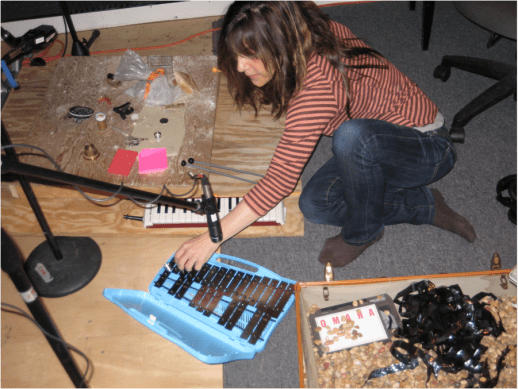
Photo Credit: Paul Geluso 2009
4. And being a woman in these worlds, have you found a difference between when you were starting out and now? Have you found a difference within the generations you work with?
I believe that for younger women, things have changed a lot: peer communities of young artists are more integrated gender-wise, and it seems that there are many more women worldwide are active and visible as experimental musicians and sound artists than when I began. I came “of age” at a different juncture and did not have this experience. To some extent this was because of the class and milieu that I came from, which meant there was no model in front of me. I do think this would have been mitigated if I had learned sooner about some of the female innovators of electronic music, among them: Bebe Barron, Wendy (Walter) Carlos, Eliane Radigue, Maryanne Amacher, Laurie Spiegel, and Pauline Oliveros. This exposure came later.
When I began working as an improvising musician, I found myself on the periphery, and never wholly part of, a group of mostly male colleagues. There were aspects to this experience that I actually now appreciate. It had value because I remained in the position of an outsider, and while I felt some sense of displacement because of this, it allowed me to develop my own critique of whatever prevailing processes and products were happening at that time, and a new assessment of what I wanted to create. I should mention that when working alone or in collaboration in other forms: intermedia, sound and performance installation, I have found that these contexts offer a more inclusive politics and discourse.
5. Something interesting came up in our last conversation that inspired me to change this question around a bit. Instead of asking you to talk about your works, and since our readers can access many different interviews, documents, and articles online, can you talk about how to talk about your work?
This is something I am learning how to do (yet again), as I become more aware that my work engages with multiple practices, multiple voices, multiple processes. It’s about beauty too (that dirty word) – in the sense that beauty (for me) is about viscerality, atmosphere, presence, fragility; this calls my attention to the physical space I am in and to how time is passing: that is to say, to mortality. Most recently I have been seeking different forms of sonic structure that are not based on “history” as forward motion, as a narrative driving through time, but that can allow for stasis, multiplicity, simultaneity, and chaos and acceptance of a potentially forward moving structure to fall totally apart.
Since 2005, in addition to exploring these modalities as an improviser and composer (for live instruments), I have been working to reintegrate a more interdisciplinary approach to my work – referencing the materiality of objects, and the body in motion, and engaging in wider range of sonic sources and processes, visual elements, and acoustical spaces. This has resulted in my creation of several fixed media works for the gallery/installation setting, as well as some electronic music pieces scored only for objects.
6. The term improvisation confuses a lot of people, and can be hard to articulate. What does it mean to you? And within improv, what does “work” and what does “play” means to you?
Speaking most simply, improvisation is (for me) a series of compositional decisions made in real time that are then immediately acted upon, with acute attention: to self, other, site and context. Being an improviser entails so much listening (to oneself and others, at the same time) and also connecting with others while maintaining one’s own sonic space/language; in a way it’s social and interiorized process at the same time. So it’s work! You are — at times – straining your ears; listening for the clues for what others are “saying,” even if they are not quite saying it. Perhaps this even involves a kind of telepathy. However, at its best moments it can be exhilarating work; there can be lively engagement among fellow performers — or when performing alone when moving among one’s own sonic materials and instruments – that is highly stimulating and fun.
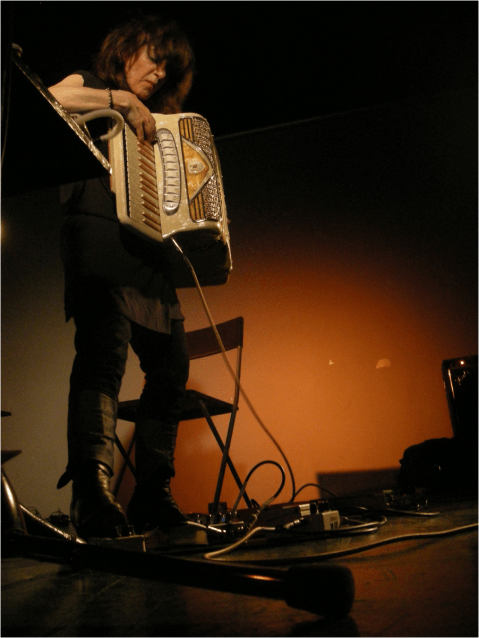
Photo credit: Maile Colbert 2010
7. Is there a hierarchy of process versus presentation for you?
I often find that my best-laid plans must be jettisoned because I have an idea or epiphany that suddenly strikes me, and it just won’t wait. For me, these “lightening bolts” often quickly resolve into having to face a challenging new work process — challenging perhaps because I have been afraid that somehow it won’t produce a result that I can readily identify as successful. But the old ways will always be there, and in the meantime it is possible that by trying something else, a new discovery will come that transforms everything – including the way I think about what a “successful result” should look like. I now feel that the notion of a “successful result” in itself has become pretty relative, and in some cases, a moot point. This is because what I now define as successful can often have much to do with my assessment of the process I employ in making something, rather than how well I have fulfilled the requirements of a pre-meditated structure: the result. This has made my engagement with my work much more open-ended in a way that I have learned to appreciate over time.
For me, composition mostly happens in the editing: that is where I find (uncover, sculpt) structure from the sound that I collect and/or record, building up a mass of material from which I can “find the piece” through editing, assemblage and layering. I think this is similar to the way some filmmakers might shoot video/film and then from raw footage hone in on or discover a film’s structure via the editing process. I like the idea that instead of filling a pre-ordained structure with content one can move the content around until the structure emerges. Maybe one recognizes the completed structure when one sees it. I like to remember that a structure, even if unusual, asymmetric, messy, seemingly random, or just plain weird – if that is what emerges – is still a structure, howsoever idiosyncratic. And it can be presented.
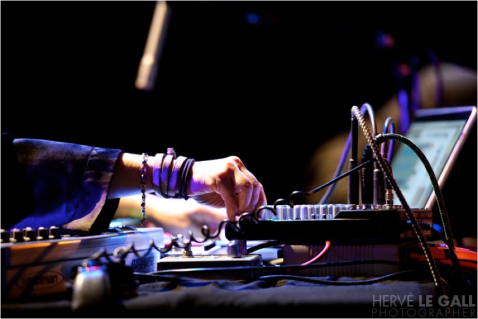
Photo Credit: Herve Le Gall 2012
8. Can you talk about differences between performance vs. play and performance vs. studio to you, and your relationship with the instruments you play?
In 2002, I began developing a MAX-based extended processing instrument inspired by Rube Goldberg and his machines. It has built into its programming seemingly “randomized” sonic processing that highlights and/or alters specific frequencies and densities, with emphasis on repetitions, interruptions, stasis and malfunction. When I began working with the instrument, I was exploring processes related to Fluxus in my compositional and improvisational practices. I was also thinking about a kind of poetics that I saw as related to my independent studies in feminist and psychoanalytic theory, and to the body of an improvising performer who is up against the limits of his or her own virtuosity. Once I designed the instrument I realized there really was a connection to these things – and to how approach decision-making as an artist – the importance of chance – but also slippage and failure and moments of physical awkwardness as what I try to accomplish on a technical level comes perilously (and for me, interestingly) close to falling apart – especially when performing with multiple instruments in simultaneity. My virtual instrument is a collaborative partner who doesn’t cooperate. It makes “sense and non-sense,” The slippage and failure relates to meaning, and for me is a metaphor for loss or displacement. For me, this is important … to me this is daily, everyday life.

Photo Credit: Glenn Cornett 2013
—
Featured Image Photo Credit: Julia Berg 2010
—
Andrea Parkins is a composer, sound/installation artist and improvising electroacoustic performer who engages with interactive electronics as compositional/performative process, and explores strategies related to Fluxus’ ordered, ephemeral activities. She is a key participant in the New York sound art and experimental music scene, and worldwide she is known for her pioneering gestural/textural approach on her electronically-processed accordion and self-designed virtual sound-processing instruments. Described as a “sound-ist,” of “protean,” talent by The New York Times music critic Steve Smith, Parkins’ laptop electronics and Fender-amped accordion create sonic fields of lush harmonics and sculpted electronic feedback, punctuated by moments of gap and rift. Her work has been presented at the Whitney Museum of American Art, The Kitchen, Diapason, and Experimental Intermedia; and international festivals/venues including Mexico City’s 1st International Sound Art Festival, NEXT in Bratislava, Cyberfest in St. Petersberg, and q-02 in Brussels. Parkins’ recordings have been published by Important Records, Atavistic, and Creative Sources, and her work has received support from American Composers Forum, NYSCA, the French-American Cultural Exchange, Meet the Composer, Harvestworks Digital Media Arts Center, and Frei und Hanseastadt Hamburg Kulturbehoerde. Parkins is on faculty at Goddard College’s MFA in Interdisciplinary Arts program.
—
Maile Colbert is a multi-media artist with a concentration on sound and video who relocated from Los Angeles, US to Lisbon, Portugal. She is a regular writer for Sounding Out!
—
REWIND! . . .If you liked this post, you may also dig:
Wayback Sound Machine: Sound Through Time, Space, and Place— Maile Colbert
Sounding Out! Podcast #15: Listening to the Tuned City of Brussels, The First Night— Felicity Ford and Valeria Merlini
Sounding Out! Podcast #10: Interview with Theremin Master Eric Ross— Aaron Trammell
Share this:


Current Top Posts





April 2021

January 2020

November 2019

October 2019

August 2019

April 2014

November 2017

March 2015

December 2017

October 2015
 Sounding Out!
Recent Comments