
The Sounds of Obsession: Subtle Menace in the Music of Yash Chopra’s “Darr”
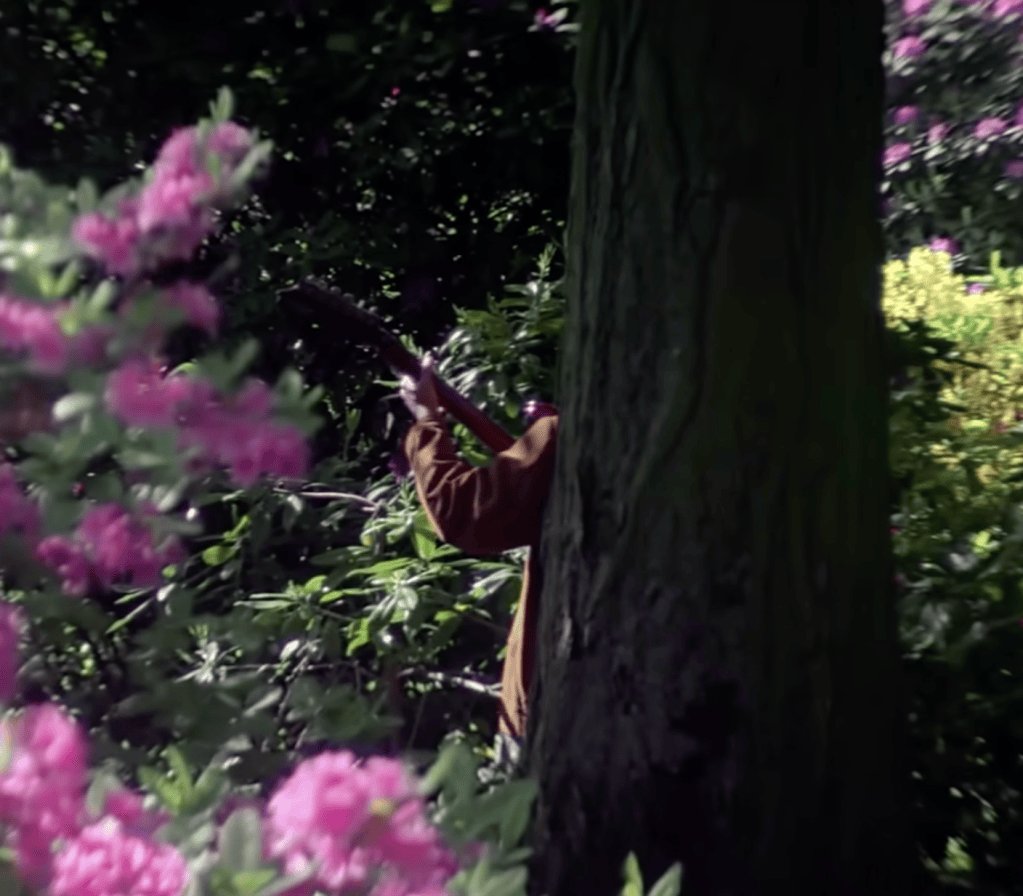
DOI: https://doi.org/10.59350/d7npv-9gn02
The classic Hindi film, Darr (1993), directed by Yash Chopra, is the story of the stalker Rahul, played by Shah Rukh Khan, wreaking havoc on the lives of the innocent lovers, Kiran and Sunil (played by Juhi Chawla and Sunny Deol respectively). As Rahul stalks Kiran, declaring his love for her, the audience is shown a window into the derangement of his psyche: the loss of his mother at a young age, unsent love letters during college, a shrine filled with pictures of Kiran, carving her name into his chest with a knife. His obsessive love turns to violence toward Sunil, and the lovers try to evade his sinister advances as Rahul chases them across the planet.
Originally advertised as “a violent love story” on its movie poster, the film largely follows the conventions of 1990s Bollywood, but Chopra and screenwriter, Honey Irani, create distortions of genre expectation through Shah Rukh Khan’s character. One of said genre conventions is the inclusion of original song sequences, composed by Pt. Shivkumar Sharma and Pt. Hariprasad Chaurasia (as the duo “Shiv-Hari”), with lyrics by Anand Bakshi. Despite their non-threatening surface exteriors, various musical devices combine with the filmmaking to give the songs a layer of menace that elevate them above the standard fare of contemporaneous Hindi film music. This creates a multi-tiered listening dynamic wherein the pleasant becomes grotesque in context.
The songs of Darr have become classics in the world of ’90s Bollywood film songs. But, behind the catchiness and fulfillment of industry expectation lies a multi-layered psycho-drama created by the songs’ interactions with Darr’s story and characters. This interaction exists not solely in lyrical concerns but also in the subtle musical gestures crafted by the minds of Shiv-Hari. At a surface level, listening to the film’s soundtrack is enjoyable; there are catchy melodies, lush orchestrations, and timeless performances by now-legendary singers. However, the deeper one listens with an analytical focus, the more disturbing, intriguing, and artistically edifying the songs become.
While the film begins with an idyllic, romantic tone, the music soon introduces an element of the sinister. After a brief introductory scene of Kiran, who is seen alone reading a letter from her fiance Sunil (although Yash Chopra already hints at Rahul’s presence in this scene), we find her with her friends at their school. We hear “Kiran, I love you” announced through the school’s public address. The music of “Jaadu Teri Nazar” (roughly “Your look is magic”) then begins diegetically, sung by Shah Rukh Khan’s Rahul (unbeknownst to Kiran).
By today’s standards, the early lyrics contain a definite romantic red flag in the lines “Tu haan kar, ya naa kar / Tu hai meri Kiran” (“whether you say yes or no, you are mine Kiran”), but in the world of early 1990’s Bollywood, this type of courtship is nothing out of the ordinary. However, Shiv-Hari’s orchestration implies something more sinister, ending the song with a repetition of the line “tu hai meri Kiran” with aggressive orchestral chords.
The actual nature of the song and truly the thesis statement of the entire film is then revealed. Kiran is seen on a train which enters a tunnel and becomes pitch black. We hear a voiceover say the words “Pyaar jab had se guzar jaae to pooja ban jaata hai, aur pooja bhatak jaae to junoon” (“when love crosses a boundary it becomes worship, and when worship goes astray it becomes obsession”). Upon emerging from the tunnel, “Jaadu Teri Nazar” begins again non-diegetically featuring more obviously sinister lyrics, such as “bekhabar meri taqdeer hai tu / tu kisi aur ki ho na jaana / kuch bhi kar jaaonga main deewaana” (“unaware, you are my destiny / don’t you become someone else’s / I am crazy and will do anything”). With this, “Jaadu Teri Nazar” becomes a cipher for the film’s stated theme of love turning into obsession.
Another thematically important part of Darr‘s soundtrack that directly connects to “Jaadu Teri Nazar” is an instrumental track labeled “Obsession (Dance Music)” on the film’s commercial soundtrack release. After proceeding to terrorize the lives of Kiran and Sunil in various episodic scenes, we see Rahul in his apartment, playing the melody of “Jaadu Teri Nazar” on his harmonica. Chopra then cuts to a fantasy sequence scored by “Obsession (Dance Music).” We see Kiran dancing in a shapeless void, assumedly in Rahul’s imagination.
Shiv-Hari’s music starts out calmly, almost entirely with percussion instruments. The fervor of the percussion increases, as does the intensity of Kiran’s dance and the rate of cuts in the visuals. Frenzied imagery and intense music combine to reflect Rahul’s increasingly spiraling self-control. Kiran’s titillating movements to the music in Rahul’s mind further showcase his derangement. The inclusion of the melodic material of “Jaadu Teri Nazar” in “Obsession (Dance Music)” helps to create the idea in the listener’s mind that this melody represents Rahul’s obsession over Kiran. After a brief guitar interlude, the music grows to a climax characterized by wordless choir singing and crashing percussion. At its highest dramatic point, the men in the choir sing the same melody as the line “tu hai meri Kiran” from “Jaadu Teri Nazar” three times before the music ends with Kiran standing in the rain with open arms.
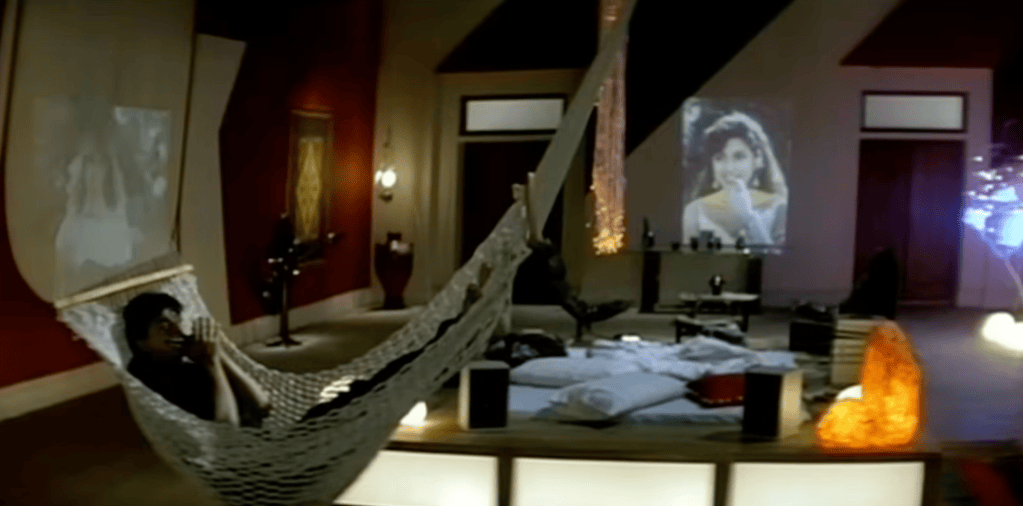
Yash Chopra zooms in towards Kiran as the sound of Rahul’s harmonica playing “Jaadu Teri Nazar” intercedes into the audio of the film, signaling the end of Rahul’s fantasy. Screenwriter Honey Irani’s choice of the harmonica for Rahul’s instrument further clarifies his character. Its sound is tied to classic cinematic images of loneliness. The 1975 Hindi film, Sholay, sees Amitabh Bachchan’s character Jai playing the harmonica while observing Radha (Jaya Bachchan). In Sholay, Radha is a widow—for her to remarry would be a social taboo. Jai’s circumstances have forced him into a life of crime for survival—his playing the harmonica while simultaneously falling into a love that is doomed from the start is paralleled in a contorted way in Darr‘s Rahul. Sholay is one of, if not the most, famous film in the history of Indian cinema—such a comparison would likely occur to contemporary viewers of Darr. This association is triggered sonically through the harmonica’s strained timbre. The instrument even at a physical level could represent Rahul’s frame of mind: it is a rare instrument where one has to both exhale and inhale in order to produce sound. The song “Tu Mere Saamne” echoes this action as it features Rahul heavily breathing in and out at a menacing cadence.
“Tu Mere Saamne,” the final song in the film, sees a dangerous evolution in Rahul’s obsession. It occurs after Sunil and Kiran steal away to Switzerland for their honeymoon, where Rahul finds them and befriends them, as they have never seen his face. His now face-to-face intervention in their lives triggers another fantasy of Kiran in his mind. Despite being a love song on its surface, Shiv-Hari begin the song with forceful orchestral bombast and men’s chorus (which precede the aforementioned heavy breathing), akin to the ending of “Jaadu Teri Nazar” and parts of “Obsession (Dance Music).” Anand Bakshi’s lyrics draw parallels between Rahul and Sunil. “Tu Mere Saamne” (“You are in front of me”) is eerily close to the first words heard in the entire film: Sunil’s words in Kiran’s mind as she reads the love letter he had sent to her (“Jaan, main tumse door hoon. Lekin, tum mere saamne ho.” This translates to “Love, I am far from you. But you are in front of me.”). Sunil’s love is true, but Rahul’s love has crossed the threshold.
Rahul’s early fantasy of Kiran picturized in “Obsession (Dance Music)” did not include Rahul in her presence. This new fantasy changes that dynamic. The line “Tujhko dekhoon ke pyaar karoon” (“Should I gaze at you or make love to you?”) is intermingled with lyrics indicating disbelief yet confirmation that Kiran is now his possession. “Jaadu Teri Nazar” stated “Tu hai meri, Kiran”–simply “You are mine.” The iteration of this sentiment in “Tu Mere Saamne” reaches a point of completion with the line “Tu meri ho gayi”–literally, “You have become mine.” The mukhda (a term that translates literally to “face” that refers to the initial memorable portion of a song) finishes with the line “Kaise main aitbaar karoon” (“How can I trust [this reality]?”). Udit Narayan’s vocals, as well as the contour of the melody line, are fairly simple, unadorned, reflecting the single-minded arrested development at play in Rahul’s psyche (the same could be said for Narayan’s vocals in “Jaadu Teri Nazar”).
Lata Mangeshkar’s vocals in the next stanza overlap with the ending of Udit Narayan’s stanza with considerable echo effects added. This adds to the dream-like, imagined quality of the song—Rahul’s brain at the height of delusion. Mangeshkar’s vocals are shallow with an almost child-like lilt, fitting the simplistic melody. Shiv-Hari composed a tune paralleling the simplistic logic at play with Rahul’s derangement. The Kiran that sings in the song is a cheap imitation—a tulpa in Rahul’s mind. His imagined Kiran sings “Toot gayi tootke main choor ho gayi / Teri zid se majboor ho gayi / Tera jaadu chal gaya…” (“I am broken, I am shattered / Your persistence has compelled me / Your magic has worked”)—a twisted and delusional perspective on romance befitting a murderous stalker.

The danceable, but somewhat menacing instrumental interludes of the song also connect with the earlier sequence set to “Obsession (Dance Music).” The use of a prominent clarinet solo, an uncommon occurrence in Bollywood film songs, adds to the phantasmagorical quality of the song by introducing a foreign timbre. The visual is that of a strange liminal space, a place with no coherent scenery but with raining rose petals. Rahul plays piano as Kiran writhes suggestively. This particular visual shows that Rahul has now placed himself next to her in his own fantasy as opposed to just seeing her. He is no longer simply declaring that she is his—she has become his.
(The following two paragraphs contains significant spoilers)
Throughout the finale of the film, where Rahul is found out and killed by Sunil, Shiv-Hari’s background score is dominated by a particular theme that had been first introduced earlier, always connected to Rahul’s fixation with Kiran. It is characterized by two notes constituting a rising major sixth interval which morphs into a rising perfect fifth interval before deteriorating into a winding chromatic melody that eventually loses intelligibility. The first mentioned interval, the major sixth, traditionally has a romantic quality, especially at its iterated tempo in Darr–a soaring, almost Wagnerian yearning. The second interval, the perfect fifth, is acoustically at rest. But, with the pitch level at which it is presented in relation to the earlier major sixth, it is contorted–it implies a different musical key, an incompatibility. This particular interval happens to be the same as the beginning of “Jaadu Teri Nazar.” This theme’s association with Rahul indicates its mirroring of his emotional incapacity. What he views as love, in this case represented by the major sixth, becomes contorted into his obsession with Kiran, the perfect fifth that connects to “Jaadu Teri Nazar.”
The melody that succeeds these two intervals is simultaneously chaotic and tragic—chaotic in light of his murderous actions, tragic as Rahul’s final end symbolizes a human life wasted on mental derangement. At the end of the film, Shiv-Hari use the theme to paint this tragedy, iterating it twice, first with a subdued muted trumpet, then with a wordless female chorus, as Rahul utters his last words. Yash Chopra reiterates the overarching theme of the entire film one more time by playing an a cappella version of “Jaadu Teri Nazar” over one final shot of Rahul’s lifeless body.
Both the songs and background score of Darr showcase an approach to soundtracking wherein the sonic content not only operates in close coordination with the mood and atmosphere of the film, but with the characters, storyline, themes, and intrinsic reference points orchestrated by Yash Chopra and his crew. Shiv-Hari’s music is not simply color and vibe, but multi-faceted content that rewards close listening just as repeat viewings of the film can illuminate the finer nuances of the plot. It is music that contains a sub-surface circuitry that, even when the listener is unaware of its complexities, creates a richer artistic statement than music that has a similar surface (a similar color and vibe) without the same profound approach to its unseen infrastructure. Shiv-Hari’s soundtrack’s rich subterrain integrating with and projecting onto the visual and narrative elements of Darr creates a rare cinematic totality.
—
Featured Image: Still from “Jaadu Teri Nazar” by SO!
—
Zane Merritt is a composer, guitarist, teacher, and scholar. He holds a PhD in music composition from the University at Buffalo (SUNY). His recent activities include designing and teaching a course on Bollywood and its music, collaborations with Nepali poets, setting their recitations to original music, and releasing a classical guitar album that places arrangements of Indian film music alongside the western classical canon.
—

REWIND! . . .If you liked this post, you may also dig:
“Gendered Soundscapes of India, an Introduction“–Monika Mehta and Praseeda Gopinath
The Queer Sound of the Dandiya Queen, Falguni Pathak–-Pavitra Sundar
“Out of Sync: Gendered Location Sound Work in Bollywood“—Priya Jaikumar
“So Jao”: Sound, Death and the Postcolonial Politics of Cinematic Adaptation in Vishal Bhardwaj’s “Haider” (2014)—Abhipsa Chakraborty
Share this:

This Past Weekend with Theo Von: Brocasting Trump, Part II

But first. . .
A Brief Synopsis of an Introduction to Bro-casting Trump: A Year-long SO! Series by Andrew Salvati
—
In total, Trump appeared on fourteen podcasts or video streams during his 2024 campaign, which together earned a combined 90.9 million views on YouTube and on other video streaming platforms, not even including audio podcast listens, which, because of the decentralized nature of RSS, are notoriously difficult to pin down.
That’s a lot.
In the following series of posts, I am particularly concerned with Trump’s success with the so-called podcast bros – partially because my own research interests are in the area of mediated masculinities, but also because they may have put him over the edge with a key demographic – with (white) Gen-Z men.
Over this series—which began in January 2026 with Logan Paul—I will examine several of Trump’s appearances on largely apolitical “bro” podcasts during the 2024 campaign season, including his interviews with Logan Paul, Theo Von, Shawn Ryan, Andrew Schulz, the Nelk Boys, and Joe Rogan. In the course of this examination, I will pay attention not only to what Trump said on these shows, but also to the way in which they established a sense of intimacy, and how that intimacy worked to underscore Trump’s reputation for authenticity. Along the way, I will also discuss the podcasts and podcasters themselves and attempt to locate them within the broader scope of the manosphere. Finally, given the passage of time since Trump’s appearances, I will consider to what extent, if any, individual hosts have become critical of his administration’s policies and actions – as Joe Rogan famously has.
Here’s the second installment, on This Past Weekend with Theo Von.
***
This Past Weekend with Theo Von: Brocasting Trump, Part II
DOI: 10.59350/qkwp6-e439
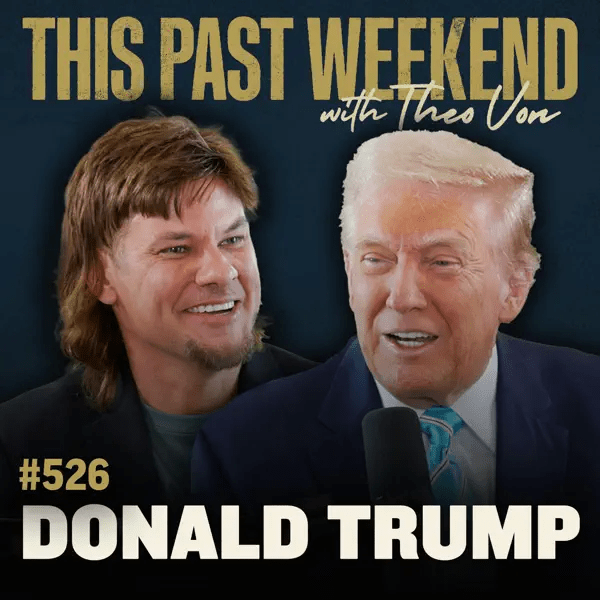
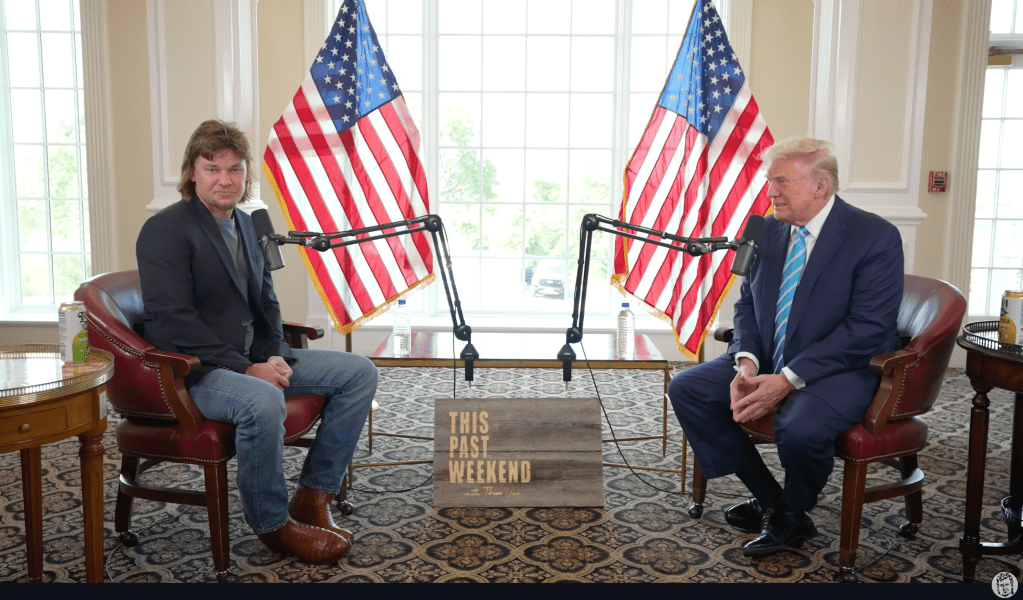
With about five-and-a-half minutes remaining in the podcaster and comedian Theo Von’s August 2024 interview with Donald Trump, the conversation turned to the U.S. southern border. Thus far, the interview had not shied away from policy concerns; however, though the questions were earnest, the answers were evasive and superficial. Noting that he had hosted Border Patrol agents on his show in the past, Von reported that one of the biggest problems that the agency faced was that its officers were arresting the same people over and over again. The reason, according to Von, was that “the people that are coming in illegally aren’t being prosecuted.”
The 44-year-old podcaster then asked the president in his lilting Louisiana accent what he would do differently to alleviate the problem and make the border more secure. Like many, it was a question that allowed Trump to indulge in his penchant for superlative and self-aggrandizement.
“So, the borders, well, I did it. I did it,” Trump declared. “We had the best border … we had the wall built. We had more going to come beyond, long beyond what I promised. I built hundreds of miles of wall, and it worked.”
Now, this post isn’t necessarily the venue for relitigating the failures of what was Trump’s signature project during his first administration, for reminding you, dear reader, that despite his promise on the 2016 campaign trail that he would “build a great, great wall on our southern border” (which Mexico would pay for), and despite signing an executive order just days after taking office that directed the Secretary of Homeland Security “to immediately plan, design, and construct a physical wall along the southern border,” by the end of his term in office in January, 2021, only 452 miles of wall had been constructed – much of which was not new, and had merely replaced existing barriers. Such reminders can be found elsewhere.
Rather, the moment captured the credulity which Von freely gave the former president throughout the interview, and thereby highlighted what I suggested in my last post is the problem – or, from the candidate’s perspective, the virtue – of a media strategy that allotted a significant amount of time to non-journalists: it was unlikely that he’d get much pushback.
***
And after listening through the episode a few times and trying to put myself in the place of an apolitical Theo Von listener, or one perhaps too young to remember the first Trump administration, I began to more fully appreciate the extent to which his apparent authenticity coupled with a sense that he is not just a political outsider, but an autonomous agent free of obligation to party. Typically, this last part comes out when Trump takes aim at “them” – Joe Biden, Kamala Harris, Chuck Schumer, Nancy Pelosi, and other unnamed Democratic elites, as well as any other members of the “deep state,” or “establishment” who oppose him.
In contrast to these shadowy figures, Trump presents himself as someone who, largely because of his wealth, remains independent, and as such, is uncorrupted by “them.” He can thus position himself as a man of the people, and in fact frequently trumpeted his own popularity during the episode – with Von only too happy to provide affirmation.
But this turn toward the border and to immigration policy is also significant in retrospect, given that Von has since been critical of the second Trump administration’s mass deportation policies, and of the Department of Homeland Security’s (DHS’s) unauthorized use of his image and voice in one of its marketing videos in a way that seemed as if he supported the department’s deportation efforts.
In the now-deleted video (part of which can be seen here), Von looks directly into the camera and says “Heard you got deported dude, bye.”
The comedian quickly took to X (formerly Twitter) to vent. “Yoo DHS I didn’t approve to be used in this,” he said in a post that he later deleted. “I know you know my address so send a check. And please take this down and please keep me out of your ‘banger’ deportation videos. When it comes to immigration my thoughts and heart are a lot more nuanced than this video allows. Bye!”
Roughly a week later, on October 2, 2025, Von returned to the subject on his podcast with an impassioned statement explaining to his listeners the situation with the video and outlined some of his own thoughts on immigration. Contextualizing the clip by saying that it had been made in a parking lot after one of his comedy shows as a joke – though in Von’s telling, what he said still comes off as callous, as the “girl” who approached him with the camera was trying to tell the comedian that her friend had recently been deported – Von went on to talk about the blowback he received as a result of the DHS video, which was in no way an accurate depiction of his complex thoughts on immigration.
“And my father immigrated here from Nicaragua, right?” he explained, his voice beginning to break. “Like one of my prized possessions is I have his immigration papers [from] when he came here. And I have them in a frame … and, so I have tons of thoughts about it, but this was just fucked up, right? It was fucked up. And it was everywhere. It was on all platforms and stuff.”
What Von seemed to be doing here was saying that, though he may have supported a tough line on illegal immigration and had little tolerance for those who had been admitted into the country with a criminal record, he could not necessarily get behind the Trump DHS’s indiscriminate deportation scheme, which was sweeping up immigrants who had come into the country the “right way” alongside those who maybe hadn’t.
However in listening to Von’s Trump interview from 2024, it’s hard not to hear the future president laying the groundwork for what would become a maximalist strategy on immigration. “We have over 20 million people, in my opinion, right now, that came into our country [the number of unauthorized immigrants in the U.S. was estimated at 14 million in 2023]. Many come from prisons, jails, mental institutions, many terrorists,” Trump claimed, later adding that “we’re going to spend a lot of time getting the criminals out … we have a lot of people, hundreds of thousands of murderers. We have people, drug dealers … it’s not even believable.”
Although it would have been difficult at the time of the recording to imagine the terror that Trump’s Immigration and Customs Enforcement (ICE) sweeps would unleash on communities like Los Angeles, Chicago, New York, and Portland in the months following his return to office, we can hear in his attempts to vilify unauthorized foreign nationals, and in his fear-mongering about how many of them were bad actors, a justification for the use of blunt force rather than nuanced policy.
And it seemed like Von agreed, at least in principle, with the law-and-order logic underpinning Trump’s statements. “Oh, I don’t think people should be allowed to be in our country if they’re criminals,” he stated.
To give this conversation a charitable reading, it is perhaps likely that Von assumed that, once in office, Trump’s administration would have the tools to determine which foreign nationals were authorized to be in the country and which were not. Further, he may also have believed ICE would know who among this group had a criminal record – and not conduct mass roundups based on race.
Yet, as we should have all probably known by the summer of 2024, for Trump and his chief advisers, blunt force (and cruelty) was the point. Recall the so-called “Muslim Ban” instituted during Trump’s first term, which was hardly an example of a well-calibrated policy, but was rather a “total and complete shutdown” of travelers and immigrants from seven Muslim-majority countries (though even this wasn’t without its conflicts of interest as it excluded several countries like Saudi Arabia and the United Arab Emirates where Trump had business dealings).
Even the wall, which was conceived by Trump insiders in 2015 as a mnemonic device intended to help their boss to remember to mention illegal immigration at his campaign rallies, was deemed effective precisely because it was not subtle. As Trump 2016 campaign adviser Sam Nunberg told Business Insider, “I think one issue is people did understand walls … the wall in 2016 was symbolic of Donald Trump: common sense, practical solutions, simplified answers – as opposed to long nuanced, detailed policy speak.”
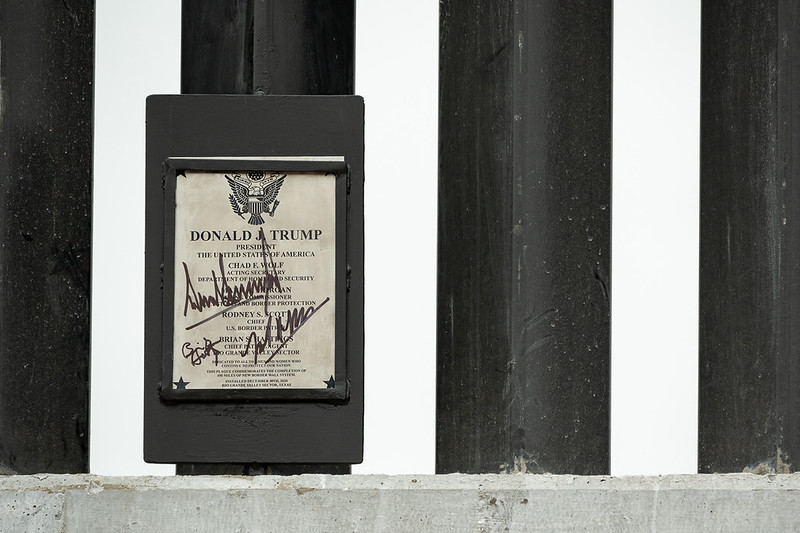
President Donald J. Trump’s signature is seen on a plaque on the border wall Tuesday, Jan. 12, 2021, at the Texas-Mexico border near Alamo, Texas. (Official White House Photo by Shealah Craighead) (PDM 1.0)
And this would be a fair characterization of Trump’s remarks on This Past Weekend – when Von asked earnest policy questions, Trump offered simplified, seemingly common sense responses that presented his own approach to the problems of government as something different than politics-as-usual, different because it was guided by an intensely practical, no-nonsense ethos.
Like his appearance on Logan Paul’s Impaulsive, Trump’s calm, yet forceful tone of voice on This Past Weekend tended to support his overall credibility as a leader capable of bringing logical solutions to a crisis-ridden government – of brining decisive, masculine order to the chaos in Washington. Such was the impression that listeners may have gotten, for instance, from Trump and Von’s discussion of the president’s first term executive order mandating price transparency for hospital care, which Von asked Trump about specifically, and which, Trump claimed, “would have brought down the cost of care by 50, 60%” if Biden and Kamala had enforced it.
But Trump’s appeals to common sense also provided cover for what might have otherwise been an embarrassing bit of hypocrisy. When Von began to turn the conversation toward the power of lobbyists, asking why it was that the government couldn’t seem to do anything about the so-called revolving door, Trump explained that there was a “whole constitutional thing there” (the First Amendment right to petition the government), and agreed with Von that it was “a problem and … a big problem,” adding that “we were [in his first term] doing things about it.”
What his administration did, was issue an executive order banning executive branch employees from becoming lobbyists for a period of five years. This move may have seemed like it indicated a genuine desire to “drain the swamp,” as Trump routinely promised to do on the campaign trail in 2016, but, as ProPublica revealed in a 2019 report, his administration had actually hired 1 lobbyist for every 14 political appointees that it had made since taking office (281 in total), which was four times more than Obama had appointed six years into office.
Given that they had provided ingress to the executive branch, it is perhaps unsurprising that they would eventually provide egress, executive order notwithstanding. Indeed, on the final day of his first term, Trump revoked the order without giving explanation, clearing the way for members of his administration to secure lucrative lobbying gigs. Such contradictions, however, were more or less concealed behind Trump’s populist rhetoric, behind his apparent recognition that conflicts of interest are a problem in politics, or that medical debt is crushing Americans.
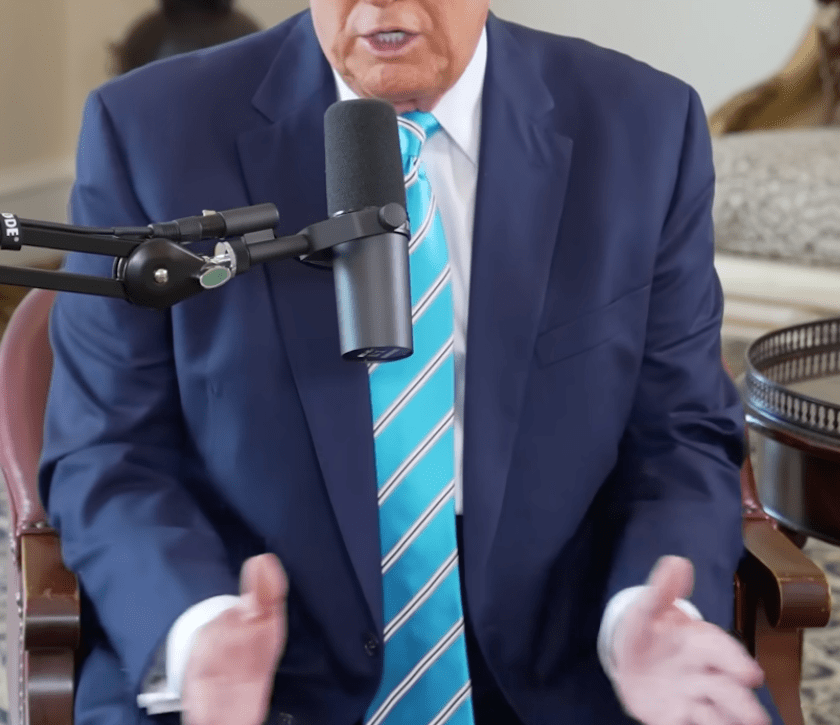
But taking a sound studies perspective, we can also see – or hear – how Trump’s tone of voice, which admittedly seems less energetic than it was during his Logan Paul interview, tended to convey an assurance that what he said was an authentic expression of his own thoughts and perspectives. Again, this was not the kind of stream-of-consciousness raving that we have come to expect from his rallies, but rather a low-key, intimate conversation about relevant issues and facts – or, at least facts as Trump saw them.
The implication here is that Trump as a political leader is free to operate in ways that mere politicians and government officials simply can’t because of their obligations to party, to donors, or to lobbyists. What is likely missed in all of this, however, is that what Trump is describing is a thoroughly authoritarian approach to political power, one that is of a piece with his claim that “I alone can fix it.” Positioning himself outside the political establishment – and even independent of the Republican Party of which he is nominally the leader – Trump can offer himself as a political messiah and claim the moral authority to act without regard for democratic processes in the name of a specious popular mandate.
In other words, by contrasting himself with “them,” and by holding himself at a distance from the dominant political order, Trump clears himself of the obligation to work with any group or individual that he deems to be opposed to his own quasi-populist agenda.
And for Von and those in his audience who are fed up with the status quo, that is a powerful appeal.
—
Featured Image: Theo Von, Edited James Tamim, Wikimedia Images (CC BY-SA 2.0)
—
Andrew J. Salvati is an adjunct professor in the Media and Communications program at Drew University, where he teaches courses on podcasting and television studies. His research interests include media and cultural memory, television history, and mediated masculinity. He is the co-founder and occasional co-host of Inside the Box: The TV History Podcast, and Drew Archives in 10.
—
REWIND! . . .If you liked this post, you may also dig:

Impaulsive: Bro-casting Trump, Part I—Andrew Salvati
Taters Gonna Tate. . .But Do Platforms Have to Platform?: Listening to the Manosphere—Andrew Salvati
Listening to MAGA Politics within US/Mexico’s Lucha Libre –Esther Díaz Martín and Rebeca Rivas
Gendered Sonic Violence, from the Waiting Room to the Locker Room–Rebecca Lentjes
—
Layout by Jennifer L. Stoever
—
Share this:




Current Top Posts





April 2021

January 2020

November 2019

October 2019

August 2019

April 2014

November 2017

March 2015

December 2017

October 2015
 Sounding Out!
Recent Comments