
Beyond the Grave: The “Dies Irae” in Video Game Music
DOI: https://doi.org/10.59350/fxtwy-axz26
For those familiar with modern media, there are a number of short musical phrases that immediately trigger a particular emotional response. Think, for example, of the two-note theme that denotes the shark in Jaws, and see if you become just a little more tense or nervous. So too with the stabbing shriek of the violins from Psycho, or even the whirling four-note theme from The Twilight Zone. In each of these cases, the musical theme is short, memorable, and unalterably linked to one specific feeling: fear.
The first few notes of the “Dies Irae” chant, perhaps as recognizable as any of the other themes I mentioned already, are often used to provoke that same emotion.
Often, but not always. The “Dies Irae” has been associated with death since its creation in the thirteenth century, due to its use in the Requiem Mass for the dead until the Second Vatican Council (1962–65). Its text describes the Last Judgment, when all humanity will be sent to heaven or hell. But from the Renaissance to today, the “Dies Irae” has also come to symbolize everything from the medieval church and Catholic ritual to the sinister, superstitious, or supernatural, even violence and battle—and any combination of the above.
Because of its unique history not only within its original liturgical context but also within later musical genres, this chant has become largely divorced from its original purposes, at least in modern popular imagination. Instead, it now holds a multiplicity of meanings; composers manipulate these meanings by utilizing this chant in a new setting, and thus in turn continue to reinforce those meanings within modern media. Since its use within the Mass, concert music, and films has already been well documented, this blog post explores its presence in an as yet unexamined medium: video games.
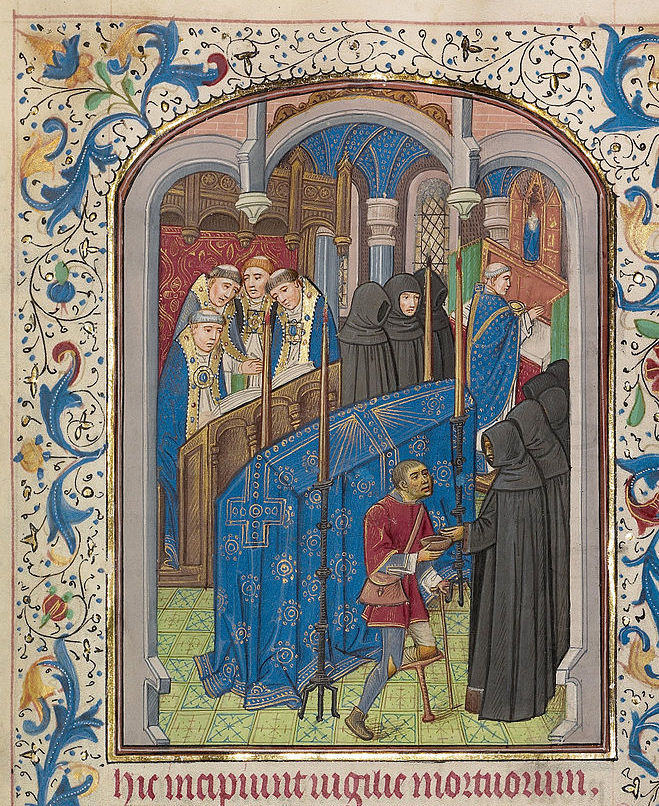
Chant—monophonic music of the Western Christian tradition—is the largest surviving body of music from the medieval period. Although chant was not written down until the ninth century, it has been continuously sung for over two thousand years. Before the Reformation, chant permeated the musical landscape of Western Europe. But as John Haines points out, chant’s meanings changed in the sixteenth century; to Protestants, chant was a sign of superstitious, even sinister, ritual, whereas to Catholics it was a flawed but holy tradition (112). Chant became ever more confined to the Catholic liturgy; although composers continued to use chant in new compositions, by the late nineteenth century the only chant guaranteed to be recognized by a secular audience was the “Dies Irae.”
Beginning in the late eighteenth century, the text was set in Requiems for the secular stage by composers such as Mozart, Verdi, and Britten. But due to both its evocative text and its memorable melody (often just the first sixteen, eight, or even four notes), the “Dies Irae” chant soon was incorporated into secular instrumental works, where it signified the past, the supernatural, the oppressive, the demonic, and death. No work is more responsible for this than Hector Berlioz’s Symphonie Fantastique, where the chant symbolizes the composer’s own death and the depravity of the demons and witches who dance at his funeral.
The history of this chant, together with its use in film, has been explored by scholars such as Linda Schubert and John Haines. Because the “Dies Irae” was already a well-known symbol of the aforementioned characteristics, and because early silent film musicians borrowed musical ideas from previously composed works, the chant segued quickly into early film, where its symbolic possibilities were reinforced. Thus, even in newly composed soundtracks, composers utilized this chant as an aural shortcut to a host of emotional and psychological reactions, especially (as James Deaville and others discuss) within horror films. It appears in scenes depicting inner anguish, fear, the occult, evil, and imminent death in films from It’s a Wonderful Life, The Seventh Seal, and The Shining to Disney’s The Lion King and Star Wars, in musicals like Sweeney Todd, and in literary works such as Gaston Leroux’s The Phantom of the Opera, but it also symbolizes power and even heroism, such as in this Nike shoe commercial.
The “Dies Irae” appears analogously in video game soundtracks, where it communicates the same symbolic meanings that it does in film scores and concert music. Its recognizability also lends itself to parody, as it did in Monty Python and the Holy Grail. Yet, unlike in film music, the evolution of its use in game music speaks also to the evolution of game music technology.
In the earlier years of video games, technology could not create continuous soundtracks. The first such was in Space Invaders (1978), although it consisted only of four descending notes looped indefinitely. Additionally, while voice synthesis was used in game soundtracks as early as 1982, reproduction of musical voices was limited even into the 1990s. William Gibbons describes how early systems had a limited number of channels (40); as a result, Baroque-style counterpoint worked well texturally, and reproducing music from earlier composers such as Bach was not only permissible by copyright but also demonstrated the capabilities of their systems (201–204). As such, earlier games were less interested in a monophonic chant, although several (such as Fatal Fury) did use Mozart’s setting of the “Dies Irae.”
The “Dies Irae” chant is first used in game music in the late 1980s and early 1990s, by which point most systems had five or more channels, allowing for improved timbres and sound synthesis. The opening theme song to F-19 Stealth Fighter (1988–92, DOS/PC/Amiga/Atari) subtly references the first phrase of the chant. Composer Ken Lagace sets the first eight pitches evenly in the lower voice before moving them to a higher, rhythmicized register. The chant is accompanied by a consistent percussive element and several higher, chordal voices, which splinter off into fast arpeggios before restating the opening. There is as yet no action, nor is the plot either spiritual or supernatural, so the chant here actually works in a somewhat anomalous way. It heightens the player’s tension through its aural connotations of fear and death, thus setting the stage for the battles still to come in the game itself.
Indiana Jones and the Fate of Atlantis (1992, PC) is another early instance of the “Dies Irae,” which appears at the end, when Indiana and his companion Sophia confront the malevolent Doctor. The chant again increases tension but also indicates the presence of evil. Musically, the first two phrases of the chant appear in long, low tones, accompanied by several high, sustained, dissonant pitches. New voices enter, reminiscent of the opening phrase, before the chant returns in full in all registers. The system’s capability for thicker textures allowed the composers to stack the monophonic “Dies Irae” against itself, further emphasizing the threat of imminent danger in this final encounter.
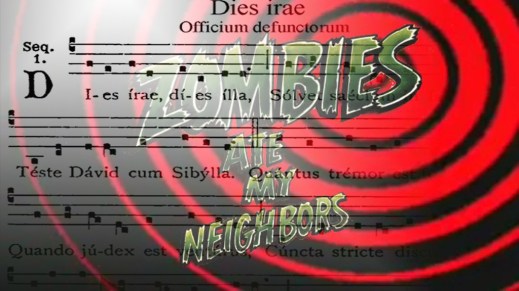
The last of the early case studies is Zombies Ate My Neighbors (1993, SNES/Genesis). These systems featured multiple channels capable of emulating a variety of acoustical settings. The game is a parody of 1950s horror films; the protagonists race through standard horror settings such as malls and castles to rescue their neighbors from demonic babies, vampires, zombies, and other stock creatures. The soundtrack also mimics the musical tropes in such films: chant itself, especially the “Dies Irae,” but also timbres such as tremolo, stingers, extreme ranges, and dissonance. The track “Curse of the Tongue,” which plays upon encountering the final boss, Dr. Tongue’s Giant Head, emulates a Gothic pipe organ. The low organ drone sustains underneath the first sixteen notes of the chant, which sound in a shrieking, vibrato-heavy register. The voices then move in parallel fifths as in medieval polyphony. The “Dies Irae” here brings to mind an entire film genre while also overtly characterizing the final battle against the otherworldly, sinister, evil Head. In this case, the chant works literally to signify the current battle and threat of death, but also parodically to indicate the absurdity of the situation.
The development of video game audio technology allowed first for voice emulation, then voice reproduction. Vocal samples were used as early as the 1980s, but were often confined to theme songs. Yet even after voices were reproduced within soundtracks, it is the “Dies Irae” melody alone that is most frequently sampled, strikingly paralleling its earlier use in film and concert music. When the “Dies Irae” text is used, it is set to newly composed music or borrowed from the Mozart or Verdi Requiems. Moreover, as in earlier media, all that is needed as an aural mnemonic is the first phrase, even just the first four notes, of the chant melody.
For example, two games released for PC in 1999—Heroes of Might & Magic III and Gabriel Knight 3: Blood of the Sacred, Blood of the Damned—both use just the first portion of the “Dies Irae.” In “Burying the Manuscript” from Gabriel Knight, pizzicato violins first allude to the first four or five notes of the chant (1:25); the full first phrase is then presented in parallel motion in the brass. The remainder of this theme alludes to the first few notes, making the “Dies Irae” a constant presence here and underscoring the secrecy, even the occult nature, of the manuscript in this scene.
Heroes III uses even less melodic material. In the Necropolis, composer Paul Romero uses the first four notes of the “Dies Irae” to underpin the entire theme. The bass plays the first four notes in a low register before seguing into newly composed material, but the contour of that phrase returns throughout the theme. The full chant phrases do not appear until the very end. The chant hints constantly at the overwhelming metaphor of death in this area, as well as to the presence of supernatural creatures such as vampires, zombies, and wraiths.
Unusual for many reasons, then, is the last case study: the game Dante’s Inferno (2010, PS3/Xbox360). It is the sole example here to use voices, but the text appears to be newly composed. As John Haines noted, the presence of Latin or pseudo-Latin is in and of itself a trope of the diabolical or demonic, which adds further nuance to this scene (129). The familiar melody is presented by a choir of mixed voices, accompanied by a roar of low brass, ambient noise, and a descant voice singing on open vowels, all signifiers of horror or the medieval. Moreover, the “Dies Irae” is not reserved for a final battle, as in previous examples, nor does it characterize supernatural creatures. Rather, it is the first theme heard in the game, reinforcing not only the medieval setting and the constant presence of death but also the ultimate trajectory of Dante, and the gamer, into Hell.
While the “Dies Irae” has been well studied as an aural signifier within film and concert music, its use in video games has, before now, been largely ignored. As in earlier musical genres, this chant brings to games a host of culturally accepted, musically mediated meanings that allow composers to immediately flesh out a character or scene. In so doing, game composers acknowledge that sound is not just sound, but rather it is (to borrow a phrase from Elizabeth Randell Upton) “a complex interaction of experiences and expectations on the part of the audience.” These experiences are continuously shaped by new compositions, scores, and soundtracks, which in turn continuously shape the audience’s expectations for future works.
As such, game soundtracks, along with other kinds of media, continue to transform the “Dies Irae” out of its original context and into an ever-growing set of pop culture symbols. The chant now signifies everything from the medieval to the present day, from judgment, battle, and death to demons, witches, and the occult. Within games in particular, though, it acts as a “memento mori,” a reminder of the mortality that game characters, and thus game players, seek to avoid through play. As such, it may instill fear in a player, but also suspicion, alertness, tension, even excitement, spurring the player to react in whichever manner suits the individual game.
The iconic status of the opening phrases of the “Dies Irae” chant marks it as a particularly useful polyvalent symbol for composers. Yet the utilization of this well-known trope is not without its problems. As I discuss in a forthcoming article, this chant, and indeed all plainchant, originates in a particular sacred, liturgical tradition. When a chant such as “Dies Irae” is used as a signifier of a general sense of spirituality, or of the medieval, or even of horror, then by default those characteristics are reified, if subtly, as Christian. Moreover, linking a chant such as the “Dies Irae” to the supernatural or the occult serves to perpetuate early modern stereotypes of Catholicism as nothing more than superstitious magic; see, for example, the purported origins of the phrase “hocus pocus.” Such anachronistic uses further obfuscate chant’s continuous role within Catholic (and other) liturgy; it is both a historic and a very modern practice.
Given that the “Dies Irae” is certainly not the only musical means to the aforementioned symbolic ends, perhaps these concerns are not pressing. Still, as Anita Sarkeesian points out, we can enjoy modern media while simultaneously critiquing facets that are problematic. There is no clear-cut way, at this point, to overturn hundreds of years of accumulated symbolic meaning for a musical icon such as the “Dies Irae,” but it behooves us as participants in auditory culture to become better aware of the multiple, and occasionally challenging, meanings within what we hear.
[Other games that also use the “Dies Irae” chant include Gauntlet Legends (1999, N64/PS/Dreamcast), Final Fantasy IX (2000, PS), EverQuest II (2004, MMORPG), Heroes of Might and Magic V (2006, PC), Sam & Max: Season 2 (2007–8, Wii/PC/PS3/Xbox 360), Ace Combat: Assault Horizon (2011, PS3/Xbox 360), and Diablo 3 (2012–4, PC/PS3/Xbox/PS4). My thanks go to VGMdb and Overclocked Remix for bringing several of these games to my attention, and to Ryan Thompson and Dana Plank for comments.]
–
Featured Image: A mashup of the first lines of the Dies Irae and the Zombies Ate My Neighbors title screen. Remixed for purposes of critique.
–
Dr. Karen Cook specializes in medieval and Renaissance music theory, history, and performance. She is currently working on a monograph on the development of rhythmic notation in the fourteenth and early fifteenth centuries. She also maintains active research interests in popular and contemporary music, especially with regard to music and identity in television, film, and video games. She frequently links her areas of specialization together through a focus on medievalism, writ broadly, in contemporary culture. As such, some of her recent and forthcoming publications include articles on fourteenth-century theoretical treatises, biographies of lesser-known late medieval theorists, and the use of plainchant in video games, a book chapter on medievalist music in Harry Potter video games, and a forthcoming co-authored Oxford Bibliography on medievalism and music.
–

REWIND!…If you liked this post, you may also dig:
SO! Amplifies: Mega Ran and Sammus, The Rappers With Arm Cannons Tour–Enongo Lumumba-Kasongo
Video Gaming and the Sonic Feedback of Surveillance: Bastion and the Stanley Parable–Aaron Trammell
Playing with the Past in the Imagined Middle Ages: Music and Soundscape in Video Game–James Cook
—
Share this:

A Manifesto, or Sounding Out!’s 51st Podcast!!!

DOI: https://doi.org/10.59350/a89ek-90e31
This week, Sounding Out! dropped its 51st podcast episode. As the curator and producer, I thought it necessary to commemorate the occasion with some fanfare. I want to shout from the hilltops about how proud I am that our little podcast has turned 51!
Erm…at least I’m posting about it.
Also, I want to clear the air a little about what it is that we do. I’ve received feedback here and there over the years about the sound of our podcasts, that we sound “different” and/or “inconsistent,” that we need to normalize the sound a bit: hello out there, audiophiles! Today, I want to say, once and for all, that our sound is intentional and that we are proud of it, hiss, distortion, and all! We think what some hear as “imperfections” are all part of what sets us apart from the ever-growing pack of podcasters. SO!’s podcast has sounded different since we MacGyvered our first episode from an epic talk, a few great ideas, and a rogue tape recorder at River Read Books in Binghamton, NY in April, 2011.
The Sounding Out! Podcast began as a series of conversations within the editorial team back in 2011. We knew that the blog was “talking the talk” in new, excellent, and often provocative ways, but that something was missing to keep pushing the form into the red, not just the content. We knew we needed something more—a little snap, crackle, and pop, if you will—a way to show how Sounding Out! was always listening, and a way for thinkers, artists, provocateurs, and more to engage with sound more directly. In 2011, podcasts were accumulating in the shadows waiting to lunge forth to center stage. They seemed really cool, but there were relatively few, and fewer still (if any at all) on the topic of sound studies. Even though we knew that podcasts were going to be a big thing eventually, we had no idea that they would blow up so quickly.
While we flipped around many ideas, we decided to put our energies behind what was then an occasional series of podcasts that allowed us to capture important yet fleeting moments—too quick and dirty to really transcribe. While our our initial vision for the podcast was to capture these rare and powerful moments, over the past 5 years we have kept this mission consistent while evolving to better accommodate artists and theorists alike. During that time we have hosted mystics and librarians, shared fieldwork from São Paolo, Brazil to Lodi, Ohio, interviewed theremin players and visionaries. See the full list of episodes here. Even though our content has been wide ranging and eclectic, we’ve made it a point to privilege access and immediacy in all of our episodes.
As I listen back to the past five years, I realize that our contribution to the fields of sound studies and podcasting has not just been in terms of who we broadcast and what we amplify, but through the sound of our podcasts themselves. Our podcasts don’t sound perfect. They’re spiritually aligned by the raw production ethic of bands like The Minutemen, who always privileged the emotive qualities of immediacy, access, and intimacy over the brooding qualities of studio production. Particularly because we founded the podcast upon these same principles, I have strived to prioritize radical visions and ideas and to amplify new voices above all else. I want each podcast to arrive in your queue like a wrapped gift—topic, content, production, and sound all equally mysterious. Some of our podcasts were recorded on cellphones and others were recorded in high-end studios and recording booths. Our 51st anniversary isn’t the perfect occasion, either. But, hey, we’re proud of these audible distortions.
“The Minutemen: #1 Hit Song”
So what do I mean that our podcast sounds different? Well, I mean two things: First, we sound different than what episodic radio sounds like. Our DIY—or, more accurately, we will help you “Do It Yourself”—ethics deliberately dial back radio’s genre conventions: smooth identifiable hosts, heavy compression, sound-proof rooms with the latest in equipment. We encourage and construct our podcast with a deliberate sonic diversity, providing little sonic consistency from episode to episode in order to challenge regimes of production that threaten to make all recordings sound the same. We have many many different announcers and hosts; for this podcast to be the space of radical discourse that we intend, it’s important to cast our net wide. This isn’t to say that we don’t care about “quality,” but rather that we define quality differently. Rather than an audiophilic emphasis on the sorts of tone found most frequently in microphone technique, sound booths, and—when all else fails—postproduction, we believe that a “quality” podcast—particularly one about sound—should explore sounds that we rarely hear and allow its artists freedom over how they present their work.
I curate our podcast as a sonic refuge from the invisible regime of auditory production that has slowly constricted and strangled radio this past century. And I’m proud to share podcasts that have been recorded on in impromptu circumstances, Episode XXXIX: Soundwalking Davis, CA and New Brunswick, NJ, for example. We want artists to show more than they tell; Episode XII: Animal Transcriptions, Listening to the Lab of Ornathology is a perfect example of this. Here Jonathan Skinner’s brilliant exploration of animal sounds perfectly balances sound and interview and invites listeners to compare sounds to speech, and vice versa. Another example of this ethic is film professor Monteith Mccollum’s remix of the original War of the Worlds broadcast. Although Mccollum offers some commentary at the start of the recording, what follows is a unique and dazzling sonic experience. Giving radical ideas both the space and platform to be heard is this podcast’s mission. So far, so good!
The second way our podcast sounds different has to do with our deliberate curatorial resistance to consistency between our episodes. When programs bend to the whims of genre conventions, creativity is all but snuffed out. For our podcast to excel as a form for sharing visions, ideas, and experiments, we must allow our composers, authors, and auditors the freedom to explore sonic space. We celebrate Sounding Out!’s anniversary annually with a series of mixes hand-picked by our stable of authors (Listen to years 1, 2, 3, 4, 5, and 6 here!), we’ve entertained interviews, panels, and sound art alike. You may have missed it, but we even have an episode diving into the work of ambient sound in a Dungeons and Dragons game.
While I do think about the sound of our podcast aesthetically—I used to run a music production studio out from the trunk of my car—we do not cultivate a DIY anything-goes ethic strictly for a “cool factor” or just for its own sake. Rather, we have calibrated our different sonic approach in deliberate defiance of styles of production which are all too frequently celebrated within the cultures of straight white men. (Check out SO! Editor-in-Chief Jennifer Lynn Stoever’s epic three-part treatise on the tape recorder in popular film to glean some sense of the tape-recorder’s role as an instrument of masculine control. Part 1, Part 2, Part 3). The standards of taste which have long governed the domain of radio production (and audio production, as a whole) are historically connected to the communities of practice which have occupied invisible yet powerful roles as audio producers, engineers, critics, and marketers.
As Jonathan Sterne explains in MP3, the science of audio fidelity has historical roots within a corporate logic that privileges sounds that are easily shared through telephone cables. “AT&T encountered hearing as an economic problem once its options for extracting additional profit through price were limited,” Sterne says, “Among other strategies, it sought to learn which frequencies could be excluded from the market for telephone signals” (14). In other words, the entire craft of audio engineering has historical roots in privileging sounds that make money above all else. Not only this, but the standards of fidelity cultivated by engineers allow them to gatekeep and demand money at the outset, blocking access to the means of production. These standards are more often than not embedded within the cultures of listening and sales fostered by the radio industry. Fortunately, podcasts have been able to challenge many of these genre tropes, We’re proud to contribute to this momentum and to propel it forward as we continue our series. And we’re not stopping! Up on deck in 2016 we have some amazing compositional sound art, more from Marcella Ernest’s trek to uncover lost sounds, and some notes on a forthcoming project in archiving one city’s local music scene.

So, in the spirit of Sounding Out!’s annual blog-o-versary we’re popping the cork for our podcast’s 50th episode with a few of the milestones we hit this past five years.
We found a theme song. This was a small but important step in our development. What would a podcast about sound be without some kind of awesome anthem representing it? (Nothing, that’s what!) We need to officially thank the members of Hunchback (Miranda, Mike, Jay, and Craig) for donating their song “Feeling Blind” to our podcast. Hunchback was a legendary horror-surf band from the NJ basement scene who endeavored to produce highly visceral sonic experiences of the highest caliber in their songwriting. You can still find a ton of their recordings on the internet. Thanks, crew!

We got listed on iTunes and Stitcher. It bears mentioning that quite a bit of technical muscle is involved in establishing a podcast. We would have gotten nowhere without Andreas Duus Pape’s help and guidance during our earliest moments. Andreas was instrumental in opening up the hood of the podcast and making it purr. Not only did he donate his time to plug us into iTunes’ network of podcasts, but he also shared some excellent philosophical thoughts on the topic. You can listen here and read them here.
We went monthly. Originally we had conceived the podcast as more a haphazard, occasional treat for our readers. Slowly but surely as demand and interest grew, we began to carve out a more regular calendar space for our podcast. First we switched to a bi-monthly format, and then we started with monthly broadcasts. Can’t slow this beat down.
We are the sonic archive of a sound art conference. That’s right, we featured sonic mixdowns of the entire Tuned City of Brussels sound art festival. Over the course of the festivals three days, we featured daily mixdowns of the prior day’s key sounds and moments. Each mixdown is brilliant and a testiment to the raw passion of our podcast contributors. They worked round the clock to produce such an amazing series. Check out the night before, and days 1, 2, and 3.

We produced a LOT of soundwalks. If you’re a listener you know that we love our soundwalks. We’re proud to be host to play host to a variety of soundwalks from cities around the world. Last month’s Yoshiwara soundwalk by Gretchen Ju challenged listeners to critically engage with the city’s fraught history of sex work. Other contributors in our soundwalk series like James Hodges have considered how the ambient music of big box stores and shopping malls are part of the architecture of commerce. Finally others like Frank Bridges have taken us to the edge of history and soundwalked the grounds of Thomas Edison’s workshop in Edison, NJ. No matter what the locale, our soundwalks are part of our podcast’s signature.
We found a regular contributor. Regular contributors are the heart and soul of Sounding Out! They lead the conversation on sound and work to bring you the best, most interesting content. For these reasons we’re proud to announce that Marcella Ernest will be joining our podcast as a regular contributor with her series “Searching for Lost Sounds.” Marcella will be interviewing a variety of sonic practitioners in an effort to give voice to the voiceless. Her most recent entry in the series was posted last Thursday. You can listen here.
We’re going to keep it coming. That’s our promise to you! We’ll be producing great content as long as you’re listening. Take a moment to subscribe to our iTunes or Stitcher accounts and also explore our Episode Guide to see if you missed anything this past 5 years. It’s been a rewarding adventure so far and we guarantee that we’ve already got some great content lined up in the coming months.

–
Aaron Trammell is a Provost’s Postdoctoral Scholar for Faculty Diversity in Informatics and Digital Knowledge at the Annenberg School for Communication and Journalism at the University of Southern California. He earned his doctorate from the Rutgers University School of Communication and Information in 2015. Aaron’s research is focused on revealing historical connections between games, play, and the United States military-industrial complex. He is interested in how military ideologies become integrated into game design and how these perspectives are negotiated within the imaginations of players. He is the Co-Editor-in-Chief of the journal Analog Game Studies and the Multimedia Editor of Sounding Out!
–
Featured image is “Roscoe Considers Recording a Podcast” by zoomar @Flickr CC BY-NC.
—

REWIND! . . .If you liked this post, you may also dig:
Sounding Out! Podcast #1: Peter DiCola at River Read Books – Peter DiCola
It’s Our Blog-O-Versary — Jennifer Lynn Stoever
Sounding Out! Podcast #51: Creating New Words from Old Sounds – Marcella Ernest
—
Share this:




Current Top Posts





April 2021

January 2020

November 2019

October 2019

August 2019

April 2014

November 2017

March 2015

December 2017

October 2015


Recent Comments