
A Manifesto, or Sounding Out!’s 51st Podcast!!!

DOI: https://doi.org/10.59350/a89ek-90e31
This week, Sounding Out! dropped its 51st podcast episode. As the curator and producer, I thought it necessary to commemorate the occasion with some fanfare. I want to shout from the hilltops about how proud I am that our little podcast has turned 51!
Erm…at least I’m posting about it.
Also, I want to clear the air a little about what it is that we do. I’ve received feedback here and there over the years about the sound of our podcasts, that we sound “different” and/or “inconsistent,” that we need to normalize the sound a bit: hello out there, audiophiles! Today, I want to say, once and for all, that our sound is intentional and that we are proud of it, hiss, distortion, and all! We think what some hear as “imperfections” are all part of what sets us apart from the ever-growing pack of podcasters. SO!’s podcast has sounded different since we MacGyvered our first episode from an epic talk, a few great ideas, and a rogue tape recorder at River Read Books in Binghamton, NY in April, 2011.
The Sounding Out! Podcast began as a series of conversations within the editorial team back in 2011. We knew that the blog was “talking the talk” in new, excellent, and often provocative ways, but that something was missing to keep pushing the form into the red, not just the content. We knew we needed something more—a little snap, crackle, and pop, if you will—a way to show how Sounding Out! was always listening, and a way for thinkers, artists, provocateurs, and more to engage with sound more directly. In 2011, podcasts were accumulating in the shadows waiting to lunge forth to center stage. They seemed really cool, but there were relatively few, and fewer still (if any at all) on the topic of sound studies. Even though we knew that podcasts were going to be a big thing eventually, we had no idea that they would blow up so quickly.
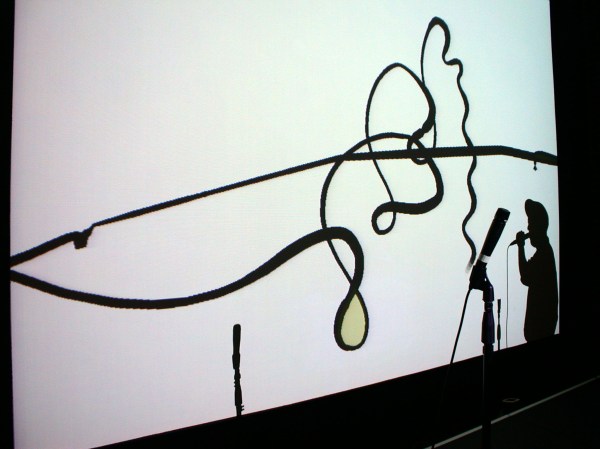
While we flipped around many ideas, we decided to put our energies behind what was then an occasional series of podcasts that allowed us to capture important yet fleeting moments—too quick and dirty to really transcribe. While our our initial vision for the podcast was to capture these rare and powerful moments, over the past 5 years we have kept this mission consistent while evolving to better accommodate artists and theorists alike. During that time we have hosted mystics and librarians, shared fieldwork from São Paolo, Brazil to Lodi, Ohio, interviewed theremin players and visionaries. See the full list of episodes here. Even though our content has been wide ranging and eclectic, we’ve made it a point to privilege access and immediacy in all of our episodes.
As I listen back to the past five years, I realize that our contribution to the fields of sound studies and podcasting has not just been in terms of who we broadcast and what we amplify, but through the sound of our podcasts themselves. Our podcasts don’t sound perfect. They’re spiritually aligned by the raw production ethic of bands like The Minutemen, who always privileged the emotive qualities of immediacy, access, and intimacy over the brooding qualities of studio production. Particularly because we founded the podcast upon these same principles, I have strived to prioritize radical visions and ideas and to amplify new voices above all else. I want each podcast to arrive in your queue like a wrapped gift—topic, content, production, and sound all equally mysterious. Some of our podcasts were recorded on cellphones and others were recorded in high-end studios and recording booths. Our 51st anniversary isn’t the perfect occasion, either. But, hey, we’re proud of these audible distortions.
“The Minutemen: #1 Hit Song”
So what do I mean that our podcast sounds different? Well, I mean two things: First, we sound different than what episodic radio sounds like. Our DIY—or, more accurately, we will help you “Do It Yourself”—ethics deliberately dial back radio’s genre conventions: smooth identifiable hosts, heavy compression, sound-proof rooms with the latest in equipment. We encourage and construct our podcast with a deliberate sonic diversity, providing little sonic consistency from episode to episode in order to challenge regimes of production that threaten to make all recordings sound the same. We have many many different announcers and hosts; for this podcast to be the space of radical discourse that we intend, it’s important to cast our net wide. This isn’t to say that we don’t care about “quality,” but rather that we define quality differently. Rather than an audiophilic emphasis on the sorts of tone found most frequently in microphone technique, sound booths, and—when all else fails—postproduction, we believe that a “quality” podcast—particularly one about sound—should explore sounds that we rarely hear and allow its artists freedom over how they present their work.
I curate our podcast as a sonic refuge from the invisible regime of auditory production that has slowly constricted and strangled radio this past century. And I’m proud to share podcasts that have been recorded on in impromptu circumstances, Episode XXXIX: Soundwalking Davis, CA and New Brunswick, NJ, for example. We want artists to show more than they tell; Episode XII: Animal Transcriptions, Listening to the Lab of Ornathology is a perfect example of this. Here Jonathan Skinner’s brilliant exploration of animal sounds perfectly balances sound and interview and invites listeners to compare sounds to speech, and vice versa. Another example of this ethic is film professor Monteith Mccollum’s remix of the original War of the Worlds broadcast. Although Mccollum offers some commentary at the start of the recording, what follows is a unique and dazzling sonic experience. Giving radical ideas both the space and platform to be heard is this podcast’s mission. So far, so good!
The second way our podcast sounds different has to do with our deliberate curatorial resistance to consistency between our episodes. When programs bend to the whims of genre conventions, creativity is all but snuffed out. For our podcast to excel as a form for sharing visions, ideas, and experiments, we must allow our composers, authors, and auditors the freedom to explore sonic space. We celebrate Sounding Out!’s anniversary annually with a series of mixes hand-picked by our stable of authors (Listen to years 1, 2, 3, 4, 5, and 6 here!), we’ve entertained interviews, panels, and sound art alike. You may have missed it, but we even have an episode diving into the work of ambient sound in a Dungeons and Dragons game.
While I do think about the sound of our podcast aesthetically—I used to run a music production studio out from the trunk of my car—we do not cultivate a DIY anything-goes ethic strictly for a “cool factor” or just for its own sake. Rather, we have calibrated our different sonic approach in deliberate defiance of styles of production which are all too frequently celebrated within the cultures of straight white men. (Check out SO! Editor-in-Chief Jennifer Lynn Stoever’s epic three-part treatise on the tape recorder in popular film to glean some sense of the tape-recorder’s role as an instrument of masculine control. Part 1, Part 2, Part 3). The standards of taste which have long governed the domain of radio production (and audio production, as a whole) are historically connected to the communities of practice which have occupied invisible yet powerful roles as audio producers, engineers, critics, and marketers.
As Jonathan Sterne explains in MP3, the science of audio fidelity has historical roots within a corporate logic that privileges sounds that are easily shared through telephone cables. “AT&T encountered hearing as an economic problem once its options for extracting additional profit through price were limited,” Sterne says, “Among other strategies, it sought to learn which frequencies could be excluded from the market for telephone signals” (14). In other words, the entire craft of audio engineering has historical roots in privileging sounds that make money above all else. Not only this, but the standards of fidelity cultivated by engineers allow them to gatekeep and demand money at the outset, blocking access to the means of production. These standards are more often than not embedded within the cultures of listening and sales fostered by the radio industry. Fortunately, podcasts have been able to challenge many of these genre tropes, We’re proud to contribute to this momentum and to propel it forward as we continue our series. And we’re not stopping! Up on deck in 2016 we have some amazing compositional sound art, more from Marcella Ernest’s trek to uncover lost sounds, and some notes on a forthcoming project in archiving one city’s local music scene.

So, in the spirit of Sounding Out!’s annual blog-o-versary we’re popping the cork for our podcast’s 50th episode with a few of the milestones we hit this past five years.
We found a theme song. This was a small but important step in our development. What would a podcast about sound be without some kind of awesome anthem representing it? (Nothing, that’s what!) We need to officially thank the members of Hunchback (Miranda, Mike, Jay, and Craig) for donating their song “Feeling Blind” to our podcast. Hunchback was a legendary horror-surf band from the NJ basement scene who endeavored to produce highly visceral sonic experiences of the highest caliber in their songwriting. You can still find a ton of their recordings on the internet. Thanks, crew!

We got listed on iTunes and Stitcher. It bears mentioning that quite a bit of technical muscle is involved in establishing a podcast. We would have gotten nowhere without Andreas Duus Pape’s help and guidance during our earliest moments. Andreas was instrumental in opening up the hood of the podcast and making it purr. Not only did he donate his time to plug us into iTunes’ network of podcasts, but he also shared some excellent philosophical thoughts on the topic. You can listen here and read them here.
We went monthly. Originally we had conceived the podcast as more a haphazard, occasional treat for our readers. Slowly but surely as demand and interest grew, we began to carve out a more regular calendar space for our podcast. First we switched to a bi-monthly format, and then we started with monthly broadcasts. Can’t slow this beat down.
We are the sonic archive of a sound art conference. That’s right, we featured sonic mixdowns of the entire Tuned City of Brussels sound art festival. Over the course of the festivals three days, we featured daily mixdowns of the prior day’s key sounds and moments. Each mixdown is brilliant and a testiment to the raw passion of our podcast contributors. They worked round the clock to produce such an amazing series. Check out the night before, and days 1, 2, and 3.

We produced a LOT of soundwalks. If you’re a listener you know that we love our soundwalks. We’re proud to be host to play host to a variety of soundwalks from cities around the world. Last month’s Yoshiwara soundwalk by Gretchen Ju challenged listeners to critically engage with the city’s fraught history of sex work. Other contributors in our soundwalk series like James Hodges have considered how the ambient music of big box stores and shopping malls are part of the architecture of commerce. Finally others like Frank Bridges have taken us to the edge of history and soundwalked the grounds of Thomas Edison’s workshop in Edison, NJ. No matter what the locale, our soundwalks are part of our podcast’s signature.
We found a regular contributor. Regular contributors are the heart and soul of Sounding Out! They lead the conversation on sound and work to bring you the best, most interesting content. For these reasons we’re proud to announce that Marcella Ernest will be joining our podcast as a regular contributor with her series “Searching for Lost Sounds.” Marcella will be interviewing a variety of sonic practitioners in an effort to give voice to the voiceless. Her most recent entry in the series was posted last Thursday. You can listen here.
We’re going to keep it coming. That’s our promise to you! We’ll be producing great content as long as you’re listening. Take a moment to subscribe to our iTunes or Stitcher accounts and also explore our Episode Guide to see if you missed anything this past 5 years. It’s been a rewarding adventure so far and we guarantee that we’ve already got some great content lined up in the coming months.
–
Aaron Trammell is a Provost’s Postdoctoral Scholar for Faculty Diversity in Informatics and Digital Knowledge at the Annenberg School for Communication and Journalism at the University of Southern California. He earned his doctorate from the Rutgers University School of Communication and Information in 2015. Aaron’s research is focused on revealing historical connections between games, play, and the United States military-industrial complex. He is interested in how military ideologies become integrated into game design and how these perspectives are negotiated within the imaginations of players. He is the Co-Editor-in-Chief of the journal Analog Game Studies and the Multimedia Editor of Sounding Out!
–
Featured image is “Roscoe Considers Recording a Podcast” by zoomar @Flickr CC BY-NC.
—

REWIND! . . .If you liked this post, you may also dig:
Sounding Out! Podcast #1: Peter DiCola at River Read Books – Peter DiCola
It’s Our Blog-O-Versary — Jennifer Lynn Stoever
Sounding Out! Podcast #51: Creating New Words from Old Sounds – Marcella Ernest
—
Share this:

Mediated Sexuality in ASMR Videos

DOI: https://doi.org/10.59350/hpkcn-sr240
“Why does it feel so good when someone else is touching you?” she asks, fluttering her fingers up her forearm in demonstration. The cheerful blond woman smiles brightly. “Is it because of the physical contact itself? Or is there something else going on?”
This YouTube celebrity is Olivia Kissper, and she is about to demonstrate 40 different sounds that act as “triggers” for ASMR, or Autonomous Sensory Meridian Response. ASMR is a term coined by the community of internet users who experience a particular tingling sensation in response to certain auditory, visual, or haptic stimuli. The sensation often originates in the scalp and travels down the spine and is reported to be immensely pleasurable, as well as relaxing. “ASMRtists” now flood YouTube with a steady stream of high definition videos designed to trigger this sensation for viewers, either by whispering or making other sounds with the mouth, by tapping, crinkling, or scratching various household objects, or through role-play scenarios (which often incorporate some or all of the above). In answer to Olivia’s question, I suggest that ASMR “feels so good” because the technology affords listener-viewers the opportunity to imagine alternative sexualities outside of the dominant Western paradigm of heterosexual, two-bodied, genital, orgasmic, reproductive intercourse.
However, the online ASMR community vehemently asserts that there is nothing sexual about ASMR. Of course, that is not to say that NSFW ASMR doesn’t have a strong following on Reddit, or that there haven’t been strident debates on the topic (such as the one sparked by comedian Russell Brand earlier this year). But it does mean that the vocal majority of ASMRtists and their listeners perceive this experience as intensely pleasurable, yet outside the regime of sexuality. It seems that positioning ASMR as distinct from sexual fetishes is an effort to destigmatize what may otherwise be viewed as deviant or unhealthy sexual behavior.
The problem at hand, then, is not that ASMR may in fact be sexual, but that pervasive definitions of sexuality pertain to very narrow set of actions and gestures among a very narrow set of bodies and pertaining to a very narrow set of moralistic qualities. I argue that ASMR videos broaden the scope of what we understand as “sexuality” and provide a means for bodies to gain access to certain other bodies in particular ways, and thus serve as an outlet for people to enjoy those (sexual) pleasures alongside of what is deemed appropriate in the mainstream. By analyzing this video phenomenon, specifically through the videos of ASMRtist Olivia Kissper, I consider what is “real” about this mediated intimacy, and how this mediated intimacy can help us to reimagine sexuality.
Pleasure
If ASMR is described by those who experience it as intensely pleasurable and relaxing, and if ASMRtists craft their videos with the deliberate intention of producing this automatic, visceral, pleasurable sensation, then it is indisputable that ASMR is, above all, concerned with the production of pleasure. In this way, it is not difficult to note the parallels between ASMR videos and pornography—another “body genre” (to borrow the term from Linda Williams) that employs genre-specific techniques with the intention of producing an automatic, visceral, pleasurable sensation in the viewer. Bearing this in mind, it should not be overlooked that most of the bodies interacting with the objects in these videos are young, conventionally attractive, white women. As art historian Joceline Andersen notes, ASMR often “relies on the heteronormative gender roles of care” (685). In other words, the popularity of an ASMRtist (with few exceptions) seems to be directly related to her sexual appeal and the degree to which she upholds Western standards of beauty.
Despite the fact that these videos may not be pornographic in the traditional sense, they are certainly sensual, if not sexual. This is exemplified by the way in which these ASMRtists attempt to evoke the sensation of contact with the viewer. ASMR is triggered not only by sound, but also by touch, and many ASMRtists strive to create perfect illusions of tactile sensation through the expert manipulation of visual and aural components. These are the kinds of videos that Olivia Kissper produces most often, such as “This FEELS SO REAL! Binaural ASMR SCALP MASSAGE with head massager, cicadas & WHISPERING.”
The tabloid-headline-esque style of the video’s title exemplifies the common practice of wordy titles for ASMR videos, so that viewers can tell at a glance if the video contains the specific triggers they are looking for, in this case tactile role-play and the auditory triggers of whispering and binaural recording. The quality of ASMR videos has steadily improved over the last couple of years, and most successful ASMRtists use high definition binaural microphones that record from two different “ear” locations, so that when the listener uses headphones, it produces the immersive effect of “3D” sound.
At the beginning of this video, Olivia asks, “are you ready for the most blissful experience?” then leans in close to whisper: “Are you ready to treat your senses a little bit today?” She speaks very softly and slowly, her voice intonated by her Czech accent. She punctuates her speech with graceful, twirling hand movements, and she shows off her long fingers and perfectly groomed fingernails as she displays the head massager and taps on the different materials it is made of in order to display its texture.
As a rule, ASMR videos deliberately engage with texture: if not of objects, then of the voice and the mouth, sibilance and saliva amplified sensuously through binaural recording. ASMR, then, is exemplary of Eve Kosofsky Sedgwick’s claim in Touching Feeling that, “what [texture and affect] have in common is that at whatever scale they are attended to, both are irreducibly phenomenological” (21). Here, the pleasurable affect manifests in the phenomenological tingles across the listener-viewer’s skin as Olivia taps her fingers along “your” hairline, runs her fingers through your hair, massages your scalp with her fingertips, and pushes the tines of the wire head massager down your head. If all goes well, you will feel like Kissper really is touching, stroking, and caressing you, and the experience will trigger “the tingles.” Performances such as Kissper’s produce the sensation of proximity, and are able to do so specifically through the digital technology that allows for the perfect storm of amplified aural, visual, and haptic stimulation. Here, the ASMRtist’s performance evinces the sensation of proximity and even direct contact with another body. As sound studies scholar Joshua Hudelson has described, in ASMR media, “sound is transduced into touch, and the taut membranes of the listener’s headphones become coterminous with his own skin.” The pleasure of these role-play videos derives not only from the physiological response to the mediated contact, but from the “personal attention” trigger (one of the top five most popular ASMR triggers according to a recent survey), as established through the use of second-person address. The demand for this element of intimacy is also growing in porn, according to Ela Darling, whose new website vrtube.xxx (NSFW) features virtual, one-on-one 3D cam sessions.
Intimacy
Mediated intimacy is at play in all ASMR videos, in the sense that they are produced for personal use. ASMR videos that use binaural recording techniques must be listened to with headphones, which means that each individual among the hundreds of thousands of viewers of these performances experiences an intimate encounter with the ASMRtist. But that intimacy is turned up even higher in role-play scenarios, as in one of Olivia’s earliest videos, “❀ Whispering, HAIR BRUSHING, Braiding & card reading ASMR ❀.”
This video takes place in a softly lit bedroom, with eye level low enough to suggest that the viewer-listener is sitting on the bed. Olivia is dressed casually in a plaid shirt, which is, not incidentally, unbuttoned rather low. She begins the video by addressing the viewer-listener directly as “friend,” and providing some expository dialogue indicating that the relationship is one of good friends who have not seen each other for a long time. She tells the viewer-listener she wants to braid her hair, but before she does that, she wants to:
start with acknowledging you because I’ve realized recently that I don’t tell you certain things and I just don’t want to put it off anymore. And I’m gonna whisper it to you, um, because it is really important for me that you really get that, yeah?
However, despite the platonic relationship established in the expository introduction, the boundary-crossing proximity of Olivia’s neck and hair in the viewer-listener’s field of vision erotically charges the banal acknowledgements she whispers.

It is clear that the intimacy that I experienced with Olivia is mediated—the hair she is braiding is not my own, for example, I cannot actually touch the objects she offers me, nor would she recognize me if I met her walking down the street—but does mediation necessarily imply inauthenticity? If intimacy is affective (pleasurable) and phenomenological (tingly), then doesn’t my experience with the mediated Olivia count as “real” intimacy? Dominic Pettman has suggested that love itself is a technology in “Love in the Time of Tamagotchi,” and points to the fact that intimacy is often done better through digital simulation:
[W]ith the current technology, simultaneous eye-contact is not possible. […] The video-chatter has the choice of staring at the image of their interlocutor, or straight into the camera, but not both at the same time. […] In 2012, simulated avatars already have an advantage over other humans on video-chat, since they can better simulate such a vital interactional presence, precisely by better simulating this eye-to-eye event (110).
Although Pettman provides the example of a digital avatar in a game, I think the same could be said of ASMR videos, and that Olivia’s eye contact is equally effective and affective. Olivia herself believes this to be true, asserting on her personal website that, “Because of our emphatic [sic] human connection and mirror neurons, our brain cannot tell the difference between a face-to-face interaction and online roleplay.”
Care
The authenticity of the encounter between the ASMRtist and her listener-viewer is paramount in Olivia’s work, especially when it comes to the concept of healing. It is no coincidence that spa treatments and medical exams are two of the most popular genres of ASMR role-play: both appeal to the pleasure of being cared for. Indeed, for Olivia, her videos are not just about producing pleasure for her viewers, but about healing them. This has become more evident in her recent videos, which belie her interest in science fiction, Eastern medicine and spirituality, New Age and metaphysical therapies, and what she calls “transpersonal healing.” One of her more unique videos, “FUTURISTIC TINGLES! Binaural ASMR exam and transpersonal healing role play with binaural beats,” exemplifies this philosophy. “FUTURISTIC TINGLES!” is quite different from the typical ASMR video in that it is less about stimulating particular senses or simulating particular experiences, and much closer to the abstraction of meditation exercises. It is not realistic, nor is it trying to be. But it is still acutely concerned with the phenomenological effect on the listener-viewer’s body.
This unique video, replete with computerized special effects, opens with a quote that draws connections between the placebo effect and the role of “caring attention” in healing. The viewer-listener is then led through a complex scenario in which Olivia, as a virtual cyborg healer, examines them through their computer screen, and then leads them through a healing meditation involving trippy visual sequences and binaural beats intended to trigger different, relaxing brain wave states. While the medical tests conducted in the first half of the video set the scene (and appeal to popular tropes within the ASMR genre at large), the second half is intended to produce actual healing effects within the body, not just simulate them. Olivia’s point is not that alternative therapies such as binaural beats and ASMR could be supported by Western research if only the scientists would study them; on the contrary, her performances embrace the healing potential of those phenomena that cannot be substantiated by Western research.
But although Olivia advocates for the alternative healing qualities of ASMR, her most popular videos are still about spas and medical offices, not reiki, palm reading, or ayahuasca, although she does have videos on all of those topics. The reason these two scenarios—doctor’s offices and salons—are so much more popular than, say, scenes in which the viewer is ill or tired and being cared for by a lover or a parent is because we are more likely to already have access to those forms of intimacy in our day-to-day lives. But although our doctors and aestheticians may know our bodies more intimately than most people in our lives, they are still considered strangers, and interactions with them must therefore follow strict protocol, particularly regarding sexual encounter. We may not articulate the pleasures we enjoy at the doctor or the salon because sexuality is understood as necessarily genital, and definitively relegated to specific relationships only. Similar to Anderson’s point that ASMR videos are productive of a “queer intimacy” (697), this essay shows how ASMR videos exemplify that there are alternative pleasures in these caring intimacies, and provide an outlet for enjoying those intimacies alongside of what is deemed appropriate in the mainstream.
Conclusion
Bearing these three components of Olivia’s videos in mind—pleasure, intimacy, and care—what interests me about ASMR is that they really do touch us: the mediation of the digital recording allows the vibrations produced by Olivia’s vocal cords and finger nails to literally penetrate my ear and resonate within my body. In this way, the technological mediation of ASMR videos facilitates, rather than hinders, contact between the performer and the viewer-listener, a point that speaks to the appeal of ASMR role-play videos in particular. ASMR refers not just to “the tingles” but to the affective conglomeration of physiological tingles and psychical pleasure and relaxation, as produced by the touch of the ASMRtist. And similarly, as Teresa Brennan suggests in The Transmission of Affect, even my internal chemistry may literally be affected by “body movements and gestures, particularly through the imitation of rhythms (effected by sight, touch, and hearing)” (70). While the sexuality of this resonance is implied by the (problematically) gendered performances of ASMRtists such as Olivia Kissper, I suggest, somewhat provocatively, that ASMR is not just like sex, but is sex.
As “sex” is increasingly acknowledged as referring to a wide range of activities outside of penetrative, heterosexual, genital intercourse, it seems inevitable that its bounds will continue to expand, blur, and reconstitute themselves. Sexuality, therefore, should not be defined by the concrete gestures that constitute “sex” in a given time and place. Rather, sex could be understood as any embodied technique of pleasure, intimacy, and care, while sexuality could refer to an infinite scope of techniques within that category. In this way, by asking what sex does to the body rather than what it means for the subject, we may be able to cast aside sexuality’s moralistic conundrums and better attend to its affective aspects. What the current, dominant, Western definitions of sexuality often restrict, are the socially sanctioned opportunities for certain bodies to touch other bodies and, it follows, the ability to see the benefit of a multiplicity of intimacies. ASMR performances may be one means of transgressing the interdictions on when and how bodies may access one another, sowing the seeds for cultivating alternative, pleasurable, intimate, and caring modes of life.
–
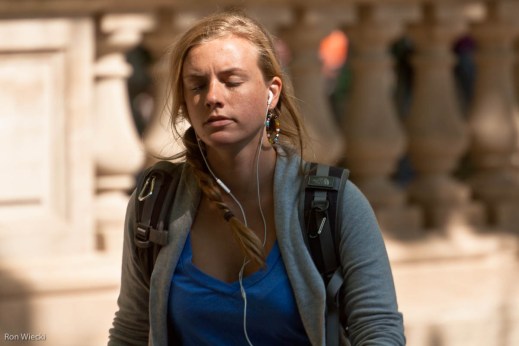
Image “In the Pink” by Koppenbadger @Flickr CC BY-NC-ND.
–
Emma Leigh Waldron is a Ph.D. student in the Performance Studies Graduate Group at the University of California, Davis and a graduate of the MA Performance Research program at the University of Bristol. She is also Co-Editor-in-Chief at the online journal, Analog Game Studies.
Emma’s research focuses on affective communities that coalesce around intimate performances of touch. She is currently researching the mediated intimacy of ASMR videos on YouTube, and how sex is represented in larp (live-action role-playing games). She is especially interested in how definitions and manifestations of sexuality are negotiated, reified, and transformed through these practices. Her work lies at the intersection of performance studies and media studies, and questions the role of embodiment in sexuality, intimacy, and touch. Her work is informed by feminist theory, queer theory, affect studies, and phenomenology. You can find Emma online at www.emmaleighwaldron.com.
—

REWIND! . . .If you liked this post, you may also dig:
Listening to Whisperers: Performance, ASMR Community, and Fetish on Youtube — Joshua Hudelson
Enacting Queer Listening, or When Anzaldúa Laughs — Maria P. Chaves Daza
Live Through This: Sonic Affect, Queerness, and the Trembling Body — Airek Beauchamp
—
Share this:




Current Top Posts





April 2021

January 2020

November 2019

October 2019

August 2019

April 2014

November 2017

March 2015

December 2017

October 2015


Recent Comments