
Re: Chuck Klosterman – “Tomorrow Rarely Knows”
DOI: https://doi.org/10.59350/nfrmg-ngz64
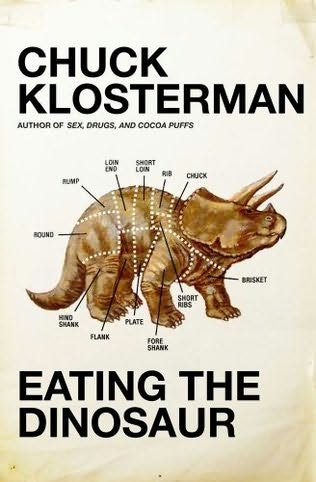
In Chuck Klosterman’s latest compilation of essays, Eating The Dinosaur, he pens an article entitled “Tomorrow Rarely Knows.” It is somewhat of a refresher course in time travel critique; geek-bait, essentially, designed to engross and compel sci-fi aficionados like myself. Although Klosterman is a critic of pop-culture, he is always at his best when writing about music. Therefore the most salient question posed by Klosterman here, is embedded within a footnote about Chuck Berry’s “Jonny B. Goode” halfway through the essay. Considering Back to the Future, Klosterman writes about how Michael J. Fox refers to “Johnny B. Goode,” as an “oldie.” Riffing on this idea he explains that in 1985 a twenty-seven year old rock song did qualify as an “oldie,” where paradoxically now no one would dare refer to Back to the Future, a twenty-four year old movie, an “oldie.” From this logic, Klosterman synthesizes:
“What seems to be happening is a dramatic increase in cultural memory: As culture accelerates, the distance between historical events feels smaller. The gap between 2010 and 2000 will seem far smaller than the gap between 1980 and 1970, which already seemed far smaller than the gap between 1950 and 1940.” (pg. 58)
Klosterman articulates two premises here, (1) There exists a cultural phenomenon in which people remember time in the past moving more slowly than it does in the present, and (2) This phenomenon occurs because culture accelerates. I take issue with the second premise – although I am uncertain of exactly what Klosterman means when he claims that culture is “accelerating,” I am confident that every possible explanation carries within it a set of presuppositions which are by their very nature determinist, teleological and ethnocentric. Most troubling is the idea that culture is ‘going’ somewhere, all progress is good progress. Culture is a metaphor used to describe a forever malleable set of material phenomenon, by constructing it as a quantifiable thing, Chuck projects a number of contemptible perspectives upon it.
Premise one however, is a much more interesting site for contemplation. Re-articulated: Why do some people remember time in the past as moving more slowly than it does in the present? My gut instinct is to argue that there is now a peculiar regime of nostalgia which delights in the rapid re-appropriation and re-articulation of all tangible media artifacts. Because recent changes in technology have made it so much easier to record, edit, splice, erase, duplicate, and distribute all media forms, we now live in a world where we are inundated by representations of the past all the time. This constant inundation is indicative of a growing cultural familiarity with past media ephemera and the subsequent changes in cultural bias. Do people even use the term “oldie,” anymore? Instead, descriptors like “retro” are used to accentuate the “cool” in instances of convergence-necromacy.
It is interesting that Klosterman constructs cultural memory through the ways that people remember music. It is therefore important to historicize the practice of listening within the history of audio technology. The 1980s historically mark the widespread dissemination of recording technology to the consumer market. This denotes a mnemonic shift, akin to the invention of writing or the printing press (Although I would argue that the printing press has more in common with the popularization of the Internet as a DIY publishing outlet). The cultural shift in language from “oldies” to “retro” has more to do with the sense of audio empowerment consumers have gained in the last twenty-four than Klosterman’s theory of cultural acceleration. It’s a shame also, Eating the Dinosaur contains Chuck’s best writing since Sex, Drugs and Cocoa Puffs.
Aaron Trammell
Share this:

Manufacturing Rebellion, Censorship in Music
DOI: https://doi.org/10.59350/wxx7p-rka47
As someone who actively self-identifies against the form of cinema, I sure write a lot about it. I saw Pirate Radio last Thursday and it was great! Here’s the plot: Set in 1966, a group of British DJs are forced to the high seas to broadcast rock and roll music in a country where the airwaves are increasingly censored. In this context of surveillance and control, every time a record needle set into a groove, it was sexy. This got me thinking about context – music is always contextualized, and I suspect that when it fits within a drab or unappealing context, it becomes less glamourous.
So flash back, forward, or sideways into any example of rebellious music. Is the music itself glamourous, or is it the context? Rebellion has always been a central concept to the mythos of rock and roll, and often contextualized within ideas of censorship. Be it issues of race, class, gender, government, geography, technology, or mobility; the history of rock is littered with examples of ‘rebel’ musicians overcoming whatever forces of censorship attempt to limit and control their influence. This is a history that I identify with, and a mythology which I love. I worry however, that it has been largely staged, appropriated, and contextualized, in such a way that the industries driving it remain invisible.
Now, more than ever before, it has become clear that the theme of rock and roll rebellion has become moot – even deceptive. Rebellion has never been an artistic production, instead it has always been critical – subject to the contexts and biases of music critics and anthologies. If this seems pessimistic, that is because it is a challenge; who are the true rock and roll ‘rebels,’ and do they still make music?
Aaron Trammell
—
Share this:




Current Top Posts





April 2021

January 2020

November 2019

October 2019

August 2019

April 2014

November 2017

March 2015

December 2017

October 2015


Recent Comments