
Sounding Out! Unplugged: “Power in Listening” (August 2026)
Hello listeners + readers!
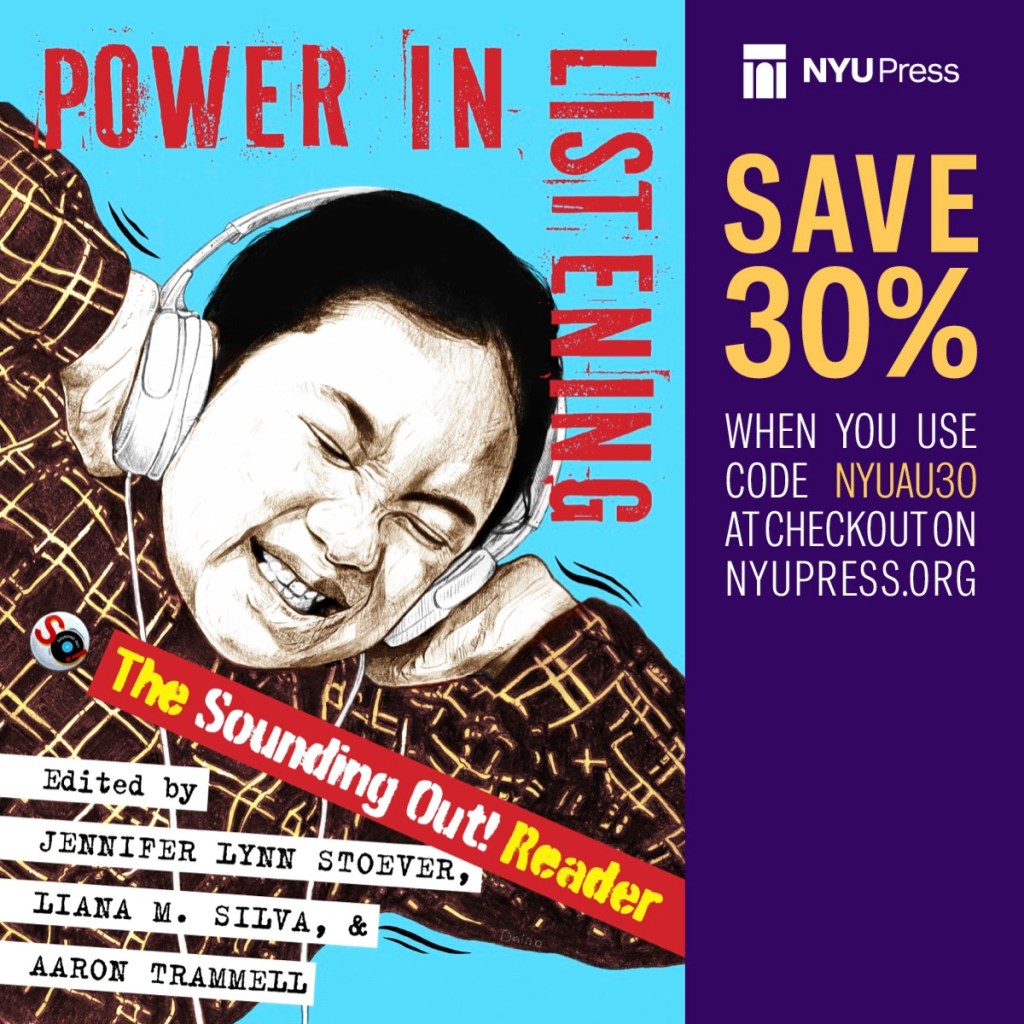
We usually take July as a BYE month to celebrate our yearly blog-o-versary, but this year, we are going bigger! Team SO! is pausing for the full summer–June, July, AND August–to catch our breath in advance of the publication of the official Sounding Out! print anthology, Power in Listening (New York University Press) on August 25, 2026 (although you can pre-order now, if you’d like at Indiepubs, direct from NYU, and other book outlets). This book is a long time coming and we are really proud of what we have put together. It’s a fresh mix of brand new essays with fan-favorites that have been revised, expanded and fully updated to the present, with an introduction by the editorial collective and a forward by SO!‘s very own Neil Verma.
Power in Listening is a love letter to everyone who has participated in the ongoing collective project of the blog over our first 15 years and a fantastic way to kick off the future together. Like the blog, it’s sharp, accessible, gorgeously written, diverse, and ready for the classroom, the library, the beach, public transit, the coffee shop, the couch on a rainy day, the club . . .wherever you love to read, but now you can be unplugged too, which we all need more than ever. Scroll down for more details about the book, including a full author list!
Enjoy the coming months–the book will be out there catching eyes in August and the blog will grab your ears once again this September! Please help us spread the word about the book– we’d love it if you’d tell two friends, so that they two friends, and so on, and so on, and so on. . .or you can share social media, whatever works for you!
Thank you and SO! looking forward–see you in September!
JLS, SO! Ed-in-Chief
P.S. Details to come on release parties, conference events, speaking engagements, podcasts, broadcasts, and all that good stuff! If you’d like us to come out your way to talk about the book, the blog, and all things sound, we have a Google form for that! Contact NYU Press at this link if you are interested in reviewing the book on your publication: https://nyupress.org/resourcesold/for-media/
—
How listening shapes power
Power in Listening explores how listening shapes—and is shaped by—power. From the politics of “sad girl” Spotify playlists to the sonic architectures of surveillance and the gendered voices of Siri and Alexa, this collection investigates how sound and listening inform identity, embodiment, and social life. How does Beyoncé’s remix of her “elevator incident” expose the surveillance of Black bodies? How do deaf listeners use multiple senses to navigate sound? How are Latina voices racialized through ideas of volume and tone?
Building from the groundbreaking Sounding Out! blog, Power in Listening curates 36 new, revised, and expanded essays from scholars, artists, DJs, and activists across more than twenty disciplines. Together, they trace how auditory culture intersects with race, gender, sexuality, technology, and media—from radio and tape to streaming and AI.
Accessible yet rigorous, this reader reveals sound studies in motion: a field that listens as a form of inquiry, protest, and care. Each essay connects theory and everyday experience, offering tools to hear the world—and each other—more critically. Power in Listening invites readers to experience listening as a social practice, a political act, and a method of understanding one’s place within a resonant and contested public sphere.
—
Authors
Neil Verma, Nichole Prucha, Rami Stucky, Max Abner, Ola Mohammed, Christie Zwahlen, Art Blake, Liana Silva, Maria Chaves Daza, Tara Betts, Marlén Ríos, Kimberly Williams, Samantha Ege, Aaron Trammell, Christina Giacona, Andrew Salvati, Kemi Adeyemi, Enongo Lumumba-Kasongo, Andreas Pape, AO Roberts, Milena Droumeva, Steph Ceraso, Linda O’Keeffe, Michael Levine, Amanda Gutierrez, Asa Mendelsohn, Rebecca Lentjes, Priscilla Peña Ovalle, Justin Burton, Gustavus Stadler, Dolores Inés Casillas, Jennifer Lynn Stoever, Chris Chien, Benjamin Tausig, Hubert Gendron-Blais, Maile Costa Colbert, and Dustin Tahmahkera
Section Titles and Topics
- Sonic Presents
- Putting The “I” in Listening: Memoir as Method
- The Sound You Make Is Not Your Own: Our Social Voices
- “Hop With It, Rock With It”: Listening to Popular Culture
- Bits and Screeches: Technology and Sound
- Hitting the Streets: Space, Place, and Sound
- Panaudicism: Sound and Surveillance
- Listening While White: Sound and Racial Privilege
- “Can You Hear Me Now?”: Sound, Agency, and Activism
—
What folks are saying. . .
Spotlighting the work of emerging scholars under innovative rubrics like space, gender, time, race, and power, Power in Listening curates an impressive array of authors and disciplinary approaches of the highest caliber. This is a welcome, fresh take on the field of sound studies. ~Roshanak Kheshti, author of Modernity’s Ear: Listening to Race and Gender in World Music
From voice and memoir to technology, space, race, surveillance, and activism, Power in Listening centers captivating soundworkers. and shows how listening can unsettle hierarchies and make new worlds audible. This sharply curated collection brings together newly revised classics from the blog as well as bold new essays that treat listening not as neutral perception, but as a site of power, struggle, pleasure, and possibility. Smart, generous, and unapologetically loud, this book doesn’t just reflect a field. It changes how you hear it. ~Karen Tongson, author of Norm Porn: Queer Viewers and the TV That Soothes Us
Not only chronicles the dynamism of the field of sound studies, but also beckons readers to find the listening experience to be an unmistakably political social practice. Power in Listening is an exceptional achievement, uniting scholars and artists across countless disciplines to foster conversations and new scholarship for years to come. ~Iván Ramos, author of Unbelonging: Inauthentic Sounds in Mexican and Latinx Aesthetics
—
Jennifer Lynn Stoever is Associate Professor of English at Binghamton University, founding Editor-in-Chief of Sounding Out!, and author of The Sonic Color Line: Race and the Cultural Politics of Listening.
Liana Silva is Managing Editor of Sounding Out! She is a teacher, writer, reader, and editor living in Houston, TX. She graduated from Binghamton University’s Department of English in 2012. In the past she was Editor-in-Chief of the professional publication Women in Higher Education.
Aaron Trammell is Assistant Professor of Informatics and Core Faculty in Visual Studies at UC Irvine and author of Repairing Play: A Black Phenomenology and The Privilege of Play. He is Editor-in-Chief of the journal Analog Games Studies and was an honoree of the hobby game industry’s prestigious Diana Jones Award.
Share this:

The Absurdity and Authoritarianism of Now: My Chemical Romance’s The Black Parade Resonates Queerly, Anew
DOI: https://doi.org/10.59350/g8byn-fea85
My Chemical Romance fans are speculating about new music after the band wiped their X account clean and wrapped up the Latin America leg of their tour this month. Whether another album is on the way or not, MCR’s magnum opus – The Black Parade – continues to endure two decades later. The sound now resonates through MCR’s commentary on fascism, critiquing the nation while holding the crowd accountable for our participation or passivity.
As the band tours The Black Parade for its 20th anniversary, the members have rejected nostalgia in favor of a new storyline, playing alter-ego characters who have been conditioned to perform for a dictator. The plot, slightly shifting night to night, encourages fans to follow along.
In the first run of the tour, each concert paused midway for an “election.” Four hooded figures walked out to the center stage. Nearby, an army official watched. Singer Gerard Way asked the audience to vote: Support these candidates or reject them? Each person in the crowd had a sign. One side: YEA. The other side: NAY.
“Now we need to hear you,” Way says. The audience roars, jeering and cheering.
No matter the spectators’ will, the result is the same: execution.
The warped election – and the sound of The Black Parade – reflects the absurdism of authoritarianism. Here is a democracy that ends in death, regardless of how you vote. Viewers log into livestreams to watch the fanfare repeat.
MCR’s commentary echoes the ramping authoritarianism and upheaval in the United States:
- The Supreme Court cleared the way for immigration agents to use race as a reason to stop and check someone’s citizenship documents. Daily ICE arrests reached a decade high last year. 2025 also marked the deadliest year for people in ICE custody in two decades.
- Protests have swept the nation, with outrage further increasing after federal agents killed two Minneapolis demonstrators this January.
- Cuts and changes to Medicaid and SNAP are on their way. The longest government shutdown also ended without extending subsidies for health care.
- The Epstein files were released, showing ties between powerful leaders and sex offender Jeffrey Epstein.
- The Department of Governmental Efficiency, named after an outdated Internet meme (DOGE), has resulted in the elimination of at least 290,000 jobs.
- The U.S. withdrew from the Paris Agreement and World Health Organization. The country also pulled out of 66 international organizations.
- Trump continues to enact steep tariffs after a Supreme Court ruling against his policy.
- Layoffs soared past 1.1 million job cuts in 2025, the highest since 2020’s COVID-19 shutdown.
This list represents a fraction of stories and executive orders in 2025; a “flood the zone” strategy overwhelmed the news cycle. Despite censorship efforts – such as the federal defunding of NPR and PBS – much of this information is available to us at the click of a button. State-sanctioned propaganda even encourages the spectacle. Just take a look at footage of ICE raids on the WhiteHouse’s TikTok account, set to songs and images of pop stars:
Yet fatigue and fearmongering keep many complacent; looming economic crises also draw our attention and time. I do not mean to diminish people’s efforts of resistance. But I am interested in the way technology has expanded our potential to witness violence, without ever requiring us to act – as well as the power of entertainment to distract.
So I turn back to MCR’s spectacle, which twists and mirrors this descent into fascism. Up against the tour’s faux-executions, the boos and the cheers of the crowd collapse into a cacophony. I locate the sound of our times within these screams, where dissent seems to go unheard and melds into the chorus of support.
The Black Parade is full of these bombastic wails, but the most intense of them are in “Mama,” a song that balloons into an extended eight-minute performance in the Long Live the Black Parade Tour. Within “Mama,” I try to make some sense of these screams, finding queer resonance with the present moment.
With my analysis, I ask: How might we hold fascist figures to account without squirming out of our own role in the daily exchange of authoritarianism? I argue My Chemical Romance’s 2025-2026 performance of “Mama” highlights structures of violence but also criticizes our participation within them.
In “Mama,” the indulgence of sin is contagious. It’s loud. It’s repeated: “Mama, we all go to hell.” This refrain, set to a polka beat, creates an abject intimacy around our shared fate. Queer listeners have interpreted this song as an angry anthem against the rejection we face from our families and dogmatic religion. For those of us who have heard, “You’re going to hell,” the response, “We all go to hell,” serves as a relief. Verses like “You should’ve raised a baby girl, I should’ve been a better son” have been reclaimed by transgender fans.
Other fans have taken issue with these interpretations, arguing queer attachments distract from the “true” meaning of the song. Indeed, “Mama” tells the story of a soldier writing from the trenches of war, while his mother judges him from afar. But I argue that by placing a queer reading in tandem with the canonical narrative, generative meanings emerge. Queer theory provides tools to understand the role of the mother here. Mama is the title of the song. Mama is pervasive. Mama is mean. Mama is on his mind. But she is also almost entirely absent, avoiding accountability for her son’s violence and instead blaming him: “She said, ‘You ain’t no son of mine.’”
The soldier finds that the trenches are not just his domain, but also his mama’s: “Mama, we’re all full of lies…And right now, they’re building a coffin your size.” His plea to his mother helps us wonder: What about the culture that birthed this violence? In this metaphor, critiquing the mother extends to critiquing the nation.
At the climax of the song, these sentiments come through screams: 30 seconds of an extended, “AHHHHHH” and a crying out of, “Mama, Mama, Mama.” In these wails, I find a soldier begging to share responsibility with his motherland, even as he contends with his own role in the violence. The cries puncture the polka, demonstrating “Mama” is not a celebration, after all.
Mama only sings one line back, through the voice of theater icon Liza Minnelli: “And if you would call me a sweetheart/I’d maybe then sing you a song.” Minnelli’s voice connects the song’s sound to her role in Cabaret, a musical which mixes together queer aesthetics and indulgent decadence with a foreboding rise of fascism. This allusion to Cabaret, as well as the tour performance, serve as a reminder: pleasure and entertainment does not always equal resistance.
In the extended version of “Mama” on tour, these lines are sung by an opera singer, whose voice, too, serves the dictator. Preceding her performance, the song briefly opens up a space for resistance. A new section of the song, debuted on the tour, includes the lyrics:
A dagger, a dagger
Please fetch me a dagger
A tool for our treasonous needs…
With tears in our eyes we collapse on the crosses
And said death be the son of us all
This war is the son of us all.
Even as Gerard Way’s character plots treason against the dictator, these new lyrics make clear: this “death” and “war” is “the son of us all.” Though we might want to pin fascism on one figure, many Americans have participated in the creation of this “death/war.” There are fatal consequences for our collective actions – or our passivity.
Ultimately, the dramatics of this song, delivered like a sinister weapon, critique violence, while ironically trapping us in its pleasures. If prayer is crying out to our father who art in heaven, “Mama” is yelling back at our mother to bring her to where she belongs: the hell in which we both exist. Given the stakes of our political moment, I argue we need to scream louder, with purpose and strategy, against our motherland.
—
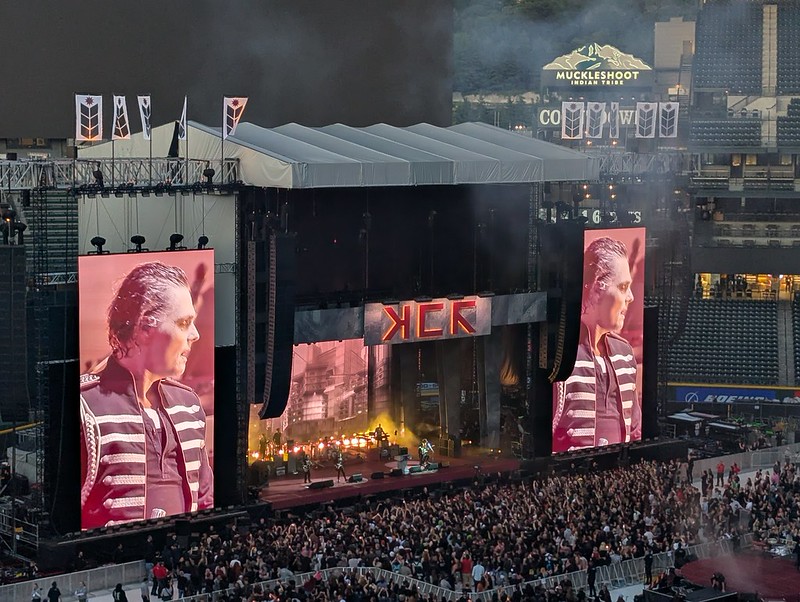
Featured Image: “My Chemical Romance Live at T-Mobile Park 6/11/25,” Image by Flickr User Laura Smith CC BY-ND 4.0
—
Max Lubbers (he/she) is a first-year PhD student in the American Studies and Ethnicity department at the University of Southern California. His research centers on transgender affects and sounds. Max earned a bachelor’s degree in Journalism and Gender and Sexuality Studies from Northwestern University, with a senior thesis on butch affect. She previously worked as a journalist, with pieces in Chicago’s NPR station, Colorado Public Radio, and Windy City Times.
—

REWIND!…If you liked this post, check out:
The Sounds of Equality: Reciting Resilience, Singing Revolutions–Mukesh Kulriya
Vocal Anguish, Disinformation, and the Politics of Eurovision 2016–Maria Sonevytsky
“To Unprotect and Subserve:” King Britt Samples the Sonic Archive of Police Violence —Alex Werth
Share this:




Current Top Posts





April 2021

January 2020

November 2019

October 2019

August 2019

April 2014

November 2017

March 2015

December 2017

October 2015
 Sounding Out!
Recent Comments