
Bob Seger, Champion of Misfits

DOI: https://doi.org/10.59350/etqvr-0dr39
Bob Seger and the sort of classic rock he performs, embodies and represents, for me (and apparently many others), the relentlessly uncool. Youth, drugs and nonconformity have long been my standards of “rock,” and within this triad, Bob Seger’s formal, cinematic songs, have always come across as a little tired. Osvaldo Oyola wrote specifically last week about these foibles: the stilted piano and canned Chuck Berry riffs sound more like parody than gospel, while the parade of effects on Seger’s voice, also quite derivative, could have also fit on a Bruce Springsteen album (although you could replace the influence of Chuck Berry with that of the quintessentially less cool Phil Spector). Problematically, even though I loathe Seger’s catalog, I love Springsteen’s, this of course has made for some very popular conversations at the bar. In fact, it was last July at a local New Brunswick haunt that I had this conversation last. My friend, who will remain nameless, completely disagreed: Seger was cool, I just couldn’t hear it, in fact I had to see it to believe it.
In order to understand Bob Seger, I needed to watch Mask, a 1985 retelling of The Elephant Man starring Eric Stoltz as the deformed Rocky Dennis and Cher as his mother Rusty Dennis. Mask was released two years after Risky Business, and featured a number of Bob Seger songs predominantly in the soundtrack. These songs uniformly mixed to the foreground, often serving as Rocky’s theme, juxtaposed against an ambient soundtrack of songs by black musicians like Little Richard and Gary US Bonds. These black oldies, “Tutti Frutti” and “Quarter to Three,” are used thematically when Rusty’s friends, a bunch of guys in a motorcycle gang, are partying. Not only is Rocky othered from the kids at school because he is ugly, he is poor, raised by a single mother with a drug addiction. Although whiteness takes center stage in this film, it holds a complex relationship to blackness. Rocky and Rusty are atypically white, finding community only with each other and a super-masculine network of bikers; they are misfits, doing their best to pass in a mainstream and affluent white society.
Bob Seger’s “Katmandu,” is the song which introduces Rocky in the opening credits. It is guilty of the trademark Bob Seger whiteness: more refurbished Chuck Berry and piano so droll it could have been played by a metronome. In the context of Rocky and his struggle to identify with white society however, it paints Seger in a different light. Bob Seger’s uncoolness can be read as a failed attempt to pay homage to black musicians like the aforementioned Little Richard and Gary US Bonds. Instead of suggesting a totalizing narrative of white appropriation, I argue that Bob Seger can be understood as a musician who would never be completely accepted by his heroes or critics. Reflected in the posters on Rocky’s wall and Universal’s contract negotiations with Columbia Records (Bruce Springsteen had been first choice for the soundtrack), Seger was not even cool to the director of the film, Peter Bogdanovich, who refered to his music as “inappropriate.”
Toward the end of the movie, Rocky holds his blind girlfriend for the last time. Her parents, disgusted by his face (but probably also by his shabby clothing), keep the two separate. Contradicting the escape narrative of Springsteen’s “Born to Run,” Rocky evinces the power of fantasy toward coping with discrimination: “We can’t run away Diana. But we can sort of run away in our minds. We can remember camp, the mountains and the Ocean…especially New Year’s Eve” (Mask Part 11 4:40). Like Rocky, Seger can’t run away from his whiteness, even though he may not relate to it, or fully embrace it, it is ever present in his recordings. Songs like “Old Time Rock and Roll,” “Katmandu,” and even “Night Moves” are celebrations of music as a forum of imagination – one where identity, be it black or white, can be reimagined as something else. Though “Old Time Rock and Roll,” will sound forever white, it relates the experience of otherness. Try as he might, Seger has no idea how to sound authentically black, and this is evident through both its celebratory lyrics and contrived arrangement.
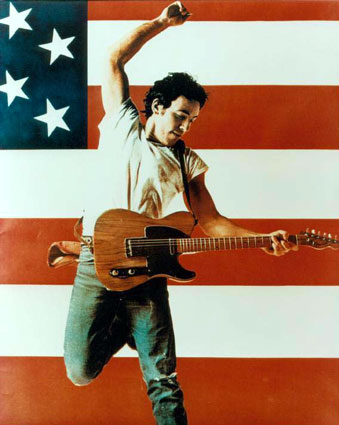
Growing up in a bi-racial household, where, depending on the holiday, my Jewishness could be as visible as my blackness, I feel a strong kinship to figures like Rocky, not completely belonging to any ethnic community. Perhaps this led to a juvenile obsession with Springsteen, who, according to my father, everyone could relate to, regardless of color (he worked at an all-night Jersey Shore diner, the Inkwell, in the early 1970s). Bruce though, was never really misfit, mulatto or poor; whether discussing his working class freehold roots, or his first guitar, his music epitomizes white privilege. Even his stage shows feature Clarence Clemons, The Big (Black) Man, notably subordinate to Bruce, or “The Boss.” Although now, my Bruce phase seems laughable, I wonder if it was also a fantasy of fitting in, of recovering a fantastic and invisible whiteness deep within myself. When he wrote “Old Time Rock and Roll,” was Bob Seger trying to do the same and recover a font of blackness deep within himself? I now see a complex web of identity politics informed by an economic and social history of Rock and Roll, but this holds an uneasy and complex relationship with the part of me that still believes in rock and roll. I was, am, and forever will be the misfit who found an identity in the church of rock and roll. Though the sermons have changed, in high school, Springsteen was the pastor, and I suspect that for my friend at the bar, Seger also conducted service. Even though I could never completely fit in to the rich white world of these artists, I wonder if this speaks to a fundamental affinity. Did Springsteen and Seger ever feel like outcasts, later to find solace in the black cool of Little Richard, Chuck Berry and Fats Domino? In the context of these figures and their music, how could whiteness seem anything but contrived, misfit and ugly – or in truth, is this dialectic really the beat which pushes rock and roll forward?
—
Aaron Trammell
__
Share this:

Sound and Sanity: Rallying Against “The Voice”

DOI: https://doi.org/10.59350/g31y2-hdw85
John Stewart’s recent Rally to Restore Sanity was an important political demonstration for all of the fairly-busy people in the USA. It was a moment when those who work forty hours per week or who have too many social bookings were able to come to the United States Capitol in order to proclaim with their “indoor voices” that the current political debates in America are characterized by too much irrationality and fear. As the RTRS website states, Stewart’s rally was expressly for “the people who think shouting is annoying, counterproductive, and terrible for your throat; who feel that the loudest voices shouldn’t be the only ones that get heard; and who believe that the only time it’s appropriate to draw a Hitler mustache on someone is when that person is actually Hitler. Or Charlie Chaplin in certain roles.” It’s interesting that the aim of this rally was ostensibly against the “shouting” and the “loudest voices” rather than any specific ideas, statements, or political positions. In other words, the problem, as Stewart sees it, is that public debates are too full of noise. And it is this noise that must be vanquished—or that, at least, should be modulated to an “indoor” level.
Stewart’s opposition between sound and sanity is actually quite common. Public noise is senseless sound, while rational debate is meaningful sound. The logic goes, then, that public debates need to have less sound or, at least, regulated sound. They must have two people who are willing to speak quietly and rationally, hear each other’s points, and raise and answer each other’s objections until some kind of consensus is built. Good public debates require less sound and more sanity.
But is this sonic modulation the right way to conduct public debate and to persuade others? The truth is that the relation between noise and reason, between senselessness and sanity, is very, very complicated. In fact, although it is a collective national fantasy that good debate is built on reason, there are lots of reasons to suggest that reason doesn’t always (or even predominately) come first. Rather, it’s often the sound that convinces people in an argument—not the reason. And in public debate, the particular sound is “The Voice.”
By looking at an episode of the animated TV show Batman: The Brave and the Bold let’s listen to how The Voice can persuade people to act against their own sanity. In “Mayhem of the Music Meister,” Neil Patrick Harris gives voice to the Music Meister, a singing villain whose tone and rhythm instantly hypnotize those who hear him and bend their actions to his will:

As the opening sequence begins, the audience is prepped for a standard showdown between three villains: Black Manta, Gorilla Grodd, and Clock King, who plan to steal a communications satellite; and three heroes: Black Canary, Green Arrow, and Aquaman, who are prepared to save the day and stop the theft of the industrial hardware. But this showdown is interrupted when–to his surprise and seemingly against his self-control–Black Manta bursts into song, crooning, “I’m sounding shrill against my will.” Soon the other villains and heroes follow suit. All lose control of their voices and begin singing and acting against their own will. What’s interesting about this moment is that losing control of their voices signals a complete loss of self-control. Yet this loss brings with it a division within themselves. On one hand, they recognize that they are singing. On the other hand, they are conscious of the fact that they are equally unable to prevent their own actions. They must sing; they must dance; they must dissolve the initial division between heroes and villains and join together in a revised plan to launch the communications satellite.
From this vantage point, we can return to the alleged difference between sound and sanity. The first problem is that The Voice bypasses reason, making people comply without, or even in spite of, critical reflection. It generally does this in two ways. As the Music Meister episode illustrates, The Voice divides the hearer against himself, taking over his body while he remains fully aware of the situation. In other words, the Voice exerts a direct control over a body while the hearer remains in control of his or her consciousness. The Voice is a science fiction staple. For example, in Frank Herbert’s Dune, the Bene Gesserit are able to speak directly to the unconscious of the hearer while the conscious mind is aware that the body is controlled by The Voice. In the filmed version, an extra quality is added to The Voice in order to highlight the difference between its conscious and subconscious aspects. The Voice must sound different from the voice.
The second way that the Voice bypasses reason is in the way in which a voice– often described musically–makes people lose control of their ability for critical reflection. An example of this form of The Voice also comes from science fiction: the Jedi Mind Trick made famous in Star Wars. In this case, Obi Wan Kenobi bypasses the storm troopers’ ability to recognize the droids they are looking for, even as C3-PO and R2-D2 hang awkwardly from the back of his sandspeeder.

When the logical reasons inevitably fail to account for the act of persuasion in public discourse, others come to the forefront. Often people will say the speaker has charisma, but often they are really referring to The Voice’s role as the persuasive element. What persuades? Not the logical argument, not sanity, but The Voice. And, often, this is against our better judgments or in spite of ourselves. So when Stewart acknowleges the role that “senseless” sound plays in public debates, he goes too far when he calls for “meaningful” sound instead. The two are not in opposition as the RTRS suggested. When all is said and done, sanity almost always depends on so-called senseless sound.
—
Mark Brantner
—
Share this:




Current Top Posts





April 2021

January 2020

November 2019

October 2019

August 2019

April 2014

November 2017

March 2015

December 2017

October 2015


Recent Comments