
Only the Sound Itself?: Early Radio, Education, and Archives of “No-Sound”
 Early cinema scholars are faced with statistics that suggest that possibly eighty percent of moving pictures produced in the first thirty years of their existence are lost—that is, they were thrown away because they were no longer profitable, or destroyed through fire or overuse. Likewise, radio historians researching early radio programming formats are confronted with a daunting inability to listen to many of the programs we write about. What does it mean to write about sound without being able to listen to the sounds firsthand? Where can radio scholars like myself track down sound in other places besides recorded media? Must we have to access “the sound itself” in order to be able to write about and understand it? While missing or incomplete sound archives in some ways narrow the depth and breadth of the historical inquiries possible, I find that these gaps of “no-sound” open up other possibilities for examining the material that does remain, in the form of station records, document archives, and programming notes.
For example, my research examines the discourse around the multifaceted campaigns for the classroom and living room educational use of (old) new media, specifically film in the 1910s, radio in the 1920s, and television in the 1950s. Often I find that the discourse around proposed and actual programs details their content quite specifically, including how these shows planned to address their audiences. But sometimes what I am looking for is a paper trail of sorts that will help me visually recreate the missing audio of these lost programs.
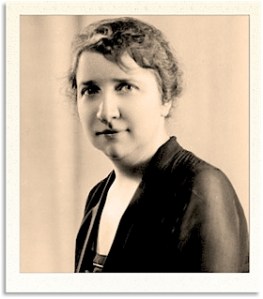
Judith Waller in the mid-1920s
In this regard, as I delved into the events around early radio and education, I became interested in Judith Waller, whose “accidental” radio success began in Chicago in 1922 as programming manager at WMAQ and continued as the Educational/Public Service Director for NBC’s Central division. At WMAQ in the 1920s, Waller helped craft a number of educational programs, including a joint venture between the Chicago Public Schools that successfully connected city-wide special exhibits and the Chicago Daily News into an audio/visual/experiential learning experience.
However, by the 1930s Waller had grown disillusioned with “educational radio.” In 1934 Waller gave an address titled “Achievements of Educational Radio,” where she spoke of her “pessimism” at what she felt was the lack of accomplishments and advancements in education by radio. She felt that most listeners were “frankly bored” by educational radio and that it only appealed to those who wanted to “appear to be very highbrow before their friends and associates.” One of her chief complaints was that many educational programs were “usually a dull and stupid reading of a prepared geography, history, or arithmetic lesson.” Besides further experimentation, she suggested a name change, from “educational” radio to “public service” broadcasting. This superficial remedy seemed like an ideal first step in reclaiming the types of programs that had elements worthy of larger audiences, but that had largely been ignored. This name change did little to suggest, however, any actual changes that might benefit the construction of educational programming.
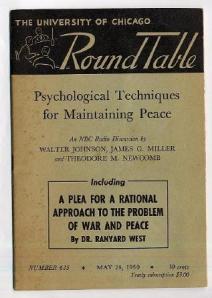 I use this example for the sheer fact that I would very much like to listen to these “dull” programs in order to examine what Waller perceived to be their fatal flaws. Now, some of the programs that Waller created and produced do still exist. The University of Chicago Round Table, for example, was a popular public service program Waller worked on for many years—which has an extensive archive of transcripts, although not recordings. In terms of other educational programming, some of the more prominent commercial network programs like the American School of the Air appear to have some availability. The programs I am interested in hearing, however, used the radio, a program guide, the newspaper, and local city events to weave an intricate educational lesson. Were programs like this, so seemingly well crafted and specifically engineered, really as “boring” as Waller lamented? Would it be clear to me, as a listener nearly a century removed, that there are clear issues or faults with their presentation of educational lessons? Or would Waller’s problems with these programs stem from more complex issues, involving her own personal ideals of what education by radio constituted and how it should be conceived?
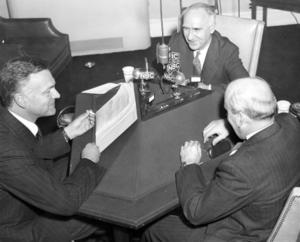
Robert M. Hutchins, Floyd Reeves, and John McCloy record The University of Chicago Roundtable, November 26, 1944
Regardless of the answerability of these questions, they are still worth thinking about in order to understand as much as possible about these missing programs in the context of their “no-sound” status. Not having these sounds to refer to forces us to pose different questions, while tougher to address, that force us to look beyond the audio text to understand what exactly about these programs produced their contemporary reactions. Reading what Waller wrote may supplant the need to hear these programs, but it does not necessarily replace our innate curiosity about them.
The discourse around these “no-sound” programs gives historians a particular reception, in this case, a critical perspective from one radio producer. However, Waller’s public disavowal of educational radio cannot speak to the private consumption of these programs, which may or may not have produced the same negative reaction. Really, then, the Waller example suggests two avenues of inquiry, both equally difficult—a full understanding of what these programs sounded like and contained, and how other listeners felt about them. At the very least, a record of these programs and a selected set of reactions lives on in the print media that avidly reported on and debated so many facets of radio programming.
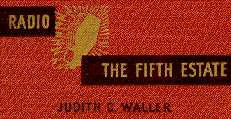
Waller's book, Radio: The Fifth Estate (1946)
—
Sate a little of your curiosity and hear Waller speak in this October 2000 re–broadcast of a 1948 interview she gave on the early days of WMAQ, from broadcaster/historian Chuck Shaden’s “Those Were the Days” radio program.
—
Amanda Keeler (Ph.D., Indiana University, 2011) is a Visiting Assistant Professor at Bucknell University. She teaches courses in film and media studies. Her current research focuses on historical emergent film, radio, and television; media history; media industries; and contemporary television.
Share this:

Eye Candy: The Absence of the Female Voice in Sports Talk Radio
If masculinity is alive and well [on sports talk radio], femininity exists on talk radio as absence, lack, and difference. — John Reffue

Radio al atardecer by Flickr user Dany Rivera
Tune in to any random sports talk radio show and listen carefully to the voices coming from the radio. Listen to the cadence in their voices, to the passionate tone about the sporting events of the day, to the witty banter with the hosts. Listen to them and see if something stands out to you.
Most of the people talking on these shows are men.
Now, go to any sports talk radio website. If you scroll down, you will notice on the webpage a scantily-clad woman. Amidst all of the sports logos, and the pictures of the men who carry the voices on the radio station, you will find eye candy for the listeners who navigate to the page. The websites offer these pictures of women-as-sexual-objects, which stand in opposition to the absence of female voices on the air. This “absence” that communications strategist Dr. John Reffue speaks of, the absence of female callers as participants, goes hand in hand with how females are portrayed in sports media more widely: as visual objects. This undermines any authority they might have in the sonic realm and relegates them figuratively to the sidelines. Women are deemed “eye candy” and not “ear candy.”
What does the (female) sports fan sound like?
According to a 2002 Arbitron report, the core demographic of sports radio is male, 25-54, “nonethnic.” (Researchers like Dr. David Nylund have pointed out that sports talk radio’s listeners are overwhelmingly white.) Even though Arbitron has not studied women’s listening habits when it comes to sports talk radio, it would be silly to ignore this demographic for the mere fact that there are female sports fans. Although there are women who listen to sports talk radio and who, on occasion call in, their invisibility in this medium is echoed by how the ratings completely ignore them. (Arbitron has several free studies and reports on their site for women, but none of them talk about women and sports talk radio, let alone talk radio in general. Interestingly enough, they have a study aptly titled “What Women Want: Factors Driving Tune-In and Tune-Out” where they briefly point out that there is a segment of female listeners they call “sports fans” but they only mention what kinds of music they will tune into.)
However, this is not the only example of how female sports fans are not heard. Dale Pontz from the blog Dames on Games makes an interesting point about women and sports talk radio when she says,
my gender is another impediment to my sports talk radio participation. I have learned through many years of watching sports at bars that men don’t mind when I sit quietly and watch (although they are known to incorrectly assume I want to flirt), but once I make a valid sports argument, that bemused interest usually becomes veiled hostility.
In this case, expressing ideas and arguments about the game becomes a turn-off, not what the man was expecting. As someone who enjoys the nuances of the game and who writes about sports, she understands that being seen as a sexual object will prevent men from actually taking what she says seriously. Although she is conflating the visual with the aural in the above, she makes the connection between women and sexuality. Pontz’s comment, as well as the responses from several female journalists to the question “Why Do Women Dislike Talk Radio?, beg the question: are women just not listening to sports talk radio?
Steve Duemig, sports talk radio host interviewed by John Reffue for his dissertation, mentions that he does have female callers, and that oftentimes their commentary is more nuanced and thought-out than that of their male counterparts. Reffue mentions, “He [Duemig] indicated that while he believes women are intimidated by the prospect of calling a show, their calls end up being better, smarter calls because…’Men spout shit and women come with facts'” (128). I too have noticed women calling into sports talk radio shows here in the Kansas City area, so the idea that women do not listen to sports talk radio falls flat. However, it is precisely the rare female voice which draws attention to the absence.
It’s A Man’s World
Sports talk radio is, evidently, the realm for heterosexual men to come to talk about sports, even though they are not the only ones to do so. Nylund explains in his article “When in Rome: Heterosexism, Homophobia, and Sports Talk Radio” that “at this historical moment when hegemonic masculinity has been partially destabilized by global economic changes and by gay liberation and feminist movements, the sports media industry seemingly provides a stable and specific view of masculinity grounded in heterosexuality, aggression, individuality, and the objectification of women.” Sports talk radio becomes the place where men can participate in this “stable view,” and talking and listening become a way of participating.
But it is John Reffue who focuses on the idea of community that the fans create as they participate in the shows. He mentions on page 9 the “broadcast format as a discursive space – a place where many come to make sense of how sports fit into their lives. I believe that in this space, sports fans are afforded a singular and unique venue to cultivate not only a deeper understanding of the sports they love, but to perform community and establish identity(ies), while knowingly or unknowingly contributing to the larger public discourse on race, gender, sexuality and class and politics. (community, identity, understand sport, contribute to public discourse on race, gender, sex, and class)” Reffue argues that sports talk radio is constructed as a male space through rhetoric and performance. Calling in and engaging the host and the listeners becomes a way of belonging to the community. I will take his argument further and argue that women are not just excluded from the sonic realm of radio by virtue of being women, but that this construction strips their voices of any authority. The divestment of the authority of women’s voices reflects tendencies in sports more generally, where women are truly and figuratively relegated to the sidelines.
The ultimate example is the dearth of female broadcasters, on radio and on television. Nationally there isn’t a female sports radio broadcaster that has as much visibility as, say Jim Rome. Men lead the sports talk radio shows. The one nationally syndicated female sports radio talk show host, Nancy Donellan (otherwise known as The Fabulous Sports Babe) went off the air in the late 1990s. This reflects what happens in sports coverage in general: men are the voices of authority when it comes to talking about sports. Although there are female color commentators and play-by-play announcers, they are in the minority. An example is Beth Mowins, who recently became ESPN2’s play-by-play announcer for college football games. Men, on the other hand, remain the voice and the face of sports coverage. Even when it comes to covering sports on tv, women are often relegated to the sidelines. It makes even more striking the comment by sound media scholars like Kaja Silverman, Amy Lawrence, and Michele Hilmes that discourses around women’s voices cast them as a “problem.”
Who Runs This Town?
I am not advocating for a change in radio formats or for sports talk radio to be more “girly.” That’s the kind of attitude that got us here in the first place, the attitude that women and men enjoy different kinds of radio formats. However, women’s voices literally and metaphorically must be a part of the sonic landscape of sports talk radio, and sports media in general. Women must be heard over the radio in order for other women to feel like they can be a part of the conversation. If men are deemed competent enough to talk about women’s sports, women should be deemed confident enough to talk about men’s sports. Women need to make themselves visible, and one way of doing that is by literally making themselves heard. Maybe this way we can get sports radio to listen to women.


Share this:


Current Top Posts





April 2021

January 2020

November 2019

October 2019

August 2019

April 2014

November 2017

March 2015

December 2017

October 2015
 Sounding Out!

Recent Comments