
SO! Reads: Janet Borgerson and Jonathan Schroeder’s Designed For Hi Fi Living

 According to the latest data from Nielson and the RIAA, vinyls are back. The old fashioned form now outsells CDs – but few have remarked on the fact that, unlike CDs and more like good little children, they are meant to be seen and not heard. At Ikea, for example, you can now easily buy frames sized for LP covers, which are clearly intended for the wall, rather than the turntable.
LP covers are art, but they also make far more intimate statements about identity, politics, and self-presentation, as you’ll immediately realize if you ask yourself which, of your vast collection, you would like to represent you to the general public via the your living room decor. Designed For Hi Fi Living: the Vinyl LP in Midcentury America (MIT Press, 2017), by Janet Borgerson and Jonathan Schroeder, takes this idea and runs with it. Beautifully packaged with creamy matte illustrations accompanied by short visual rhetorical analyses, it belongs on the one-of-a-kind coffee tables of the leisured classes, and this is particularly fitting, as its concept is that album covers from the mid-century can tell us a lot about how white middle class Americans wanted to picture themselves.
 Music For Hi Fi Living is not about sound, per se, but about the role sound may play, or have played, in the past. As a form of material culture, it’s hard to image a better trove from which to uncover the secret life of the white American middle-class. The record covers analyzed here are taken from a single collection, many of them drawn from the 12 Record set on RCA from which the book takes its title, and all of them are bizarrely kitsch.
Divided into two sections called Home and Away (side one and side two, as it were) the book makes the argument that midcentury lives were envisioned, honed, and practiced through this special form of consumption of pre-packaged ideas of “self” and “Other.” Many use strange colors and unknown fonts, surrounding drab photos of a long-gone world of the 1950s. In them, ‘sophisticated’ men and women look dowdy and frightened, while beach scenes and urban landscapes alike capture the pasts’ unlikeness to the present. On covers like those for Fiesta Linda, Your Musical Trip Around The Island of Hawai’i, and Havana Holiday, the exotic is conveyed through its utter mundanity, while ‘home life’ (on records like March Around the Breakfast Table, and Songs For An Evening At Home) is rendered as taking place in entirely private, contained, domestic spaces.
If Hi Fi has a flaw, it is its failure to grapple with the implications of race, class and ethnicity that this entire collection exhibits. For example, the “Away” section centers America, and whiteness, as its world view: though no doubt appropriate to this collector’s experience of this era, it does seem like the authors could have cast a slightly more critical eye on the way the records situate themselves and their listeners. Too often, as the authors note dispassionately, the discs contain western-influenced pop music, despite having covers that utilized shots of Zulu warriors in traditional dress (“African Zulus!”) or Watusi ceremonial dancers (“Kasongo!”). The exclamation points in these titles alone tell a complex and dispiriting tale.
Overall, Music for Hi-Fi Living draws a relationship between sight, sound, and music consumption that encourages us to reconsider in our contemporary moment, now that digitized music is streamed directly into our ears. “We can’t actually see the music we hear,” as Daniel Miller writes in the book’s forward. This is undoubtedly true, which is why the visual component of its past incarnations is so important to revisit, although we may also wonder “did we hear what we thought we saw?” One wonders what the parallel version of this book will be, fifty years from now. Spotify playlists won’t look half so good.
—
Gina Arnold is the editor of the Oxford Handbook of Punk Rock, the author of the 33 1/3rd book Exile In Guyville (Bloomsbury 2014) and the forthcoming entry in the New American Canon series, Half a Million Strong; Rock Festivals From Woodstock to Coachella (University of Iowa Press 2018).
—
 REWIND!…If you liked this post, you may also dig:
The Sound of Hippiesomething, or Drum Circles at #OccupyWallStreet –Gina Arnold
SO! Reads: Dolores Inés Casillas’s ¡Sounds of Belonging!–Monica De La Torre
SO! Reads: Roshanak Khesti’s Modernity’s Ear–Shayna Silverstein
Share this:

SO! Amplifies: Basilica Hudson’s 24-HOUR DRONE
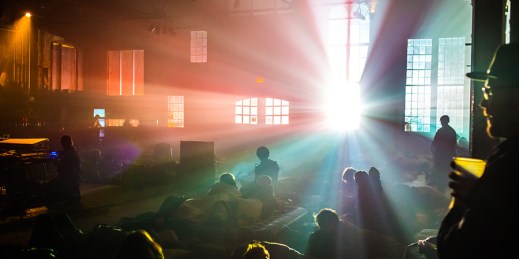

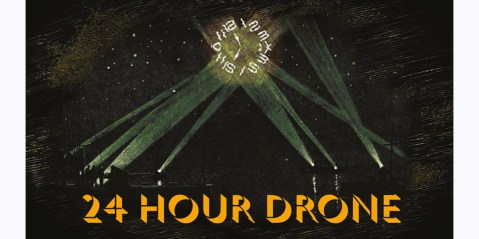
Twenty-four hours of uninterrupted sound: this was the auditory aspiration of Melissa Auf der Maur and Tony Stone–co-founders of Basilica Hudson–and their houseguest, Bob van Heur, co-founder of Le Guess Who? festival in the Netherlands. Basilica Hudson, a nonprofit artistic collective in downstate New York, has a proven history of adventurous projects that stretch the limits of the audience’s expectations. From noon on April 28, 2018 to noon on April 29, they will be producing a project that’s become something of a classic for the group to kick off their season: a 24-hour sound drone.
“It’s a really singular event, and you really come out of it being transformed,” said Kate Hewett, the program marketing and communications manager for Basilica Hudson. “It’s so unusual to be surrounded by sound in a long-form situation like that. It’s rare that you get to experience the interplay between different kind of artists and performances … it’s one of our favorite events.”
This is the third year that Basilica Hudson had compiled artists from the drone, and each year the lineup is changed. The project is sourced to both local and international sound artists, via a process that includes both an open call submissions period as well as staff reaching out to composers and collectives individually. The product is an experience that is both sonic and tactile; while the drone roves through the space and fills the converted factory with sound, participants are encouraged to bring in mats or chairs and stay through the entire 24-hour period. Some of the artists who will be played through the drone include Bill Brovold and the Mystical Miniature Orchestra, Hudson Boys Club and New London Drone Orchestra.
“The open call submissions period is really key to making the 24-HOUR DRONE happen,” Hewett said. The vision behind it is to always access new artist who haven’t played here previously, maybe artists who haven’t played in the Hudson Valley before as well as being able to showcase the incredible local talent that is offered in the region … from there, it’s really a case of weaving together a multidisciplinary lineup. The aim is to cross genres and be able to showcase lots of different kinds of artists who are all working within the rough framework of drone.”
While no live performances fit the bill of the event, there are 24-hour projects that happen in tandem with the drone. For one, a weaver will sit in Basilica’s space and use the loom for 24 hours. In another example, healers will enter the premises to perform 24-hour reiki.
“People are free to come and go as they wish — you don’t have to commit to the full 24 hours. But a lot of people do come, bring a yoga mat, and camp out for the whole time,” Hewett said. “The enjoyment and the really immersive experience is what it’s about, and what’s most important.”

Basilica Hudson is located in a solar-powered reclaimed 1880s industrial factory on the waterfront of upstate New York city of Hudson.
This season, the 24-HOUR DRONE will not be the only sound-related exhibition at Basilica Hudson. From Sept. 14 to 16, the collective will host Basilica Soundscape, a weekend of live music and art. The lineup has yet to be announced.
—
All images courtesy of Basilica Hudson
—
Shauna Bahssin is a junior at Binghamton University who double-majors in English and art history. She currently serves as managing for the student newspaper, Pipe Dream, and has written for its news and arts and culture sections in the past. Outside of the paper, she is involved with the university’s fundraising initiatives through the Binghamton Telefund, and she hopes to work within the field of arts development and advancement after she graduates.
REWIND!…If you liked this post, you may also dig:
SO! Amplifies: Anne Le Troter’s “Bulleted List”–Shauna Bahssin
SO! Amplifies: Shizu Saldamando’s OUROBOROS
SO! Amplifies: Mendi+Keith Obadike and Sounding Race in America
Share this:


Current Top Posts





April 2021

January 2020

November 2019

October 2019

August 2019

April 2014

November 2017

March 2015

December 2017

October 2015
 Sounding Out!
Recent Comments