
Flagrant: Brocasting Trump, Part III
DOI: https://doi.org/10.59350/y49hf-b4539
In total, Trump appeared on fourteen podcasts or video streams during his 2024 campaign, which together earned a combined 90.9 million views on YouTube and on other video streaming platforms, not even including audio podcast listens, which, because of the decentralized nature of RSS, are notoriously difficult to pin down.
That’s a lot.
In the following series of posts, I am particularly concerned with Trump’s success with the so-called podcast bros – partially because my own research interests are in the area of mediated masculinities, but also because they may have put him over the edge with a key demographic – with Gen-Z men.
Over this series—which began in January 2026 with Logan Paul—I will examine several of Trump’s appearances on largely apolitical “bro” podcasts during the 2024 campaign season, including his interviews with Logan Paul, Theo Von, Andrew Schulz, , and Joe Rogan. In the course of this examination, I will pay attention not only to what Trump said on these shows, but also to the way in which they established a sense of intimacy, and how that intimacy worked to underscore Trump’s reputation for authenticity. Along the way, I will also discuss the podcasts and podcasters themselves and attempt to locate them within the broader scope of the manosphere. Finally, given the passage of time since Trump’s appearances, I will consider to what extent, if any, individual hosts have become critical of his administration’s policies and actions – as Joe Rogan famously has.
Here’s our third installment, on Flagrant.
***
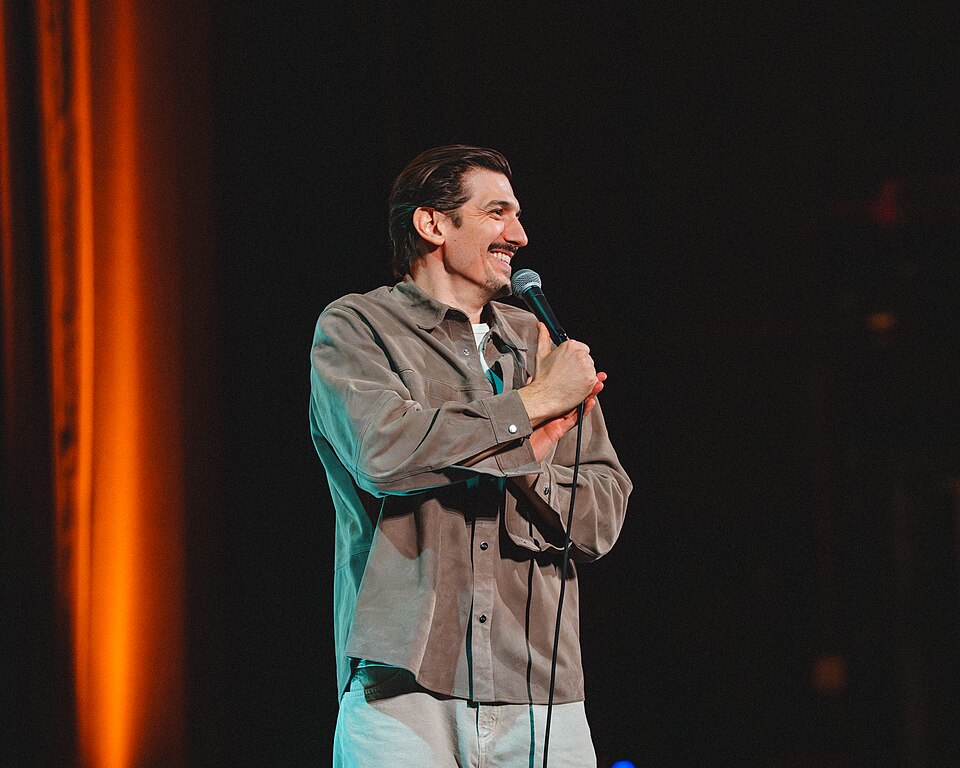
On January 28th of this year, the 42-year-old self-proclaimed “anti-woke” comedian Andrew Schulz raised a few eyebrows when he revealed on his Flagrant podcast that the January 24 murder of Alex Pretti by U.S. Customs and Border Protection (CBP) agents in Minneapolis was a “breaking point” for him (Schulz and his co-hosts would incorrectly attribute the murder to ICE agents throughout their conversation, but the agencies, which both operate under the umbrella of the Department of Homeland Security, were working together at the time on Operation Metro Surge).
“All right, let’s do it. Let’s talk about what happened in Minneapolis,” Schulz began. “ICE murdered an American citizen in cold blood and then the Trump administration called him a domestic terrorist … Like plain and simple. I see the administration trying to spin it and it’s fucking disgusting.”
He wasn’t wrong. But having hosted Trump for a softball interview just prior to the 2024 election, Schulz and his co-host, Akaash Singh, were pilloried by some in their audience for their naïve complicity.
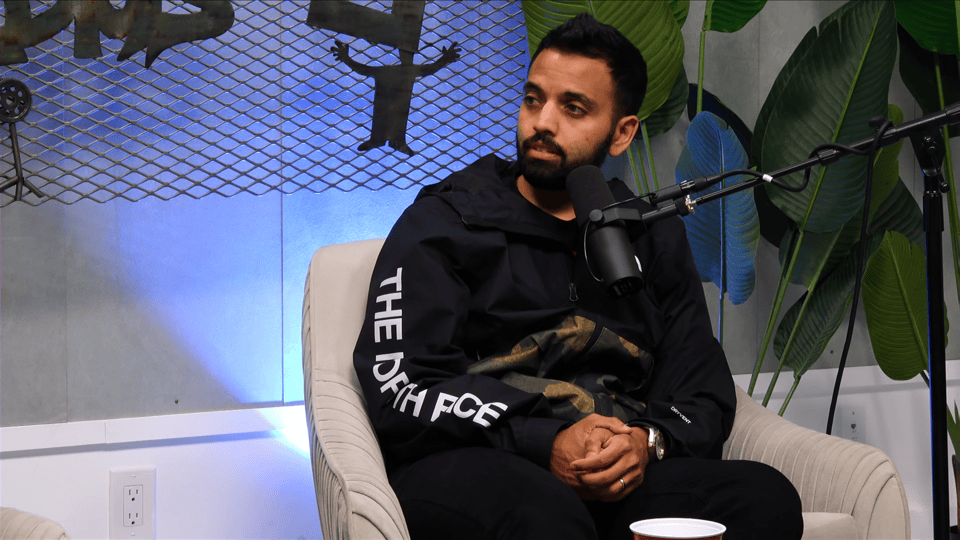
“Instead of voting for a woman, you voted for an incompetent sociopath that blamed immigrants for everything. You’re partly responsible for Alex Pretti’s death,” wrote one YouTube user.
“Comedy bros did more to elect Trump than most anybody else, based on the young man vote alone,” another observed. “The attempts to salvage your reputations will and should fail. The damage you did will take us decades to recover from, if we ever do.”
“You voted for this, you soapboxed it, you platformed this,” wrote a third. “There was [sic] no lies or secrets, Donald was very open about his plans. You are apologetic? Apologize for how you contributed to it, and actually do something about it. I am so tired of you guys ignoring your part in the damage.”
For their part, on their January 28th episode, Schulz and Singh, along with their co-hosts Alexx Media and Mark Gagnon, had a rather thoughtful conversation (to be fair, it came after about 21 minutes of jokes about masturbation and penis size) about federal agents’ “abhorrent” and murderous actions and the administration’s subsequent attempt to “gaslight” the American public. Noting that he wasn’t trying to “curry any … good will” with the administration and wouldn’t “stay silent,” Shulz explained to those who might argue that he was exaggerating, that “you have a government enforced militia with no accountability … poor training, obviously you saw from this circumstance, no effort to deescalate. If anything, efforts to escalate the situation, and … it’s absolutely disgusting.”
“They’re doing things that objectively … I don’t care what side of the aisle you’re on, objectively, are unconstitutional,” he later added.
But one wishes he would have found this fire when he was interviewing Trump in 2024. Instead, he chummed it up with the former president, asking questions that seemed designed to allow him to polish his image as a proud father, a tough-as-nails assassination survivor, a savvy negotiator, and a rhetorical genius adept at the so-called “weave.” Evidently beguiled by their guest’s charm, Schulz and Singh offered little in the way of pushback or follow-ups, taking his claims about trade imbalances, border policy, and a possible Iranian assassination conspiracy at face value rather than pressing for more information – or evidence.
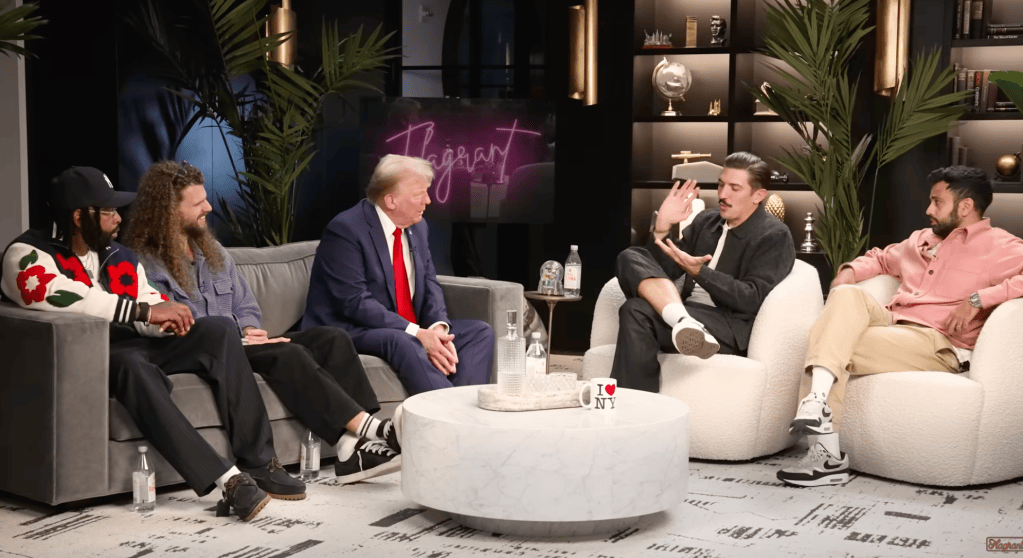
But in his own defense, Schulz noted in the January 28th episode that he had actually pushed back on Trump’s stance on immigration reform by pointing out that the real estate developer may have himself hired illegal immigrants through his businesses, and that it was necessary to have empathy and a pathway toward citizenship. Trump, Schulz remembered, had assured him that his administration would only go after the criminals. “And maybe I naively believed that he would do that,” the podcaster admitted.
This is putting it mildly. It’s hard to square, for instance, Schulz’s vision of a precisely targeted deportation effort with Trump’s 2024 campaign rhetoric, which often promised to conduct the “largest domestic deportation operation in American history.” Such maximalism would seem to preclude a focused and carefully orchestrated enforcement effort sensitive to civil liberties. This would be a mass sweep.
But if Trump’s lack of nuance didn’t bother Schulz, maybe his virulently anti-immigrant demagoguery should have. In a broadly publicized speech at an April 2, 2024 campaign rally in Grand Rapids, Michigan, for instance, Trump repeatedly called illegal immigrants “animals.”
The Democrats say, ‘Please don’t call them animals. They’re humans.’ I said, ‘No, they’re not humans. They’re animals,’ Trump said. ‘Nancy Pelosi told me that. She said, “Please don’t use the word animals when you’re talking about these people.” I said, ‘I’ll use the word animal because that’s what they are.’
If Schulz had been serious about pushing back on his guest, he might have asked him to explain these remarks; he might have identified these statements as eliminationist in character and, as such, a rhetorical prelude to launching a war within. And perhaps because of this (or, say, simply because of January 6), he might not have invited Trump on the show at all.
But he did. Recognizing his complicity, but not quite apologizing for it, Schulz admitted, “anybody who wants to criticize us for platforming [Trump], 100%. That is fair. 100%.”
In Schulz’s conception of American politics circa 2024-2025, however, Trump seems to have simply been the current Republican running for office. His departure from ethical, legal, administrative, and even epistemic norms during his first term in office, and his controversial family separation policy and “Muslim Ban” (among other things) were apparently forgotten, swept away by a kind of equivalency in which “both sides” could go too far.
Appearing on the similarly anti-woke podcast, Triggernometry in April 2025, for instance, Schulz, himself a former Democrat, explained to sympathetic hosts Konstantin Kisin and Francis Foster that in the past decade or so, it had been the Democrats themselves who had been too extreme in their embrace of wokeism and thus too distant from the values of personal liberty – especially the freedom of speech – that he associated with the political center. Politics, he asserted, was like a pendulum, and recently it had been the left that had been ascendant. But they had lost their way. Sometime after the Clinton era, they had stopped being “cool” and started being scolds.
Trump, in contrast, was cool. He was the one “getting p*ssy left and right … he’s the one saying say whatever the fuck you want,” and it was this image, this association with personal freedom that most appealed to Schulz (although he would later admit to a reporter from the New York Times that perhaps he shouldn’t have used those exact words).
But this didn’t mean that Schulz was a “right-wing MAGA lunatic.” Sure, he had optimism for the second Trump administration, but he didn’t “believe in … taking sides, per se.” Soon enough, he told Kisin and Foster, the right was liable get too extreme and “say crazy fucking shit” and alienate the public just as the Democrats had.
But Trump, he agreed with Foster, had clearly been the better candidate in 2024.
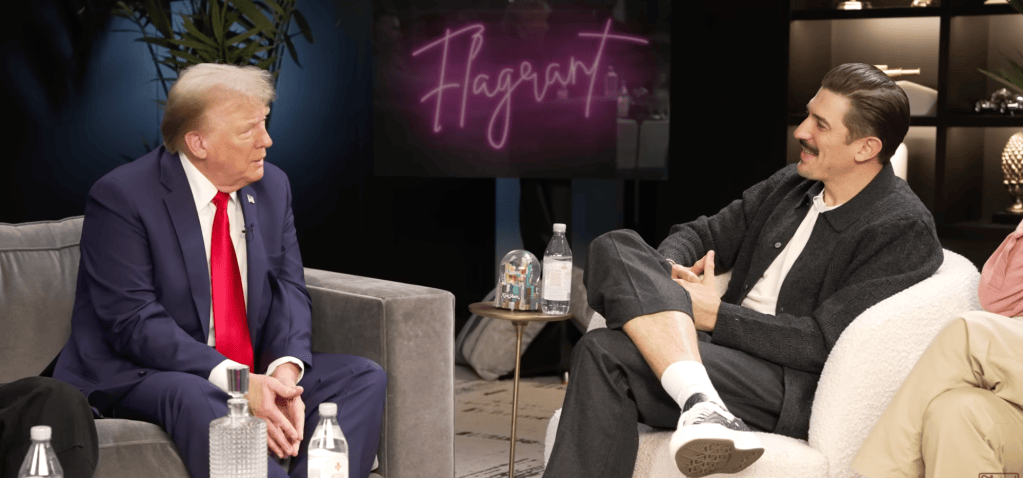
In a two-party system in which politics are typically understood in terms of a binary left-right spectrum, it can seem like such neutrality, such willingness to critique “both sides” for their inattention to “nuance” is representative of a rational center. Politics and partisanship are not co-extensive, however. The refusal to adopt a partisan position is itself political, and, at least in Schulz’s case, suggests that his anti-woke, anti-establishment positions are moderate, if a little edgy.
But if one were to describe Schulz’s politics on the eve of the 2024 election, it would probably be accurate to identify him as a disaffected Democrat, a White, heterosexual, cis-gendered man who had soured on liberals’ turn toward identity politics in the post-Ferguson era. His embrace of Trump was thus in large part a reaction to what he perceived to be a change in Democratic politics; but it can also be attributed to his dim view of Kamala Harris as a candidate, generally.
Indeed, as Schulz told Matt Wilstein of The Last Laugh podcast, he didn’t think that having Trump on his podcast really moved the needle on the election outcome. “I think that America had made up their mind, and I think that a lot of people assumed that the vote for Trump was because he’s this populist superstar that everybody loves and they’re obsessed with. And I think what they’re not calculating is, there are a lot of people that were unhappy with the status quo, and they were voting to reject the current administration, which seemingly was saying that they weren’t going to make any changes.”
This very well may describe the rationale of millions of Trump voters in 2024. Yet to support Trump is to ignore (accept?) noxious, autocratic, and just plain absurd behavior (remember sharpie-gate? His statement that there were “very fine people” on “both sides” at Charlottesville? His promise to be a dictator “on day one”?). The willingness to overlook these things, and, as Schulz earnestly put it on Flagrant’s post-election episode, to hope that Trump’s election heralded the dawn of an American “golden age,” must be seen as taking the side of illiberal reactionaries against liberal democracy as it has heretofore been practiced. However, if one calculates that the authoritarian demagogue is the lesser of two evils, one cannot claim to represent the center as it has been traditionally understood. One has thrown in their lot and should not be surprised when despotic desires have despotic ends.
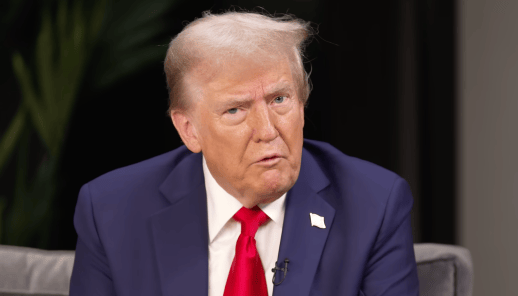
What Schulz probably got right in his post-election analysis, though (despite his protest that the audience had already made up their minds), was his assessment of why Trump’s podcast tour worked out so well for him. The distinctive characteristic of podcasting, he asserted, is its ability to forge a sense of community. Noting how comedians – himself and his co-hosts included – used podcasts as a form of self-promotion to help them sell tickets to their standup shows, Schulz conjectured that Trump was simply following the same playbook, using his podcast appearances to develop a kind of parasocial connection with audiences that would then go out and vote for him. Harris’s mistake, then, was not doing this as effectively – not really connecting with the right podcast audiences and instead relying on a legacy media strategy that didn’t pay the same parasocial dividends.
Given audio media’s reputation for intimacy, this is an important insight with implications for the future of political media strategy, and hence, for democracy. As I have suggested in previous installments of this series, the podcasting circuit provides candidates with something of a shelter from the rigorous questioning of traditional political journalists. Indeed, it is likely that podcast hosts are happy enough to have such high-profile guests to boost their engagement that they are unlikely to risk the access by being prickly (though one could reasonably point out that the question of access is relevant to legacy media as well). But neither are podcasters really trained to ask such questions.
It’s not likely to happen, but I think podcasters need to realize that they have leverage in these situations: They offer political candidates an intimate venue through which they can connect with potential voters and benefit from the community they have already built. The cost of admission could very well be a few difficult questions.
But again, most podcasters just aren’t trained for it. Nor is “journalism” really the point of these shows.
Instead, we are at a moment in which the work of the fourth estate must share space with (if it hasn’t already been superseded by) content produced by the new media royalty. And these new shapers of public discourse are decidedly less interested in playing a watchdog role than they are in staging intimate conversations and building personal brands. What this means for the future of presidential campaigning and for the cultivation of an informed electorate, remains to be seen.
—
Featured Image: M Chifftie, CC0, via Wikimedia Commons
—
Andrew J. Salvati is an adjunct professor in the Media and Communications program at Drew University, where he teaches courses on podcasting and television studies. His research interests include media and cultural memory, television history, and mediated masculinity. He is the co-founder and occasional co-host of Inside the Box: The TV History Podcast, and Drew Archives in 10.
—
REWIND! . . .If you liked this post, you may also dig:

Impaulsive: Bro-casting Trump, Part I—Andrew J. Salvati
This Past Weekend with Theo Von: Brocasting Trump, Part II–Andrew J. Salvati
Taters Gonna Tate. . .But Do Platforms Have to Platform?: Listening to the Manosphere—Andrew J. Salvati
Listening to MAGA Politics within US/Mexico’s Lucha Libre –Esther Díaz Martín and Rebeca Rivas
Gendered Sonic Violence, from the Waiting Room to the Locker Room–Rebecca Lentjes
—
Share this:




Current Top Posts





April 2021

January 2020

November 2019

October 2019

August 2019

April 2014

November 2017

March 2015

December 2017

October 2015


Recent Comments