
SO! Reads: Janet Borgerson and Jonathan Schroeder’s Designed For Hi Fi Living

 According to the latest data from Nielson and the RIAA, vinyls are back. The old fashioned form now outsells CDs – but few have remarked on the fact that, unlike CDs and more like good little children, they are meant to be seen and not heard. At Ikea, for example, you can now easily buy frames sized for LP covers, which are clearly intended for the wall, rather than the turntable.
LP covers are art, but they also make far more intimate statements about identity, politics, and self-presentation, as you’ll immediately realize if you ask yourself which, of your vast collection, you would like to represent you to the general public via the your living room decor. Designed For Hi Fi Living: the Vinyl LP in Midcentury America (MIT Press, 2017), by Janet Borgerson and Jonathan Schroeder, takes this idea and runs with it. Beautifully packaged with creamy matte illustrations accompanied by short visual rhetorical analyses, it belongs on the one-of-a-kind coffee tables of the leisured classes, and this is particularly fitting, as its concept is that album covers from the mid-century can tell us a lot about how white middle class Americans wanted to picture themselves.
 Music For Hi Fi Living is not about sound, per se, but about the role sound may play, or have played, in the past. As a form of material culture, it’s hard to image a better trove from which to uncover the secret life of the white American middle-class. The record covers analyzed here are taken from a single collection, many of them drawn from the 12 Record set on RCA from which the book takes its title, and all of them are bizarrely kitsch.
Divided into two sections called Home and Away (side one and side two, as it were) the book makes the argument that midcentury lives were envisioned, honed, and practiced through this special form of consumption of pre-packaged ideas of “self” and “Other.” Many use strange colors and unknown fonts, surrounding drab photos of a long-gone world of the 1950s. In them, ‘sophisticated’ men and women look dowdy and frightened, while beach scenes and urban landscapes alike capture the pasts’ unlikeness to the present. On covers like those for Fiesta Linda, Your Musical Trip Around The Island of Hawai’i, and Havana Holiday, the exotic is conveyed through its utter mundanity, while ‘home life’ (on records like March Around the Breakfast Table, and Songs For An Evening At Home) is rendered as taking place in entirely private, contained, domestic spaces.
If Hi Fi has a flaw, it is its failure to grapple with the implications of race, class and ethnicity that this entire collection exhibits. For example, the “Away” section centers America, and whiteness, as its world view: though no doubt appropriate to this collector’s experience of this era, it does seem like the authors could have cast a slightly more critical eye on the way the records situate themselves and their listeners. Too often, as the authors note dispassionately, the discs contain western-influenced pop music, despite having covers that utilized shots of Zulu warriors in traditional dress (“African Zulus!”) or Watusi ceremonial dancers (“Kasongo!”). The exclamation points in these titles alone tell a complex and dispiriting tale.
Overall, Music for Hi-Fi Living draws a relationship between sight, sound, and music consumption that encourages us to reconsider in our contemporary moment, now that digitized music is streamed directly into our ears. “We can’t actually see the music we hear,” as Daniel Miller writes in the book’s forward. This is undoubtedly true, which is why the visual component of its past incarnations is so important to revisit, although we may also wonder “did we hear what we thought we saw?” One wonders what the parallel version of this book will be, fifty years from now. Spotify playlists won’t look half so good.
—
Gina Arnold is the editor of the Oxford Handbook of Punk Rock, the author of the 33 1/3rd book Exile In Guyville (Bloomsbury 2014) and the forthcoming entry in the New American Canon series, Half a Million Strong; Rock Festivals From Woodstock to Coachella (University of Iowa Press 2018).
—
 REWIND!…If you liked this post, you may also dig:
The Sound of Hippiesomething, or Drum Circles at #OccupyWallStreet –Gina Arnold
SO! Reads: Dolores Inés Casillas’s ¡Sounds of Belonging!–Monica De La Torre
SO! Reads: Roshanak Khesti’s Modernity’s Ear–Shayna Silverstein
Share this:

Gender and the First Sound Films in 1930s Bombay


co-edited by Praseeda Gopinath and Monika Mehta
Our listening practices are discursively constructed. In the sonic landscape of India, in particular, the way in which we listen and what we hear is often normative, produced within hegemonic discourses of gender, class, caste, region, and sexuality. . . This forum, Gendered Soundscapes of India, offers snapshots of sound at sites of trans/national production, marketing, filmic and musical texts. Complementing these posts, the accompanying photographs offer glimpses of gendered community formation, homosociality, the pervasiveness of sound technology in India, and the discordant stratified soundscapes of the city. This series opens up for us the question of other contexts in India where sound, gender, and technology might intersect, but more broadly, it demands that we consider how sound exists differently in Pakistan, Sri Lanka, the Maldives, Bangladesh, Bhutan, Nepal, and Afghanistan. How might we imagine a sonic framework and South Asia from these locations? —Guest Editors Praseeda Gopinath and Monika Mehta
For the full introduction to the forum, click here.
To read all of the posts in the forum, click here.
—
The coming of sound in Bombay cinema in the 1930s dovetailed with discussions concerning men and women’s roles in modern Indian society and filmmakers’ efforts to establish the cinema as a respectable medium that was integral to Indian nationalist aspirations. With sound now essential to a film’s diegesis, film producers adjusted narrative strategies and how they aurally and visually presented a character as male or female, such as through voice, language/accent, and music. Christine Ehrick reminds us, gender is “represented, contested, and reinforced through the aural.” What did the addition of sound to cinema mean for presenting fe/male bodies and voices on screen? Scholars such as Laura Mulvey have famously demonstrated how film visual editing can lead to women’s objectification in cinema. The sounds and narrative of Dokhtar-e Lor “The Lor Girl” (1933)—the first Persian-language sound film—extend Mulvey’s argument by letting us hear the early sound film’s role in gendering bodies within the wider socio-political context of colonial modernity, as well as the impact the film would have on later Indian and Iranian cinematic conventions.

Golnar and Jafar discuss love in The Lor Girl (1933), Screen capture by author
Although usually featured in histories of Iranian cinema, The Lor Girl was made in Bombay in collaboration between Iranian scholar and expatriate, Abdolhossein Sepanta, and Ardeshir Irani, film producer and owner of the Imperial Film Company. Irani, who is known as the father of the first Indian talkie and Urdu-language film Alam Ara, was also a prominent member of the Bombay Parsis. Irani sought to establish his Imperial Film Company as a global film center and produced a number of the first talkie films in several other languages in India. Sepanta and Irani decided to collaborate on a Persian-language film for Parsi audiences in Bombay and for distribution in Iran. India was already establishing itself as a major global film power while Iran had not yet invested in the technology necessary to make a sound film.
The film’s first scene opens with a close up shot of Golnar’s gyrating hips and the sounds of a reed flute, oud, tabla, and male singing voices. The camera zooms out, and we see that Golnar is shaking a tambourine and performing for an audience of mostly male patrons in the café. The audience members – as indicated by their clothing – include local men of Lor and Arab backgrounds, which remind us of the café’s location near Iran’s border with modern day Iraq.. The men, as well as an ensemble of male musicians, sit in large circle around Golnar. As Golnar dances and the ensemble plays, we hear the audience clapping and yelling “very good, very good!” in encouragement. Through their jeers and taunts, the film sonically casts the men in the audience as vulgar, and its visual construction of Arabs dovetail with Orientalist aesthetics that Rosie Thomas argues were found in contemporaneous Hollywood, European, and Bombay cinemas. The sonic characteristics of these men that we hear throughout the film also reinforce the one-dimensional Orientalist, racist visual codes; the Arab sheikh’s high-pitched, cackling voice sounds simultaneously evil and weak, while the bandits’ voices cast them as brutish and uneducated.
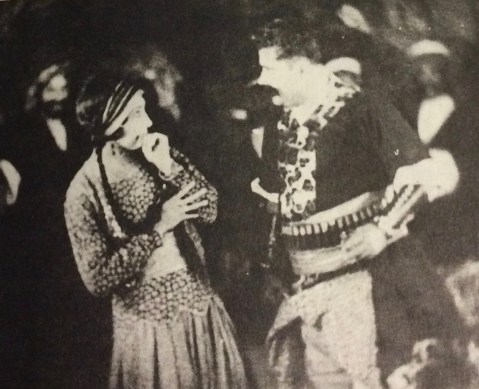
Golnar negotiates with Qoli Khan, in The Lor Girl (1933), Screen capture by author
When the song ends, Golnar skips around the circle holding out a basket to collect tips from the audience members who oblige her to flirt with them before they hand her money. After a short private conversation between Ramazan and the Arab sheikh in which both men cackle over the sheikh’s plan to visit Golnar in her room at night, the next scene shows another dancing sequence similar to the first – although this time Golnar dances for a smaller group of men in Ramazan’s lair. In both dance scenes, the sonic landscape is simultaneously seductive and threatening, elements reinforced by Golnar’s vulnerable yet enticing positioning and the audience’s leering, eager stares and shouts. The film casts men as voyeuristic listeners and consumers of sound, and through Golnar’s dancing – a role considered and reinforced by the film as disreputable – sound produces Golnar as object for the male listeners’ pleasure. While other contemporaneous Bombay films featured more spectacular song and dance sequences, Hamid Naficy notes that this scene in The Lor Girl still hints at the cabaret and café sequences which later emerged in Indian and Iranian commercial cinemas. This, is turn, demonstrates how cinematic codes – informed by discourses on gender and nation – move and are shared transnationally through co-production and exchange.
Now that cinema included both sound and images, filmmakers drew on elements of music, dancing, and other aspects of existing local performance traditions, such as Parsi theater. Representations of gender in Parsi theater were characterized by flexibility; Kathryn Hansen notes that due to concerns about female actors performing for male audiences and in public in general, female characters were often played by men. The acceptance of cross-dressing – not only in terms of body, but also voice – allowed for fluidity in terms of how femininity and masculinity were visually and aurally represented. Yet sound cinema did not allow the same flexibility in terms of gender performance due to aesthetic concerns, as well as sound cinema’s intersection with national and modernist discourses. While women’s voices on radio and records became increasingly commonplace and accepted in Bombay in the 1930s, the audiovisual experience that the sound film provided presented a challenge. Cinema was still not widely regarded as a “respectable” medium, and many of Indian cinema’s early actresses came from what were considered questionable backgrounds.
The trajectory of Golnar and Jafar’s characters encapsulates this tension between gender identities and modernity. Jafar wears a military uniform and mustache associated with the “pre-modern” Qajars. Throughout most of the film while in Iran, Golnar wears long braids and a long dress, clothing that indicates that Golnar hails from the “chaotic” Lorestan province, and that mark her as traditional and backwards in the context of colonial modernity.

Jafar and Golnar in The Lor Girl (1933), Screen capture by author
Although Jafar rescues Golnar initially, the film ultimately casts Golnar as more capable of outsmarting the bandits. Golnar saves Jafar from the bandits several times throughout the film, moments that cast her as strong and brave similar to the virangana (warrior woman) trope that was widely circulated and popular in early 20th century Indian popular culture which Rosie Thomas notes in Bombay Before Bollywood “implied gender ambivalence and multiple modes of femininity” (111).
Golnar’s high-pitched voice and regional Kermani accent associate her with the countryside – especially in contrast to Jafar’s sophisticated, cultured Persian. But her voice’s firm and confident presence resonates across the soundtrack. In the scenes in which she searches for and saves Jafar, she calls his name repeatedly, sonic moments that emphasize her role as Jafar’s rescuer. To negotiate with and escape from the bandits in other scenes, Golnar uses what seems to be her familiarity with the bandit and countryside way of life, as well as her voice; she bravely yells at the bandits and Ramazan’s henchmen while in captivity. At one point, pretending to seem frightened and intimidated by her captors through fake tears and whimpers, Golnar manages to use bandit’s whip against him and steal his horse. Golnar escapes captivity another time when she uses her brazen and coy voice and speaking style to trick Qoli Khan into letting her leave the cave to supposedly find and help capture Jafar.
Yet Golnar and Jafar experience significant transformations by the end of the film and upon their arrival in Bombay. Happy piano music plays on the soundtrack as the film shows us buildings and monuments of modern Bombay. Afterwards, intertitles inform us of the spectacular changes that have taken place in Iran while Jafar and Golnar have been in Bombay now that a new shah has come to power. In the next scene, we are in the couple’s grand living room of their house in Bombay; a servant cleans their grand staircase while we hear and see Golnar at the piano. Jafar enters the room and notes how well she has learned to play. While initially positioned similar to the virangana, Golnar now wears a European-style dress and short haircut. In Bombay Cinema: an Archive of the City, Ranjani Mazumdar discusses how in emerging Indian nationalism, “Victorian ideology entered into a comfortable alliance with Indian myths to reinvent the “virtues” and “purity” of the Indian woman,” casting her as associated with the bourgeois domestic space of the home, and interested in European-associated pursuits such as the piano (82).

Jafar and Golnar arrive in Bombay, in The Lor Girl (1933), Screen capture by author
Meanwhile, Jafar, who appeared inept at his role as soldier and potentially effeminate, now is clean-shaven and wearing a Pahlavi hat and suit. Golnar’s near silence in this scene and attentive listening contrasts dramatically with the presence of her voice in the previous scenes when she argued and negotiated with the bandits, sang solos, confidently flirted with Jafar and talked with him about the differences between notions of love in the modern city and the countryside. Now, nearly silent in terms of her voice, but providing musical accompaniment to Jafar’s nationalistic song through the piano, Golnar demonstrates the more limited essentialized femininity of the new, modern, middle-class woman, and one characterized by its association with culture. Later, reading the newspaper together, Jafar suggests that they return to Iran now that it has become modern like Bombay. Golnar quietly listens to Jafar, and assents with his desire to return.
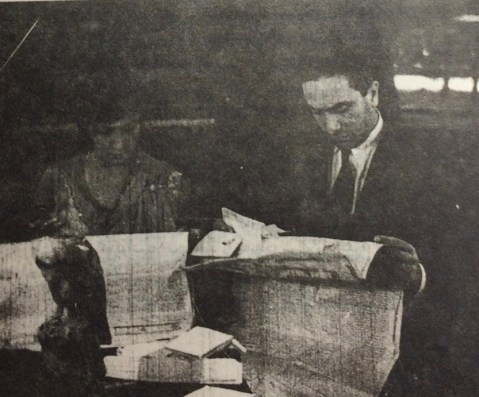
Jafar and Golnar read the newspaper in The Lor Girl (1933), Screen capture by author
The Lor Girl’s importance in Iranian cinema histories – and its near absence historiography of cinema in India – is reflective of how national cinema frameworks limit how we understand the early sounds of Iranian and Indian cinemas. The film was produced at a time when national cinema was not yet articulated with a specific language and when transnational elements played a key role in film production. In addition to its role in sonically gendering bodies, The Lor Girl demonstrates the sound film’s role in participating in the association of language and nation.
—
Featured Image: The Lor Girl (1933) Film Poster
—
Claire Cooley is a PhD student in the Department of Middle Eastern Studies at the University of Texas at Austin. Her research interests center on overlapping Middle East and South Asia film histories. Claire’s dissertation project traces connections between Egyptian, Iranian, and Indian cinemas with a focus on the 1930s-1960s, and uses sound as a framework to capture the dynamics of cinematic circulations across this contiguous region. In 2010, she received her BA from Tufts University, and from 2010-2013 she lived in Cairo, Egypt where she pursued a project translating, mapping, and blogging about graffiti during the 2011 Egyptian Revolution. Claire also teaches Persian and Arabic.
—
REWIND!…If you liked this post, you may also dig:
Fade to Black, Old Sport: How Hip Hop Amplifies Baz Luhrmann’s The Great Gatsby– Regina Bradley
Quiet on the Set?: The Artist and the Sound of a Silent Resurgence– April Miller
Play It Again (and Again), Sam: The Tape Recorder in Film (Part Two on Walter Murch)– Jennifer Stoever
Share this:


Current Top Posts





April 2021

January 2020

November 2019

October 2019

August 2019

April 2014

November 2017

March 2015

December 2017

October 2015
 Sounding Out!
Recent Comments