
Unsettled Listening: Integrating Film and Place
 Welcome to the third and final installment of Sculpting the Film Soundtrack, our series about sound in contemporary films. We’ve been focusing on how filmmakers are blurring the boundaries between music, speech, and sound effects – in effect, integrating distinct categories of soundtrack design.
In our first post, Benjamin Wright showed how celebrated composer Hans Zimmer thinks across traditional divisions of labour to integrate film sound design with music composition. Danijela Kulezic-Wilson followed up with an insightful piece on the integration of audio elements in Shane Carruth’s Upstream Color, suggesting how scholars can apply principles of music, like tempo and rhythm, to their analyses of the interactions between a film’s images and sounds. In this final entry, Randolph Jordan, considers another dimension of integration: a film’s sounds and the place where it was produced. In his provocative and insightful reading of the quasi-documentary East Hastings Pharmacy, Jordan, who is completing a post-doctoral post at Simon Fraser University, elaborates on how the concept of “unsettled listening” can clue us into the relationship between a film and its origins of production. You’ll be able to read more about “unsettled listening” in Jordan’s forthcoming book, tentatively titled Reflective Audioviewing: An Acoustic Ecology of the Cinema, to be published by Oxford University Press.
I hope you’ve enjoyed taking in this series as much as I’ve enjoyed editing it with the help of the marvelous folks at SO!. Thanks for reading. — Guest Editor Katherine Spring
—
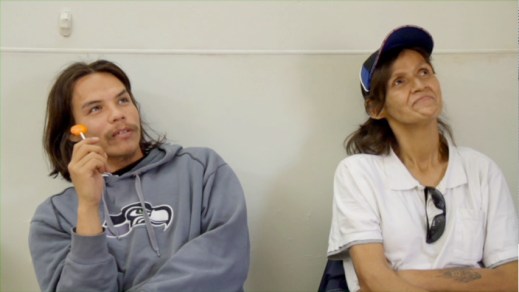
A mother and son of First Nations ancestry sit in the waiting area of a methadone clinic in Vancouver’s Downtown Eastside, their attention directed toward an offscreen TV. A cartoon plays, featuring an instrumental version of “I’ve Been Working on the Railroad” that mingles with the operating sounds of the clinic and ambience from the street outside. The tune is punctuated by a metal clinking sound at the beginning of each bar, calling to mind the sound of driving railway spikes that once echoed just down the street as the City of Vancouver was incorporated as the western terminus of the Canadian Pacific Railway (beginning thus the cycle of state-sanctioned erasure of indigenous title to the land). The familiar voice of Bugs Bunny chimes in: “Uh, what’s all the hubbub, bub?”
.
Hubbub indeed. Let’s unpack it.
The scene appears one third of the way through East Hastings Pharmacy (Antoine Bourges, 2012), a quasi-documentary set entirely within this clinic, staging interactions between methadone patients (played by locals and informed by their real-life experiences) and the resident pharmacist (played by an actress). Vancouver’s Downtown Eastside, dubbed Canada’s “worst neighborhood” for its notorious concentration of transients and public drug use, is also home to the largest community of First Nations peoples within the city limits, a product of the long history of dispossession in the surrounding areas. When the film presents this indigenous pair listening to a Hollywood fabrication of the sounds that marked their loss of title to the city it is a potent juxtaposition, especially given the American infiltration of Vancouver’s mediascape since the 1970s. Long known as “Hollywood North,” Vancouver is more famous as a stand-in for myriad other parts of the world than for representing itself, its regional specificity endlessly overwritten with narratives that hide the city and its indigenous presence from public awareness.
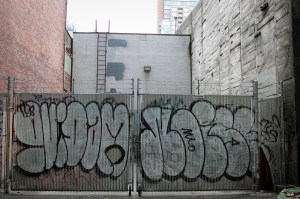
“Quidam + Noise” graffiti in Downtown Vancouver, April 6, 2013, by Flickr User Kevin Krebs
In her essay “Thoughts on Making Places: Hollywood North and the Indigenous City,” filmmaker Kamala Todd stresses how media can assist the process of re-inscribing local stories into Vancouver’s consciousness. East Hastings Pharmacy is one such example, lending some screen time to urban Natives in the 21st Century city. But Todd reminds us that audiences also have a responsibility “to learn the stories of the land” that have been actively erased in dominant media practices, and to bring this knowledge to our experience of the city in all its incarnations (9). Todd’s call resonates with a process that Nicholas Blomley calls “unsettling the city” in his book of the same name. Blomley reveals Vancouver as a site of continual contestation and mobility across generations and cultural groups, and calls for an “unsettled” approach that can account for the multiple overlapping patterns of use that are concealed by “settled” concepts of bounded property. With that in mind, I propose “unsettled listening” as a way of experiencing the city from these multiple positions simultaneously. Rick Altman taught us to hear any given sound event as a narrative by listening for the auditory markers of its propagation through physical space, and recording media, over time (15-31). Unsettled listening invites us to hear through these physical properties of mediatic space to the resonating stories revealed by the overlapping and contradictory histories and patterns of use to which these spaces are put, all too often unacknowledged in the wake of settler colonialism.
East Hastings Pharmacy provides a great opportunity to begin the practice of unsettled listening. The film’s status as an independent production amidst industrial shooting is marked by the intersection of studio-fabricated sound effects and direct sound recording, as in the example described above, and further complicated by the film’s own hybrid of fiction and documentary modes. That speaks to the complexity of overlapping filmmaking practices in Vancouver today, a situation embedded within the intersecting claims to land use and cultural propriety on the streets of Vancouver’s Downtown Eastside. To unsettle listening is to hear all these overlapping situations as forms of resonance that begin with the original context of the televised cartoon and accumulate as they spread through the interior of the clinic and outwards across the surrounding land. So let’s try this out.
.
The cartoon is Falling Hare (Robert Clampett, 1943), a good example of the noted history of cross-departmental integration at The Warner Bros.’ cartoon studios. The scene in question begins at 1:55, and here the metallic clinking sound is just as likely to have been produced by one of music orchestrator Carl Stalling’s percussionists as by sound effects editor Treg Brown. This integration can be heard in the way that the music’s unspoken reference to railway construction charges each clink with the connotation of hammer on spike. However, the image track in Falling Hare doesn’t depict railway construction, but rather a gremlin whacking the nose of a live bomb in an attempt to do away with enemy Bugs seated on top. James Lastra would say (by way of Christian Metz) that the clinking sound is “legible” as hammer on spike for the ease with which the sound can be recognized as emanating from this implied source (126). But this legibility is premised upon a lack of specificity that also allows the sound to become interchangeable with something else, as is the case in this cartoon.

Screen Capture from Falling Hare
East Hastings Pharmacy capitalizes on this interchangeability by re-inscribing the clinking sound’s railway connotations, first by stripping the original image and then by presenting this sound in the context of the dire social realities of Vancouver’s Downtown Eastside as the city’s sanctioned corral for the markers of urban poverty – and indigeneity – that officials don’t want to spill out across the neighborhood’s increasingly gentrified perimeter.
As one of a string of Warner Bros. cartoons put in the service of WWII propaganda, the Falling Hare soundtrack also resonates with wartime xenophobia and imperialist expansion, branches of the same pathos that leads to the effacing of indigenous culture from the consciousness of colonizing peoples. In Vancouver, this has taken the form of what Jean Barman calls “Erasing Indigenous Indigeneity,” the process of chasing the area’s original peoples off the land while importing aboriginal artifacts from elsewhere to maintain a Native chic deemed safe for immigrant consumption (as when the city paid “homage” to the vacated Squamish residents of downtown Vancouver’s Stanley Park by erecting Kwakiutl totem poles imported from 200km north on Vancouver Island) (26). This is an interchangeability of cultural heritage premised upon a lack of specificity, the same quality that allows “legible” sound effects to become synchretic with a variety of implied sources. And this process is not unlike the interchangeability of urban spaces when shooting Vancouver for Seattle, New York, or Frankfurt, emphasizing generic qualities of globalized urbanization while suppressing recognizable soundmarks from the mix (such as the persistent sound of float plane propellers that populate Vancouver harbour, the grinding and screeching of trains in the downtown railyard, or the regular horn blasts from the local ferry runs just north of the city).
The high-concept legibility of Warner Bros.’ sound effects – used in Falling Hare to play on listener’s expectations to comic effect – is further unsettled by its presentation within the context of documentary sound conventions in East Hastings Pharmacy. Bourges’ film commits to regional specificity in part through the use of location sound recording, which, as Jeffrey K. Ruoff identifies in “Conventions of Documentary Sound,” is particularly valued as a marker of authenticity (27-29). While Bourges stages the action inside the clinic, the film features location recordings of the rich street life audible and visible through the clinic’s windows that proceeds unaffected by the cameras and microphones. This situation is all the more potent when we account for the fact that, in this scene, the location-recorded cartoon soundtrack and ambient sound effects were added in post-production, and so represent a highly conscious attempt to channel the acoustic environment according to the conventions of “authentic” sound in documentary film.
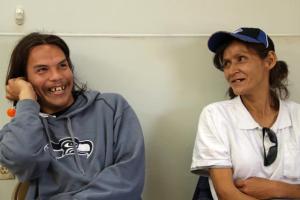
Screen Capture, East Hastings Pharmacy
While the film uses location recording as a conscious stylistic choice to evoke documentary convention, it does so to engage meaningfully with the social situation in the Downtown Eastside, underlining Michel Chion’s point that “rendered” film sound – fabricated in studio to evoke the qualities of a particular space – is just as capable of engaging the world authentically (or inauthentically) as “real” sound captured on location (95-98). By presenting this Hollywood cartoon as an embedded element within the soundscape of the clinic, using a provocative mix of location sound and studio fabrication, East Hastings Pharmacy unsettles Hollywood’s usual practice of erasing local specificity, inviting us to think of runaway projects in the context of their foreign spaces of production and the local media practices that sit next to them.
Finally, this intersection of sonic styles points to the complex relationships that exist between the domains of independent and industrial production around Vancouver. In his book Hollywood North, Mike Gasher argues for thinking about filmmaking in British Columbia as a resource industry, pointing to how the provincial government has offered business incentives for foreign film production similar to those in place for activities like logging and fishing. Here we can consider how the local film industry might follow the same unsustainable patterns of extraction as other resource industries, all premised upon willful ignorance of indigenous uses of the land. Yet as David Spaner charts in Dreaming in the Rain, the ability to make independent films in Vancouver has become largely intertwined with the availability of industrial resources in town. Just as Hollywood didn’t erase the independent film, colonization didn’t erase indigenous presence.
East Hastings Pharmacy offers a powerful example of how we can practice unsettled listening on the staged sound of Falling Hare, devoid of local context and connected to the railway only by inference, to reveal a rich integration with regional specificity as the cartoon’s auditory resonances accumulate within its new spaces of propagation. In this way we can hear local media through its transnational network, including the First Nations, to understand the overlaps between seemingly contradictory modes of being within the city. And in so doing, we can also hear through the misrepresentation of the Downtown Eastside as “Canada’s worst neighborhood” to the strength of the community that has long characterized the area for anyone who scratches the surface, an important first step along the path to unsettling the city as a whole.
—
Featured Image: Still from East Hastings Pharmacy
—
Randolph Jordan wanted to be a rock star. Academia seemed a responsible back-up option – until it became clear that landing a professor gig would be harder than topping the Billboard charts. After completing his Ph.D. in the interdisciplinary Humanities program at Concordia University in 2010 he floated around Montreal classrooms on contract appointments before taking up a two-year postdoctoral research fellowship in the School of Communication at Simon Fraser University. There he has been investigating geographical specificity in Vancouver-based film and media by way of sound studies and critical geography, research that will inform the last chapter of his book Reflective Audioviewing: An Acoustic Ecology of the Cinema (now under contract at Oxford University Press). If you can’t find him hammering away at his manuscript, or recording his three young children hammering away at their Mason & Risch, look for him under Vancouver’s Burrard Bridge where he spends his “spare time” gathering film and sound material for his multimedia project Bell Tower of False Creek. Or visit him online here: http://www.randolphjordan.com
—
 REWIND!…If you liked this post, you may also dig:
Fade to Black, Old Sport: How Hip Hop Amplifies Baz Luhrmann’s The Great Gatsby– Regina Bradley
Quiet on the Set?: The Artist and the Sound of a Silent Resurgence– April Miller
Play It Again (and Again), Sam: The Tape Recorder in Film (Part Two on Walter Murch)– Jennifer Stoever
Share this:

Blog-O-Versary #Flawless 5.0!

Click here to download our free Blog-O-Versary 5.0 Mix!
.
HAPPY 5th BLOG-O-VERSARY! Parabéns!
As I write this, I am sitting on the return flight from Portugal, where I spent an utterly transformational four days at the Invisible Places, Sounding Cities conference (deftly organized and elegantly curated by Raquel Castro), a sensory torrent that still has me buzzing. While there, I was thrilled, provoked, taken, shaken, intrigued, pleased, taught, energized, exhausted, re-energized, puzzled, lifted up. . .all of the things I hope a truly great meeting will do (and then some). What I wasn’t prepared for—and when going to a conference featuring sound artists and performers, I imagine myself ready for anything—was the flood of gratefulness and gratitude that I felt every time I had a conversation about Sounding Out!, every time all of our stickers disappeared off the registration table, every time I introduced myself and there were nods of recognition from people I had never met—people located thousands of miles from my home IP address—and every time my scouting attempts were met with enthusiasm that matched (and often rivaled) my own.
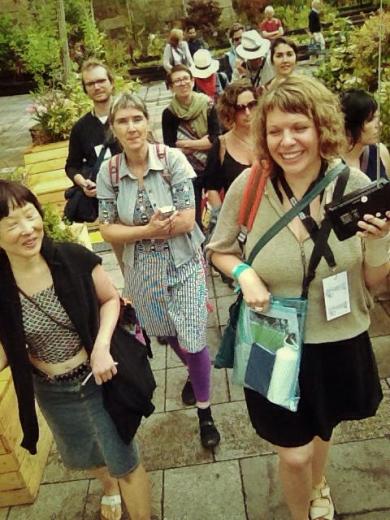
Multimedia artist, SO! Regular Writer, and Portugal resident Maile Colbert leading Invisible Places attendees on the Radio Terramoto soundwalk co-created with her partner Rui Costa (of Binaural/Nodar).
And, while I cannot deny that I my work on Sounding Out! has generated personal pride—speaking honestly, sometimes I go to soundstudiesblog.com just to LOOK at it—but the feeling I enjoyed in Viseu was different from “accomplishment.” I felt grateful for the support of our editors, writers, and podcasters—sharing the best of themselves, tirelessly and without compensation other than mad props and ‘nuff respect—for our readers, ever stretching across the globe, sharing, liking, and ReTweeting, until this endeavor became a networked community, and for our fans—Yes! We have received fan mail!—whose enthusiasm always seems to arrive at the right time, the Hail Mary eleventh hour when the editors are fighting sleep and/or needing another reason to allow Dora the Explorer to play a little longer to steal time to finish a piece. I also felt gratitude for the diverse and full-bodied sound studies community, particularly its rigorous but generous, inviting embrace, which extended to the fledgling Sounding Out! experiment five lightning-quick years ago.
In that time, I hope we have expressed our gratitude in return, by deepening and extending our mutual community, binding us in new and unexpected ways, showcasing our best and giving air to our challenges, and, most importantly, enabling us to greet each other as familiar colleagues—in Viseu, Berlin, Toronto, San Juan, Los Angeles, Copenhagen, New York, Sao Paolo. . .—even if we had never before met “In Real Life.” Know that as we continue to grow and renew the site that the function of community will always remain a prime directive of SO!. I welcome the responsibility we have collectively invested in Sounding Out!; it makes my decisions both more contemplative and surefooted. Thank you, everyone, for the last five years—lets raise a glass of Grão Vasco Dão Tinto toward many more together!
As we sip, let’s also partake in the annual SO! tradition of taking stock of the last action-packed year, with soundtrack supplied by another artist having a #flawless year, Ms. Beyoncé Knowles herself. . .
 “Irreplaceable” (Goodbye, Liana): I write this first update completely under protest. I know I am not supposed to admit to affective reactions, especially in cyberspace and especially as a woman with her feet in several male dominated fields, but when Liana Silva-Ford, our stalwart and smoothly bad-ass Managing Editor and Co-Founder, told me she was considering leaving SO!, my eyes welled up instantaneously. Okay, so she very straightforwardly told me she was leaving—even now I still have to sneak in the modifier “considering.” Liana was recently named Editor-in-Chief of the longstanding publication Women in Higher Education (now on Wiley-Blackwell)—read her first “Editor’s End Notes” here—and she is embarking on a book project on her not-so-secret passion, postcards. Liana has, rightly and deservedly, decided to bestow more of her time on these two *amazing ventures. Even though none of us has yet to successfully visualize SO! without her, we know this is right and we wish her all and only the best. Thank you, Liana for your steady hand but light touch, your sharp yet generous editorial eye, and the intelligence, professionalism, and enthusiasm you brought to every meeting, every challenge, and every writer. Working (and SO!-hiveminding) with you has been an exquisite pleasure. And thank you for letting me twist your arm into a permanent “Editor-at-Large” position (whew!).
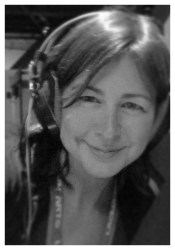 “Green Light” (Welcome Cara, Neil, Will): On the other hand, I am pleased to announce that the O.G. SO! triumvirate has happily expanded to a sextet. Media scholar Neil Verma (Visiting Assistant Professor in the Department of Radio/Television/Film at Northwestern University) our new ASA/SCMS Special Editor, came on board in late 2013, curating our new Thursday stream that launched in January 2014. Neil has already proved himself to be a skilled editor, an intuitive curator, and a natural at the brand of humor and enthusiastic tomfoolery we thrive on behind the scenes. We initiated our “L.A. Office” in December with the addition of William Stabile, our new Assistant Visual Editor, who is responsible for many of the mighty fine layouts that that you have seen this year. He is flexible, patient, and extremely gifted in the visual arts, with a wit dryer than Riverside, California this time of year. We value his work and presence immensely. And, drum roll please (especially with our crowd), we are pleased to announce right here today, that Cara Lynne Cardinale is our new Managing Editor, coming to us live from the East Bay in Northern California with a soaring collection of great ideas and her feet firmly planted on the ground of spreadsheets, calendars, and deadlines. Cara graduated in 2010 with her Ph.D. in English from the University of California, Riverside, with a brilliant dissertation that I am constantly telling my graduate students to seek out: “‘Through the Eyes’: Reading Deafened Gestures of Look-Listening in Twentieth Century Narratives.” A unanimous selection for her intensity, sharpness, and style-for-miles, Cara will undoubtedly turn this mother out!.
 “Upgrade U” (Thursday Stream!): You may have noticed that there has been twice the SO! to love in 2014, thanks to Neil Verma’s work on the Thursday stream, with his cadre of guest editors and an array of media-related subjects that has greatly expanded and deepened the site’s threshold. The year is only a little more than half-over and already we have been treated to forums on Cuban radio history (Tom McEnaney’s “Radio de Acción”), Lou Reed’s voice and sonic influence (NV’s “Start a Band”), and Justin Burton’s rumbling “The Wobble Continuum” of dubstep sounds and scholarship. Jump on the most current series of the stream, “Sculpting the Film Soundtrack” (guest edited by Katherine Spring), a collection of posts that re-frames the cinematic soundtrack to to be heard anew. The media stream + our monthly podcast series + SO!’s monthly pass-the-mic “Sound Off! // Comment Klatsch” = vibrant sounding Thursdays. We like this new math.
 “Check on It” (“SO! Amplifies”) b/w “Schoolin’ Life” (Book Reviews): Sounding Out!, by design, is not a clearing house for any-and-all sound-related events [however, you CAN get all that information by following us on Twitter, liking us on Facebook, and Tumbling with us too]. BUT, we realized this year that relationships are built and connections are made through support of one another’s work, and, more often than not, it takes more than 140 characters to properly accomplish this important task. So, in 2014, we launched two new ongoing series, “Sounding Out! Reads,” reviewing the latest monographs of interest to Sound Studies peeps, and a curatorial series called “SO! Amplifies” that enables selected makers, artists, authors, researchers, designers, and other creative/creating folks to introduce their work and tell SO! readers how/why it is important to them (and should be to us). In addition to amplifying the signal sent out by our featured works, we also hope to enable the production of new research, art, and other types of projects and connections through the introduction of these new tools, models, information, and archives. At the very least, we will be hipping your ears and eyes to some seriously cool new ish.
 “Satellites” b/w “Rocket” (War of the Worlds collabo extravaganza): Neil Verma came to the SO! team last summer in search of a site to host observations on the occasion of the 75th Anniversary of Orson Welles’ 1938 broadcast of War of the Worlds. Knowing the brilliance and exceptional quality of Neil’s work—please buy and devour his 2012 Theater of the Mind (University of Chicago Press, SCMS First Book Award Winner) ASAP—I automatically said an enthusiastic “YES.” BOOM. Just like that, an international multimedia fandango was born. On the ground, or since we are talking radio, terrestrially, #WOTW75 sounded like a three-hour radio broadcast on Binghamton University’s WHRW 90.5 with 2 hours of original content produced by Team SO! (one of them live!) bookending a re-broadcast of Welles’ original at the precise date and time of its debut, 8:00 PM EST, October 30th [1.5 hours are available via our podcast series: EPISODE XXII: Remixing War of the Worlds presents an original creative sound composition by Monteith McCollum and his Performative Processes class at Binghamton University that re-imagined act three of WOTW and EPISODE XXIII: War of the Worlds Revisited, the new 60-minute audio documentary featuring interviews with top media scholars engineered by our very own Multimedia editor Aaron Trammell]. BUT, out in the aether and Twittersphere, #WOTW75 looked like so much more: simultaneous listening parties dotting the globe—a special shout out to Jake Smith’s event at Northwestern U in Chicago—a months-long supergroup collabo between the
  Sounding Out! crüe and the University of Wisconsin-Madison’s Antenna—mad props to Andrew Bottomley—a real-time Twitter conversation using the hashtag #WOTW75 that sparked myriad reactions from excitement to snark—NV has curated the best of these for the upcoming sound special issue of Velvet Light Trap—academic panels, radio interviews, podcasts—thank you Aca-Media!—TV interviews, live dramatic radio performances—you rock, Charles Berman and the WHRW drama dept—a live collaging project put on by Toronto’s Collage Collective at the Textile Museum of Canada, martian-themed cupcakes, commemorative T- shirts by artisanal screen printers Muckles Ink, a theme-song (!!) written and performed by Binghamton’s finest ambient surf-noise band The Short Waves, and, we dearly hope, renewed excitement for the experience of “liveness” in the twenty-first century, an experience greatly changed since 1938, but no less vital in importance and thrilling in affect.
- “Run the World” (Citations, Reposts, and Writer Updates): It has been a great year for our writers, who have found their work cited and re-blogged in many venues including The Society Pages, The Feminist Wire, Twentieth Century Music, The New Inquiry’s Sunday Reading, Radio Survivor, Repeating Islands, Past and Present, About Place Journal’s 1963-2013 Civil Rights Retrospective, and American History Now [for the full bibliographic details see our SO! Media page].
We also congratulate our writers on their recent news and updates!
- Kaj Ahlsved is working hard on his PhD dissertation “Music and sport: soundscape, identity, context and function.” He published his first article in the 2013 Yearbook for the Finnish society for Ethnomusicology. His second article, “Let’s Play Hockey,” is currently under peer review. He is also part of a research project called Kiekkokansa that will publish a book on Finnish ice hockey culture in April 2015. For this project he and a few other researchers had the opportunity to do ethnography in Minsk during the 2014 World Ice Hockey Championships.
- Regina Bradley released her video dialogue series called Outkasted Conversations. She has a chapter titled “Kanye West’s Sonic [Hip Hop] Cosmopolitanism” in the collection The Cultural Impact of Kanye West. She also has an article forthcoming on Edward P. Jones’ The Known World and the Hip Hop Imagination in Southern Literary Journal.
- Dolores Inés Casillas was promoted to Associate Professor with tenure at the University of California at Santa Barbara.
- Kariann Goldschmitt will be a Visiting Lecturer in the Faculty of Music at the University of Cambridge this upcoming October. Her essay on mobile tactics in the Brazilian independent music industry has been published in The Oxford Handbook of Mobile Music Studies, Volume 1.
- Carter Mathes saw the release of his new book this year, titled Imagine the Sound: Experimental African American Literature after Civil Rights.
- Jonathan Sterne is co-organizing, with Nick Mirzoeff and Tamar Tembeck, the first-ever sound studies-meets-visual culture studies conference. Called Sound, Vision, Action, it puts scholars and artists in dialogue across sonic and visual traditions. They are especially interested in how each field addresses questions of power. The lineup is still being confirmed, but it will be hosted by Media@McGill in Montreal, 14-15 November 2014. Sterne is teaching a graduate seminar in conjunction with the conference in the Fall. More details will be available at http://media.mcgill.ca.
- Jennifer Stoever was promoted to Associate Professor with tenure at the State University of New York, Binghamton where she was also awarded a 2014 Chancellor’s Award in Teaching.
 And now. . .because this is how we do year after year, roll up your rug or roll down your partition, please, it is time to celebrate our #flawless 5.0 blog-o-versary, ‘Yonce-style. –JS, Editor-in-Chief
—
Jennifer Stoever is co-founder and Editor-in-Chief of Sounding Out! She is also Associate Professor of English at Binghamton University.
—
Click here for Sounding Out!‘s Blog-O-Versary #Flawless 5.0 mix with track listing
(Just in case you missed last year’s 4.0 celebration and mix click here; 3.0 click here; for year two, click here; and for our first Blog-O-Versary party mix click here)
—
Share this:


Current Top Posts





April 2021

January 2020

November 2019

October 2019

August 2019

April 2014

November 2017

March 2015

December 2017

October 2015
 Sounding Out!
Recent Comments