
Juno and Antifolk: Pro-life?
DOI: https://doi.org/10.59350/m47hh-fec19
This post is a bit out of date, considering that The Moldy Peaches were relevant about ten years ago, and that the movie Juno was released almost two years ago. The upswing to this is that if you missed it in theaters, you can easily get your hands on it through Netflix, a Red Box, or possibly even a Hollywood Video. Pros and cons aside, I need to describe my horror at the movie’s attempts to trick me into seeing it as an authentically “independent” production. Now wait — why does this chunk of cinema critique belong in a sound blog? The Trojan horse to indieville in this production is the soundtrack.
Basically, the soundtrack is chock full of figures from New York’s turn of the century antifolk family, including of course, seven(!#*!) by Kimya Dawson of the Moldy Peaches. I’m not an expert at what makes a movie soundtrack tick, but I contend that seven songs (and this is not counting collaborations, aliases, duets and covers) qualifies Juno as a Kimya Dawson themed movie. In lieu of that description however, the tag: anti-folk will suffice. Wikipedia summarizes anti-folk: “Anti-folk (or antifolk) is a music genre that takes the earnestness of politically charged 1960s folk music and subverts it. . .Nonetheless, the music tends to sound raw or experimental; it also generally mocks the seriousness and pretension of the established mainstream music scene.” Anti-folk works to destroy the mainstream, either musically or politically.
Given the fairly subversive nature of the soundtrack, one would expect Juno’s narrative to match ideologies. It does not, the film centers around quirky highschool drama a-la Fast Times at Ridgemont High, but ultimately ends with the protagonist advocating pro-life as opposed to pro-choice. Given that America’s pro-choice movement is in no way a dominant ideological paradigm, it is frustrating for me to witness anti-folk music working to subvert the movement through its intimate association with Juno.
In the clip below, Kimya Dawson justifies her presence in the Juno soundtrack. In many ways, the event is described as serendipitus and coincidental. Adam Green, also interviewed, admits to appreciating his newfound publicity. I feel deceived, if not by Juno, then by the ideology of anti-folk music, and it’s prophets: Adam Green and Kimya Dawson.
Aaron Trammell
Share this:

Gendered Ears
DOI: https://doi.org/10.59350/ccj60-jc088
While there is a rich discussion in cultural studies about gendered representation in popular music, there remains very little about gendered listening experiences—or, more accurately—gendered perceptions of other’s listening experiences. Big Ears: Listening for Gender in Jazz Studies, one of the newest offerings from Duke’s Refiguring American Music series, makes promising headway in this direction, initiating a conversation about the way in which various types of listening practices—that of fans, musicians, and critics—are coded in the largely male dominated world of jazz. In popular music, however, this conversation has remained more nascent. As a female practitioner in the field with multiple identities—fan, vinyl collector, academic critic, consumer, blogger—it is uncomfortable how frequently I find people making very circumspect and circumscribed assumptions about the way in which I listen to music.
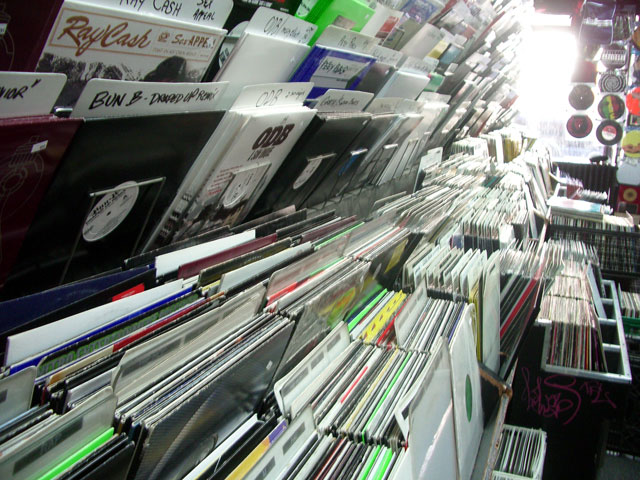
I have been collecting vinyl since the days when it was just called “buying records.” My first purchase at age 5, made via my Dad, was The GoGos’ Beauty and the Beat, which I still own, now carefully tucked into a plastic sleeve. And, thanks to my Dad’s gentle lesson in how to handle vinyl, it isn’t in very bad shape, either. Record collecting was a thrill my father shared with me, creating a connection between us that sometimes held when other bonds were endangered. No matter what, I always wanted to call him and tell him when I finally found a mint copy of Michael Jackson’s Off the Wall at a thrift store or Prince’s Purple Rain with the poster still inside.
A number of weeks ago, I was on a routine summer Saturday morning mission: trolling the yard sales in my neighborhood for kid’s stuff, used books, and vinyl. While I never expect to find the holy grail of record albums at a yard sale, I am always willing to flip through piles of Barbara Streisand, Eddie Rabbit, Billy Joel, and Herb Alpert in the hopes I might uncover it. Usually, I just end up taking in the ripe dusty smell and silently cursing the sad condition of the vinyl I find there, hating to leave even the most scratched-up Mantovani warping in the full summer sun. But you never know.
On this particular Saturday, I was vinyl hunting with my infant son strapped to my chest and had my dog, He Who Cannot Be Named, pulling at the leash. In effect, I had suburban motherhood written all over my body as I strained on my tip-toes to reach records at the back of the pile and whispered to my sleeping son about why I was so excited to find a Les Paul and Mary Ford record. In the midst of my record reveries, I overheard a man next to me begin telling the proprietor of the yard sale about his record collecting habit. He went on and on about how long he has been collecting, how many records he has, how he “just got back from buying a thousand records off a guy in Appalachin.”
My hackles were instantly raised by this conversation about record-size. I already felt a bit left out, as this man obviously chose to ignore the woman actually looking at the records in favor of the only other man around. Vinyl collecting remains an overtly male phenomenon, as Bitch Magazine discussed in their 2003 Obsession issue. Although I am embodied evidence that women do collect vinyl, I am used to being in the complete minority at record shows, music conferences, and dusty basement retail outlets and overhearing countless conversations just like this one. In spite of myself, I decided to jump in to the conversation. . I thought I would cast out a lifeline to my fellow vinyl junkie, as the yard sale guy was obviously not interested and just humoring the record geek in front of him in the hopes that he would cart away the entire stack. Plus, I miss geeking out with someone else who loves records. After a lifetime in urban California, I now live in a small town in Upstate New York. While the record bins are not so tapped out here, it is lonely going for a record head. So I said to him, “I collect records too. I can’t believe you found so many records in Appalachin.” My invitation down the path of geekdom, however, was rebuffed. “Oh,” he said, barely looking up, “yeah. It happens all the time.” And then back to yard sale guy.
I tried not to take it personally, but it became impossible after this same scene was re-enacted at four or five different houses down the block. This guy was like a cover version of the Ancient Mariner, compelled to tell man after man all about the size of his enlarging record collection, the beloved albatross around his neck: “Man, have you ever tried to move a thousand records all at one time? They are so heavy and they take up so much space!”
And, I was the invisible witness to his tale of obsession, love, and woe, silently flipping through records just a few steps ahead of him. That is ultimately how I knew he did not see me as an equal rival in the world of vinyl hunting—he let me get ahead and stay ahead in the bins, neither sneaking peeks at what I pulled or, fingers flying, moving faster and faster in the hopes of overtaking me. He just assumed that I, dog in hand and baby on chest, would pull complete crap.
My listening ears then, bear the weight of my gender and the limited ways in which women are expected to engage with music. Women remain perpetually pegged as teeny-bopper fan club leaders and screaming Beatle fans, perpetually deafening themselves to the “real music.” Despite the deft critiques of Norma Coates, Susan Douglas, and Angela McRobbie, in which the early Beatles audience is re-imagined as proto-feminist and teenaged girls’ bedrooms are viewed as sites of cultural competency rather than deaf consumerism, my female ears remain cast as those of a groupie but never an aficionado, as if the two are somehow mutually exclusive. Imagine the Ancient Mariner’s surprise when this vinyl mama plucked pristine copies of The Cure’s Faith, The Fania All Stars Live at Yankee Stadium, and Aretha Franklin’s Live at the Fillmore West right out from under his own blind ears.
Jennifer Lynn Stoever
Share this:




Current Top Posts





April 2021

January 2020

November 2019

October 2019

August 2019

April 2014

November 2017

March 2015

December 2017

October 2015
 Sounding Out!
Recent Comments