
The Absurdity and Authoritarianism of Now: My Chemical Romance’s The Black Parade Resonates Queerly, Anew
DOI: https://doi.org/10.59350/g8byn-fea85
My Chemical Romance fans are speculating about new music after the band wiped their X account clean and wrapped up the Latin America leg of their tour this month. Whether another album is on the way or not, MCR’s magnum opus – The Black Parade – continues to endure two decades later. The sound now resonates through MCR’s commentary on fascism, critiquing the nation while holding the crowd accountable for our participation or passivity.
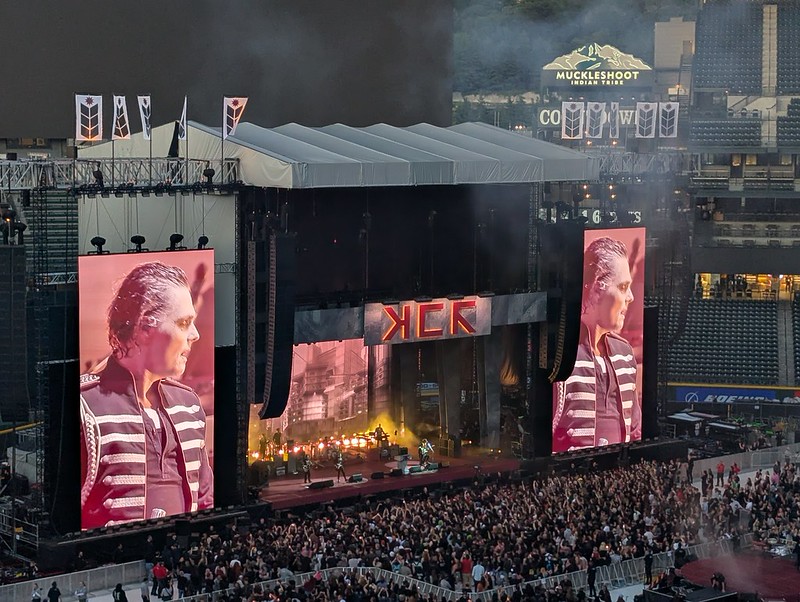
As the band tours The Black Parade for its 20th anniversary, the members have rejected nostalgia in favor of a new storyline, playing alter-ego characters who have been conditioned to perform for a dictator. The plot, slightly shifting night to night, encourages fans to follow along.
In the first run of the tour, each concert paused midway for an “election.” Four hooded figures walked out to the center stage. Nearby, an army official watched. Singer Gerard Way asked the audience to vote: Support these candidates or reject them? Each person in the crowd had a sign. One side: YEA. The other side: NAY.
“Now we need to hear you,” Way says. The audience roars, jeering and cheering.
No matter the spectators’ will, the result is the same: execution.
The warped election – and the sound of The Black Parade – reflects the absurdism of authoritarianism. Here is a democracy that ends in death, regardless of how you vote. Viewers log into livestreams to watch the fanfare repeat.
MCR’s commentary echoes the ramping authoritarianism and upheaval in the United States:
- The Supreme Court cleared the way for immigration agents to use race as a reason to stop and check someone’s citizenship documents. Daily ICE arrests reached a decade high last year. 2025 also marked the deadliest year for people in ICE custody in two decades.
- Protests have swept the nation, with outrage further increasing after federal agents killed two Minneapolis demonstrators this January.
- Cuts and changes to Medicaid and SNAP are on their way. The longest government shutdown also ended without extending subsidies for health care.
- The Epstein files were released, showing ties between powerful leaders and sex offender Jeffrey Epstein.
- The Department of Governmental Efficiency, named after an outdated Internet meme (DOGE), has resulted in the elimination of at least 290,000 jobs.
- The U.S. withdrew from the Paris Agreement and World Health Organization. The country also pulled out of 66 international organizations.
- Trump continues to enact steep tariffs after a Supreme Court ruling against his policy.
- Layoffs soared past 1.1 million job cuts in 2025, the highest since 2020’s COVID-19 shutdown.
This list represents a fraction of stories and executive orders in 2025; a “flood the zone” strategy overwhelmed the news cycle. Despite censorship efforts – such as the federal defunding of NPR and PBS – much of this information is available to us at the click of a button. State-sanctioned propaganda even encourages the spectacle. Just take a look at footage of ICE raids on the WhiteHouse’s TikTok account, set to songs and images of pop stars:
Yet fatigue and fearmongering keep many complacent; looming economic crises also draw our attention and time. I do not mean to diminish people’s efforts of resistance. But I am interested in the way technology has expanded our potential to witness violence, without ever requiring us to act – as well as the power of entertainment to distract.
So I turn back to MCR’s spectacle, which twists and mirrors this descent into fascism. Up against the tour’s faux-executions, the boos and the cheers of the crowd collapse into a cacophony. I locate the sound of our times within these screams, where dissent seems to go unheard and melds into the chorus of support.
The Black Parade is full of these bombastic wails, but the most intense of them are in “Mama,” a song that balloons into an extended eight-minute performance in the Long Live the Black Parade Tour. Within “Mama,” I try to make some sense of these screams, finding queer resonance with the present moment.
With my analysis, I ask: How might we hold fascist figures to account without squirming out of our own role in the daily exchange of authoritarianism? I argue My Chemical Romance’s 2025-2026 performance of “Mama” highlights structures of violence but also criticizes our participation within them.
In “Mama,” the indulgence of sin is contagious. It’s loud. It’s repeated: “Mama, we all go to hell.” This refrain, set to a polka beat, creates an abject intimacy around our shared fate. Queer listeners have interpreted this song as an angry anthem against the rejection we face from our families and dogmatic religion. For those of us who have heard, “You’re going to hell,” the response, “We all go to hell,” serves as a relief. Verses like “You should’ve raised a baby girl, I should’ve been a better son” have been reclaimed by transgender fans.
Other fans have taken issue with these interpretations, arguing queer attachments distract from the “true” meaning of the song. Indeed, “Mama” tells the story of a soldier writing from the trenches of war, while his mother judges him from afar. But I argue that by placing a queer reading in tandem with the canonical narrative, generative meanings emerge. Queer theory provides tools to understand the role of the mother here. Mama is the title of the song. Mama is pervasive. Mama is mean. Mama is on his mind. But she is also almost entirely absent, avoiding accountability for her son’s violence and instead blaming him: “She said, ‘You ain’t no son of mine.’”
The soldier finds that the trenches are not just his domain, but also his mama’s: “Mama, we’re all full of lies…And right now, they’re building a coffin your size.” His plea to his mother helps us wonder: What about the culture that birthed this violence? In this metaphor, critiquing the mother extends to critiquing the nation.
At the climax of the song, these sentiments come through screams: 30 seconds of an extended, “AHHHHHH” and a crying out of, “Mama, Mama, Mama.” In these wails, I find a soldier begging to share responsibility with his motherland, even as he contends with his own role in the violence. The cries puncture the polka, demonstrating “Mama” is not a celebration, after all.
Mama only sings one line back, through the voice of theater icon Liza Minnelli: “And if you would call me a sweetheart/I’d maybe then sing you a song.” Minnelli’s voice connects the song’s sound to her role in Cabaret, a musical which mixes together queer aesthetics and indulgent decadence with a foreboding rise of fascism. This allusion to Cabaret, as well as the tour performance, serve as a reminder: pleasure and entertainment does not always equal resistance.
In the extended version of “Mama” on tour, these lines are sung by an opera singer, whose voice, too, serves the dictator. Preceding her performance, the song briefly opens up a space for resistance. A new section of the song, debuted on the tour, includes the lyrics:
A dagger, a dagger
Please fetch me a dagger
A tool for our treasonous needs…
With tears in our eyes we collapse on the crosses
And said death be the son of us all
This war is the son of us all.
Even as Gerard Way’s character plots treason against the dictator, these new lyrics make clear: this “death” and “war” is “the son of us all.” Though we might want to pin fascism on one figure, many Americans have participated in the creation of this “death/war.” There are fatal consequences for our collective actions – or our passivity.
Ultimately, the dramatics of this song, delivered like a sinister weapon, critique violence, while ironically trapping us in its pleasures. If prayer is crying out to our father who art in heaven, “Mama” is yelling back at our mother to bring her to where she belongs: the hell in which we both exist. Given the stakes of our political moment, I argue we need to scream louder, with purpose and strategy, against our motherland.
—
Featured Image: “My Chemical Romance Live at T-Mobile Park 6/11/25,” Image by Flickr User Laura Smith CC BY-ND 4.0
—
Max Lubbers (he/she) is a first-year PhD student in the American Studies and Ethnicity department at the University of Southern California. His research centers on transgender affects and sounds. Max earned a bachelor’s degree in Journalism and Gender and Sexuality Studies from Northwestern University, with a senior thesis on butch affect. She previously worked as a journalist, with pieces in Chicago’s NPR station, Colorado Public Radio, and Windy City Times.
—

REWIND!…If you liked this post, check out:
The Sounds of Equality: Reciting Resilience, Singing Revolutions–Mukesh Kulriya
Vocal Anguish, Disinformation, and the Politics of Eurovision 2016–Maria Sonevytsky
“To Unprotect and Subserve:” King Britt Samples the Sonic Archive of Police Violence —Alex Werth
—
Share this:

Boom! Boom! Boom!: Banda, Dissident Vibrations, and Sonic Gentrification in Mazatlán


This series listens to the political, gendered, queer(ed), racial engagements and class entanglements involved in proclaiming out loud: La-TIN-x. ChI-ca-NA. La-TI-ne. ChI-ca-n-@. Xi-can-x. Funded by an Andrew W. Mellon Foundation as part of the Crossing Latinidades Humanities Research Initiative, the Latinx Sound Cultures Studies Working Group critically considers the role of sound and listening in our formation as political subjects. Through both a comparative and cross-regional lens, we invite Latinx Sound Scholars to join us as we dialogue about our place within the larger fields of Chicanx/Latinx Studies and Sound Studies. We are delighted to publish our initial musings with Sounding Out!, a forum that has long prioritized sound from a queered, racial, working-class and “always-from-below” epistemological standpoint. —Ed. Dolores Inés Casillas
—
DOI: https://doi.org/10.59350/astzz-ep180
Boom! Boom! Boom! Da-da-da-da-da— The unmistakable blast of the tuba and the resounding crash of cymbals, embedded in banda sinaloense, reverberate through the narrow streets of Mazatlán, Sinaloa. It’s a sound that shakes you to your core, quite literally—a sound that some may find overwhelming but for others, it’s the heartbeat of the city. Yet, this very heartbeat is increasingly at odds with a new rhythm, imposed by the influx of white American settlers (retirees, snow birds) and tourists who prefer quieter, more sanitized (less sucio) soundscapes. Public debates about sound – its volume, its rightful “place” – demonstrate how sonic gentrification displaces local, cultural identities and highlights the impact of globalization on indigenous soundscapes.. In a city where culture has always been expressed loudly and proudly, this clash is more than just about volume; it’s about identity, survival, and the right to exist audibly.
Banda is unapologetically brass-heavy with its tubas, trumpets, clarinets, and trombones–direct inheritances from the German brass bands brought to Mexico in the late 19th century by German immigrants and traders. Helena Simonett’s hallmark book, Banda: Mexican Musical Life Across Borders, details how the influence of polka is unmistakable in the rhythmic patterns of banda, with its characteristic 2/4 meter and the upbeat, driving rhythms that push the music forward. Both styles share repetitive rhythmic, danceable, lively tempos and showcase the tuba’s full, resonant sound. In polka, the tuba provides a consistent “oom-pah” bass line, while in banda, the tuba drives the harmonic structure with deep, grounding tones that propel the music forward, often in a steady and rhythmic pulse that mirrors the polka bass line. The accompanying tambora, a large bass drum unique to the genre, adds an unmistakable Mexican flair, infusing banda music with rhythmic accents that tie it back to the Mexican dance traditions of sones and norteños. With the loud combination of brass and tambora blaring through the city, it’s understandable that white tourists and settlers would feel a dissonance between the soundscape and their Western settler notions of respectability.

Sonic gentrification refers to the process in which local auditory cultures are marginalized or displaced by soundscapes that cater to the preferences of more affluent or dominant groups as Marie Thompson discusses in Beyond Unwanted Sound (2017). This concept aligns with Stoever’s “listening ear,” which privileges certain auditory experiences—such as quiet and controlled soundscapes favored by Western tourists—while marginalizing others. This phenomenon in Mazatlán manifests through tensions surrounding the sounds of banda, increasingly heard as incompatible with the tranquil settings promoted by the tourist industrial complex. To Western ears unaccustomed to such instruments blaring through their environments, banda is heard as intrusive or abrasive. Yet, banda was never meant to be quiet or contained; it’s a celebratory proclamation of life itself.
As a symbol of the region’s cultural, namely working-class identity, banda’s shaky acceptance dates back to when nobility regarded banda as music of the commoners. It is often mariachi music, with its more melodic and string-dominated compositions, that is seen as “easier on the ear” and perceived as a more sophisticated representation of Mexico’s soundscape— incidentally hailing from a racially whiter region of Mexico. Reclaiming banda as a proud symbol of Northern Mexican culture is a direct challenge to both the casteism of Spanish settlers and the sonic imperialism imposed by white American settlers.
The response by local musicians to new ordinances aimed at limiting live banda performances on Mazatlán’s beaches are being met with “dissident vibrations.” Or, as I describe, when a musical collective effervescence can be harnessed to challenge dominant structures and create spaces for marginalized voices to assert their rights and identities. In Mazatlán, these dissident vibrations took on a visible and visceral form when a viral video showed tourists enjoying a classical guitar performance inside a hotel while the energetic sounds of banda blasted from the beach just outside.
Y hoy los músicos de Mazatlán tomaron las avenidas principales del puerto 🙌🏼 pic.twitter.com/6LOQ8axGu7— Revista ESPEJO (@EspejoRevista) March 27, 2024
This video sparked a heated online debate about noise levels, with some tourists and local authorities advocating for more restrictions on banda music. Soon after, the conversation escalated with a public notice at a condominium complex prohibiting the hiring of live bands in the beach area—a move that directly impacted local banda musicians who depend on beach performances for their livelihood.
The tensions culminated in a nine-hour protest, during which hundreds of musicians marched through the streets of Mazatlán, playing their instruments in defiance of the regulations that aimed to control the noise. Their march, which eventually turned into a riot after clashes with police, was a sonic manifestation of resistance, challenging the regulations that limited not only the number of live banda performances but also attempted to regulate the very essence of Mazatlán’s cultural identity. These acts of dissident vibrations served as powerful counter-narratives to the dominant discourse that seeks to sanitize public spaces from their vibrant soundscapes. These musicians not only contested their economic marginalization but also championed the existential right of their culture to flourish in its native setting, resisting efforts to reduce their sound to mere noise in favor of tourist comforts. Their defiance highlights the complex interplay between cultural and economic survival, identity, and resistance within the broader context of globalization and cultural homogenization.
Critics who dismiss banda often fail to appreciate its rich harmonics and historical significance in the cultural landscape of Mazatlán. By reducing this music to mere noise, they overlook the deep-rooted connections it fosters within local communities and its role as a communal bond reflecting the spirit and resilience of the people. Such dismissals prioritize the comfort of tourists over the cultural rights of the local population, further entrenching inequalities between those who advocate for cultural integrity and those who perceive the city merely as a short-term, leisure destination.The role of banda in Mazatlán, an exemplary case of sonic gentrification, raises essential questions about who has the authority to define the cultural and sonic boundaries of public spaces.
Sonic gentrification in Mazatlán serves as a poignant example of global discussions on cultural identity, heritage, and the impacts of globalization on local communities. But this isn’t just a local issue; banda has followed the Mexican diaspora, becoming an audible assertion of identity in cities across the United States. The call to action is clear: to preserve banda not as a relic of the past, but as a living, breathing sound that defines working class public spaces of color far beyond Mexico’s borders. Whether in Los Angeles, Chicago, or Houston, these vibrant sounds demand to be heard, and more importantly, understood. The beat of the tuba and tambora still thunder on, daring us to listen.
—
Featured Image: “Todos dorados” by Flickr User Juanantibes CC BY-SA 2.0
—
Kristie Valdez-Guillen, PhD, is an interdisciplinary scholar whose work bridges the fields of musicology and decolonial studies. With a PhD in Musicology from UCLA and advanced training in American Studies and Ethnicity at USC, her research delves into the critical intersections of decoloniality, music, and politics across the Americas and the Caribbean. Currently, she brings her expertise to USC’s Writing Program, where she teaches first-year and first-generation students, with a focus on writing across disciplines. Dr. Valdéz-Guillén is dedicated to fostering critical thinking and empowering the next generation of scholars and writers.
—

REWIND!…If you liked this post, you may also dig:
Ronca Realness: Voices that Sound the Sucia Body—Cloe Gentile Reyes
Echoes in Transit: Loudly Waiting at the Paso del Norte Border Region—José Manuel Flores & Dolores Inés Casillas
Listening to MAGA Politics within US/Mexico’s Lucha Libre –Esther Díaz Martín and Rebeca Rivas
—
Share this:




Current Top Posts



April 2021
January 2020

November 2019

October 2019

August 2019

April 2014

November 2017
March 2015

December 2017

October 2015


Recent Comments