
Misophonia: Towards a Taxonomy of Annoyance

 This is the second post in Sounding Out!’s 4th annual July forum on listening in observation of World Listening Day on July 18th, 2015. World Listening Day is a time to think about the impacts we have on our auditory environments and, in turn, their effects on us. For Sounding Out! World Listening Day necessitates discussions of the politics of listening and listening, and, as Carlo Patrão shares today, an examination of sounds that disturb, annoy, and threaten our mental health and well being. –Editor-in-Chief JS
An important factor in coming to dislike certain sounds is the extent to which they are considered meaningful. The noise of the roaring sea, for example, is not far from white radio noise (…) We still seek meaning in nature and therefore the roaring of the sea is a blissful sound. Torben Sangild, The Aesthetics of Noise
DOI: https://doi.org/10.59350/a6m7p-4k290
When hearing bodily sounds, we often react with discomfort, irritation, or even shame. The sounds of the body remind us of its fallible and vulnerable nature, calling to mind French surgeon René Leriche’s statement that “health is life lived in the silence of the organs” (1936). The mind rests when the inner works of the body are forgotten. Socially, sounds coming from the organic functions of the body such as chewing, lip smacking, breathing, sniffling, coughing, sneezing or slurping are considered annoying and perceived as intrusions. A recent study by Trevor Cox suggests that our reactions of disgust towards sounds of bodily excretions and secretions may be socially-learned and vary according to whether it is considered acceptable or unacceptable to make such sounds in public.

However, for people suffering from a condition called Misophonia, these bodily sounds aren’t simply annoying, rather they become sudden triggers of aggressive impulses and involuntary fight or flight responses. Misophonia, meaning hatred of sound, is a chronic condition characterized by highly negative emotional responses to auditory triggers, which include repetitive and social sounds produced by another person, like hearing someone eating an apple, crunching chips, slurping on a soup spoon or even breathing.
The consequences of Misophonia can be very troublesome, leading to social isolation or the continuous avoidance of certain places and situations such as family dinners, the workplace and recreational activities like going to the cinema. While rate of occurrence of new cases of Misophonia in the population is still under investigation, the fast growing number of online communities gathered around the dislike of certain sounds may indicate that this condition is more common than previously thought.
But why do people with Misophonia feel such strong reactions to trigger sounds? This fundamental question remains up for debate. Some audiologists suggest these heightened emotional responses can be explained by hyperconnectivity between the auditory, limbic and autonomic nervous systems. However, we continue to lack a comprehensive theoretical model to understand Misophonia, as well as an effective treatment to help sufferers of Misophonia cope with intrusive sound triggers.
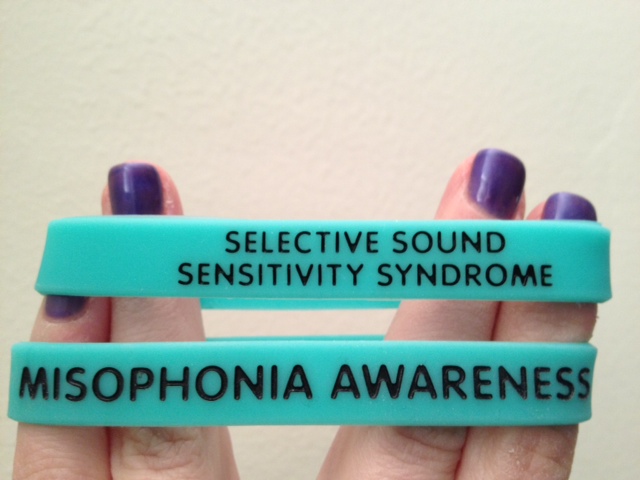
The Art of Annoyance: is it possible to reframe misophonic trigger sounds as misophonic music?
Between 1966 and 1967, John Cage and Morton Feldman recorded four open-ended radio conversations, called Radio Happenings (WBAI, NYC). Among many topics, Feldman and Cage address the problem of being constantly intruded upon by unpleasant sounds. Feldman narrates his annoyance with the sounds blasted from several radios on a trip to the beach. Cage’s commentary on the growing annoyance of his friend reveals a shift of perception in dealing with unwanted sounds:
Well, you know how I adjusted to that problem of the radio in the environment (…) I simply made a piece using radios. Now, whenever I hear radios – even a single one, not just twelve at a time, as you must have heard on the beach, at least – I think, “Well, they’re just playing my piece.-– John Cage, Radio Happenings.
Cage proposes a remedy via appropriation of environmental intrusions. The negative emotional charge associated with them is neutralized. Sound intrusions no longer exist as absolute external entities trying to intrude their way in. They become part of the self. Ultimately, there are no sonic intrusions, as the entire field of sound is desirable for composition.
Cage’s immersive compositional anticipated an important strategy to build resilience towards aversive sound: exposure-based cognitive-behavioral therapy, which proposes a gradual immersion in trigger sounds. And I suggest we can mine the history of avant-garde practice to productively further the idea of immersion; in the realms of sound poetry, utterance based music, Fluxus events and many other sound art practices, bodily sounds have consistently been exalted as source of composition and performance. Much like Cage did with what he perceived as intrusive radio sounds, by performing chewing, coughs, slurps and hiccups, assembling snores and nose whistles, and singing the poetics of throat clearing, we may be able to elevate our body awareness and challenge the way we perceive unwanted sounds. In what follows, I sample these works with an ear toward misophonia, discussing their interventions in the often jarring world of everyday irritation.
Oral Oddities
As pointed out by Nancy Perloff, while the avant-garde progressively expanded to incorporate the entire scope of sound into composition, sound poetry followed a similar course by playing with the non-semantic proprieties of language and exploring new vocal techniques. The Russian avant-garde (zaum), the Italian futurists (parole in libertà) and the German Dada (Hugo Ball’s verse ohne Worte) built the foundations of a new oral hyper-expression of the body through moans, clicks, hisses, hums, whooshes, whizzes, spits, and breaths.
Henri Chopin, Les Pirouettes Vocales Pour Les Pirouettements Vocaux
Sound poets like Henri Chopin created uncanny sonic textures by only using ‘vocal micro-particles’, revealing a sounding body that can be violent and intrusive. François Dufrêne and Gil J Wolman brought forward more raw and glottal performances.
Bridging the gap between the Schwitter’s Dada-constructivism and a contemporary approach to sound poetry, Jaap Blonk’s inventive vocal performances cover a wide range of mouth sounds. In the same vein, Paul Dutton explores the limits of his voice, glottis, tongue, lips and nose as the medium for compositions — as can be heard on the record Mouth Pieces: Solo Soundsinging.
Paul Dutton, Lips Is, Mouth Pieces: Solo Soundsinging
Fluxus: Eat, Chew, Burp, Cough, Perform!
The Event is a metarealistic trigger: it makes the viewer’s or user’s experience special. (…) Rather than convey their own emotional world abstractly, Fluxus artists directed their audiences’ attention to concrete everyday stuff addressing aesthetic metareality in the broadest sense. Hannah Higgins, Fluxus Experience
The emergence of Fluxus is strongly linked to Cage’s 1957-59 class at New School for Social Research in NYC. George Bretch’s Event Score was one of the best known innovations to emerge from these classes. The Event Score was a performance technique drawn from short instructions that framed everyday life actions as minimal performances. Daily acts like chewing, coughing, licking, eating or preparing food were considered by themselves ready-made works of art. Many Fluxus artists such as Shigeko Kubota, Yoko Ono, Mieko Shiomi, and Alison Knowles saw these activities as forms of social music.
For instance, Alison Knowles produced several famous Fluxus food events such as Make a Salad (1962), Make a Soup (1962), and The Identical Lunch (1967-73).
Also, Mieko Shiomi‘s Shadow Piece No. 3 calls attention to the sound of amplified mastication, while Philip Corner’s piece Carrot Chew Performance is solely centered in the activity of chewing a carrot.
Philip Corner, Carrot Chew Performance, Tellus #24
In Nivea Cream Piece (1962), Alison Knowles invites the performers to rub their hands with cream in front of a microphone, producing a deluge of squeezing sounds:
Alison Knowles – Nivea Cream Piece (1962) – for Oscar (Emmett) Williams
Coughing is a form of love.
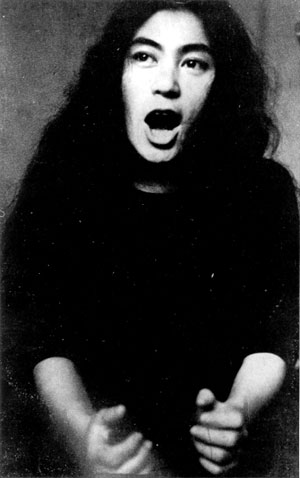 In 1961, the Fluxus artist Yoko Ono composed a 32 minute, 31 second audio recording called Cough Piece, a precursor to her instruction Keep coughing a year (Grapefruit). In this recording, the sound of Ono’s cough emerges periodically from the indistinct background noise. The Cough Piece plays with the concept of time, prolonging the duration of an activity beyond what is considered socially acceptable. While listening to this piece, Yoko Ono brings us close to her body’s automatic reflexes, pulling back the veil of an indistinct inner turmoil. Coughing can be a bodily response to an irritating tickling feeling, troubled breathing, a sore throat or a reaction to foreign particles or microbes. In response, coughing is a way of clearing, a freeing re-flux of air, a way out. Coughing is a form of love.
Yoko Ono – Cough Piece

Sonic Skin
In the work The Ego and the Id (1923), Sigmund Freud stated that the ego is ultimately derived from bodily sensations. The psychoanalyst Didier Anzieu expanded this idea by suggesting that early experiences of sound are crucial to consolidate the infant’s ego. The bath of sounds surrounding the child created by the parent’s voices and their soothing sounds provides a sonorous envelope or an audio-phonic skin that protects the child against ego-assailing noises and helps the creation of the first boundaries between the inside and the external world. The lack of a satisfactory sound envelope may compromise the development of a proper sense of self, leaving it vulnerable to invasions from outside.
It’s no surprise that conditions like Misophonia exist and are very common among us, considering how important our early exposure to sound is in building our sense of self and our sensory limits. For Misophonics, the everyday sounds we make without even thinking about them can be the source of a fractured and disruptive experience that we should not dismiss as the overreactions of a sensitive person. During the month we observe World Listening Day, our discourse usually praises the pleasures of listening and tends to focus on the sounds that soothe rather than annoy. However, conditions like Misophonia show us that there is much more that needs to be said on the subject of unpleasant sound experience. I can’t help but notice a disconnect between the vast exploration of annoying and irritating sounds in the avant-garde and the critical discourse in our sound communities that is dominated by the pleasures of listening. Cage’s call to embrace intrusive sounds urges us to consider all sounds regardless of where they fall on the spectrum of our emotions. For all of us who would consider ourselves philophonics, let’s create a critical discourse that addresses the struggles of listening as much as its pleasures.
—
Thanks to Jennifer Stoever for the thoughtful suggestions.
—
 REWIND! . . .If you liked this post, you may also dig:
Share this:

Sounding Our Utopia: An Interview With Mileece

DOI: https://doi.org/10.59350/g1wyx-a2c67
There is no utopia without nature. Life is already a utopia–Mileece
When I heard sound artist and environmental researcher Mileece refer to utopia as she presented on her bio-sound work this past year for MOMA’s PSA1 series “Speculations: The Future Is ____” I was startled and intrigued. When I asked Mileece to delve further into her conception, Mileece explained how when faced with an environment lacking flora–such as on a recent trip to India where she spent a lot of time in a cityscape heavy with apartment blocks–she noticed that finally coming upon a garden outside a temple or other flush area felt like utopia. “I’m referring to an ecological utopian society, not a fictional one.” Mileece told me, “But either way, what we imagine as a perfect society always comes with fruit. Nature makes man right in the head. Without it, things get really rough. With it too of course, but you can see what happens to people deprived of green.” Her participatory art installations explore and communicate her sense of the lushness and sensory surprises of the natural world.
Mileece is a internationally acclaimed, multi- disciplinary sonic artist and renewable energy ambassador. Her work “promoting ecology through technology and the arts’ has brought her international critical acclaim as a composer and installation artist. Formations, her debut album, inspired by cycles and formations in nature (“beautiful, real, musical science,” BBC), was the result of her initial works in computer generated compositions, using Super Collider, an object-oriented programming language.–Decibel festival bio
.
Mileece and I recently continued our conversation via Skype–she in the city of Jaisalmer in Rajasthan performing camera and sound work on mouthharps, and me in my studio in Lisbon, Portugal–what follows is a transcript of our talk. Mileece had just finished showing in Bhutan, where she created an installation in a dome at their first international festival.
—
Maile Colbert: Was the installation [in Bhutan] related to the work you did recently in MOMA [at POPRALLY in February 2013]?
Mileece: similar in being an installation with interactive plants and sensors.
.
MC: And when you are home and in the studio, what does your day look and sound like?
M: That depends on much. The last project I did before leaving for Bhutan was a dome at a school, which had me with a shovel in garden clothes up early onsite, then home late, so I wasn’t in the studio at all. Then I worked on the plant interface for Bhutan and generally to get a public interface finished-hardware and software as pre-made wireless ‘off the shelf’ devices and learning kits that I can distribute to people and artists and do more complex projects with. So at random hours, when my colleague who is helping me with the engineering aspects had a moment, we would sit and quickly go over the builds. I did recently decide I want to do a less intensely computer based project, so completely rearranged my studio, borrowed a loop station, bought a gold guitar and started to ‘jam’. It’s something I’ve never done before. I’ve had days where it’s fourteen hours working constantly in the studio, tweaking buttons and writing code. But it all depends…
.
MC: So, does each project tend to take you into something new…new tools, new methodology…or do you think you work like that because that’s how you like it, to be an exploration as well as a process?
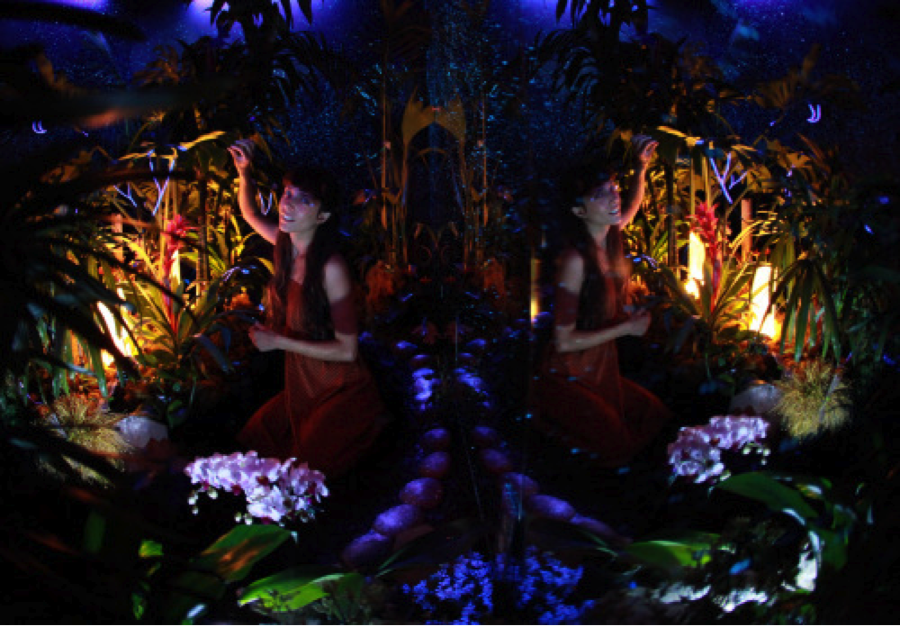
M: I’m always refining, but the software I wrote is 10 years old now and I’ve been working on the plant project for about 15 years. “Soniferous Eden” is an installation series where interior spaces are transformed into star-studded micro-ecologies, where lush groves of plants generate rich and dynamic soundscapes in response to the touch and presence of the participants, who can saunter barefoot in moist soil amongst them. I’m always working on it, whether the code, concept, or its elements.
.
M (cont. . .): Every time I do an installation it’s site specific, so never the same, and generally it’s evolved into a variety of different types with focus on various objectives. For example, the dome at the school is a bio-library and sound sanctuary, where I created a pond, dry creek, planted area, and interactive sitting ‘pods’ inside a dome so kids can read and be in a seemingly natural environment, sitting on the ground in a way that is ergonomic and triggers soundscapes when they are still. There is an array of benefits to being around plants and within a ‘high fidelity’ acoustic environment, as R. Murray Schafer would call it (from whose works some of the concepts were modeled)…from helping the parts of the brain dealing with abstract thinking, to developing memory and social skills. It’s argued that attention deficit disorder is a behavioral issue that can be traced to the decrease in natural habitat available to children.
On other projects, such as for Bhutan, more emphasis was on the interactivity with the plants themselves, so I worked on the code of the plant synths, written in SuperCollider, an object-oriented programming language.
I’m not really reinventing at this point, just tweaking and improving. Although, having said that, for these next projects there are significant advancements in the works…it’s like invention. Sometimes I make new sensors and design new sounds, but since my work has spanned quite a variety of stuff from renewables to software to gardens, each one evolves slowly.
MC: Can you tell us a bit about your background and where you are from? And what from this do you think led you to “Tree We’vr”, and working with biofeedback data of plants?
M: I’m from England and grew up in multiple cities (London, New York, Los Angeles) and the countryside equally, so I was exposed to rural and urban environments. I saw The Secret Life of Plants when I was around nineteen, and a couple of years before that Mobius 8 had shown me his work with MIDI and sensors.
M (cont. . .): I had imagined holographic plants (my mum did holography in the 80’s)…which then seemed completely uninteresting since plants THEMSELVES could iterate music.
MC: Have you always had an interest in micro-worlds? What about worlds barely perceptible to us interests you?
M: Yes, micro-worlds…love that. In Suffolk, where I grew up for some time, we had this greenhouse and I remember making this tiny micro-garden in it. I LOVED it and was just mortified when my father told me it needed to be torn down for being unsafe, which he did by getting riotously pissed with his best friend and driving the Range Rover through it.
I have great respect and love for the world and living things. I truly ache for the well being of plants and animals and most people so overall I am dedicated to helping support a healthy ecology, in the holistic sense of the word. And sometimes these ‘hidden things’ are what makes the link to show up the ‘livingness’ and connection we are lacking…the ‘magic’ we need to see and touch to remember that we are a spinning spool of intangible energy organized and perpetuated only by our own existence.
MC: Do you feel your sonification with plants as an instrument, or translation? Can you describe the connection you have with a plant when working with it…is it emotional, scientific, intellectual curiosity…a mix? Is it a dialogue?
M: Nail on the head. My work as an artist is to find the balance between the two. I call it aesthetic sonification, as what you are looking to do is relay data in a way that people understand it, which isn’t necessarily how it iterates, as there are psychoacoustics and other human factors as to how we interpret sound that need to be considered when you are translating information into the sonic realm. So you find a way to relay the information, then make it beautiful for both the human and the plant to be able to enjoy, which is key to art being successful. It’s a balance, and that is my job. That is where I see the necessity for artistry and mastery, and where I try to get it right. The rest is understanding the technicalities.
.
M (cont. . .): An instrument holds potential as a set of elements and offers a composer/musician that spectrum of potential to weave from. The limitations are the possible manifestations of that potential as choreographed by the degree of expertise of the musician/composer. Sonification doesn’t care about weaving potentials, it wants to be direct as possible. The degree of articulation of the information is a strictly technical matter. So I am somewhere in there, where the sonification is the limitation of the instrument, and the instrument is the plant and interface.
MC: Do you find people understand your work? How much of understanding what you do is important for you to have from your audience?
M: b A whole spectrum of folk come and make use of the installations. Though perhaps not many thoroughly understand my work, most understand the consequence. When I explain what I’m doing I don’t usually get vacant stares, most people follow. I don’t really have an audience, I have participants, so people do a thing, and a thing happens…then they wonder how, and they can find out. Their curiosity leads them on that journey of discovery, and it doesn’t really matter, the issue is plants are alive more than we thought. So long as someone walks away with that, that’s right and good. And if the music and ambience moves them, that’s best.
An instrument holds potential as a set of elements and offers a composer/musician that spectrum of potential to weave from. The limitations are the possible manifestations of that potential as choreographed by the degree of expertise of the musician/composer. Sonification doesn’t care about weaving potentials, it wants to be direct as possible. The degree of articulation of the information is a strictly technical matter. So I am somewhere in there, where the sonification is the limitation of the instrument, and the instrument is the plant and interface.
.
MC: You mentioned once plants “lacking representation”…I find this intriguing, can you tell us more about this concept?
M: There really isn’t one part of our economy that doesn’t rely on the exploitation of plants, either themselves or their habitat. We have rights for animals, rights for people, and we know we abuse them often, as there are representatives who tell us so. But we don’t often think about the plants, and the plants are also living. They support life, all life almost, so we have to start thinking about that. They are now using ‘excess’ plant energy to power devices. I find this idea of ‘excess’ interesting, like over 90% of our DNA is junk, and 94% of the Universe is ‘dark’. I wouldn’t like to be so assertive.
MC: What tends to happen with the sound from the plants when they are touched? Does it depend on the kind of touch? Does it depend on the kind of plant, or where it is touched? Do plants scream? Or is this anthropomorphizing?
M: Plants emit indicators, best known to be chemical, when they experience threats or distress. The smell of freshly cut grass for example, this is a chemical emitted by the plants to express distress. So ‘screaming’ is an anthropomorphic viewpoint on that possibly unemotional ‘response,’which is what plant biologists would commonly call it. This is because we don’t understand plant biology well. They have systems to take in a calculate information, make decisions, and produce self-regulated results, but we have a hard time figuring that out since it isn’t in the form of what we say is required of sentient beings… a nervous system and a brain. But no, it doesn’t matter where you touch a plant, that doesn’t make different sounds, at least that I can tell. I don’t have scientific instruments, I have arty ones, so they aren’t accurate enough to make precise measurements or declarations. I’m in the experience, not research department. The synths I’ve written are modulated by the current from the plant, so the sound changes in direct function of the modulation of the current, which changes with touch or presence and general livingness.
.
[. . .]
MC: You go way beyond trend or gimmick, you have been doing this a while. Where do you think your work is going? Do you have more in this vein to explore…is it leading somewhere you can share with us?
M: I’m currently working with Eden Labs and some other partners at UCSD on a project engaging custom made technology to hybridize with living systems, forging lucid and direct connections between the inner city and wild ecologies in real time.
—
All images courtesy of the artist
—
Maile Colbert is a multi-media artist with a concentration on sound and video who relocated from Los Angeles, US to Lisbon, Portugal. She is a regular writer for Sounding Out!
—
REWIND!…If you liked this post, you may also dig:
Sounding Out! Podcast #34: Sonia Li’s “Whale”
Sound Designing Motherhood: Irene Lusztig & Maile Colbert Open The Motherhood Archives— Maile Colbert
Playing with Bits, Pieces, and Lightning Bolts: An Interview with Sound Artist Andrea Parkins— Maile Colbert
—
Share this:




Current Top Posts





April 2021

January 2020

November 2019

October 2019

August 2019

April 2014

November 2017

March 2015

December 2017

October 2015


Recent Comments