
Playing with the Past in the Imagined Middle Ages: Music and Soundscape in Video Games
DOI: https://doi.org/10.59350/s68q1-37217
Each of the essays in our “Medieval Sound” forum focuses on sound as it, according to Steve Goodman’s essay “The Ontology of Vibrational Force,” in The Sound Studies Reader, “comes to the rescue of thought rather than the inverse, forcing it to vibrate, loosening up its organized or petrified body (70). These investigations into medieval sound lend themselves to a variety of presentation methods loosening up the “petrified body” of academic presentation. Each essay challenges concepts of how to hear the Middle Ages and how the sounds of the Middle Ages continue to echo in our own soundscapes.
Read all the previous posts here, and, HEAR YE!, in April 2017, look for a second series on Aural Ecologies of noise! –Guest Editors Dorothy Kim and Christopher Roman
–
Freed though they have been from the historiographical pit of the Dark Ages, the Middle Ages inevitably slip ever further into the past. Nonetheless, they have never been easier to visit. We have but to open our computers or turn on our televisions to be transported into the past. As any good Sci-fi show will tell you, we must be careful when we travel into the past; we can change things.
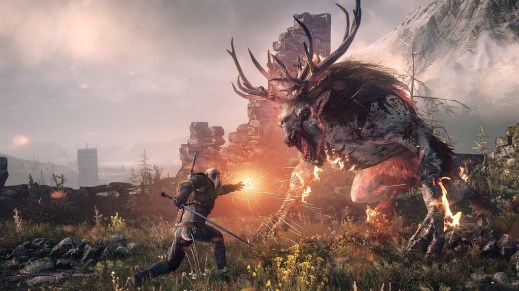
The medium on which I wish to focus – videogame – relies precisely upon on this ability to affect change. It takes aspects of filmic medievalism but must also confront an intrinsic interactivity. This interactive capacity may seem to authenticate further the experience of the past by creating a rich and responsive world but it also frees aspects of narrative agency from the control of game designers, composers, and sound engineers. In this article, I will demonstrate some of the ways in which issues of space/place, identity, orientalism/otherness, and the norms of the medium itself can play out. In recomposing the past – be that with a nod to authenticity, within the realms of historical metafiction, or even the imagined (neo-)medievalism of the fantasy genre – videogames create something that sits between the past and present that nonetheless has a profound effect on the public conception of the medieval soundscape. My focus here is on CD Projekt Red’s high-fantasy game The Witcher III: Wild Hunt, addressing not only the musical score but also wider aspects of soundscape such as vocal accent, foley, and manipulation of the aural field.
.
The genre of fantasy could be described as medievalist in origin and aesthetic, taking clear inspiration from the medieval world and often using it, or a close approximation, as a geographical, historical, and cultural setting. Many of the more fantastical elements of fantasy too are drawn from medieval bestiaries and the genre of the medieval romance. The late Umberto Eco popularised the term neo-medievalism, albeit in a rather pejorative sense and in opposition to ‘responsible philological study’, to describe this interaction between medieval history and the fantastical. Perhaps due to the rather negative associations of neo-medievalism, both terms tend to be used somewhat interchangeably today.
A divide could perhaps be suggested as to whether medieval aspects are presented as unproblematic and nostalgic, or treated in a more critical and distanced manner. For instance, David Marshall defines neo-medievalism as ‘a self-conscious, ahistorical, non-nostalgic imagining or reuse of the historical Middle Ages that selectively appropriates iconic images…to construct a presentist space that disrupts traditional depictions of the medieval.’ In contrast, Kim Selling notes of medievalism that, after the breakdown of modernist historical metanarratives, the pre-modern world of the medieval offers a ‘rich, satisfying, and authentic’ counterpoint to the ‘profound social, spiritual, and political dislocation’ of postmodernism. From this viewpoint, the world of medievalist fantasy offers pure escapism back to a world in which old certainties can be re-asserted; perhaps, as Elkins notes, a reaction against the rationalistic, anti-heroic, materialist, and empiricist bent of modern society.
Regardless of the author’s framing of ‘the medieval’, it offers many narrative advantages. As Kim Selling has noted, in placing an imagined world in a simplified version of the Western European Middle Ages, the fantasy author can make use of narrative shorthands. The world of kings, queens, knights, peasants, dragons, magic, witches, and elves is already known from myth and fairy tale. These aspects require no explanation but rather build upon a tradition of understood western folkloric conventions – conventions that can also imply certain types of social structure.
The Witcher is certainly situated in a simplified medieval Europe (see the similarity between the coasts of Poland and Nilfgaard) and it clearly occupies a world with presentist concerns. More than this, its extreme use of narrative indeterminacy betrays a staunch adherence to postmodern concepts of storytelling and a distinct anti-heroic edge. The player navigates a world of many shades of grey, often choosing the lesser of many evils. They make decisions – which often result in unintended consequences – based on their own morality and desired outcomes. This said, perhaps the question of whether it could be defined as medievalist or neo-medievalist depends on the actions of the player and precisely the kind of narrative they construct.
An early example of unintended consequences and choosing the lesser of many evils
The visual world inhabited by The Witcher certainly relies on appropriating iconic images; the analogue aural world on appropriating iconic sounds, accents, and musical ideas as the player continuously explores regions with distinct identities, social structures, urban/pastoral settings, and religions. The rational, urban, and merchantile world of Oxenfurt (a city famous for its world-class university with a crest clearly based on that of the University of Cambridge and a name that hints at the university town of Oxford’s medieval etymology) and Novigrad are clearly at odds with the rural peasant life of the Velen wastelands or the Celtic imagery of the Skellige isles.

The landscape and soundscape of Oxenfurt
The landscape and soundscape of Novigrad
The landscape and soundscape of Velen (with multiple examples of the ‘combat music’)
The landscape and soundscape of Skellige (with the ‘combat music’ adapted for this area)
Like much medievalist fantasy the tension between rationalism and the fantastical is one of the central elements of dramatic tension. As the great cities of this world grow and the expansionist Nilfgaardian Empire press forward, the pre-modern world of The Witcher shrinks. Allied to the spread of rationalism, we also see the ‘Church of the Eternal Fire’ (an identifiable stand-in for Christianity) seek to eradicate magic, non-human populations, and more identifiably ‘pagan’ religions. The architecture of its buildings invite comparison with European sacred architecture and its witch hunters and inquisitions with particularly regrettable episodes of European history.
The Temple of the Eternal Fire burning people at the stake
Just as the visuals employ iconic imagery to imply certain ideas, the soundscape’s most important function is to provide the aural analogue of this. One aspect is the score. Within this, individual musical stems are layered in response to player actions. As the composer Marcin Przybylowicz noted in a recent interview with the Tech Times ‘[t]he cues (that were interactive) are divided into smaller layers, which come together, in the case of a combat cue, only when we are dealing with a very powerful enemy. If the enemy is small … only the first layer of the piece will play’. These layers are re-orchestrated in each area so as to preserve its aural identity. In a separate interview with IC-Radio.de, Przybylowicz notes:
No Mans (sic.) Land [Velen] is a war ravaged land… It’s also full of slavic references, pagan beliefs etc. …. Then, there’s Novigrad – the biggest city in northern kingdoms. … I decided music in Novigrad should be more civilized – that’s why there are lots of string instruments playing there (dulcimer, bouzouki, guitars, lutes, cimbalom etc.), and overall tone of the music is lighter, [and] reminds [me] a bit music of [the] Renaissance. Finally, [the] Skellige Isles – [a] region with Celtic, Scottish and Norse references, that had to be reflected in music as well. Use of bagpipes, flutes and Scandinavian folk instruments corresponds with that setting. On top of that, I had to think how it would all work together. That’s where our themes come in … We use those themes in every major location …. [and] we reorchestrate them with instruments corresponding to a particular region.
Combat music in Velen and Skellige respectively. Note how both utilise the orchestration of their own respective areas to alter the main theme and how additional layers are added to the music depending on the intensity of the fighting.
In viewing the different medievalisms on offer in this game, a comparison of the three areas mentioned above is instructive. The Skellige isles, an archipelago which looks curiously like Scottish islands, are occupied by inhabitants with Irish accents. As can be heard in the videos above, the clearly Celtic-influenced music of this area supports this association and the relative lack of diegetic music in this area, combined with natural sounds (the sea, wind, storms) combine to give a sense that the music is a part of the geography. Celtic folk music as a shorthand for the Middle Ages is nothing new. Simon Nugent has noted the tendency of many historically-situated films to draw on Celtic influence. His work has shown that the creation of ‘Celtic’ folk has little to do with a discrete geographical area or with historical accuracy but rather is a modern marketing creation that plays on associations with nature and an escape from modernity. This is precisely the case in The Witcher where, rather than utilising a real historical Celtic medieval repertory, it instead draws on aural cues from the popular medievalism of the filmic soundscape tradition, filtered through the need for an indeterminate score. This ‘packaging’ brings with it associations of an ‘authentic’ Celtic folk tradition as a remnant of the ‘true folk tradition’ that once existed for everyday people elsewhere.
We can perhaps see a link to the works of fantasy writers such as Gael Baudino and Patricia Kennealy-Morrison who turn to pagan Celtic sources as an alternative to what they perceive as the medieval Christian degradation of women, as Jane Tolmey has noted. This association between pagan prehistory, matriarchy, and freedom for women seems a common theme in the popular conception of the past, echoed by theorists such as Albert Classen. The fact that Skellige evokes a recognisably ‘Celtic’ soundscape (relying heavily on the Polish Folk band Percival who collaborated on both new works and who took several from a previous album which were then adapted for indeterminate playback) therefore comes with many associations, drawn almost entirely from the filmic soundscape tradition. This is a pre-modern, pagan land; a land with an authentic peasant class: roughhewn but honest. This Celtic imagery and soundscape also offers a counterpoint to the sexual politics of other areas. Women can more easily participate in areas which might otherwise be seen as male-dominated: depending on the actions of the player, a woman may rule Skellige. A matriarchal class of priestesses govern the region’s predominant religion in stark contrast to the male Priests in other areas. The soundscape here is therefore absolutely crucial to the identity of this area. In creating a Celtic sonic identity – equal part music and accent – the game designers have created a rich culture that need only be hinted at to be understood.
By contrast, the urban world of Novigrad and Oxenfurt is far less folk-influenced. Unlike the other areas of the game, it does not draw so heavily on either the pre-existent or newly composed music of Percival, make such explicit use of folk instrumentation, and seems far more closely related to a Renaissance dance music tradition. The urban/pastrol divide is enhanced by the sounds of a busy city compared to the sounds of nature and the frequent cries of the townsfolk give a sense of bustling urban life (this time with accents from the North of England – compare HBO’s Game of Thrones).
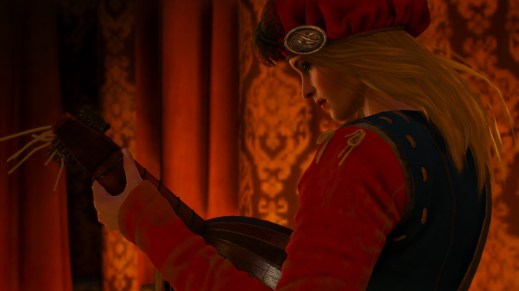
Compared to the wind instruments and female vocals of Skellige, percussion and plucked/struck strings predominate. There is indeed more of a Renaissance feel in an area already touched by modernity. Most notably, there is more diegetic music in these two cities. We frequently see and hear small Renaissance dance bands, using period instruments, entertaining crowds (watch from around 3:45 of the above video of Novigrad for an example; note how diegetic music slowly enters the soundtrack as they are approached). Perhaps the most significant diegetic moment, however, is the song by the Trobaritz Priscilla. The audio and visuals are surprisingly well matched, and the tuning of the lute adds emphasis to the fact of live performance. As a video cut-scene, this is one of few moments in the game where the player has no ability to affect their environs and must simply watch and listen.
Priscilla’s song
Far more so than in other areas, the music in Novigrad and Oxenfurt is for and by people. This is in marked contrast to the soundscapes found on Skellige and in Velen where the music is almost purely non-diegetic. In contrast to the pre-Christian matriarchal associations of the priestesses of Skellige is the aural handling of the Temple of the Eternal Fire in Novigrad and its male priests. As Adam Whittaker has recently identified, there is a clear link between musicological discourse on purely vocal performance in Christian sacred space in Early Music, and its representation on screen. Male a capella voices, and a ‘chanting’ vocal style (again hinting at plainchant, rather than using pre-existent chant music), are often used to denote the aural identity of a church. Precisely this kind of vocal delivery is added to the soundtrack as the player moves closer to the Temple of the Eternal Fire, explicitly linking this Christian association with the aural presence of the Temple. The contrast with the female-dominated vocals elsewhere enhances the distinction and re-enforces the links between the ostensibly pre-Christian worlds of Skellige and Velen and the Christian associations made in Novigrad.
Approaching the Temple of the Eternal Fire
The music of the Velen wasteland and the neighbouring White Orchard, like Skellige, is more folk influenced, yet clearly distinct. Gone are the Celtic folk influences; instead, this area fuses a cinematic pastoral idyll (again laden with nature sounds and with a peasantry speaking with West Country accents – compare the idyllic ‘Shire’ in Peter Jackson’s The Lord of the Rings) with a dark and sinister undertone which draws on the ‘otherness’ of many non-western and folk instruments, particularly the kemenche, electric cello, hurdy gurdy, bowed gusli, gheychak, and the bowed yaylı – the vast majority of which only enter the soundscape in this area. The use of the medieval as a source of dangerous and primitive ‘otherness’ is common at the moment (evidinced, for instance, by the many recent descriptions in the West of the so-called Islamic State as ‘medieval’) and draws on modernist thought which characterized the middle ages as a period of dark and dangerous alterity between the glories of antiquity and the Renaissance.
That the soundscape of The Witcher draws on competing categorisations of the medieval as ‘dangerous’ and ‘pastoral’ says much about the mutability of medievalisms. Musically, this ‘otherness’ can be expressed as a kind of orientalism, both exotic and dangerous, and the microtonal inflections and use of glissandi here give a sinister undertone to what is otherwise a quintessentially pastoral film score. This area has one of the most memorable parts of the entire soundtrack ‘Ladies of the Wood’, underscoring a genuinely horrific narrative and visuals (some of the consequences of which are shown in the first video of this post with a lengthier section of the music given below). The exotic instrumentation combined with the driving repetition, at odds with an audio usually so responsive to the player’s actions, makes the experience unsettling and claustrophobic.
Ladies of the Wood
Taken together, these very distinctive sound worlds serve to demonstrate some of the many medieval soundscapes which permeate our collective consciousness. In utilising iconic aural cues, composers and sound designers in a neo-medievalist tradition can conjure up particular cultural and social structures with ease, taking many of the shorthands which have emerged from the TV and film traditions in recent years. The indeterminacy inherent to videogame, and the common response of using audio stems, means that the soundscape moves far beyond what is possible in TV and film. However, it also makes problematic the concept of using real, historically-informed music from the period being invoked which would not be able to respond to the interactivity of the world. In The Witcher, the decisions we make effect the world around us, including its soundscape. The effect is crucial both to helping to conjure the world of The Witcher and to helping us feel immersed in it – perhaps paradoxically this may make the soundworld invoked seem more authentic even if it simultaneously reduces the possibility of using ‘authentic’ historical repertoire.
—
Featured image by Carlos Santos @YouTube CC BY.
—
James Cook is a University Teacher in Music at the University of Sheffield. His work focuses on the musical period that falls neatly between the Middle Ages and the Renaissance. In particular, the ways that musical cultures in this period interact and how expatriate groups (merchants, clergy, and nobility) imported and used music. Some of his work (like this essay) concerns the representation of early music on stage and screen, be that the use of ‘real’ early music in multimedia productions, the imaginative re-scoring of historical dramas, or even the popular medievalism of the fantasy genre.
—

REWIND! . . .If you liked this post, you may also dig:
Sounding Out! Podcast #49: Sound and Sexuality in Video Games – Milena Droumeva and Aaron Trammell
Sounding Out! Podcast #29: Game Audio Notes I: Growing Sounds for Sim Cell–Leonard J. Paul
Papa Sangre and the Construction of Immersion in Audio Games— Enongo Lumumba-Kasongo
The Dark Side of Game Audio: The Sounds of Mimetic Control and Affective Conditioning – Aaron Trammell
—
Share this:

A Manifesto, or Sounding Out!’s 51st Podcast!!!

DOI: https://doi.org/10.59350/a89ek-90e31
This week, Sounding Out! dropped its 51st podcast episode. As the curator and producer, I thought it necessary to commemorate the occasion with some fanfare. I want to shout from the hilltops about how proud I am that our little podcast has turned 51!
Erm…at least I’m posting about it.
Also, I want to clear the air a little about what it is that we do. I’ve received feedback here and there over the years about the sound of our podcasts, that we sound “different” and/or “inconsistent,” that we need to normalize the sound a bit: hello out there, audiophiles! Today, I want to say, once and for all, that our sound is intentional and that we are proud of it, hiss, distortion, and all! We think what some hear as “imperfections” are all part of what sets us apart from the ever-growing pack of podcasters. SO!’s podcast has sounded different since we MacGyvered our first episode from an epic talk, a few great ideas, and a rogue tape recorder at River Read Books in Binghamton, NY in April, 2011.
The Sounding Out! Podcast began as a series of conversations within the editorial team back in 2011. We knew that the blog was “talking the talk” in new, excellent, and often provocative ways, but that something was missing to keep pushing the form into the red, not just the content. We knew we needed something more—a little snap, crackle, and pop, if you will—a way to show how Sounding Out! was always listening, and a way for thinkers, artists, provocateurs, and more to engage with sound more directly. In 2011, podcasts were accumulating in the shadows waiting to lunge forth to center stage. They seemed really cool, but there were relatively few, and fewer still (if any at all) on the topic of sound studies. Even though we knew that podcasts were going to be a big thing eventually, we had no idea that they would blow up so quickly.
While we flipped around many ideas, we decided to put our energies behind what was then an occasional series of podcasts that allowed us to capture important yet fleeting moments—too quick and dirty to really transcribe. While our our initial vision for the podcast was to capture these rare and powerful moments, over the past 5 years we have kept this mission consistent while evolving to better accommodate artists and theorists alike. During that time we have hosted mystics and librarians, shared fieldwork from São Paolo, Brazil to Lodi, Ohio, interviewed theremin players and visionaries. See the full list of episodes here. Even though our content has been wide ranging and eclectic, we’ve made it a point to privilege access and immediacy in all of our episodes.
As I listen back to the past five years, I realize that our contribution to the fields of sound studies and podcasting has not just been in terms of who we broadcast and what we amplify, but through the sound of our podcasts themselves. Our podcasts don’t sound perfect. They’re spiritually aligned by the raw production ethic of bands like The Minutemen, who always privileged the emotive qualities of immediacy, access, and intimacy over the brooding qualities of studio production. Particularly because we founded the podcast upon these same principles, I have strived to prioritize radical visions and ideas and to amplify new voices above all else. I want each podcast to arrive in your queue like a wrapped gift—topic, content, production, and sound all equally mysterious. Some of our podcasts were recorded on cellphones and others were recorded in high-end studios and recording booths. Our 51st anniversary isn’t the perfect occasion, either. But, hey, we’re proud of these audible distortions.
“The Minutemen: #1 Hit Song”
So what do I mean that our podcast sounds different? Well, I mean two things: First, we sound different than what episodic radio sounds like. Our DIY—or, more accurately, we will help you “Do It Yourself”—ethics deliberately dial back radio’s genre conventions: smooth identifiable hosts, heavy compression, sound-proof rooms with the latest in equipment. We encourage and construct our podcast with a deliberate sonic diversity, providing little sonic consistency from episode to episode in order to challenge regimes of production that threaten to make all recordings sound the same. We have many many different announcers and hosts; for this podcast to be the space of radical discourse that we intend, it’s important to cast our net wide. This isn’t to say that we don’t care about “quality,” but rather that we define quality differently. Rather than an audiophilic emphasis on the sorts of tone found most frequently in microphone technique, sound booths, and—when all else fails—postproduction, we believe that a “quality” podcast—particularly one about sound—should explore sounds that we rarely hear and allow its artists freedom over how they present their work.
I curate our podcast as a sonic refuge from the invisible regime of auditory production that has slowly constricted and strangled radio this past century. And I’m proud to share podcasts that have been recorded on in impromptu circumstances, Episode XXXIX: Soundwalking Davis, CA and New Brunswick, NJ, for example. We want artists to show more than they tell; Episode XII: Animal Transcriptions, Listening to the Lab of Ornathology is a perfect example of this. Here Jonathan Skinner’s brilliant exploration of animal sounds perfectly balances sound and interview and invites listeners to compare sounds to speech, and vice versa. Another example of this ethic is film professor Monteith Mccollum’s remix of the original War of the Worlds broadcast. Although Mccollum offers some commentary at the start of the recording, what follows is a unique and dazzling sonic experience. Giving radical ideas both the space and platform to be heard is this podcast’s mission. So far, so good!
The second way our podcast sounds different has to do with our deliberate curatorial resistance to consistency between our episodes. When programs bend to the whims of genre conventions, creativity is all but snuffed out. For our podcast to excel as a form for sharing visions, ideas, and experiments, we must allow our composers, authors, and auditors the freedom to explore sonic space. We celebrate Sounding Out!’s anniversary annually with a series of mixes hand-picked by our stable of authors (Listen to years 1, 2, 3, 4, 5, and 6 here!), we’ve entertained interviews, panels, and sound art alike. You may have missed it, but we even have an episode diving into the work of ambient sound in a Dungeons and Dragons game.
While I do think about the sound of our podcast aesthetically—I used to run a music production studio out from the trunk of my car—we do not cultivate a DIY anything-goes ethic strictly for a “cool factor” or just for its own sake. Rather, we have calibrated our different sonic approach in deliberate defiance of styles of production which are all too frequently celebrated within the cultures of straight white men. (Check out SO! Editor-in-Chief Jennifer Lynn Stoever’s epic three-part treatise on the tape recorder in popular film to glean some sense of the tape-recorder’s role as an instrument of masculine control. Part 1, Part 2, Part 3). The standards of taste which have long governed the domain of radio production (and audio production, as a whole) are historically connected to the communities of practice which have occupied invisible yet powerful roles as audio producers, engineers, critics, and marketers.
As Jonathan Sterne explains in MP3, the science of audio fidelity has historical roots within a corporate logic that privileges sounds that are easily shared through telephone cables. “AT&T encountered hearing as an economic problem once its options for extracting additional profit through price were limited,” Sterne says, “Among other strategies, it sought to learn which frequencies could be excluded from the market for telephone signals” (14). In other words, the entire craft of audio engineering has historical roots in privileging sounds that make money above all else. Not only this, but the standards of fidelity cultivated by engineers allow them to gatekeep and demand money at the outset, blocking access to the means of production. These standards are more often than not embedded within the cultures of listening and sales fostered by the radio industry. Fortunately, podcasts have been able to challenge many of these genre tropes, We’re proud to contribute to this momentum and to propel it forward as we continue our series. And we’re not stopping! Up on deck in 2016 we have some amazing compositional sound art, more from Marcella Ernest’s trek to uncover lost sounds, and some notes on a forthcoming project in archiving one city’s local music scene.

So, in the spirit of Sounding Out!’s annual blog-o-versary we’re popping the cork for our podcast’s 50th episode with a few of the milestones we hit this past five years.
We found a theme song. This was a small but important step in our development. What would a podcast about sound be without some kind of awesome anthem representing it? (Nothing, that’s what!) We need to officially thank the members of Hunchback (Miranda, Mike, Jay, and Craig) for donating their song “Feeling Blind” to our podcast. Hunchback was a legendary horror-surf band from the NJ basement scene who endeavored to produce highly visceral sonic experiences of the highest caliber in their songwriting. You can still find a ton of their recordings on the internet. Thanks, crew!

We got listed on iTunes and Stitcher. It bears mentioning that quite a bit of technical muscle is involved in establishing a podcast. We would have gotten nowhere without Andreas Duus Pape’s help and guidance during our earliest moments. Andreas was instrumental in opening up the hood of the podcast and making it purr. Not only did he donate his time to plug us into iTunes’ network of podcasts, but he also shared some excellent philosophical thoughts on the topic. You can listen here and read them here.
We went monthly. Originally we had conceived the podcast as more a haphazard, occasional treat for our readers. Slowly but surely as demand and interest grew, we began to carve out a more regular calendar space for our podcast. First we switched to a bi-monthly format, and then we started with monthly broadcasts. Can’t slow this beat down.
We are the sonic archive of a sound art conference. That’s right, we featured sonic mixdowns of the entire Tuned City of Brussels sound art festival. Over the course of the festivals three days, we featured daily mixdowns of the prior day’s key sounds and moments. Each mixdown is brilliant and a testiment to the raw passion of our podcast contributors. They worked round the clock to produce such an amazing series. Check out the night before, and days 1, 2, and 3.

We produced a LOT of soundwalks. If you’re a listener you know that we love our soundwalks. We’re proud to be host to play host to a variety of soundwalks from cities around the world. Last month’s Yoshiwara soundwalk by Gretchen Ju challenged listeners to critically engage with the city’s fraught history of sex work. Other contributors in our soundwalk series like James Hodges have considered how the ambient music of big box stores and shopping malls are part of the architecture of commerce. Finally others like Frank Bridges have taken us to the edge of history and soundwalked the grounds of Thomas Edison’s workshop in Edison, NJ. No matter what the locale, our soundwalks are part of our podcast’s signature.
We found a regular contributor. Regular contributors are the heart and soul of Sounding Out! They lead the conversation on sound and work to bring you the best, most interesting content. For these reasons we’re proud to announce that Marcella Ernest will be joining our podcast as a regular contributor with her series “Searching for Lost Sounds.” Marcella will be interviewing a variety of sonic practitioners in an effort to give voice to the voiceless. Her most recent entry in the series was posted last Thursday. You can listen here.
We’re going to keep it coming. That’s our promise to you! We’ll be producing great content as long as you’re listening. Take a moment to subscribe to our iTunes or Stitcher accounts and also explore our Episode Guide to see if you missed anything this past 5 years. It’s been a rewarding adventure so far and we guarantee that we’ve already got some great content lined up in the coming months.

–
Aaron Trammell is a Provost’s Postdoctoral Scholar for Faculty Diversity in Informatics and Digital Knowledge at the Annenberg School for Communication and Journalism at the University of Southern California. He earned his doctorate from the Rutgers University School of Communication and Information in 2015. Aaron’s research is focused on revealing historical connections between games, play, and the United States military-industrial complex. He is interested in how military ideologies become integrated into game design and how these perspectives are negotiated within the imaginations of players. He is the Co-Editor-in-Chief of the journal Analog Game Studies and the Multimedia Editor of Sounding Out!
–
Featured image is “Roscoe Considers Recording a Podcast” by zoomar @Flickr CC BY-NC.
—

REWIND! . . .If you liked this post, you may also dig:
Sounding Out! Podcast #1: Peter DiCola at River Read Books – Peter DiCola
It’s Our Blog-O-Versary — Jennifer Lynn Stoever
Sounding Out! Podcast #51: Creating New Words from Old Sounds – Marcella Ernest
—
Share this:




Current Top Posts





April 2021

January 2020

November 2019

October 2019

August 2019

April 2014

November 2017

March 2015

December 2017

October 2015


Recent Comments