
Coconut Clops and Motorcycle Fanfare: What Sounds Medieval?


Series co-editors Dorothy Kim and Christopher Roman
Until the nineteenth century, very little medieval music had been rediscovered, and what little was known was known mainly to specialists. However, the nineteenth-century fascination with the Middle Ages, the Gothic Revival in art and literature, inspired composers to write symphonic works and operas using medieval stories and themes. By the time twentieth-century musicologists began decoding and publishing music from the medieval past, a general consensus as to “what sounds medieval” had already been established in the minds of educated listeners familiar with European art music (see Annette Kreuziger-Herr’s 2005 article “Imagining Medieval Music: A Short History”). Ideas of the medieval constructed in the 19th century via medievalist works of art persisted well into the twentieth, and eventually the imagined medieval sound of Romantic music turned out to be incompatible with the newly discovered historical record.
While Early Music performers in the 1970s and 1980s based their performance styles on historical research, their artistic work was inevitably conceived in relation to existing concert repertoires and standards of performance, as well as ideas about the Middle Ages known by them and by their audiences. A general goal was to create performances that audiences could feel were convincingly accurate to how the music would have sounded in the past. But a sense of authenticity depends not just on the performers’ historical accuracy, but on a complex interaction of experiences and expectations on the part of the audience.

Screen Capture from Monty Python by SO!
Two films, Monty Python and the Holy Grail and Knightriders, play directly with the clash between romantic interpretation of the Middle Ages and historically informed performances of music, for comedic effect. In Music in Films on the Middle Ages: Authenticity vs. Fantasy, John Haines examines six tropes of music in medievalist films: bells, horn calls and trumpet fanfares, court and dance music, minstrels, chant, and warriors on horseback. Haines mentions Monty Python and the Holy Grail several times, but does not discuss any of its music; he does not discuss Knightriders, likely because of its modern setting.
This essay examines the way these two films used music to highlight issues of the real, the historical, and the existence of competing medievalisms central to the understanding of medieval music in modern times. In the director’s commentary for the film Monty Python and the Holy Grail (1975), writer/performer/director Terry Jones had this to say about the film’s music:
Neil Innes had originally written the music for the entire film, and when we showed it, it didn’t really seem to work… we’d all agreed that Neil should go for a very authentic sound, and authentic instruments. The trouble is, it sounded quaint, and when we went to do the read-up I realized that actually you needed kind of mock-heroic music. But of course at that stage, we couldn’t afford to go and record some more music, so the only thing I could do was to go to a music library – I went to DeWolfe’s [a music library that licenses stock music] in London, and spent sort of weeks going through their discs, and sorting out bits of music to put on to it, to give it that sort of … it was just that we realized that if you had sort of music that sounded slightly quaint, because it was on original instruments, and you had all these silly goings-on, it looked comic, the music, instead of actually looking, um, real….
They wanted an “authentic sound,” but what they got didn’t seem real: here is the problem of conflicting expectations in a nutshell. Jones likely meant that the newly composed music, including the sounds of pre-modern instruments, was consciously reminiscent of older music as it was beginning to be known. The song sung by Sir Robin’s minstrels is likely a survival of Innes’ “authentic” score. The singer – Innes himself – sings a minor-mode melody reminiscent of a Tudor-era tune (think “Greensleeves”), accompanied by recorders, some reed instrument, and drum beats. The terms “original instruments” or “authentic instruments” don’t just refer to antique instruments (or copies of antique instruments), they were code for a particular approach to the performance of old music, an approach that was becoming very popular in 1970s Britain (for more on the British Early Music revival, see The Art of Re-Enchantment: Making Early Music in the Modern Age by Nick Wilson).
Jones characterized the pre-existing stock music chosen at De Wolfe’s as “mock Heroic,” but there’s really nothing mock about it per se— it’s genuinely heroic-sounding orchestral music, in the romantic post-Wagnerian style of Hollywood film scores, probably written in the 1950s or 1960s. There are brass fanfares when the company sights Camelot in the distance, angelic choirs for the vision of God who speaks to Arthur from the clouds, and especially, there is the wonderful music used when the company is galloping with coconuts. Here they are, approaching the castle of Gui de Lombard
The music for the galloping horses is heard several times during the film, and the contrast between its epic majesty and the sight of King Arthur and his knights not riding horses but rather banging two halves of coconuts together to simulate the sound of hoofbeats enhances the sight gag. The melody consists of four repetitions of the same melody, a strong rhythmic fanfare. The melody itself is made up of two almost identical phrases that each rise and then return down. The rhythm both emphasizes the steady pace and, through its mixture of long and short durations (a so-called “dotted rhythm”), suggests the gait of galloping horses. First we hear percussion, the high-frequency snare drums and lower booming tympani, then the low brass play the melody, harmonized. Higher trumpets join in for the second repeat, with flutes doubling the melody at a higher octave for added brilliance. That combination plays the third repeat, with strings joining for the fourth repeat. The tympani play faster, approaching the fanfare’s final cadence, but it becomes an anti-climax as Patsy, played by Terry Gilliam, can’t really play his long herald’s trumpet. A very knowing joke, as onscreen Hollywood heralds are frequently accompanied by the sound of modern valved trumpets playing chromatic phrases impossible to play on the visible long trumpets.
[The whole piece can be heard here; the part heard repeatedly in the film begins at 1:27:]
In its instrumentation, especially the use of brass and percussion, and the dotted rhythms (long, short, long, short, etc.) suggesting hoofbeats, this fanfare draws on a long tradition of music written to suggest galloping horses, whether ridden by medieval knights or other hunters or warriors. The most famous example is probably the finale to the “William Tell” Overture by Gioachino Rossini (1839). That galloping music influenced many film scores featuring knights on horseback, and it is likely that Terry Jones recognized the style from films he could have seen since the 1950s, such as MGM’s Knights of the Round Table (1953), starring Mel Ferrer as King Arthur and the very wooden Robert Taylor as Sir Lancelot which features music by Miklós Rózsa (1907-1995), who wrote similar music for both medieval knights and Roman charioteers, including trumpets to suggest fanfares and uneven rhythms to suggest hoofbeats.
The music in my second example deals directly with the clash between then and now. The 1981 film Knightriders was written and directed by George A. Romero, better known for his horror films (he invented the modern zombie film with 1968’s Night of the Living Dead). Knightriders follows the adventures of a traveling Renaissance-faire troupe of actors who stage jousting tournaments while riding motorcycles; the interactions between the actors come to parallel Arthurian stories. The film revolves around the conflict between modern reality and the desire to live one’s life according to (a modern understanding of) medieval chivalric virtues. This scene shows the troupe’s act: the action is straightforward, but the music is complicated, with the score by Donald Rubenstein using five distinct kinds of music in a theoretically sophisticated manner. In order, we hear: live music played on-screen by visible performers, recorded music played onscreen, and then three musically distinct flavors of underscore music. Watch for a yet another knowing gag about the technical capabilities of heralds blowing straight trumpets, as well as a cameo appearance by the writer Stephen King as a scornful man eating a sandwich.
The music performed on-screen functions as part of the scene. The painfully amateur band of minstrels plays a tune from Handel’s oratorio “Judas Maccabeus” (1746), probably known to the squeaky violinist from its use as a Suzuki teaching piece. We can imagine that these musicians are playing the oldest piece of music they know, and in response the audience—both onscreen and offscreen—is led to believe that the rest of the show will be similarly amateurish. The professionally recorded trumpet fanfare demonstrates again how their (and our) musical associations for medieval scenes, especially tournaments, come so strongly from Hollywood. The actors can’t begin to play their instruments, but everyone knows that the heralds and their fanfares are crucial for the scene they’re trying to set.
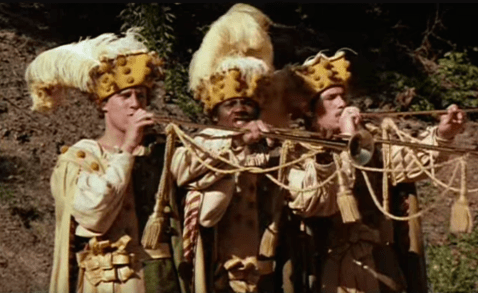
Screen Capture from Knightriders (1981) by SO!
When King William and Linet take their thrones, we hear underscore music—guitar and fiddle—for the first time; the shift from source music to underscore is done with great subtlety. This music has the informal flavor of folk music, which connects it to the little onscreen band, but now played professionally. The cue is extremely short, but serves as a transition from the real world of the tacky Ren-fest to the imagined world of chivalry and knighthood in some mythical past enacted by the modern-day warriors. The spectacular motorcycle stunts are underscored by more folk-sounding music: again fiddle and guitar, this time playing a fast jig. This music is exciting, as befits the action, but the specific sounds, reminiscent of Irish folk music, do more than just underscore excitement: they begin to move us backwards in time. Folk music reads as traditional, as old, but not ancient. The folk music sounds inhabit an intermediate place, a remembered past between the present and the imagined distant past of the middle ages.
When the individual jousts begin, the underscore music changes again, first to the heroic type of “Hollywood Knights” music, prompting the audience to equate the “real” riders onscreen with their fictional (and filmic) knightly counterparts. This kind of orchestral music, with prominent strings, is used throughout the film for moments of almost magical transformation, suggesting that for believers, such transformation is indeed possible. For the second and third jousts the underscore changes one last time, to trombones playing very archaic-sounding music. Here at last in 1980 is the sound of “authentic instruments” that Terry Jones eschewed back in 1974, and it doesn’t sound quaint at all here, it sounds real. These riders aren’t (just) carnival performers, they are knights at a tournament, risking bodily injury in their quest for personal excellence.

Screen Capture from Knightriders (1981) by SO!
The music in this sequence plays with a basic distinction in film music and film music scholarship: is the music diegetic, that is, part of the film’s story, or nondiegetic, that is, as Robynn J. Stilwell describes in “The Fantastical Gap between Diegetic and Nondiegetic,” in Beyond the Soundtrack, “an element of the cinematic apparatus that represents that world?” (184). The terms were first used by Claudia Gorbman in her pioneering study, Unheard Melodies: Narrative Film Music (1987), and have been a major focus of film music scholarship ever since.
In this sequence, the amateur musicians and the taped fanfare, count as diegetic music, while everything else is nondiegetic. Stilwell points out that border crossings between these two categories are common, but meaningful; she coined the term “fantastical gap,” the gap between what we see and hear and what we hear without seeing, to discuss the liminal (conceptual) space between the two (185-187). Stilwell describes movement from diegetic to nondiegetic as a “trajectory [that] takes on great narrative and experiential import. These moments do not take place randomly; they are important moments of revelation, of symbolism, and of emotional engagement within the film and without” (200). The Knightriders tournament sequence, already liminal as a “play within the play” of the film, traverses the fantastical gap in a way that dramatizes a central question for the performance of Early Music: what happens when modern performances are historically informed, but emotionally unsatisfying? For George Romero, as for Terry Jones, the answer is to give priority to the emotional, drawing on their and their audiences’ expectation for “Hollywood Knights” soundtrack music. Early Music performers in the 1980s made similar choices, merging familiarity and unfamiliarity in exciting ways that unfortunately left them open to criticism that their performances were “inauthentic,” an advertising claim they found themselves defending.

Recorded fanfare in Knightriders, Screen Capture by SO!
The modern performance of surviving pieces of medieval music, recorded in notation, will always enact a kind of medievalism, involving the creative use of material survival from the past. But to understand the goal for the performance of medieval music as historical accuracy alone is to miss an important point. Medievalisms, the creative use of historical material, create meanings for modern audiences, meanings that then help to shape further understanding of the historical past.
The decades since these two films were made and released saw great growth in both artistic approaches to Early Music, and in the skill of performers in playing old instruments and singing in newer, non-Classical styles. Professional recordings enjoyed real commercial success as a sub-genre in Classical music starting in the 1980s, accelerating audiences’ familiarity with the novel sounds of old music re-vivified. The 1990s saw “new age” music and Celtic folk-music sounds added to the mix, while performers in the 2000s have drawn inspiration from Greek Orthodox chant, and continental folk musics. “What sounds medieval” will always be conditioned by what modern performers and listeners imagine “the medieval” to be, and how “the medieval” is understood to be different from later times. As those imaginings are themselves constantly changing, so will their representations in music.
—
Featured Image: “Monty Python Coconuts” by Flickr User Mark Turnauckus
—
Elizabeth Randell Upton is Associate Professor of Musicology at UCLA and the author of Music and Performance in the Later Middle Ages (“The New Middle Ages” series, Palgrave Macmillan, 2013), which examines late fourteenth and early fifteenth century vocal music to discover evidence for the experiences of performers and listeners in the medieval past, recorded in surviving musical notation. Her next book will explore mid-twentieth century Early Music revivals in the UK and US, moving beyond the usual focus on musicological scholarship and classical music traditions to examine Early Music’s interactions with both folk music revivals and popular music.
—
REWIND!…If you liked this post, you may also dig:
Sounding Out! Podcast #54: The Sound of Magic-K.A. Laity
Mouthing the Passion: Richard Rolle’s Soundscapes–Christopher Roman
EPISODE LI: Creating New Words from Old Sounds–Marcella Ernest, Candace Gala, Leslie Harper, and Daryn McKenny
Share this:

Make a Noise Joyful: Cirm in the Old English Exodus

Series co-editors Dorothy Kim and Christopher Roman
When the narrator of the Old English poem Exodus declares “Gehyre se ðe wille” (Let him hear who will), what sounds is he asking us to attend to? [Note: Text from Peter Lucas’s edition, 7b. All translations are author’s own.] This post argues that the Old English noun cirm (noise, shout, outcry) challenges our conceptualization of noise. In the Anglo-Saxon corpus, cirm most often refers to the indistinguishable, non-linguistic hum of a crowd, rather than the meaningful utterance of an individual. This accords with the popular view of noise in sound studies: whether medieval or modern, noise (as opposed to meaningful sound) is associated with alterity, disruption, and violence.
However, and strikingly, in the Old English Exodus, words for noise describe not only the terrible sounds of the drowning Egyptians as the roaring waters of the Red Sea rush over them, but also the survival of the Israelites. I argue that this cirm is a mark of the Israelites’ triumphal assertion of their continued presence and plenitude, a celebration of the fact that they can still be a multitude despite captivity. That cirm may not sit easily within our definition of noise should provoke not a redefinition of cirm’s joyful use, but a reconceptualization of Anglo-Saxon noise.

‘Amalek Attacks Israel and Is Defeated’, in the Old English Hexateuch, British Library, MS Cotton Claudius B IV
What is Noise?
“Noise” has a range of meanings, but most often implies “unwanted sound” as R. Murray Schafer argues in The Soundscape (73). Following the work of Jacques Attali and Jeffrey J. Cohen, noise has been associated with alterity, difference, and monstrosity. Noise, as opposed to sound, may be non-linguistic or disordered: nonsense, babble, the roar of a jet engine. According to David Novak’s contribution to Keywords in Sound, noise is not present in nature, but is created by modern technology (129). In the modern world, noise is often considered negative: cities have rules about noise pollution, apartment buildings set quiet hours, and airplane passengers don noise-cancelling headphones. In the pre-industrial age, noise was not exempt from criticism, though the word could also be applied to more pleasant sounds, like birdsong.
In the European Middle Ages, Valerie J, Allen argues in “Broken Air,” noise was often figured as violent, transgressing boundaries, inappropriately closing the distance between sound producer and sound receiver (310 and 317-318). According to Macrobius, it was not silence that was the opposite of sound, but noise (311). Grammar, which was “devoted to the pursuance of ratio through sound,” was ethical; noise was therefore considered “a kind of audible violence; corruption [wa]s something one can hear” (305). But some medieval noises were more ambiguous: the Old English word dream (joy, joyful sound) could also be applied to the terrible sounds of Hell or the terror of Judgment Day, as in Kazutomo Karasawa’s analysis in “OE dream for Horrible Noise in the Vercelli Homilies.” Likewise, “clamor,” which originated as a (mostly) negative noise, became an important legal instrument, as discussed by Richard Barton in “Making a Clamor to the Lord: Noise, Justice and Power in Eleventh- and Twelfth-Century France.” But in general, we tend to assume medieval noise is negative, or marks its producer as other.
Noises in Exodus
The Old English Exodus, found in the c. 1000 manuscript known as Bodleian MS Junius 11, is a notoriously difficult and complex poetic adaptation of the Old Testament Exodus 12-14. The author and date of composition are unknown, though it is often considered quite early, perhaps as early as the eighth century as Paul Remley and Lucas argue. Few institutions were rich enough to own a complete Bible. The author of Exodus may have had access to a written Latin version of Exodus, or may have been exposed to the text via the liturgy, especially the liturgy of the Easter Vigil.
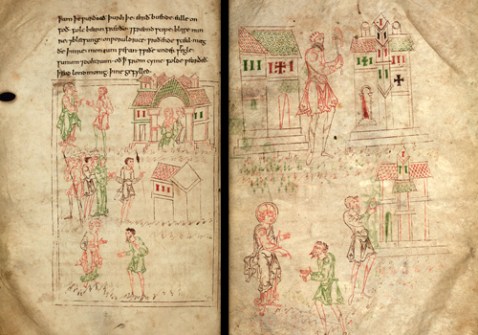
The Junius Manuscript, Oxford, Bodleian Library, MS. Junius 11, pp. 84-5
Exodus delights in sensory details, but until recently, I had always thought of Exodus as primarily visual – the gleaming of war-gear, the glittering of Egyptian spoils washed up on the shore, tents and a pillar of cloud to protect the Israelites from the desert sun, and a pillar of fire to guide them. But the poet is also attentive to the larger sensory world, including the world of sound and noise. Those who accept the poet’s opening challenge to his audience (“Gehyre se ðe wille!” [Let him hear who will!]) will recognize that the poem is in fact filled with sounds – the battle trumpets that provide order and structure to the movements of the army, the rushing and later silencing of waters, the terrible evening songs of wolves eager for battle, the awful rasping of the blade Abraham draws to sacrifice Isaac in the poem’s digression on the patriarchs, the triumphant songs produced by Israelite men and women in praise of God after the Egyptians are defeated. In what follows, I focus on the multiple deployments of a single word for noise (cirm), applied to both Israelites and Egyptians, asking what this word can reveal about Anglo-Saxon conceptions of noise.
It has often been remarked that the poet resists easy distinctions between Israelites and Egyptians, applying similar vocabulary to both, and this is certainly illustrated by the poet’s sonic play. In a climactic scene near the end of the poem, the drowning of the Egyptians in the Red Sea is accompanied by horrible noises:
Storm up gewat
heah to heofonum, herewopa mæst;
laðe cyrmdon (lyft up geswearc)
fægum stæfnum. Flod blod gewod:
randbyrig wæron rofene, rodor swipode
meredeaða mæst. Modige swulton,
cyningas on corðre. Cyrm swiðrode
wæges æt ende; wigbord scinon.
[A storm went up high to the heavens, the greatest of cries of the army; the hostile ones cried out with doomed voices (the air grew dark above). Blood pervaded the water: ramparts were broken, the greatest of sea-deaths lashed the sky. The brave ones died, kings in a troop. The noise fell silent at the end of the water; battle-boards shone. (460b-467; emphasis added)]
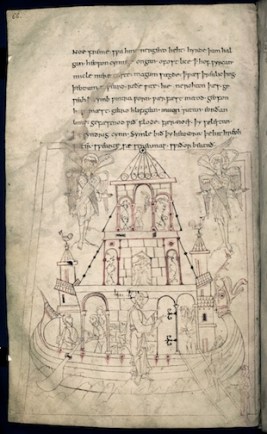
The Junius Manuscript, Oxford, Bodleian Library, MS. Junius 11, p. 66.
Cirm occurs twice in this passage, first as a verb (cyrmdon) and then as a noun (cyrm). The manuscript reading in 466b is cyre (choice). Lucas emends to cyrm because cyre is not a poetic word, and I would argue that the echo with the Israelites’ cyrm (107) must be deliberate. Even if we accept MS cyre, the passage still includes the verb cyrmdon (462a), and other sonic vocabulary (herewopa, “army’s cries” [461], and fægnum stefnum, “doomed voices” [463]). The noun occurs roughly 60 times in the corpus; the verb 17 times (DOE).
In the Old English corpus, cirm is often negative, applied to the tortures of hell or the terror of Judgment Day, and indicates a particularly loud sound (DOE, Lucas). According to the DOE, the noun means “shout, cry, shriek” or “noise of non-human origin, clamour.” The Egyptian cirm is obviously threatening, the meaningless cries of men who, like a raging storm, lash out in terror as the waters close over their heads. Even the visual horror of blood mingling with water maintains sonic affiliations: this line is a rare example of internal rhyme in Old English poetry (flod blod gewod). The end of the Egyptian threat is marked by the silencing of their voices and cirm, metaphorically a silencing of the army’s advance against the Israelites.
Given the negative associations with noise in both medieval and modern sound theory, that the Egyptian defeat is accompanied by their terrible cirm may not seem particularly surprising. Strikingly, this is not the only such noise in the poem. Near the beginning of the poem, the Israelites celebrate their initial escape from Egypt by producing not just any noise, but cirm. On the third day, after the pillar of cloud has appeared, the Israelites awaken with trumpets, and seeing the pillar,
Folc wæs on salum,
hlud herges cyrm.
[The people were joyful, loud was the noise of the army. (106b-107a; emphasis added)]
If cirm is threatening, loud noise, associated with difference and violence, why would the Israelites produce it? I would like to suggest that cirm suggests not merely loud noise, but crowd noise. The Israelites’ cirm is not an assertion of difference, or the meaningless babble of a drowning, almost non-human army, but an assertion of triumphant plenitude. Their joyful cirm is a fulfillment of God’s covenant with Abraham, which the poet will remind us of later in the poem (435-442). Just as God promised Abraham innumerable offspring, his support of the Israelites in their exodus signals that they will continue to be a multitude (as they certainly are in this battle, in which they have 600,000 fighting men (224-233).
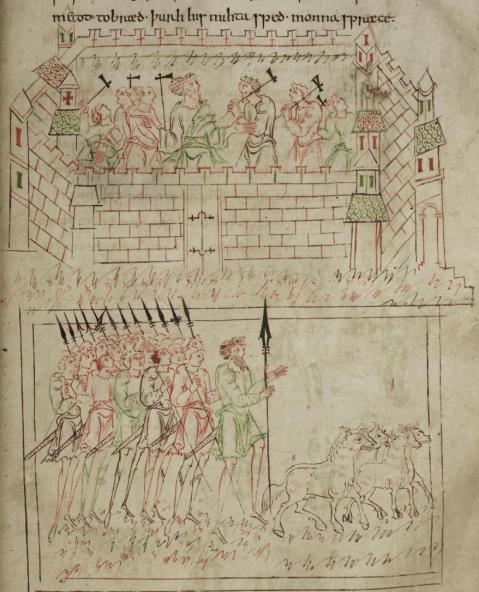
The Junius Manuscript, Oxford, Bodleian Library, MS. Junius 11, p. 81.
In fact, the Israelites’ triumphant crowd noise is echoed at the end of the poem as well. After the defeat of the Egyptians, who make terrible cirm as they perish in the Red Sea (460b-467), the Israelites issue more celebratory sound, this time transformed from crowd noise to harmonious music:
Æfter þam wordum – werod wæs on salum –
sungon sigebyman (segnas stodon),
fægerne sweg
[After these words – the troop was joyful – victorious trumpets sang a beautiful sound (battle-standards stood). (565-67a; emphasis added)]
The Israelites’ cirm (107), which they produced while on salum (joyful), is balanced and echoed by the celebratory sounds of the end of the poem, also produced by a people who are on salum (565). Whatever threat the Israelites’ assertion of plenitude and cirm may have made possible is mitigated by replacing that cirm (noise) with a beautiful sound (fægerne sweg), a harmonious, if also loud and multiple, expression.
According to Attali, music can be used to produce order, but “noise is violence: it disturbs. To make noise is to interrupt a transmission, to disconnect, to kill. It is a simulacrum of murder” (26). In this sense, the Israelites’ crowd noise in the desert is violent – it threatens the order of the Egyptians, or the hierarchy the Egyptians have sought to impose on the Israelites in their captivity. But because this story ends in the triumph of the Israelites, told from the point of view of their Christian descendants, it celebrates this assertion of communal power and communal violence without fully othering them. The true violence is inflicted on the Egyptians by God in the Red Sea, allowing the Israelites to reassert their normativity, their cohesion, their power, and their non-otherness. While the drowning Egyptians produce cirm, it is silenced because the cirm of the Israelites has conquered them. Noise, or at least cirm, is therefore not merely negative or disruptive; it is a powerful claim to be blessed by God, an assertion of belonging rather than a boundary crossing.
—
Featured Image:Detail of a miniature of the plague of hail (Exodus 9:22-25), Add MS 15277, f. 7r
—
Jordan Zweck is an assistant professor in the Department of English at the University of Wisconsin-Madison. She specializes in early medieval vernacular literature and culture, especially Old English, and is interested in documentary culture, media studies, and sound studies. She is currently completing a book on Anglo-Saxon epistolarity and early English media, examining the representation of letters in vernacular texts such as letters from heaven, hagiography, and poetry. She is also working on a second book on sound, noise, and silence in Anglo-Saxon England, a portion of which is forthcoming in Exemplaria. Zweck is a recipient of the University of Wisconsin-Madison Center for the Humanities’ First Book Award, has held a resident fellowship at the Institute for Research in the Humanities at UW-Madison, and has won several teaching awards.
—
REWIND!…If you liked this post, you may also dig:
‘A Clateryng of Knokkes’: Multimodality and Performativity in “The Blacksmith’s Lament”–Katherine Jager
Mouthing the Passion: Richard Rolle’s Soundscapes–Christopher Roman
Sounding Out! Podcast #54: The Sound of Magic-K.A. Laity
Share this:


Current Top Posts





April 2021

January 2020

November 2019

October 2019

August 2019

April 2014

November 2017

March 2015

December 2017

October 2015
 Sounding Out!
Recent Comments