
Malcolm Gladwell’s Bad Aesthetics

Malcolm Gladwell, who recently wrapped the first season of his podcast Revisionist History, has been on a roll lately. Not a particularly endearing one, though. I’ve been trying to locate his nadir, but it’s not easy with so many options to choose from. Is it in the New Yorker, when he condescendingly exclaims “Of course not!” in response to whether Caster Semenya should be allowed to compete in the 800-meter at the Olympics? He follows up with the assertion that no track-and-field fan disagrees with him, as if the complexity of gender identification is somehow best left to a majority appeal. Or is it in Revisionist History’s Episode 9, “Generous Orthodoxy,” when he chides Princeton students protesting the use of Woodrow Wilson’s name around campus? Calling one student “angry”—a loaded word to lob at a black woman—and surmising she would later “regret her choice of words,” Gladwell advises the students to instead threaten to leave the university if their requests aren’t honored. Why? Because otherwise “every crotchety old Princeton alum” wouldn’t believe they actually care about the university.

For those keeping score, that’s Gladwell, who spent an entire other episode of his podcast lamenting that we don’t “capitalize” people’s educational potential well enough, counseling black students to separate themselves from an Ivy League education as a way to make a point about a pro-segregationist president. Gladwell’s seventh episode, “Hallelujah,” where he discusses musical genius, is not obviously about the kind of systemic inequalities he bumbles in the Semenya and Princeton examples. But the conclusions he draws about genius and the anti-pop aesthetic judgments he claims are informed by the same bad gender and race politics that would put a person’s gender identification in other people’s hands and place the burden of sacrifice on the aggrieved in matters of racial injustice.
The episode “Hallelujah” revolves around two songs that Gladwell argues reached their peak of genius years after they were initially recorded: “Deportees Club” (1984) by Elvis Costello and “Hallelujah” (1984) by Leonard Cohen. In each case, Gladwell asserts that the first recordings were flawed but that they attained a certain beauty in later versions that reveals something about how genius works, though each attained that genius status by different routes. While Costello is responsible for the version of “Deportees Club” that Gladwell loves—he re-recorded it as “Deportee” in 1985 (it wouldn’t be released until 1995 on a re-issue of Goodbye, Cruel World)—“Hallelujah” would peak for Gladwell in a series of covers, most famously by Jeff Buckley (1994), performed by artists other than Cohen. Gladwell’s focus on the process by which a song reaches genius status is a riff on David Galenson’s Old Masters and Young Geniuses theory. Here, Costello and the litany of “Hallelujah” coverers display a process of genius called “experimental innovation,” where the first draft is never the final draft, and genius is only unlocked after years of work. I’ll return to Gladwell’s notion of musical beauty and how it relates to his bad politics momentarily, but I first want to unpack the theory of genius that enthralls him in this episode.
 Galenson’s notion of genius is a binary, where some geniuses (“conceptual innovators”) are very young, decisive artists and others, like the “experimental innovators” responsible for “Deportee” and “Hallelujah,” are endless tinkerers who tend to reach their creative potential later in life. Gladwell uses the same paradigmatic examples that Galenson does to categorize geniuses; conceptual innovators are Pablo Picasso, while experimental innovators are Paul Cézanne. Curiously, Gladwell notes that this theory of genius may be best exemplified in music, but he doesn’t seem aware that music scholars have already laid out this same broad theory of genius with easy comps: Mozart the young genius and Beethoven the old master. Moreover, Gladwell doesn’t seem aware that this is a lousy theory of genius.
I’ve written elsewhere about genius myths, and there’s a rabbit hole of problematic ideas out there about classical music genius that run from benignly self-serving to violently racist. One critique is particularly useful for pushing back against Gladwell, as it highlights the gender and race problems with Gladwell’s approach to genius. Tia DeNora’s Beethoven and the Construction of Genius (1994) is a painstaking deconstruction of Beethoven’s genius. While DeNora’s argument includes a number of moving parts, it can be summarized as a demonstration of the way “genius” isn’t so much innate talent as it is a combination of several social and political ideals intersecting with a person’s talents or insights.
It was the 90s, when postmodernity crested in musicology, and the aim of DeNora’s analysis is quintessentially postmodern: undo the Great White Man myth to make room for other kinds of histories and notions of genius to be accommodated. If we understand Beethoven’s genius to be firmly rooted in a number of social and political attitudes—including the reflexive belief that only a white man could be a genius—that tipped in his favor, then we can understand that history isn’t telling us that only men or only white people can be geniuses; rather, history is showing its biases. This sort of deconstruction doesn’t really move the academic needle now—most college freshmen can articulate the Great White Man critique—largely due to the work of DeNora and other deconstructionists who effectively cleared the space for us to build other kinds of scholarship on top of their work.

“Pop!Tech 2008 – Malcolm Gladwell” by Flickr user Pop!Tech, CC BY 2.0
Alas, though, the 90s truly must be all the rage right now, because Gladwell is wading right back into Great White Man territory. To be clear, he isn’t doing it on purpose, for whatever that’s worth. In Episode 9, the one where he counsels the black Princeton students to threaten to leave the school, he performs a whole Great White Man rant to establish his credibility as A Guy Who Gets It. But beyond understanding that there are too many things named after white men, Gladwell doesn’t indicate that he knows what the rub really is, that the name on a building or School is a tiny piece of a much bigger, systemic problem of race and gender. Perhaps unsurprisingly, then, his ideas about musical genius betray his own tendency to set up hierarchies where Great White Men are always on top. So excuse me while I pump some air in my Reeboks, hitch up my Guess jeans, and douse myself in CK1; we have some 90s theory to attend to.
Gladwell doesn’t—and perhaps can’t—articulate what’s genius about the versions of “Deportee” and “Hallelujah” he reveres, and his assessment of the originals is similarly vague. About 1984’s “Deportees Club,” he exclaims, “Oh, god, It’s awful!” For Cohen’s 1984 “Hallelujah,” Gladwell borrows a line from Michael Barthel, who could’ve just as well been describing Gladwell’s podcast: “The entire performance is so hyperserious that it’s almost satire.” [Historiographic aside: Barthel, who is now a researcher for the Pew Research Center, seems to be the under-cited source for the “Hallelujah” history in both Gladwell’s podcast and Alan Light’s book on the song]. Gladwell may suffer a poverty of aesthetic language to describe what is or isn’t good about these songs, but by considering what he does and doesn’t like—what counts as genius or not for him—we can understand where his aesthetic allegiances lie.

Screenshot of Leonard Cohen’s “Hallelujah” video on YouTube
Gladwell finds beauty in music whose emotional content is as stripped down as the acoustic guitar textures on the later recordings of “Deportee” and “Hallelujah.” The line he quotes from Barthel misses the point: Barthel likes the satirical nature of the original “Hallelujah” and finds the famous Buckley version—which becomes something of an ürtext for all the covers that came after it—an unfortunate telescoping of emotional range, a “Hallelujah” that only knows lament instead of the many “holy, broken, profane, transcendent” hallelujahs Cohen first explored. But all those hallelujahs, along with the “angry, loud, and upsetting” original “Deportees Club,” don’t seem to suit Gladwell, who prefers versions of the songs where both the emotional and musical content are as straightforward as possible.

Screenshot from Jeff Buckley’s video for “Hallelujah”
That Gladwell is drawn to the versions of Buckley’s “Hallelujah” and Costello’s later “Deportee” that feature an acoustic singer-songwriter coffeehouse vibe isn’t a coincidence. The villain in his account of genius is pop. Noting that both songs were initially recorded in 1984, he reminds us that year’s “biggest album” was Michael Jackson’s “Thriller,” “pop music glossed to perfection…not a single stray note or emotion on that record.” “Thriller” was the final single from an album two years old, and it peaked at #4 on the Billboard Hot 100, so Gladwell’s definition of “biggest album” is suspect, but he’s looking for “the antithesis of ‘Deportee’ and ‘Hallelujah,’” so I’ll engage on his terms and zero in on his aesthetics by figuring out what he thinks is wrong with pop music like “Thriller.”
Gladwell offers a couple other assessments of pop aesthetics in his description of producers. Clive Langer and Alan Winstanley, who co-produced the Goodbye, Cruel World album “Deporteees Club” appeared on, are the ill-fitting pop perfectionists who try to harness Costello’s sound but only manage to screw it up. Trevor Horn is the guy spending four weeks—“a month,” Gladwell bemoans—shaping a snare sound for Frankie Goes to Hollywood’s “Two Tribes” (1983). Whether it’s Langer and Winstanley, Horn, or Quincy Jones (who Gladwell doesn’t name but who produced “Thriller”), Gladwell has no space for the behind-the-glass work of sound design and sonic processing in his aesthetics of genius. He argues, citing Costello’s own assessment, that glossy pop perfection couldn’t capture the “dark, emotional, bitter songs, gritty and spare,” pouring out of Costello. For Gladwell, pop music production is the villain because it short circuits the true, raw emotion that he finds beautiful.
The problem with Gladwell’s aesthetics is that he’s mistaking his taste for genius, then reverse-manufacturing an explanation of genius that privileges a specifically white masculine mode of expression. “Glossy pop perfection,” in his estimation, covers up something beautiful, obscuring real emotion. But directly sharing one’s emotions—whether musically or politically—is more acceptable for some than for others. We need look no further than Gladwell for proof. If you’re Elvis Costello or Jeff Buckley singing laments? You’re a genius. If you’re a black woman protesting Woodrow Wilson at Princeton? You’re “angry.”
![Joe Mabel [GFDL (http://www.gnu.org/copyleft/fdl.html) or CC BY-SA 3.0 (http://creativecommons.org/licenses/by-sa/3.0)], via Wikimedia Commons](https://commons.wikimedia.org/wiki/File:Janelle_Mon%C3%A1e_12.jpg)
Joe Mabel [GFDL (http://www.gnu.org/copyleft/fdl.html) or CC BY-SA 3.0 (http://creativecommons.org/licenses/by-sa/3.0)%5D, via Wikimedia Commons
Gladwell’s bad aesthetics, his refusal to recognize beauty in pop music, is also bad politics. By holding up an aesthetic that prizes stripped-down, straightforward emotionality, a form of expression available to some but not others, Gladwell ends up in the same Great White Man genius bind DeNora and others unraveled in the postmodern 90s. So I’ll sum it up with a 90s phrase: genius is always already political. Denora argues—and Gladwell inadvertently demonstrates—that labeling artists as genius relies on politically volatile aesthetic judgments that reinforce existing power hierarchies, in this case along the lines of race and gender. Like his response to Princeton students and his armchair adjudication of Semenya’s gender identity, Gladwell’s theory of musical genius proves to be less a revision of history and more a revival of history’s worst politics.
—
Featured image: “Malcolm Gladwell” by Flickr user Ed Schipul, CC BY-SA 2.0
—
Justin D Burton is Assistant Professor of Music at Rider University, and a regular writer at Sounding Out!. His research revolves around critical race and gender theory in hip hop and pop, and his current book project is called Posthuman Pop. He is co-editor with Ali Colleen Neff of the Journal of Popular Music Studies 27:4, “Sounding Global Southernness,” and with Jason Lee Oakes of the Oxford Handbook of Hip Hop Music Studies (2017). You can catch him atjustindburton.com and on Twitter @justindburton. His favorite rapper is Right Said Fred.
—
 REWIND! . . .If you liked this post, you may also dig:
Pop’s Chill Thrills Aren’t So Cheap-Robin James
Trap Irony: Where Aesthetics Become Politics-Justin D. Burton
This is What It Sounds Like . . . . . . . . On Prince (1958-2016) and Interpretive Freedom-Ben Tausig
Share this:

Coconut Clops and Motorcycle Fanfare: What Sounds Medieval?
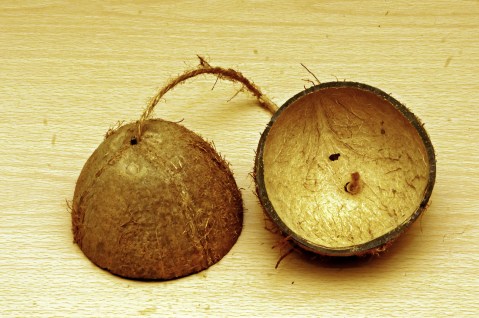

Series co-editors Dorothy Kim and Christopher Roman
Until the nineteenth century, very little medieval music had been rediscovered, and what little was known was known mainly to specialists. However, the nineteenth-century fascination with the Middle Ages, the Gothic Revival in art and literature, inspired composers to write symphonic works and operas using medieval stories and themes. By the time twentieth-century musicologists began decoding and publishing music from the medieval past, a general consensus as to “what sounds medieval” had already been established in the minds of educated listeners familiar with European art music (see Annette Kreuziger-Herr’s 2005 article “Imagining Medieval Music: A Short History”). Ideas of the medieval constructed in the 19th century via medievalist works of art persisted well into the twentieth, and eventually the imagined medieval sound of Romantic music turned out to be incompatible with the newly discovered historical record.
While Early Music performers in the 1970s and 1980s based their performance styles on historical research, their artistic work was inevitably conceived in relation to existing concert repertoires and standards of performance, as well as ideas about the Middle Ages known by them and by their audiences. A general goal was to create performances that audiences could feel were convincingly accurate to how the music would have sounded in the past. But a sense of authenticity depends not just on the performers’ historical accuracy, but on a complex interaction of experiences and expectations on the part of the audience.

Screen Capture from Monty Python by SO!
Two films, Monty Python and the Holy Grail and Knightriders, play directly with the clash between romantic interpretation of the Middle Ages and historically informed performances of music, for comedic effect. In Music in Films on the Middle Ages: Authenticity vs. Fantasy, John Haines examines six tropes of music in medievalist films: bells, horn calls and trumpet fanfares, court and dance music, minstrels, chant, and warriors on horseback. Haines mentions Monty Python and the Holy Grail several times, but does not discuss any of its music; he does not discuss Knightriders, likely because of its modern setting.
This essay examines the way these two films used music to highlight issues of the real, the historical, and the existence of competing medievalisms central to the understanding of medieval music in modern times. In the director’s commentary for the film Monty Python and the Holy Grail (1975), writer/performer/director Terry Jones had this to say about the film’s music:
Neil Innes had originally written the music for the entire film, and when we showed it, it didn’t really seem to work… we’d all agreed that Neil should go for a very authentic sound, and authentic instruments. The trouble is, it sounded quaint, and when we went to do the read-up I realized that actually you needed kind of mock-heroic music. But of course at that stage, we couldn’t afford to go and record some more music, so the only thing I could do was to go to a music library – I went to DeWolfe’s [a music library that licenses stock music] in London, and spent sort of weeks going through their discs, and sorting out bits of music to put on to it, to give it that sort of … it was just that we realized that if you had sort of music that sounded slightly quaint, because it was on original instruments, and you had all these silly goings-on, it looked comic, the music, instead of actually looking, um, real….
They wanted an “authentic sound,” but what they got didn’t seem real: here is the problem of conflicting expectations in a nutshell. Jones likely meant that the newly composed music, including the sounds of pre-modern instruments, was consciously reminiscent of older music as it was beginning to be known. The song sung by Sir Robin’s minstrels is likely a survival of Innes’ “authentic” score. The singer – Innes himself – sings a minor-mode melody reminiscent of a Tudor-era tune (think “Greensleeves”), accompanied by recorders, some reed instrument, and drum beats. The terms “original instruments” or “authentic instruments” don’t just refer to antique instruments (or copies of antique instruments), they were code for a particular approach to the performance of old music, an approach that was becoming very popular in 1970s Britain (for more on the British Early Music revival, see The Art of Re-Enchantment: Making Early Music in the Modern Age by Nick Wilson).
Jones characterized the pre-existing stock music chosen at De Wolfe’s as “mock Heroic,” but there’s really nothing mock about it per se— it’s genuinely heroic-sounding orchestral music, in the romantic post-Wagnerian style of Hollywood film scores, probably written in the 1950s or 1960s. There are brass fanfares when the company sights Camelot in the distance, angelic choirs for the vision of God who speaks to Arthur from the clouds, and especially, there is the wonderful music used when the company is galloping with coconuts. Here they are, approaching the castle of Gui de Lombard
The music for the galloping horses is heard several times during the film, and the contrast between its epic majesty and the sight of King Arthur and his knights not riding horses but rather banging two halves of coconuts together to simulate the sound of hoofbeats enhances the sight gag. The melody consists of four repetitions of the same melody, a strong rhythmic fanfare. The melody itself is made up of two almost identical phrases that each rise and then return down. The rhythm both emphasizes the steady pace and, through its mixture of long and short durations (a so-called “dotted rhythm”), suggests the gait of galloping horses. First we hear percussion, the high-frequency snare drums and lower booming tympani, then the low brass play the melody, harmonized. Higher trumpets join in for the second repeat, with flutes doubling the melody at a higher octave for added brilliance. That combination plays the third repeat, with strings joining for the fourth repeat. The tympani play faster, approaching the fanfare’s final cadence, but it becomes an anti-climax as Patsy, played by Terry Gilliam, can’t really play his long herald’s trumpet. A very knowing joke, as onscreen Hollywood heralds are frequently accompanied by the sound of modern valved trumpets playing chromatic phrases impossible to play on the visible long trumpets.
[The whole piece can be heard here; the part heard repeatedly in the film begins at 1:27:]
In its instrumentation, especially the use of brass and percussion, and the dotted rhythms (long, short, long, short, etc.) suggesting hoofbeats, this fanfare draws on a long tradition of music written to suggest galloping horses, whether ridden by medieval knights or other hunters or warriors. The most famous example is probably the finale to the “William Tell” Overture by Gioachino Rossini (1839). That galloping music influenced many film scores featuring knights on horseback, and it is likely that Terry Jones recognized the style from films he could have seen since the 1950s, such as MGM’s Knights of the Round Table (1953), starring Mel Ferrer as King Arthur and the very wooden Robert Taylor as Sir Lancelot which features music by Miklós Rózsa (1907-1995), who wrote similar music for both medieval knights and Roman charioteers, including trumpets to suggest fanfares and uneven rhythms to suggest hoofbeats.
The music in my second example deals directly with the clash between then and now. The 1981 film Knightriders was written and directed by George A. Romero, better known for his horror films (he invented the modern zombie film with 1968’s Night of the Living Dead). Knightriders follows the adventures of a traveling Renaissance-faire troupe of actors who stage jousting tournaments while riding motorcycles; the interactions between the actors come to parallel Arthurian stories. The film revolves around the conflict between modern reality and the desire to live one’s life according to (a modern understanding of) medieval chivalric virtues. This scene shows the troupe’s act: the action is straightforward, but the music is complicated, with the score by Donald Rubenstein using five distinct kinds of music in a theoretically sophisticated manner. In order, we hear: live music played on-screen by visible performers, recorded music played onscreen, and then three musically distinct flavors of underscore music. Watch for a yet another knowing gag about the technical capabilities of heralds blowing straight trumpets, as well as a cameo appearance by the writer Stephen King as a scornful man eating a sandwich.
The music performed on-screen functions as part of the scene. The painfully amateur band of minstrels plays a tune from Handel’s oratorio “Judas Maccabeus” (1746), probably known to the squeaky violinist from its use as a Suzuki teaching piece. We can imagine that these musicians are playing the oldest piece of music they know, and in response the audience—both onscreen and offscreen—is led to believe that the rest of the show will be similarly amateurish. The professionally recorded trumpet fanfare demonstrates again how their (and our) musical associations for medieval scenes, especially tournaments, come so strongly from Hollywood. The actors can’t begin to play their instruments, but everyone knows that the heralds and their fanfares are crucial for the scene they’re trying to set.
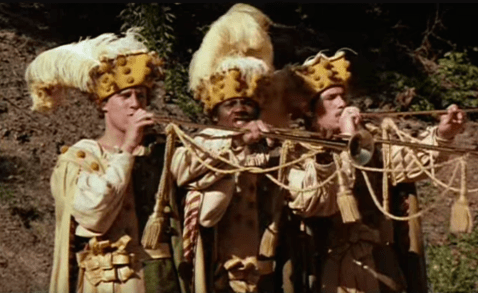
Screen Capture from Knightriders (1981) by SO!
When King William and Linet take their thrones, we hear underscore music—guitar and fiddle—for the first time; the shift from source music to underscore is done with great subtlety. This music has the informal flavor of folk music, which connects it to the little onscreen band, but now played professionally. The cue is extremely short, but serves as a transition from the real world of the tacky Ren-fest to the imagined world of chivalry and knighthood in some mythical past enacted by the modern-day warriors. The spectacular motorcycle stunts are underscored by more folk-sounding music: again fiddle and guitar, this time playing a fast jig. This music is exciting, as befits the action, but the specific sounds, reminiscent of Irish folk music, do more than just underscore excitement: they begin to move us backwards in time. Folk music reads as traditional, as old, but not ancient. The folk music sounds inhabit an intermediate place, a remembered past between the present and the imagined distant past of the middle ages.
When the individual jousts begin, the underscore music changes again, first to the heroic type of “Hollywood Knights” music, prompting the audience to equate the “real” riders onscreen with their fictional (and filmic) knightly counterparts. This kind of orchestral music, with prominent strings, is used throughout the film for moments of almost magical transformation, suggesting that for believers, such transformation is indeed possible. For the second and third jousts the underscore changes one last time, to trombones playing very archaic-sounding music. Here at last in 1980 is the sound of “authentic instruments” that Terry Jones eschewed back in 1974, and it doesn’t sound quaint at all here, it sounds real. These riders aren’t (just) carnival performers, they are knights at a tournament, risking bodily injury in their quest for personal excellence.

Screen Capture from Knightriders (1981) by SO!
The music in this sequence plays with a basic distinction in film music and film music scholarship: is the music diegetic, that is, part of the film’s story, or nondiegetic, that is, as Robynn J. Stilwell describes in “The Fantastical Gap between Diegetic and Nondiegetic,” in Beyond the Soundtrack, “an element of the cinematic apparatus that represents that world?” (184). The terms were first used by Claudia Gorbman in her pioneering study, Unheard Melodies: Narrative Film Music (1987), and have been a major focus of film music scholarship ever since.
In this sequence, the amateur musicians and the taped fanfare, count as diegetic music, while everything else is nondiegetic. Stilwell points out that border crossings between these two categories are common, but meaningful; she coined the term “fantastical gap,” the gap between what we see and hear and what we hear without seeing, to discuss the liminal (conceptual) space between the two (185-187). Stilwell describes movement from diegetic to nondiegetic as a “trajectory [that] takes on great narrative and experiential import. These moments do not take place randomly; they are important moments of revelation, of symbolism, and of emotional engagement within the film and without” (200). The Knightriders tournament sequence, already liminal as a “play within the play” of the film, traverses the fantastical gap in a way that dramatizes a central question for the performance of Early Music: what happens when modern performances are historically informed, but emotionally unsatisfying? For George Romero, as for Terry Jones, the answer is to give priority to the emotional, drawing on their and their audiences’ expectation for “Hollywood Knights” soundtrack music. Early Music performers in the 1980s made similar choices, merging familiarity and unfamiliarity in exciting ways that unfortunately left them open to criticism that their performances were “inauthentic,” an advertising claim they found themselves defending.
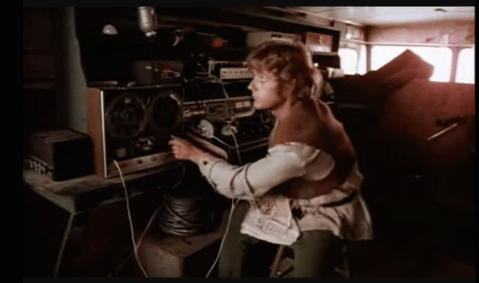
Recorded fanfare in Knightriders, Screen Capture by SO!
The modern performance of surviving pieces of medieval music, recorded in notation, will always enact a kind of medievalism, involving the creative use of material survival from the past. But to understand the goal for the performance of medieval music as historical accuracy alone is to miss an important point. Medievalisms, the creative use of historical material, create meanings for modern audiences, meanings that then help to shape further understanding of the historical past.
The decades since these two films were made and released saw great growth in both artistic approaches to Early Music, and in the skill of performers in playing old instruments and singing in newer, non-Classical styles. Professional recordings enjoyed real commercial success as a sub-genre in Classical music starting in the 1980s, accelerating audiences’ familiarity with the novel sounds of old music re-vivified. The 1990s saw “new age” music and Celtic folk-music sounds added to the mix, while performers in the 2000s have drawn inspiration from Greek Orthodox chant, and continental folk musics. “What sounds medieval” will always be conditioned by what modern performers and listeners imagine “the medieval” to be, and how “the medieval” is understood to be different from later times. As those imaginings are themselves constantly changing, so will their representations in music.
—
Featured Image: “Monty Python Coconuts” by Flickr User Mark Turnauckus
—
Elizabeth Randell Upton is Associate Professor of Musicology at UCLA and the author of Music and Performance in the Later Middle Ages (“The New Middle Ages” series, Palgrave Macmillan, 2013), which examines late fourteenth and early fifteenth century vocal music to discover evidence for the experiences of performers and listeners in the medieval past, recorded in surviving musical notation. Her next book will explore mid-twentieth century Early Music revivals in the UK and US, moving beyond the usual focus on musicological scholarship and classical music traditions to examine Early Music’s interactions with both folk music revivals and popular music.
—
REWIND!…If you liked this post, you may also dig:
Sounding Out! Podcast #54: The Sound of Magic-K.A. Laity
Mouthing the Passion: Richard Rolle’s Soundscapes–Christopher Roman
EPISODE LI: Creating New Words from Old Sounds–Marcella Ernest, Candace Gala, Leslie Harper, and Daryn McKenny
Share this:


Current Top Posts





April 2021

January 2020

November 2019

October 2019

August 2019

April 2014

November 2017

March 2015

December 2017

October 2015
 Sounding Out!
Recent Comments