
“This is Not a Sound”: The Treachery of Sound in Comic Books
DOI: https://doi.org/10.59350/3rbq5-djg69
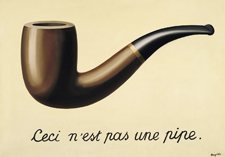
In comics theorist Scott McCloud‘s seminal work Understanding Comics (1993), there comes a point following his convoluted description of Magritte’s “The Treachery of Images” where he asks the reader, “Do you hear what I’m saying?” In the next panel he adds, “If you do, have your ears check because no one said a word.” The joke is, of course, that while his comic doppelganger is depicted as talking through the use of word balloons, no words are being spoken. We are reading, not hearing. And yet, sound (or rather, its representation) remains a crucial part of reading and enjoying comic books.
Magritte was trying to get us to think about the treachery of visual representation, while McCloud points us of the treachery of aural representation. A stylized “SPLAT!” is certainly not a sound, but our instinctual understanding of sound helps us to interpret what is otherwise a silent medium in ways beyond the mere the descriptive effect of a sound’s depiction. The way comics use sound can teach us about the function of sound in understanding the visual and textual. As McCloud asserts, comics depend on the reader to create closure between parts of an imagined whole in order for disparate panels to make sense. While it second-nature for the comic reader to interpret the depiction of sound in comics, the closure enacted to make stylized textual elements into “a sound” is a central way that this is enacted.
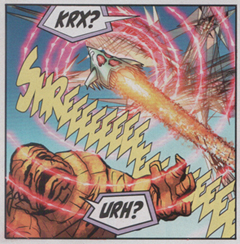
The most famous use of comic sound effect words is probably from the old 1960s Batman TV series—where the “SOCK!” and “BONG!” of superhero and sidekick reinforced the campy aesthetic of the program. It is telling that the Batman-theme (and the fight scenes in general) uses horn flares to emphasize those “POW!” and “BIFF!” moments. The suggestion is that the ostentatious representations of sound that these textual flare sound effect words provide are an empty signifier. There is no sound behind that sound. The weak-sounding slaps and smacks of knuckles on flesh would never suffice for the larger than life world of comic superheroes, and the more out-there comics get the more difficult it is to trace a relationship between the textual/visual representation and any sound in the real world. There is no point of comparison by which to understand the “SHREEEEEE!” of a launching “zirrer” in Kurt Busiek’s Astro City, but only the vague evocation of some loud shrill noise.
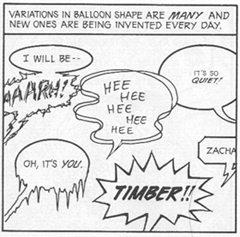
And yet, comic readers not only understand these representations as sound, but there are also a variety of visual clues given that help the reader interpret some quality of those sounds. The most ubiquitous example of sound in comics is, of course, the word balloon—so ubiquitous in fact that it is easy to take for granted the fact that comics have their own conventions for handling and describing sound without recourse to adjectives. The irony is that the shape and texture of word balloons (just like the shape and texture of sound effect words like “BOOM!”) that help to convey the quality of sound become nearly invisible to the reader. Just as any literate person sees a word they know and interprets it for what it is meant to represent and not a collection of individual letters, the dripping icicle-like shape of a word balloon is read as a cold tone or the sharp points of the balloon are read as loud and abrupt.
In her essay “The Comic Book’s Soundtrack” from The Language of Comics (2001), Catherine Khordoc provides a very good overview of the use of sound in comics using the example of Goscinny and Uderzo’s Asterix to provide examples of the various ways word balloons and the implanting of onomatopoeic words directly into the panel image itself are used to represent sounds in comic books. Yet, the function of the representation of sound in comic runs even deeper than simply translating the quality of sound itself; it also serves to help establish timeframes for panels (or sets of panels) and functions in establishing the closure the reader performs in making sense of both individual panels and their context within a sequence of panels. Discrete sounds—whether it’s the “FWOOSH!” of the Human Torch flaming on or long-winded pseudo-scientific explanation of the Negative Zone by Mr. Fantastic—require the passage of time to be intelligible. In order for sounds to be differentiated, they must have some form of beginning, middle and end (or in the parlance of synthesized sound, “attack, decay, sustain, release”). This means that in comics, a medium where space and time merge, representations of sound are crucial to making sense of action, in particular, to the passage of time within a singular panel—for while time can be shown to pass between two or more panels through the process of closure (implicitly understanding the movement or occurrence not depicted between panels that makes them sequential), a singular panel is not necessarily a discrete moment, as an entire conversation can occur within it, requiring readers to perform closure even within the scope of a single panel.
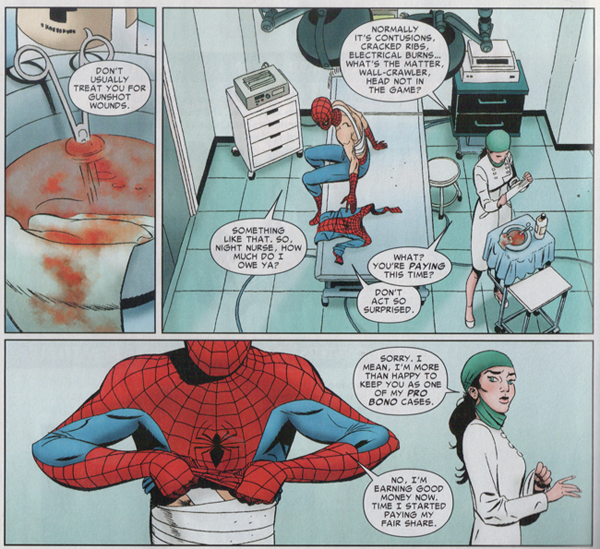
For example, in the second panel below, despite the static image, the passage of time suggested by the conversation about Spider-man’s wounds and payment leads the reader to make sense of the sequence between it and the panel that follows. It is the reader’s understanding that it takes time to talk and listen out loud that helps make the time of the panel apparent.
Perhaps the most telling evidence of the centrality of sound, at least to the superhero comic genre, was Marvel’s decision to include a synopsis and explanation of the action at the end of each issue of the “‘Nuff Said,” “silent” month of comics back in 2001—wherein there was no dialogue or captions.
There is still a lot to consider when it comes to sound in comics—not just the rhetoric of sound or sound as a signifier of time, but sound as identity. Representations of sound in comics can serve as a form of character signature, and I do not mean only famous lines like Superman’s “Up, up and away!” (which really emerged from Superman radio plays), but iconic sounds such as Spider-man’s web-shooters going “THWIPP!” or Wolverine’s claws, “SNIKT!” that over time have come to be more than just descriptive sound-words, but signifiers that are unique for the characters themselves. (See TV Trope’s page on signature sound effects)
In the end, this brief overview will hopefully serve as a starting point in generating more thoughts on not only how our familiarity with sound informs our reading and interpreting of comics, but how this (admittedly) very general idea can be applied to other ostensibly silent and primarily visual media. The use of sound in comics is a perfect example of how the transparency of sound can make it presence and function easy to overlook. Furthermore, the way in which it is used to orient the reader and help provide closure between and within panels, and identify characters clues us in to the importance of its role and the importance of considering where and how else it might function. I, for one, am going to keep thinking on it and looking for examples of in comics and hope that others join their thoughts to the discussion. Until then, as Stan Lee would “say,” Excelsior!
—
Osvaldo Oyola
—
Share this:

I Hear You, I See You
DOI: https://doi.org/10.59350/w9ba8-n8t81
(The title of this post comes from an episode from Season Two of NBC’s Parenthood; Zeke, the patriarch, learns in marriage counseling that he must listen to his wife and let her know he is listening.)
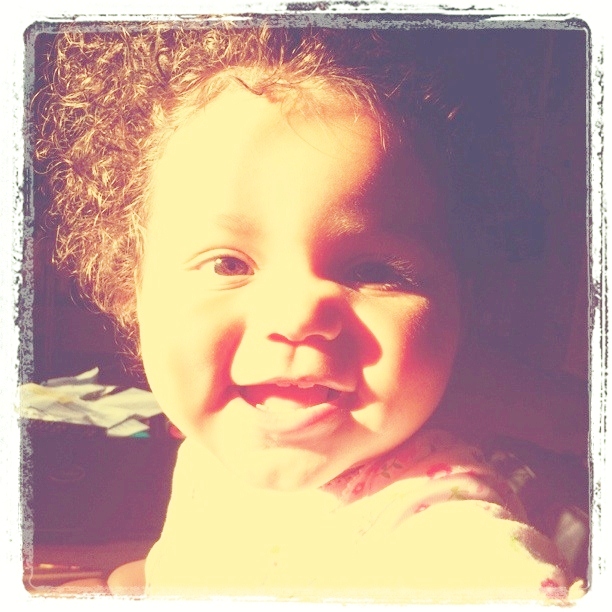
Since she was in the womb I’ve recorded Miss E’s sounds. I’ve posted before about my experience listening to her heartbeat at every obstetrician appointment. Late in my pregnancy I managed to record her heartbeat. I still play it and replay it in amazement; those beats were a sign of the life growing inside of me. I felt like I was eavesdropping on her every time we tuned in. It was sonic peeking. After she was born, I wanted to continue recording the sounds she made because I wanted to have recordings as well as pictures for her when she grew up.
For the past eleven months I’ve recorded my daughter’s sounds at different stages with my iPhone (as I’ve mentioned in my latest KC post, my iPhone is my preferred recording device if only because it is always within reach). I record when I remember, or when she adds a new sound to her repertoire. However, I try to record her once a month. The same way that she has gone from not moving at all to crawling all over our apartment, she has gone from not making any sounds to babbling, squeeling, and laughing. The sounds she makes are an indication of development, but they are also a sign of her awareness of the world around her.
As a first-time mom, I expected a lot of things early on. I didn’t understand why she held her fists closed for the first few weeks or why she didn’t follow me around the room. It almost felt like she was ignoring me. The same thing happened with her sounds. The fact that she didn’t respond to my words with sounds worried me. I always wondered if she was sad! And it’s no wonder: all she would do was cry. Of course, I realized soon after that her crying was her only way of communicating with the world. One of my first recordings of Miss E is of her shrill crying, and it still makes my chest tighten up when I hear it.
My second recording is of her at three months. By this point the cries have morphed into more of a grunt. As I typed this post I listened to my recordings, and it’s remarkable how inarticulate she sounds compared to what she sounds like now. But back then, I was excited that she was making more sounds other than crying. Indeed, the fact that she wasn’t always crying was a relief. These new sounds, to me, were her attempt at trying to communicate, or rather discovering ways to communicate. It’s almost as if she had discovered that she had a voice. The silences talked as much as the sounds, for at this stage she spends more time awake (and more time awake without crying).
As Miss E has grown throughout this first year, her sounds have started to vary. Very much like a language, she has different registers, different sounds depending on what she wants to say. Whereas before she would only give me a smile when she woke up, now she provides me with a running commentary on her dreams and her giraffe while I change her diaper. Even her giggles developed different registers. She had different kinds of giggles! Now she makes sounds on her own, not as a response to something I had done but because there is something she wants to respond to. I read in her babbles the beginning of her path to independence. it’s a long way until she moves out of our household, but the fact that she wants to talk to other people or talk about what she wants, and not in response to what I am saying or doing is amazing. It’s also a little sad, for it’s also an indication of her willingness to move on to other things.
We tend to forget that during that first year babies have little interest in interacting with people outside of their nuclear family. They stare at strangers or shy away. But the moment they start talking to themselves or their toys, you are no longer the center of their world. And it’s a bone-chilling thought.
Recording her sounds is important to me just as much as taking pictures. (I don’t take video of her mostly because we didn’t have any way to do that until recently when I updated my phone to an iPhone 4). I wanted her to have visuals as well as audio, and even though video recordings could do just as well, the effect of just listening to sounds and being able to focus on that is an interesting (if jarring) experience. Those sound recordings trigger memories just as vividly as pictures do, or even more so than pictures. I hope to keep these recordings until she is older so that she can see herself as well as hear herself when she was just a little girl. I want to know that “I hear you, I see you,” that hearing is just as relevant as seeing.
Bonus tracks: Here’s Miss E at several stages in the last year.
Miss E at 3 months (trying to get Mommy’s attention)
Miss E at 10 months (banging and making music)

—
Liana Silva
—
Share this:




Current Top Posts





April 2021

January 2020

November 2019

October 2019

August 2019

April 2014

November 2017

March 2015

December 2017

October 2015


Recent Comments