
Introduction to Sound, Ability, and Emergence Forum
The language of sound studies, and even the word sound itself, doesn’t do justice to our scholarship. Sound studies is, to me, a populist discipline that has given me a social setting and theoretical framework in which to develop my own ideas. Into this field I can carry my own history and let it screech and flash until it finds at least passing resolution.
Sound studies is less about sound than vibration, though this distinction is not easy for me to clarify. My experience of sound studies is somewhere in the web of music-as-activism, music-as-tactile-experience, and cultural studies. It all comes back to music, but music is, to me, a fairly broad term. I have written about the work of Diamanda Galás and Throbbing Gristle— lately I have been going back to early Sonic Youth and Aphex Twin’s song [Equation] which, at the end features noise that, when sent through a spectrogram analysis, reveals a visual face. The thread that runs through this music is a lack of “standard” musicality. Instead many of these artists create an atmosphere of sound, a deeply affective field in which the audience is immersed. Although not music in the traditional sense, these musical experiences produce the shrill prick of goosebumps in my body, the deeply triumphant bass in my bones. It is a convergence of things that can’t be contained in the auditory cortex.

On rhythm: My tattoo artist working on the last piece of my half sleeve. Usually I find the visceral rattle of the gun trumps physical discomfort, and I try to remain as quiet as possible and focus on the whir, the vibration, echoing between layers of my skin, somewhere in the connection between bodily stimulus and neural recognition.
Eleni Ikoniadou’s 2014 book The Rhythmic Event explores rhythm from a confluence of media theorists and artists who embrace the body and temporal experience as an immanent mode of becoming. While criticized by Eddie Lohmeyer (2015) for not drawing explicit connections between theorists, I believe Ikoniadou prevails in her attempt to theorize the rhythmic event as a means of collapsing or decoding linear time and discrete experience into an underlying and rhizomatically immanent means of affective and affinitive connections. Rich in theory and exciting in promise, Ikoniadou’s work builds on preexisting theory and syncs it with the body in its ambient, affective field. As she deftly explains, rather than a Platonic understanding of rhythm as a means of ordering time, Ikoniadou adopts a Deleuzian view of rhythm as “a middle force that occupies the distance between events, hinting that there is no empty space or void waiting to be filled by human perception” (13). This immanence— an ontology in which the universe thrums always with a richness of vibration, sets in motion new ways of understanding art and experience, replacing the subjective with the affective. In many ways Ikoniadou’s work informs and reinvigorates the convergence of affect theory, queer theory, and sound studies. Often, it is transcendent, enabling “sound studies” to encompass any possible connotation of feeling, of touch, of culture, of intuition, of the intricate nature of intersectionality, interconnectedness.
While sound studies once fought to decenter the Western cultural reliance on the gaze as the default sense through which critical theory should run, we are now as a discipline much more textured, synaesthetic. Through sound studies we learned of remote intimacy (Jennifer Terry via Karen Tongson) and the network of interlinking experience that connected us past simple auditory stimuli. We now have constructed a vibrational ontology in which sound is essential, though it is not always experienced as simply sound.
The Sound, Ability, and Emergence Forum stretches, yearns, and trembles toward these critical questions: Where do we move from here? How will our language reflect the broadening sense of sound as delicately connected to all our other experiences? and how can we allow for theories and experiences from those who listen but might not hear in the traditional and often ableist sense of the word?
—
Airek Beauchamp is an Assistant Professor at Arkansas State where he specializes in Writing Studies. As Assistant Director of Campus Writing at Arkansas State he has the privilege of engaging academic and community activism, and he attempts to tie all of his scholarship to concrete political action. His other areas of research include queer theory, affect theory, and trauma in the LGBTQ community.
—
 REWIND! . . .If you liked this post, you may also dig:
The Listening Body in Death –Denise Gill
Live Through This: Sonic Affect, Queerness, and the Trembling Body–Airek Beauchamp
Queer Timbres, Queered Elegy: Diamanda Galás’s The Plague Mass and the First Wave of the AIDS Crisis –Airek Beauchamp
Share this:

SO! Amplifies: Anne Le Troter’s “Bulleted List”
 SO! Amplifies. . .a highly-curated, rolling mini-post series by which we editors hip you to cultural makers and organizations doing work we really really dig. You’re welcome!
—
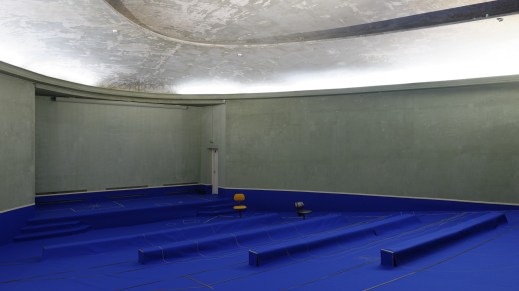
Nestled deep in a corner of Paris’ Palais de Tokyo, Anne Le Troter’s sound piece “Bulleted List” invites the museum’s visitors to explore the social similarities that people verbally express in response to cold calls. Le Troter’s first solo show to be on display in Paris, the work invites the audience to sit inside a modified cinema amphitheater as the sounds of recorded people answering survey queries echo throughout the sloped room. The seating arrangement inside the exhibition mirrors the cubicle-style setup of a call center, though each “station” consists solely of an outline designating where to sit and a coordinating amplifier. Both the questions and answers in the sound piece are produced by real survey callers; each voice sounds polished, poised and mechanized from years of vocal experience, revealing the automated nature that comes with the territory of making a scripted call. The result of each recorded voice unto the listener is akin to standing in the center of a symphony, with vocal patterns as punctuated as a visual, typographic list.
At the Palais de Tokyo I set up a play of light, a new element in my work, which gives visitors a time reference, even if they arrive half way through. Each broadcast is incidentally interspersed with a long silence to emphasize the idea of a session. This determines the attention span given to a work. The collective listening situation I find especially interesting because it reveals a set of patterns of behaviour, a whole language of bodies and eyes between the spectators. These micro-actions, just like the mental paratext of visitors and pollsters (those words that are not uttered but which ring out in our heads when we think or write), swell the work. –Anne Le Troter, interview with Raphael Brunel
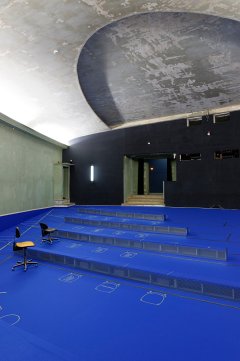
Still of Anne Le Troter’s “Bulleted List” at the Palais de Tokyo, image by author
The progression of sounds in the exhibition follow a distinct, if not choppy routine, with a clearly enunciated polling question asked — “What is your relationship status?” for example — followed by equally simplistic answers — “widowed,” “married” and “couple,” to note a few. Reflective of the exhibition’s timely concurrence with the French presidential election, each of the questions asked in the sound piece culminates in a political questionnaire, with the same questions and answers being traded back and forth between people in all areas of the political spectrum — indicating that there are fewer differences between the various polling demographics and how they express their opinions than what appears at first glance.
“Bulleted List” opened at the Palais de Tokyo on Feb. 3, 2017, and will close on May 8.
Anne Le Troter was born in 1985 and currently lives in Paris. She graduated from the Geneva School of Art and Design in 2012, and her first solo shows were held at the Arnaud Deschin Gallery (Paris, 2016), BF15 (Lyon, 2015), Espace Crosnier (Geneva, 2015) and Espace Quark (Geneva, 2014). In 2016, she was awarded the Grand Prix at the 61st Salon de Montrouge.
—
Featured Image: Still of Anne Le Troter’s “Bulleted List” taken by the author
—
Shauna Bahssin is a sophomore at Binghamton University who double-majors in English and art history. She currently serves as the copy desk chief for the student newspaper, Pipe Dream, and has written for its news and arts and culture sections in the past. Outside of the paper, she is involved with the university’s fundraising initiatives through the Binghamton Telefund, and she hopes to work within the field of arts development and advancement after she graduates.
—
REWIND!…If you liked this post, you may also dig:
SO! Amplifies: Shizu Saldamando’s OUROBOROS
SO! Amplifies: Mendi+Keith Obadike and Sounding Race in America
Sound and Curation; or, Cruisin’ through the galleries, posing as an audiophiliac–reina alejandra prado
Share this:




Current Top Posts





April 2021

January 2020

November 2019

October 2019

August 2019

April 2014

November 2017

March 2015

December 2017

October 2015
 Sounding Out!
Recent Comments