
Misophonia: Towards a Taxonomy of Annoyance

 This is the second post in Sounding Out!’s 4th annual July forum on listening in observation of World Listening Day on July 18th, 2015. World Listening Day is a time to think about the impacts we have on our auditory environments and, in turn, their effects on us. For Sounding Out! World Listening Day necessitates discussions of the politics of listening and listening, and, as Carlo Patrão shares today, an examination of sounds that disturb, annoy, and threaten our mental health and well being. –Editor-in-Chief JS
An important factor in coming to dislike certain sounds is the extent to which they are considered meaningful. The noise of the roaring sea, for example, is not far from white radio noise (…) We still seek meaning in nature and therefore the roaring of the sea is a blissful sound. Torben Sangild, The Aesthetics of Noise
When hearing bodily sounds, we often react with discomfort, irritation, or even shame. The sounds of the body remind us of its fallible and vulnerable nature, calling to mind French surgeon René Leriche’s statement that “health is life lived in the silence of the organs” (1936). The mind rests when the inner works of the body are forgotten. Socially, sounds coming from the organic functions of the body such as chewing, lip smacking, breathing, sniffling, coughing, sneezing or slurping are considered annoying and perceived as intrusions. A recent study by Trevor Cox suggests that our reactions of disgust towards sounds of bodily excretions and secretions may be socially-learned and vary according to whether it is considered acceptable or unacceptable to make such sounds in public.

However, for people suffering from a condition called Misophonia, these bodily sounds aren’t simply annoying, rather they become sudden triggers of aggressive impulses and involuntary fight or flight responses. Misophonia, meaning hatred of sound, is a chronic condition characterized by highly negative emotional responses to auditory triggers, which include repetitive and social sounds produced by another person, like hearing someone eating an apple, crunching chips, slurping on a soup spoon or even breathing.
The consequences of Misophonia can be very troublesome, leading to social isolation or the continuous avoidance of certain places and situations such as family dinners, the workplace and recreational activities like going to the cinema. While rate of occurrence of new cases of Misophonia in the population is still under investigation, the fast growing number of online communities gathered around the dislike of certain sounds may indicate that this condition is more common than previously thought.
But why do people with Misophonia feel such strong reactions to trigger sounds? This fundamental question remains up for debate. Some audiologists suggest these heightened emotional responses can be explained by hyperconnectivity between the auditory, limbic and autonomic nervous systems. However, we continue to lack a comprehensive theoretical model to understand Misophonia, as well as an effective treatment to help sufferers of Misophonia cope with intrusive sound triggers.
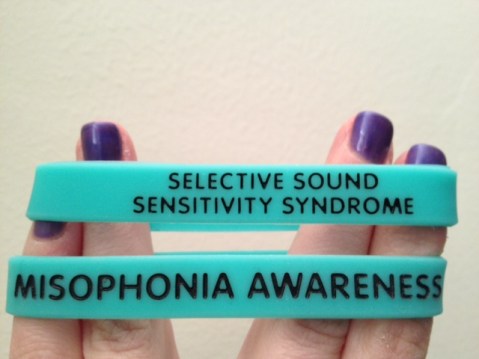
The Art of Annoyance: is it possible to reframe misophonic trigger sounds as misophonic music?
Between 1966 and 1967, John Cage and Morton Feldman recorded four open-ended radio conversations, called Radio Happenings (WBAI, NYC). Among many topics, Feldman and Cage address the problem of being constantly intruded upon by unpleasant sounds. Feldman narrates his annoyance with the sounds blasted from several radios on a trip to the beach. Cage’s commentary on the growing annoyance of his friend reveals a shift of perception in dealing with unwanted sounds:
Well, you know how I adjusted to that problem of the radio in the environment (…) I simply made a piece using radios. Now, whenever I hear radios – even a single one, not just twelve at a time, as you must have heard on the beach, at least – I think, “Well, they’re just playing my piece.-– John Cage, Radio Happenings.
Cage proposes a remedy via appropriation of environmental intrusions. The negative emotional charge associated with them is neutralized. Sound intrusions no longer exist as absolute external entities trying to intrude their way in. They become part of the self. Ultimately, there are no sonic intrusions, as the entire field of sound is desirable for composition.
Cage’s immersive compositional anticipated an important strategy to build resilience towards aversive sound: exposure-based cognitive-behavioral therapy, which proposes a gradual immersion in trigger sounds. And I suggest we can mine the history of avant-garde practice to productively further the idea of immersion; in the realms of sound poetry, utterance based music, Fluxus events and many other sound art practices, bodily sounds have consistently been exalted as source of composition and performance. Much like Cage did with what he perceived as intrusive radio sounds, by performing chewing, coughs, slurps and hiccups, assembling snores and nose whistles, and singing the poetics of throat clearing, we may be able to elevate our body awareness and challenge the way we perceive unwanted sounds. In what follows, I sample these works with an ear toward misophonia, discussing their interventions in the often jarring world of everyday irritation.
Oral Oddities
As pointed out by Nancy Perloff, while the avant-garde progressively expanded to incorporate the entire scope of sound into composition, sound poetry followed a similar course by playing with the non-semantic proprieties of language and exploring new vocal techniques. The Russian avant-garde (zaum), the Italian futurists (parole in libertà) and the German Dada (Hugo Ball’s verse ohne Worte) built the foundations of a new oral hyper-expression of the body through moans, clicks, hisses, hums, whooshes, whizzes, spits, and breaths.
Henri Chopin, Les Pirouettes Vocales Pour Les Pirouettements Vocaux
Sound poets like Henri Chopin created uncanny sonic textures by only using ‘vocal micro-particles’, revealing a sounding body that can be violent and intrusive. François Dufrêne and Gil J Wolman brought forward more raw and glottal performances.
Bridging the gap between the Schwitter’s Dada-constructivism and a contemporary approach to sound poetry, Jaap Blonk’s inventive vocal performances cover a wide range of mouth sounds. In the same vein, Paul Dutton explores the limits of his voice, glottis, tongue, lips and nose as the medium for compositions — as can be heard on the record Mouth Pieces: Solo Soundsinging.
Paul Dutton, Lips Is, Mouth Pieces: Solo Soundsinging
Fluxus: Eat, Chew, Burp, Cough, Perform!
The Event is a metarealistic trigger: it makes the viewer’s or user’s experience special. (…) Rather than convey their own emotional world abstractly, Fluxus artists directed their audiences’ attention to concrete everyday stuff addressing aesthetic metareality in the broadest sense. Hannah Higgins, Fluxus Experience
The emergence of Fluxus is strongly linked to Cage’s 1957-59 class at New School for Social Research in NYC. George Bretch’s Event Score was one of the best known innovations to emerge from these classes. The Event Score was a performance technique drawn from short instructions that framed everyday life actions as minimal performances. Daily acts like chewing, coughing, licking, eating or preparing food were considered by themselves ready-made works of art. Many Fluxus artists such as Shigeko Kubota, Yoko Ono, Mieko Shiomi, and Alison Knowles saw these activities as forms of social music.
For instance, Alison Knowles produced several famous Fluxus food events such as Make a Salad (1962), Make a Soup (1962), and The Identical Lunch (1967-73).
Also, Mieko Shiomi‘s Shadow Piece No. 3 calls attention to the sound of amplified mastication, while Philip Corner’s piece Carrot Chew Performance is solely centered in the activity of chewing a carrot.
Philip Corner, Carrot Chew Performance, Tellus #24
In Nivea Cream Piece (1962), Alison Knowles invites the performers to rub their hands with cream in front of a microphone, producing a deluge of squeezing sounds:
Alison Knowles – Nivea Cream Piece (1962) – for Oscar (Emmett) Williams
Coughing is a form of love.
 In 1961, the Fluxus artist Yoko Ono composed a 32 minute, 31 second audio recording called Cough Piece, a precursor to her instruction Keep coughing a year (Grapefruit). In this recording, the sound of Ono’s cough emerges periodically from the indistinct background noise. The Cough Piece plays with the concept of time, prolonging the duration of an activity beyond what is considered socially acceptable. While listening to this piece, Yoko Ono brings us close to her body’s automatic reflexes, pulling back the veil of an indistinct inner turmoil. Coughing can be a bodily response to an irritating tickling feeling, troubled breathing, a sore throat or a reaction to foreign particles or microbes. In response, coughing is a way of clearing, a freeing re-flux of air, a way out. Coughing is a form of love.
Yoko Ono – Cough Piece

Sonic Skin
In the work The Ego and the Id (1923), Sigmund Freud stated that the ego is ultimately derived from bodily sensations. The psychoanalyst Didier Anzieu expanded this idea by suggesting that early experiences of sound are crucial to consolidate the infant’s ego. The bath of sounds surrounding the child created by the parent’s voices and their soothing sounds provides a sonorous envelope or an audio-phonic skin that protects the child against ego-assailing noises and helps the creation of the first boundaries between the inside and the external world. The lack of a satisfactory sound envelope may compromise the development of a proper sense of self, leaving it vulnerable to invasions from outside.
It’s no surprise that conditions like Misophonia exist and are very common among us, considering how important our early exposure to sound is in building our sense of self and our sensory limits. For Misophonics, the everyday sounds we make without even thinking about them can be the source of a fractured and disruptive experience that we should not dismiss as the overreactions of a sensitive person. During the month we observe World Listening Day, our discourse usually praises the pleasures of listening and tends to focus on the sounds that soothe rather than annoy. However, conditions like Misophonia show us that there is much more that needs to be said on the subject of unpleasant sound experience. I can’t help but notice a disconnect between the vast exploration of annoying and irritating sounds in the avant-garde and the critical discourse in our sound communities that is dominated by the pleasures of listening. Cage’s call to embrace intrusive sounds urges us to consider all sounds regardless of where they fall on the spectrum of our emotions. For all of us who would consider ourselves philophonics, let’s create a critical discourse that addresses the struggles of listening as much as its pleasures.
—
Thanks to Jennifer Stoever for the thoughtful suggestions.
—
 REWIND! . . .If you liked this post, you may also dig:
Share this:

The New Wave: On Radio Arts in the UK

 In the UK there has never been much scope for radio art within the realm of public service broadcasting, leading artists to seek funding for their own independent projects, predominantly from the Arts Council of England (ACE) and other state funding bodies and charitable trusts. In this article, the final in Sounding Out!‘s series Radio Art Reflections, I will consider this recent avenue of practice, because its results – in terms of audience composition, artistic output and the wider cultural context of the form – shed light on both the particular context of radio art practice in the UK, and also have implications for the wider struggle for sustainable independent media networks against the diminished imaginative horizons of a public broadcast culture endlessly inured to ‘unavoidable’ cuts and the free market enclosure of the digital commons.
In the name of ‘austerity’ such cuts have been inflicted upon broadcasters worldwide. The loss of key radio arts programmes like Australia’s Listening Room, as discussed in the last post by Colin Black, is by no means the exception, even in an age of expansion in digital spaces. As De Lys stated way back in 2006 it may be considered “[i]ronic that the ‘rationalization’ of radio arts by public broadcasters occurs at the same time that audio arts activity and the creative use of sound are expanding exponentially in community spaces, in galleries, games, and online.” (De Lys, S and Foley, M; 2006, “The Exchange: A Radio-Web Project for Creative Practitioners and Researchers” Convergence; The International Journal of Research into New Media Technologies, 12; 129, Sage)
Elsewhere, institutional affirmation through public broadcasting connects local, national and international art radio broadcasters, as it also empowers two long running international radio art competitions that continue today: the Prix Italia set up by RAI, in 1948, to engage creatives to work with radio and create new works for the medium; and the The Karl Sczuka Prize for Radio Art, established by SWR in Germany in 1955, notable (sadly) for how so few women artists have ever won the awards. For Kersten Glandien, contributing to the Reinventing The Dial symposium back in 2009, the availability of public radio funding in the 80s and 90s enabled a heyday of commissions and festivals, events and prizes (Glandien, K; 2009. Keynote Paper given at Reinventing the Dial Symposium. Canterbury Christ Church University).

No such radio art competition or open call for new radio art work has ever been run by the BBC, highlighting its resistance to the form. At present the BBC runs just one experimental programme that has been on air for 20 years: Between The Ears on BBC Radio 3, which leans towards more narrative-centered features reflecting Black’s issues with ABC’s Soundproof discussed in the last article.
ART STATIONS AND COMMUNITY RADIO IN THE UK
The first experimental art radio station in the UK went on air in Liverpool for a week in 1995, Hearing is Believing on 105.8FM. As Scanner wrote at the time it offered the chance for listeners to hear “sound works, performance and innovative documentaries that would never receive airplay on even the most ‘progressive’ FM bands. Remember, BBC Radio still has problems playing certain works of Stockhausen because they contain randomly-culled shortwave radio signals.”(The Wire, 1995). That inspired the London Musicians Collective to run its own month long arts station in Resonance 107.3FM in 1998. I was part of its action group and then its steering group as the station went full time in 2002.
Tight regulation across public and commercial radio in the UK also meant that artists were late to explore the medium. Trevor Wishart reminisced with me at Radio Without Boundaries about a radio piece he made with the BBC in mind that took over 28 years to be played on the radio in the UK, being not sufficiently ‘musical’ for a music station and not ‘dramatic’ enough to fulfill the conventions of drama.
In this context, community radio has been an important if limited platform and nurturing site for new radio art. There are now over 200 such stations in the U.K. but only two dedicated to the arts community: Resonance FM and Soundart Radio at 102.5 FM, the latter based in Devon since 2006. Soundart Radio exists on a hand-to-mouth basis via small grants to provide training for disadvantaged groups. Resonance FM, by contrast, has achieved regular funding by walking a line between its community status and its avant garde roots. Its success is due largely to its location and the exceptional work of volunteer artists and musicians who have developed innovative programming without budgets.
Arts Council England increased Resonance’s funding as it became a ‘national portfolio organisation’ in 2012. The station may tower over other most community stations, but its yearly funding is still only comparable with that of many regional arts festivals. Moreover, radio art is only a small part of what Resonance broadcasts, and is mostly scheduled as discrete programmes such as Radia, and as less frequent one-off programming such as Remote Performances a collaboration between London Fieldworks, the Live Art Development Agency and ACE, broadcasting 20 live mostly music based performances for a week from Glen Nevis, Lochaber, Scotland.
FUNDING RADIO ARTISTS
Open funding for artists directly from community radio stations is very limited and ad hoc. The Community Media Association was able to offer small commissions for Modulate, an open call to encourage artists to team up with community stations to encourage more arts diversity and address the fact that around “70 per cent of the community radio sector’s programming is music-based” (CapeUK, 2008, p.08). Meanwhile, Art Transmission was a welcome one-off project early this year run by Francis Knight who commissioned three sound artists including Jane Pitt and Xentos Jones to work with young boxers and steam railway enthusiasts to make radio works for the small community station BRFM on the Isle of Sheppey. A recent CapeUK report concluded that Community radio “offers creative and artistic freedom to their contributors unmediated by the editorial control exercised in commercial or public service broadcasting.” (CapeUK, 2008, p.20).

It would be naive to imagine editorial constraints do not exist in the community radio sector. This is perhaps why several British artists have gone it alone to retain autonomy by running their own short durational arts stations as Restricted Service Licenses for projects which run for up to 28 days and can broadcast up to 25 watts, such as Kaffe Matthews Radio Cycle (2003) and Tom McCarthy and INS Calling All Agents (2004), Celestial Radio (2008), Boat Radio (2012), Writtle Calling (2012), Radio Boredcast (2012) and The Dark Outside (2012-14) all funded by The Arts Council. This marks an increasing trend in the UK of artists-curated FM stations.
Grants for the Arts from ACE offers a way for artists to receive funding to make new work. My own group Radio Arts has, through funding from ACE and Kent County Council, been able to recently commission new radio art works for broadcast from Colin Black (AU), Arturas Bumsteinas (LITH), Iris Garelfs (GER), Anna Friz (CAN), Louise Harris (UK),Olivia Humphreys (UK),Langham Research Centre (UK), GX Jupitter- Larsen (US), Carlo Patrao (PORT), Mikey Weinkove (UK),Joaquim Cofreces (Argentina), Esther Johnson (UK), Michael McHugh (UK), Gregory Whitehead (USA), as well as Radio Arts members Genetic Moo, myself and James Backhouse (UK). Radio Arts ran a series of workshops, a radio art showcase exhibition and will be running a forthcoming live event and online gallery and further workshops next year alongside broadcasts of the new works to be heard on eight partner stations in four countries.
However, such work can only continue with further funding. For me it is important to move away from the current creative commons ethos, where no one is ever paid to participate. We should allow sound and radio artists to gain a fee to produce new radio work, particularly as the Artist Network in the UK is campaigning for artists to be paid in galleries.
MICROBROADCSTING AND ARTS SPACES
Another interesting area which has taken off from Japanese radio artist Tetsuo Kogowa is micro broadcasting, the use of small range transmitters allowing artists to broadcast in a localized space of up to one watt, without the need for a license, either by building the transmitters or buying them readymade. These work well for radio installation and have allowed me to continuously play works as discrete stations and produce surround works allowing a different voice or sound to emanate from each radio in the installation. For eight years, mostly unfunded, I worked on Switch Off a PhD radio art project documented on my blog creating eight different fictional stations as micro broadcast installations each imaging a future use for FM when it has been abandoned in the UK these works explored radio art practice from a post digital perspective.
.
Micro broadcasting these works proved to be a very liberating way of sharing radio art work in galleries and outside of conventional radio broadcasts and allowed me to really experiment without constraint, whilst the web has brought me closer with other international artists and communities to share practice and projects. Having used radios as a readymades for multiple and surround installations my experience has led me to new ways of thinking about installation work such as a bespoke transmitting book Spiritual Radio 2014, which broadcasts itself and awaits the listener to find its frequency.
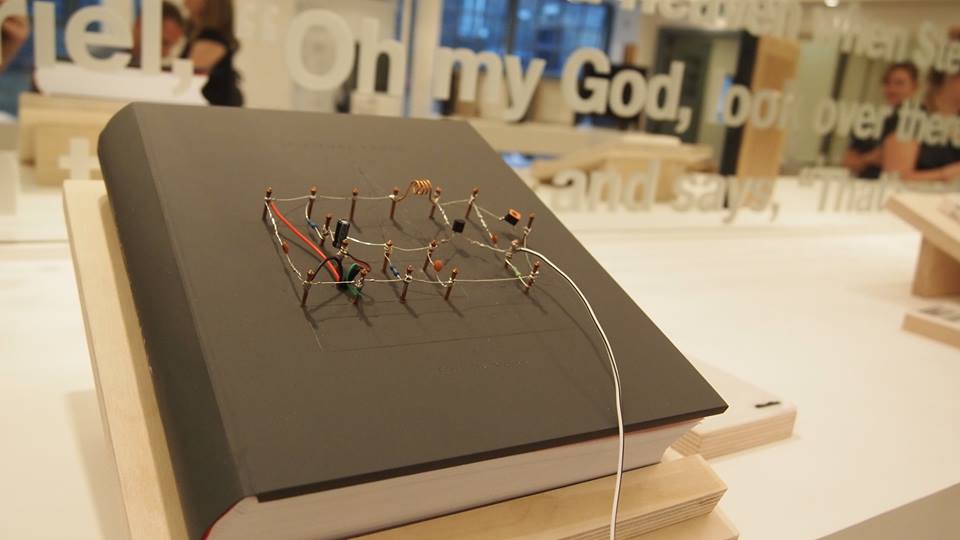
Magz Hall Spiritual Radio (2014) Whitechapel Gallery London
Following this line, many online arts stations have been set up by galleries and arts spaces, often as temporary projects. Online arts station Basic FM started in 2011, and was a project of Newcastle independent cinema Pixel Palace having hosted Vicki Bennett’s Radio Boredcast at the AV Festival (2012). It “presented an audio gallery that exhibited the work of those making interesting noise: sound collage, found sound, spoken word, discourse, dialogue and discussion, musique concrète or original, remixed and detourned musics” (Basic FM, 2014, website). Run by one part-time member of staff and funded by the Arts Council to run for thirty months until 30th Sept 2014 Basic FM did not carry on due to lack of further funding, a real loss after it steadily building up its reputation as the third full time arts station in the UK.
It seems that in the UK the lack of artistic airspace on public and community radio has been sidestepped by radio artists who have forged their own stations to redefine public space in myriad forms. And there are possibilities in the future. The latest temporary UK arts station call comes from the well regarded CCA Gallery Glasgow Radiophrenia next year, while London’s Tate Britain is currently running a family programme Radiocity and its community programmes have commissioned myself and Jim Backhouse from Radio Arts to run a series of workshops called Reclaim the Waves from the end of February, working with the local Westminster community to document the changing city and produce a participatory radio installation for exhibition.

—
Magz Hall is a sound, radio artist and founder of Radio Arts an artist led group who promote radio art. Her work has been exhibited in the British Museum, the Sainsbury Centre, MACBA Barcelona, Denmark, Italy, Germany, Norway, Morocco, Canada and the USA and broadcast internationally. Her ambisonic soundtrack of Hong Kong Airport at the British Museum was described as “extraordinary and rich.” Radio Mind (2012) an “intriguing and beautiful work” was commissioned by the Lightworks Festival. Her most recent work Spiritual Radio (2014) “looks like a hardback on life support” (TLS) was commissioned for ‘Unbinding the Book’a touring exhibition. A senior lecturer at Canterbury Christ Church University and a founder of London’s arts station Resonance FM, she has just completed a practice based PhD on radio art at CRISAP, LCC, University of the Arts London entitled Radio After Radio: Redefiningradioart in the light of new media technology through expanded practice.
—
Images courtesy of the artist.
—

REWIND! . . .If you liked this post, you may also dig:
Sound and Curation — Santaperversa
From Kitschy to Classy: Reviving the TR-808 — Ian Dunham
Revising the Future of Music Technology — Aaron Trammell
Share this:


Current Top Posts





April 2021

January 2020

November 2019

October 2019

August 2019

April 2014

November 2017

March 2015

December 2017

October 2015
 Sounding Out!
Recent Comments