
Sounding Out! Unplugged: “Power in Listening” (August 2026)
Hello listeners + readers!
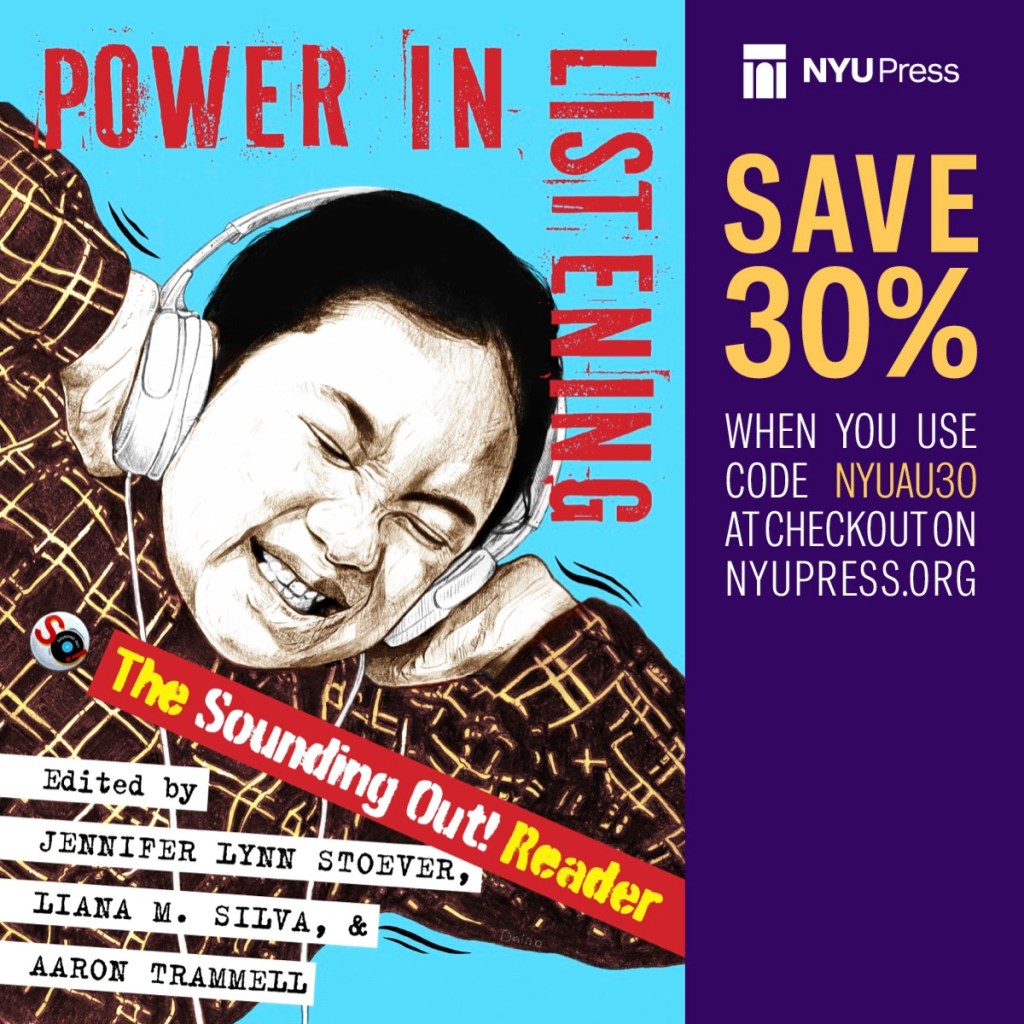
We usually take July as a BYE month to celebrate our yearly blog-o-versary, but this year, we are going bigger! Team SO! is pausing for the full summer–June, July, AND August–to catch our breath in advance of the publication of the official Sounding Out! print anthology, Power in Listening (New York University Press) on August 25, 2026 (although you can pre-order now, if you’d like at Indiepubs, direct from NYU, and other book outlets). This book is a long time coming and we are really proud of what we have put together. It’s a fresh mix of brand new essays with fan-favorites that have been revised, expanded and fully updated to the present, with an introduction by the editorial collective and a forward by SO!‘s very own Neil Verma.
Power in Listening is a love letter to everyone who has participated in the ongoing collective project of the blog over our first 15 years and a fantastic way to kick off the future together. Like the blog, it’s sharp, accessible, gorgeously written, diverse, and ready for the classroom, the library, the beach, public transit, the coffee shop, the couch on a rainy day, the club . . .wherever you love to read, but now you can be unplugged too, which we all need more than ever. Scroll down for more details about the book, including a full author list!
Enjoy the coming months–the book will be out there catching eyes in August and the blog will grab your ears once again this September! Please help us spread the word about the book– we’d love it if you’d tell two friends, so that they two friends, and so on, and so on, and so on. . .or you can share social media, whatever works for you!
Thank you and SO! looking forward–see you in September!
JLS, SO! Ed-in-Chief
P.S. Details to come on release parties, conference events, speaking engagements, podcasts, broadcasts, and all that good stuff! If you’d like us to come out your way to talk about the book, the blog, and all things sound, we have a Google form for that! Contact NYU Press at this link if you are interested in reviewing the book on your publication: https://nyupress.org/resourcesold/for-media/
—
How listening shapes power
Power in Listening explores how listening shapes—and is shaped by—power. From the politics of “sad girl” Spotify playlists to the sonic architectures of surveillance and the gendered voices of Siri and Alexa, this collection investigates how sound and listening inform identity, embodiment, and social life. How does Beyoncé’s remix of her “elevator incident” expose the surveillance of Black bodies? How do deaf listeners use multiple senses to navigate sound? How are Latina voices racialized through ideas of volume and tone?
Building from the groundbreaking Sounding Out! blog, Power in Listening curates 36 new, revised, and expanded essays from scholars, artists, DJs, and activists across more than twenty disciplines. Together, they trace how auditory culture intersects with race, gender, sexuality, technology, and media—from radio and tape to streaming and AI.
Accessible yet rigorous, this reader reveals sound studies in motion: a field that listens as a form of inquiry, protest, and care. Each essay connects theory and everyday experience, offering tools to hear the world—and each other—more critically. Power in Listening invites readers to experience listening as a social practice, a political act, and a method of understanding one’s place within a resonant and contested public sphere.
—
Authors
Neil Verma, Nichole Prucha, Rami Stucky, Max Abner, Ola Mohammed, Christie Zwahlen, Art Blake, Liana Silva, Maria Chaves Daza, Tara Betts, Marlén Ríos, Kimberly Williams, Samantha Ege, Aaron Trammell, Christina Giacona, Andrew Salvati, Kemi Adeyemi, Enongo Lumumba-Kasongo, Andreas Pape, AO Roberts, Milena Droumeva, Steph Ceraso, Linda O’Keeffe, Michael Levine, Amanda Gutierrez, Asa Mendelsohn, Rebecca Lentjes, Priscilla Peña Ovalle, Justin Burton, Gustavus Stadler, Dolores Inés Casillas, Jennifer Lynn Stoever, Chris Chien, Benjamin Tausig, Hubert Gendron-Blais, Maile Costa Colbert, and Dustin Tahmahkera
Section Titles and Topics
- Sonic Presents
- Putting The “I” in Listening: Memoir as Method
- The Sound You Make Is Not Your Own: Our Social Voices
- “Hop With It, Rock With It”: Listening to Popular Culture
- Bits and Screeches: Technology and Sound
- Hitting the Streets: Space, Place, and Sound
- Panaudicism: Sound and Surveillance
- Listening While White: Sound and Racial Privilege
- “Can You Hear Me Now?”: Sound, Agency, and Activism
—
What folks are saying. . .
Spotlighting the work of emerging scholars under innovative rubrics like space, gender, time, race, and power, Power in Listening curates an impressive array of authors and disciplinary approaches of the highest caliber. This is a welcome, fresh take on the field of sound studies. ~Roshanak Kheshti, author of Modernity’s Ear: Listening to Race and Gender in World Music
From voice and memoir to technology, space, race, surveillance, and activism, Power in Listening centers captivating soundworkers. and shows how listening can unsettle hierarchies and make new worlds audible. This sharply curated collection brings together newly revised classics from the blog as well as bold new essays that treat listening not as neutral perception, but as a site of power, struggle, pleasure, and possibility. Smart, generous, and unapologetically loud, this book doesn’t just reflect a field. It changes how you hear it. ~Karen Tongson, author of Norm Porn: Queer Viewers and the TV That Soothes Us
Not only chronicles the dynamism of the field of sound studies, but also beckons readers to find the listening experience to be an unmistakably political social practice. Power in Listening is an exceptional achievement, uniting scholars and artists across countless disciplines to foster conversations and new scholarship for years to come. ~Iván Ramos, author of Unbelonging: Inauthentic Sounds in Mexican and Latinx Aesthetics
—
Jennifer Lynn Stoever is Associate Professor of English at Binghamton University, founding Editor-in-Chief of Sounding Out!, and author of The Sonic Color Line: Race and the Cultural Politics of Listening.
Liana Silva is Managing Editor of Sounding Out! She is a teacher, writer, reader, and editor living in Houston, TX. She graduated from Binghamton University’s Department of English in 2012. In the past she was Editor-in-Chief of the professional publication Women in Higher Education.
Aaron Trammell is Assistant Professor of Informatics and Core Faculty in Visual Studies at UC Irvine and author of Repairing Play: A Black Phenomenology and The Privilege of Play. He is Editor-in-Chief of the journal Analog Games Studies and was an honoree of the hobby game industry’s prestigious Diana Jones Award.
Share this:

This Is How You Listen: Reading Critically Junot Díaz’s Audiobook
DOI: https://doi.org/10.59350/x7hrf-mzd19
Last month, T.M. Luhrmann compared the experience of reading a written book versus listening to books in the New York Times article “Audiobooks and the Return of Storytelling.” Lurhmann points out how audiobook sales jumped 20% in 2012, whereas total industry book sales went down 1%. From the looks of it, books have benefited from audiobook sales, but in literary studies, print remains the primary vehicle for analysis. Might listening to an audiobook actually change how we critically read a text?
As I listened to Junot Díaz narrate This Is How You Lose Her (2012), the first book Díaz has read as an audiobook and the first book of short stories the author has published since 1996’s Drown, I wondered how his reading influenced how I interpreted the text. Díaz’s reading sounds less like regular speech and more like a performance, with its own cadence and rhythm:
This post approaches the audiobook as a text in itself, coming from a sound studies perspective. I attempt to conceptualize the idea of “close listening” as a methodology akin to “close reading” in literary studies. I listen for how Diaz reads the text but more specifically how the reading itself becomes a way of authoring the text. Ultimately, I argue that Díaz’s reading becomes a re-authoring the text—re-writing the text sonically. On a broader level, I hope to add to the conversation of what it means to read an audiobook, as Birgitte Stougaard Pederson and Ibsen Have brought up in “Conceptualising the Audiobook Experience.” Using This Is How You Lose Her, I show that reading an audiobook means engaging with the text from the angle of the ear, and that close listening can become an aural reading practice that relies not so much on the visual texts, but on aural cues from the narrator.
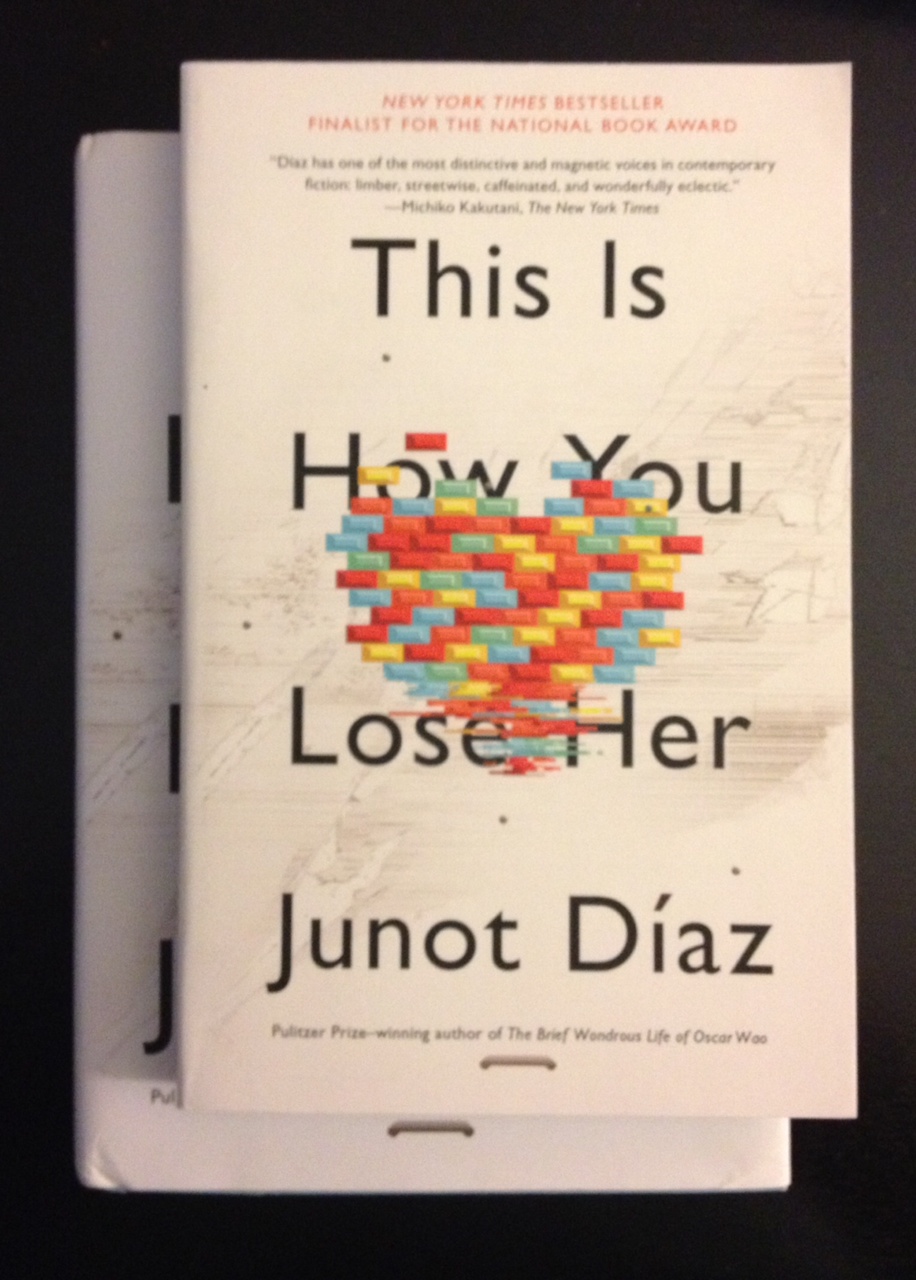
This Is How You Lose Her revolves around Yunior, a young Dominican immigrant who grows up in New Jersey and who ends up as a professor in Boston, and the many loves he has had or that he has encountered growing up. The stories trace his progress from a young, recently arrived Yunior, to a tenured, mature Yunior, showcasing certain relationships that influence how he relates to women—in sum, illustrating how he loses the women he loves. Throughout the short story collection, Díaz also calls attention to other relationships that may influence Yunior’s perspective, for example, his brother’s attachments with women, especially toward the end of his young life as he battled cancer, and his father’s relationship with his mistress, a Dominican woman who lived in New Jersey. At the end, Díaz illuminates how a mujeriego (womanizer) like Yunior comes to be; the short stories indicate that Yunior is as much a product of his environment as he is a seller of the merchandise.
Díaz is not a professional audiobook narrator. Although Díaz has done live readings, reading the full-length version of a book one has written is a different exercise. The Penguin Audio version of the collection is based on the actual short story collection (in other words, unabridged), so it does not contain additional stories or behind the scenes interviews. Technically, it is no different than the print version.
Listening to authors read their own work has value beyond the pleasure of hearing them read their text. Scholarly writing on audiobooks has emphasized the experience of listening to an audiobook for pleasure (like Deborah Phillips’ “Talking Books: The Encounter of Literature and Technology in the Audiobook” and James Shokoff’s “What Is An Audiobook?”), but it wasn’t until the 2011 edited collection Audiobooks, Literature, and Sound Studies that audiobooks were considered on their own instead of as extensions of the literature they were based on. The allure of doing this scholarly exercise with the audiobook version of This Is How You Lose Her is that Díaz’s delivery of the text is uncommon at the least.
Talking about Junot Díaz’s readerly voice requires to tune into conversations about his writerly voice. In many reviews of Díaz’s books, writers discuss how Díaz deftly conveys a writer’s voice in his text, indicating that his success is that his characters have a very clear voice—or at least Yunior does. Michiko Kakutani, for example, points out how “Junot Díaz has one of the most distinctive and magnetic voices in contemporary fiction: limber, streetwise, caffeinated and wonderfully eclectic, capable of conjuring for the reader everything from the sorrows of Dominican history to the banalities of life in New Jersey.” Although this quotation is in reference to Díaz’s second book, The Brief Wondrous Life of Oscar Wao, it describes Díaz’s writing in terms of his voice instead of, for instance, in terms of his use of metaphors or choice of subject.
Richard Wolinsky, in his Guernica interview with Díaz, sees an overlap between Yunior and Díaz: “He’s [Yunior] got a very distinct voice, and it’s a voice that’s informed by [Diaz’s] own reading, particularly science fiction and fantasy.” Although Díaz has pointed out that Yunior is loosely based on events that have happened to him, Wolinsky “hears” Díaz in his main character. The tone and the language Yunior uses is read as a reflection of Díaz.
Conversations about the voice of the writer point to a sensibility about sound, but are often limited to a written text. Anna Barnet, in an interview with Junot Díaz, states “His two principal linguistic registers (‘this kind of crazy Caribbean language and music’ and ‘this sort of African-American-infused American vernacular’) grind against each other along with the many other voices he ventriloquizes in his writing.” Barnet reminds readers that Díaz’s writing style is based in spoken language—particularly Díaz’s spoken language. This language of “voice” to describe a writer’s style (or, specifically, a writer’s ability to convey a clear sense of who the character is and/or their views) is commonplace but gives the impression that there is a sonic aspect to an author’s work, when in reality it is but a metaphor for something that occurs at the level of text.
A critical reading of a text that includes the audiobook rendition allows critics to add substance to those references to “voice.” In Junot Díaz’s case, it is possible that readers encounter him first through written text, and so have an expectation of what Díaz (or Yunior) would sound like live. In my textual analysis of eight audiobook reviews (and one book review that included a mention of the narration in the audiobook) most listeners showed some sort of discomfort with Díaz’s narration. One reviewer, for example, had issue with the “smoothness” of Díaz’s narration: “At times the reading was a little shaky and uneven”. Another reviewer stated “at times his cadence is choppy, with odd pauses and emphasis on strange words that detract from the overall experience.” Reviewers also had an issue with Díaz’s pace, which is characterized by pauses in places that many not seem normal in casual American speech. These statements hint at a “weird” quality in Díaz’s speech, something that does not come through when Díaz has a casual conversation. (Listen to this podcast episode of NPR’s Alt. Latino guest-starring Díaz and compare with this video of him reading part of This Is How You Lose Her.) Although one blogger pointed out that Díaz sounded “professorial” in the reading, others used the words “native,” “authenticity,” “Dominican” and even “Jersey accent” to describe how Díaz sounded. It is unclear how these reviewers define “native” or “authentic.”
Connecting sound to authenticity implies that Dominicans can only sound a certain way, or that the audio narration is lacking when it does not represent a “typical” Dominican voice. To the extent that Díaz is Dominican, his voice is of a Dominican male who has grown up in the Northeastern United States. His uneven audio narration creates a feeling of sonic unintelligibility in the listener, similar to the effect of including Spanish words in the written text. Díaz-as-narrator can make a listener uncomfortable, and by extension forces that reader to listen.
The sonic unintelligibility also relies on the text, on how Díaz plays with language by switching back and forth from English to Spanish. Díaz mentions in an interview with Marva Hinton that some readers are not happy with his choice of Spanglish in his writing: “There [are] folks who hear one Spanish word, and they’re convinced this is some sort of immigrant conspiracy” Farther down, in the same article, Díaz refers to his mix of Spanish and English (and a particular kind of Spanish and English at that, since he moves among Standard American English, African American Vernacular English, and Dominican Spanish) as “opaque language.” There’s a connection between the kind of “opaqueness” that Spanish gives and the unintelligible effect of Díaz read his work.
An example of how sonic unintelligibility operates in the audiobook is the first story, “The Sun, The Moon, The Stars.” This opener, told in first person, revolves about one of Yunior’s break-ups; Yunior and his girlfriend Magdalena, on whom he cheated, go to the Dominican Republic on a trip they had planned before she found out about the affair. It frames the book as being an in-depth analysis of loves lost, from the man who keeps losing them. It also sets the tone sonically for the audiobook reading: after the introduction of the book, a snippet of bachata music comes on, and then makes way for Díaz, who reads the title of the story. This is the pattern of the book: slices of bachata, followed by Díaz’s narration.
His voice is characterized by a slight sing-song cadence that is reminiscent of Dominican Spanish accent. If this were in Spanish, it might be easier to lose track of the cadence, but in English it sounds like a disembodied accent. I showcase the swing in Díaz’s narration by alternating capital letters and lower-case letters: “Her FAther, who usually would treat me like his HIjo, CALLS me an ASShole on the PHONE, SOUNDS like he’s STRANgling himself with the cord.” The voice seems to float for a while until Díaz arrives to the end of a paragraph or a series of sentences, and then it sinks. Moreover, this pattern does not change when Díaz switches characters: it’s hard to tell Yunior apart from Magdalena unless the reader pays close attention to when the narrator is switching characters and/or when the narrator uses a pronoun. The same effect comes from the odd pauses in the author’s narration: “Oh God, she wailed. Oh. My God.”
The choppiness and the emphasis in the reading are a way to dislocate the listener, in a similar way that Spanish phrases or lack of quotation marks in the text dislocate a reader who does not understand Spanish or who depends on the quotation marks to make sense of the prose. Also, this story focuses on Magdalena withdrawing from Yunior and not communicating with him. The tone, cadence, and sound of Díaz’s voice can be read to mirror the relationship between Yunior and Magdalena (and the other women in the text): the sonic unintelligibility is manifest at the level of plot through Yunior’s relationships.
Although many audiobook reviewers may consider the plot in their reviews, part of what makes an audiobook stand out is the performance of the text. I take my cues from audiobook reviewers and consider critically my listening experience of This Is How You Lose Her and how this can become the basis for a critical interpretation of the text. My analysis underscores that having an author read a text can provide a different way into analyzing the text and prompts readers to pay attention to sound. If, like Shokoff asserts, most audiobook readers listen to an audiobook while doing something else, Díaz shows that listening closely to the audio text can be as rewarding as reading a book.
—
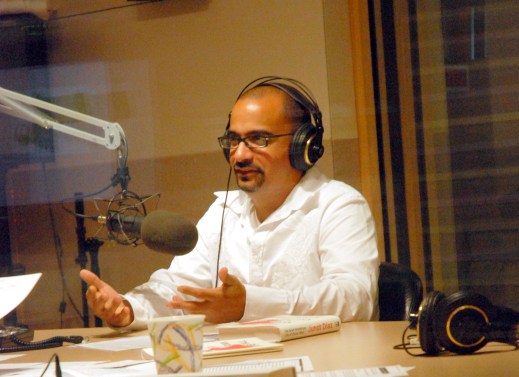
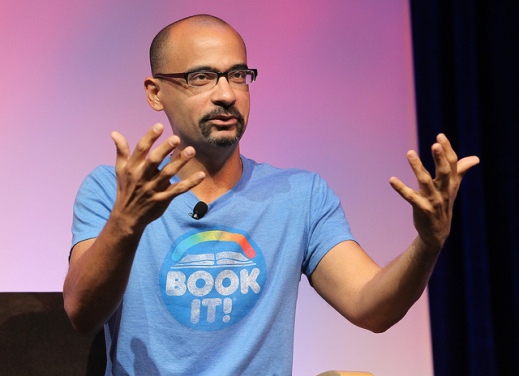
Featured Image: “Junot Diaz” by WBUR Boston’s NPR News Station, Attribution-NonCommercial-NoDerivs License
—
Liana Silva-Ford is co-founder and Managing Editor of Sounding Out!.
—

REWIND! . . .If you liked this post, you may also dig:
“‘Or Does It Explode?’ Sounding Out the U.S. Metropolis in Hansberry’s A Raisin in the Sun“-Liana Silva-Ford
“‘HOW YOU SOUND??’: The Poet’s Voice, Aura, and the Challenge of Listening to Poetry”-John Hyland
“Fade to Black, Old Sport: How Hip-Hop Amplifies Baz Luhrmann’s The Great Gatsby“-Regina Bradley
Share this:




Current Top Posts





April 2021

January 2020

November 2019

October 2019

August 2019

April 2014

November 2017

March 2015

December 2017

October 2015


Recent Comments