
Norman Corwin: Radio at the Intersection of Art and Commerce
 Editor’s Note: Today, Shawn VanCour continues our summer series “Tune In to the Past,” which explores the life and legacy of radio broadcaster Norman Lewis Corwin, the “poet laureate of radio” who died last summer at the age of 101. Sounding Out!‘s three-part exploration of his legacy by radio scholars Neil Verma (June), VanCour (July), and Alex Russo (August) not only gives Corwin’s work new life (and critique), but also speaks to the growing vitality of radio studies itself. And now, a word from our sponsor, Shawn VanCour.–JSA
—
An experiment in radio is something nobody ever tries except strange people with a funny look. Good businessmen know better than to try experiments . . . . on account of you can’t play too safe when it comes to trying out new things.
–Unaired passage from script for “Radio Primer,” Twenty-Six by Corwin, May 4, 1941
The story of Norman Corwin is by now a familiar one: joining such illustrious figures as Irving Reis, William Robson, and Orson Welles, Corwin led a new generation of sound artists in developing pioneering techniques of radio drama that exploited the medium’s potential as a “theater of the mind” and inaugurated the celebrated “Golden Age” of network broadcasting. In death as in life, Corwin has been much praised for these contributions, and for his signature style so eloquently analyzed by Neil Verma in the opening volley of this SO! series.
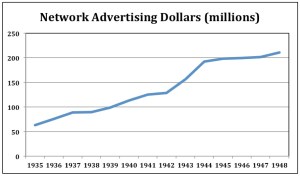
Advertising dollars spent on network radio programming from 1935-1948, based on data compiled in the 2002 edition of Christopher Sterling and John Kittross’s Stay Tuned: A History of American Broadcasting. Advertiser investment climbed sharply, spurred by a corresponding growth in network affiliates.
However, as Erik Barnouw notes in his preface to LeRoy Bannerman’s biography of this broadcasting legend, Corwin’s story is also bound up with a larger economic history of radio, unfolding during a period of intensified growth in and controversy surrounding commercial broadcasting. From Corwin’s first show for CBS in 1938 to his last network broadcast in 1947, the percentage of affiliated stations in the country grew from 52 to 97, while investment by commercial advertisers more than doubled. To answer critics of commercialism and give its network signs of distinction, CBS dramatically increased its public service commitments (what David Goodman refers to as “radio’s civic ambition”), investing heavily in “sustaining” (unsponsored) shows that gave producers like Corwin room for unprecedented aesthetic experimentation.
This second, institutional dimension of Corwin’s story warrants further consideration. Observing the Marxist adage that history is made by individuals not in conditions of their own making, I propose that assessing Corwin’s legacy for radio and sound studies demands we attend not only to the what of that legacy–the techniques Corwin pioneered and programs he produced–but also to its how and why: the institutional context that spawned and encouraged these aesthetic innovations. How, in other words, did commercial concerns at the structural level shape and enable the rise of the “Corwinesque” as a viable mode of sonic expression? What peculiar set of economic relations undergirded these grand experiments in twentieth century sound art, and what lessons might this period offer for understanding creativity and aesthetic innovation in subsequent eras such as our own?
Sounds of Commerce
Corwin’s 1941 play, “A Soliloquy to Balance the Budget,” opened with the sounds of an adding machine and voice of a “soliloquist” tabulating the cost of each musical note and on-air gag. Such is the secret soundtrack of every broadcast since commercial radio’s inception, as one of the past century’s largest and most successful industries dedicated to the business of packaging and selling sounds for corporate profit.
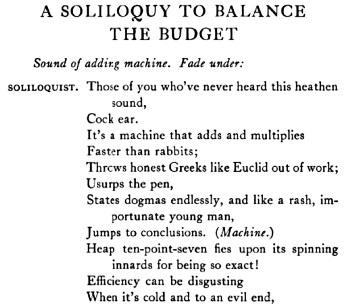
Excerpt from script for “A Soliloquy to Balance the Budget,” broadcast on CBS’s Twenty-Six by Corwin series, June 15, 1941.
Rather than seeing the flowering of the Corwinesque as a brief but “golden” reprieve from an otherwise dark history of commercial mediocrity, I propose we use the case of Corwin to critically interrogate presumed antipathies between opposing forces of art and commerce in U.S. broadcasting, and seemingly intractable tensions between competing goals of public service and corporate profit. Might we see in Corwin, instead, an instance where concerns with profit margins in fact facilitated aesthetic innovation, and where goals of public service and commercial success entered into strategic (if temporary) alignment?
This perspective is by no means intended as a neoliberal apologia for the commercial system. Yet, at the same time, the modes of aesthetic experimentation in which Corwin engaged were never so antithetical to run-of-the-mill commercial forms as traditional histories have implied. Corwin contributed to both sustaining and commercial programs, and the techniques he developed were eagerly copied by radio ad-writers. Moreover, public service programming for CBS was no mere loss leader, but rather offered opportunities for financial profit both in its own right and as part of a larger system of coordinated transmedia flows. Listening for the sounds of commerce in these programs demands a more sophisticated grasp of industry economics than the reductive binaries of traditional histories allow, beginning with an interrogation of the Romantic ideology of art on which those binaries rest.
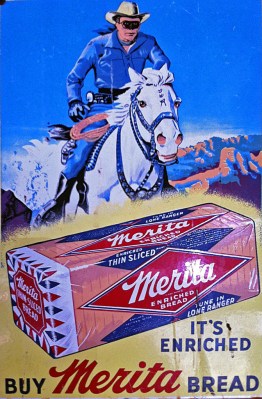
Merita was a longtime sponsor of The Lone Ranger on radio and television beginning in 1938. Image by Flickr user Jeffrey.
De-Romanticizing Radio Art
Unlike other radio greats such as Robson and Welles who worked extensively on commercial series, what distinguishes Corwin in traditional accounts is his alignment with a protected sphere of noncommercial programming. Hired by CBS to work on sustaining series such as the Columbia Workshop, Corwin was celebrated by contemporaries like Richard Goggin as “pleasantly isolated from ‘commercial’ broadcasting,” with its “struggle for sales and maximum audiences” (63-4). His official biographer similarly praised him as an artist who “flourish[ed] in a freedom of ‘sustaining’ programming [that was] the hallmark of the Golden Age” and “refused to forsake this liberty for commercial earnings, although corporations clamored for his talent” (5).
Corwin himself directly contributed to this anti-corporate mythos. In a 1944 book on radio writing, he advised those aspiring to work in radio to “Do the opposite of what a sponsor or an agency executive tells you, if you want to write originally and creatively” (53), while including regular jabs at network and advertising executives in scripts for sustaining shows such as his “Radio Primer” or “Soliloquy to Balance the Budget.” But by 1947, Bannerman explains, “the contest for higher ratings” had won out, and Corwin exited the network arena for greener pastures and a new job with the United Nations (10). In a 1951 article for The Writer, Corwin now recommended that “the writer who wants to do the best work in his power, in defiance of formula,” simply “forget radio,” and “until such time as [it] returns to a constructive attitude toward public service and the esthetic values in writing, look upon [it] as a trade outlet, not an art” (1, 3).
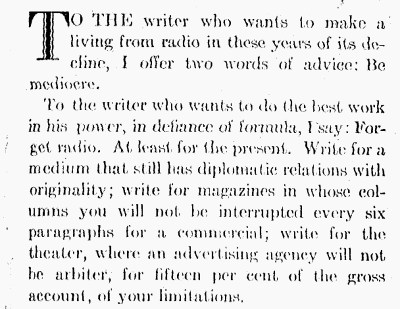
Opening lines of February 1951 essay by Corwin for The Writer, in which aspiring writers who wish to exercise their creative freedom are advised to “forget radio” and look elsewhere.
Setting aside the dubious merit of a narrative that denies any real aesthetic achievements for the 15 years preceding and 65 years following Corwin’s ten-year run in network radio–the apogee of a tragically brief “Golden Age”–we may recognize the conception of creativity espoused here as a distinctly Romantic one. Within this view, so-called “true art” flouts the rules and formulas on which commercially driven mass art depends, and is pursued for purposes other than financial gain. This Romantic ideology of art has been repeatedly challenged, from earlier work by M. H. Abrams, to more recent critiques by Noel Carroll and R. Keith Sawyer. My own concern is not with its veracity per se, but rather with the historical exclusions needed to sustain its underlying binaries of art/commerce and public service/commercialism vis-à-vis the work of Norman Corwin. These exclusions (acts of forgetting on which remembrances of Corwin’s legacy are grounded) may be grouped into three basic categories: the selective operations of canon-formation, cross-fertilization of techniques in commercial and sustaining programming, and profitability of public service within the CBS business model.
Canon-Formation
The received view immediately works to remove Corwin from the sphere of commercial programming, marginalizing his contributions to sponsored series such as the Cresta Blanca Carnival—whose ad agency Corwin himself commended for checking the customary “fear of anything suggesting artistic endeavor” (402)—or Dupont’s Cavalcade of America, for which he wrote his “Ann Rutledge” play, better known from its later revival on the Columbia Workshop. So, too, does it single out among his many production credits a comparatively small list of broadcasts for which he wrote his own scripts, while limiting its purview to his radio works at the expense of his contributions to other media. (For a comprehensive list of Corwin’s creative works, including his many commercial film and television productions, see the appendix in this volume.) As with all processes of canon-formation–a crucial component of what Michel Foucault calls the “author-function”–bids for Corwin’s artistry thus entail a series of selective filtering operations. The totality of the individual’s creative labor is negated within a synecdochical logic of “best” works that renders the exceptional as typical and relegates the typical to the realm of historical oblivion. What other “Corwins” might further scrutiny reveal?
Cross-Fertilization
Efforts to preserve the purity of Corwin’s art by maintaining its opposition to and inherent tension with commercial broadcasting also ignore the extent to which the advertising industry itself embraced Corwin’s techniques. In 1942, trade magazine Broadcasting reported with much clamor Corwin’s acceptance of a bronze medal at New York’s Annual Advertising Awards Dinner, given to honor an “individual, who by contemporary service has added to the knowledge or technique of radio advertising” (22). Authors of popular radio writing manuals noted, in particular, the impact of Corwin’s technique of “choral speech,” which Barnouw in his 1945 Radio Drama in Action claimed was “so successful with listeners that . . . producers of dramatized commercials . . . [now] use [it] for spot announcements to sell soap flakes” (204-5).
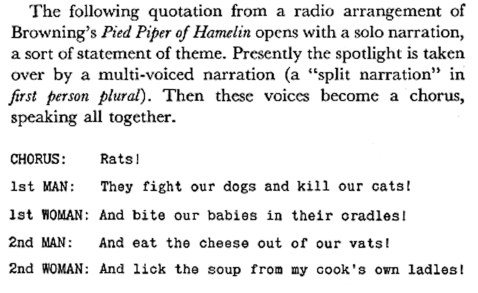
Example of choral speech from script for episode of Corwin’s 1938-39 Words Without Music, reproduced in Barnouw’s 1939 Handbook of Radio Writing
Choral Speech in ad for Ajax household cleanser, late 1940s
Omitted from later accounts, such lost tales of cross-fertilization suggest not simply blind spots in the received view, but a fundamental abnegation: the separation of art and commerce as much an achievement of historical memory as historical fact.
Profitability of Public Service
Positioning the art of Corwin in contradistinction to growing tendencies toward commercialism also ignores the tremendous profitability of public service programming within CBS’s business model, both in its own right and as part of a system of carefully coordinated, cross-platform media flows. As Barnouw notes in Vol. 2 his 1968 History of Broadcasting series, CBS ramped up its investment in sustaining programming during the 1930s as part of a race with NBC to attract affiliates and expand its national network. Whereas NBC charged affiliates for sustaining shows to defray production costs, CBS provided stations with sustaining programs at no charge in exchange for guaranteed carriage of its sponsored series. (NBC stations, by contrast, were given right of refusal for any sponsored shows they wished to opt out of.) For CBS, sustaining shows presented not a financial burden but a path to commercial profitability. Attracting stations eager for free “quality” programming, the network drew fresh revenue in membership fees for each new affiliate it added. Eager to capitalize on these expanded economies of scale and willing to pay the corresponding ad rates, sponsors in turn flocked to the network, giving CBS valuable new accounts and further revenue boosts.
Recognizing their economic value, CBS heavily promoted sustaining stars like Corwin as talented auteurs who represented the network at its best, while working to parlay their products across multiple media platforms. In a 1942 Broadcasting ad promoting Corwin’s newly published script collection, Thirteen by Corwin, the network highlighted his artistry while tracing its corporate signature into his own, reminding readers that these plays were “written and produced under the sponsorship of the Columbia Broadcasting System,” as a new “literature of the air . . . . [whose] first editions . . . [are] printed in decibels instead of type” (62-3).
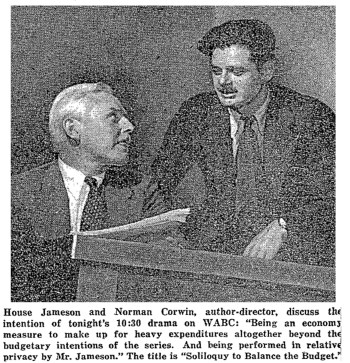
Images of a well-oiled network publicity machine at work. Newspapers such as the New York Times frequently printed network-supplied publicity stills and promotional copy in their radio sections. Here’s a publicity still of Corwin with actor House Jameson preparing for the the “Soliloquy” episode of Twenty-Six by Corwin (6-15-41).
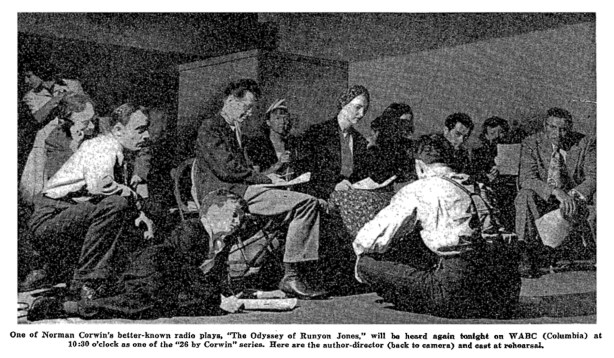
Publicity still of actors rehearsing for an encore presentation of Corwin’s critically acclaimed radio play, “Odyssey of Runyon Jones” (11-26-41).
Corwin’s 1945 VE-Day celebration, “On a Note of Triumph,” was released not only in print, but also on disc by Columbia Records, converting an otherwise ephemeral sustaining feature into a source of direct profit while advancing the larger Columbia brand.
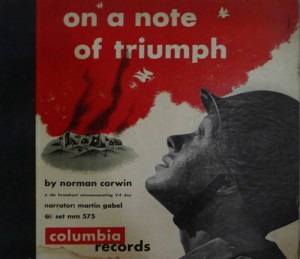
Cover art for 1945 Columbia Records release of Corwin’s “On a Note of Triumph” – leveraging content across media platforms for increased profit potential.
Whether attracting new affiliates and sponsors, or offering opportunities to improve brand recognition and exploit ancillary markets, CBS’s public service programming thus operated not in opposition to commercial forces but rather in the service of the network’s larger bid for economic competitiveness.
Lessons for Radio and Sound Studies
My remarks here are not intended to impugn Corwin’s artistic integrity, nor to imply a lack of commitment to loftier civic goals by CBS executives. The question, again, is a structural one: within what institutional context do the forms of aesthetic expression associated with “the Corwinesque” become possible and desirable? Put simply, how and why, from a structural perspective, do innovations in radio and sound art occur, and what forms can they take under given conditions?
Such inquiries are ill-served by presuming ipso facto oppositions between art and commerce or public service and commercial profit. Indeed, while often resting uneasily together, in the American system they have been bedfellows from the very beginning. To presume, moreover, that aesthetic innovation demands a protected space of noncommercial programming, or that such a space inherently fosters meaningful alternatives to commercial fare, would be a mistake. Within the received view, the legacy of Norman Corwin can be read only as a tale of lament: the death of public service and triumph of commercialism over art. Instead, I suggest we critically interrogate both present and past alike: the “Golden Age” is gone and likely never was, while closer scrutiny of earlier or subsequent eras may reveal aesthetic and institutional complexities hitherto unsuspected.
In a historical moment characterized by an unprecedented proliferation of new media outlets and alternative distribution platforms, but also an extreme concentration of media ownership, can we chart a critical trajectory that avoids both the Scylla of knee-jerk anti-capitalism and Charybdis of hyberbolic neoliberal and techno-utopian praise?

Conflicting attitudes toward contemporary sound industries. User-generated images responding to the SodaHead.com post, “Is Hannah Montana a Tool of the Devil?”, offer excoriating views on the cultural effects of commercialization and conglomeration.

Meanwhile, popular books such as Start and Run Your Own Record Label celebrate opportunities for creative autonomy and aesthetic innovation afforded by niche marketing and digital distribution technologies.
The proper course, whether studying conditions and possibilities for sound art in Corwin’s era or our own, lies somewhere in between.
—
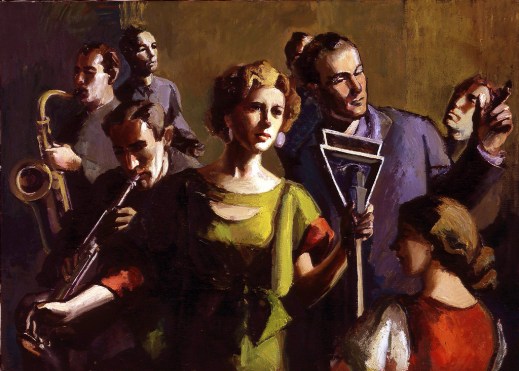
Featured Image Credit: Julia Eckel, Radio Broadcast, 1934, Courtesy of the American Art Museum. An idealized representation, it contains no scripts in hand, no call numbers on the microphone and, importantly, no sponsors’ symbols on the wall.
—
Shawn VanCour is a media historian and lecturer in Film and Media Studies at the University of South Carolina. He has published articles on radio music and sound style in early television, as well as essays on Rudolf Arnheim’s radio theory and the origins of American broadcasting archives. He is currently completing a book on production practices and aesthetic norms for early radio programming and pursuing work for a second project on the radio-television transition of the 1940s-1950s.
Share this:

Play it Again (and Again), Sam: The Tape Recorder in Film (Part Two on Walter Murch)
 The second installment of my summer series, “Play it Again (and Again), Sam: The Tape Recorder in Film” continues to unspool chronologically, this time focusing on the recorder’s key role in two films indelibly imprinted by legendary editor Walter Murch: Touch of Evil (1958) and The Conversation (1974). [If you missed my first installment, June’s piece on Noir, you can catch up to speed right here].
Most famous for his work on American Grafitti (1973), The Godfather: Part II (1974), Apocalypse Now (1979) and The English Patient (1996), Murch was one of the first folks catapulted into the critical pantheon of sound studies. Not only is his sound (and image) editing intuitive and innovative, but he is one of the only sound editors to speak and write extensively about his creative process. His collaborative book with Michael Ondjaate, a transcription of their extensive and wide-ranging discussions entitled The Conversations: Walter Murch and the Art of Editing Film (2002), is stunning in its depth, breadth, and accessibility: an intellectual trifecta. It is the kind of summer beach reading that is both gripping and brag-worthy.
In The Conversations, Murch describes the excitement of being age 10 and discovering the tape recorder for the first time, especially how
“That passion, which was a kind of delirious drunkenness with what the tape recorder could do, completely possessed me” (6).
In homage to “that passion,” the next two films on my “Top 6” list of the appearance of the tape recorder in film show how Murch’s oeuvre carefully and affectionately represents not only the early drunken experiences with the machine’s heady possibilities, but also the lingering technological hangover in the 1970s, not just for Murch but for the U.S. writ large.

"Mixed Tape" by Thristian (2008)
For those keeping track, the first two films on my list are: 1. Double Indemnity (1944) and 2. Blackboard Jungle (1955), with a little Mike Hammer for good measure with Kiss Me Deadly (1955). And, before you get comfy on the couch, don’t forget our third and final installment, on the 1980s, coming August 15th.
3. Touch of Evil (Universal, 1958, Dir. Orson Welles):

by presspublish
And how, you ask did Walter Murch possibly have any part in editing 1958’s Touch of Evil, given that he was all of 15 years old? Murch didn’t get his hands on the film until 40 years later, when film preservationist and scholar Rick Schmidlin tracked down the complete version of Orson Welles’s single-spaced, 58 page production memo to Universal’s studio heads, telling them how to fix the mess they had made of his movie. Welles had been pulled from his film as he worked laboriously on the rough cut and the studio completely re-edited the movie, even filming additional scenes. Once Touch of Evil was finished, Universal allowed Welles one shot at the film in a private screening room, with no pauses or rewinds, and the astonishingly detailed (and restrained) memo is the result of that screening. Unfortunately for Welles, Universal completely ignored Welles, releasing the studio re-cut of this late-noir gem as a B-movie. Welles never again directed a major film and his memo was thought to have been placed directly into the circular file until Jonathan Rosenbaum published selections from it in Film Quarterly in 1992. [For full details and a link to the lost memo, check out Lawrence French’s web essay].
Once Schmidlin tracked down the entire piece, he was determined to re-cut Touch of Evil according to Welles’s written directions. Here Schmidlin discusses how Murch became involved:
“When I was given the green light to re-edit Orson Welles’s Touch of Evil, based on his memo, it didn’t take a rocket scientist to know who I wanted to re-edit this film. I got Walter’s phone number through a friend and called him at home. I said, Walter, this is Rick Schmidlin. You don’t know me, but I’m producing a re-edit of Orson Welles’s Touch of Evil and I can’t think of any intellect that could match Orson Welles’s better than yours. Would you be interested? Walter said, Mmmm. Send me the memo and I’ll take a look” (The Conversations, 182).
Murch was able to make all 50 of Welles’s suggested changes and then some; he unearthed an additional 9-page sound memo after tracking down the 89-year-old former head of post-production at Universal, Ernie Nims, who had stashed it in his attic. Tim Tully’s “The Sounds of Evil” from Filmsound.org provides a detailed description of Murch’s editorial process and the end result, which manages to be both subtle and dramatic. Film people actually like (and increasingly, prefer) the 1998 re-release, which speaks volumes about Murch’s work (and Welles’s presience). I refer to Murch’s version in the thoughts that follow.
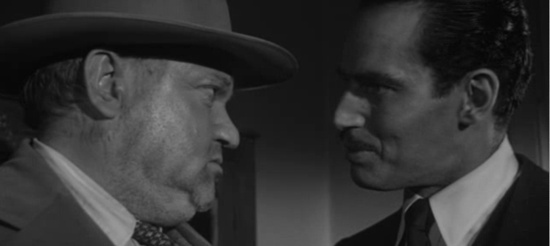
Quinlan vs. Vargas (Screen Capture by AWWS)
So Touch of Evil features Charlton Heston in brownface doing his best to look like Vicente Fernandez; I am not going to deny (or defend) this casting disaster. However, I will say that this 1958 story of U.S. police corruption on the nation’s borders has reinvigorated after last week’s revelations of the FBI’s “Fast and Furious” importation of illegal firearms into Mexico. Our current era of the “Global War on Terror” has produced, imagined, and inflamed an insatiable sense of national vulnerability that demands “illegal alien” scapegoats (peep John McCain’s recent assertion that “substantial evidence” exists that Mexicans crossing the border started Arizona’s recent spate of wildfires). However, the GWOT had its precedent; America’s post-WWII Cold War anxieties ended any semblance of a “Good Neighbor Policy” long before films like Touch of Evil portrayed the border as a lawless, indefensible place where wealthy, pleasure seeking white men can be killed in bomb blasts and white police corrupted by easy money and hard-line policing. As protagonist Miguel Vargas (Heston) tells his American bride Susie (Janet Leigh), “This isn’t the real Mexico, you know that! All border towns bring out the worst in their country.” Although no one ever says it aloud, by film’s end it is clear that Welles intended this barb to cut both sides of the border.
The plot of Touch of Evil pits Vargas, a straight-arrow Mexican drug official on his honeymoon, against the celebrated but hard-drinking and crooked-as-they-come American police captain Hank Quinlan (played by an especially sweaty Orson Welles). Both are working the same case—a car-bomb kills a rich man and his mistress as they cross the border to the U.S.—but from decidedly different angles. Quinlan, in bed with Mexican gangster “Uncle” Joe Grandi (Akim Tamiroff) plants evidence on the investigation’s hastily drummed-up prime suspect, Manelo Sanchez (Victor Millan). Vargas knows it, and sets about trying to prove Quinlan’s guilt to the skeptical and increasingly hostile American police force, led by Sergeant Pete Menzies (Joseph Calleia), even if it means postponing his honeymoon and his trip to Mexico City to testify against the Grandi crime family. Quinlan would prefer that he never gets there, if you catch my drift, and he arranges for the kidnapping of Vargas’s wife, among other cruelties.

Not the Optimum Recording Conditions: Scene of the Climax of "Touch of Evil"
Vargas, compassionate and honor-bound even as he is grimly world-weary—“There are plenty of soldiers who don’t like war,” he tells the Americans when they question his commitment to the job—decides to use the tape recorder as a weapon of truth in his dirty war against Quinlan, “a potent weapon” according to Murch (194). While it is difficult to discuss specifics about the recorder’s prominence in the film without spoiler alerting all over the place, I will say that the machine heightens the tension of the cat-and-mouse game Vargas is forced to play with Quinlan, especially because the technology of the moment did not allow for distant long-range audio surveillance, like we will later see in The Conversation. The intimacy he shares with Quinlan, shadowing him closely to stay in range of the radio-mic without being seen or heard, unnerves Vargas and he displaces his discomfort onto the recorder: “I hate this machine, spying, creeping.” However, as the bodies ultimately fall where they may, Vargas’s tape emerges as the lone certainty and lasting proof against the sordid, shifting, (and exceedingly sweaty) janus-faced juggernaut that is Hank Quinlan. Absent the recorder’s stark evidence to untangle the truth, all that remains is chaos: the dangerous and mixed-up dominant border imaginary of the 1950s U.S.
.
4. The Conversation (Paramount, 1974, Directed by Francis Ford Coppola):
“In that denouement of Touch of Evil, Welles worked out something that’s very close to my heart because it’s so similar to the beginning of The Conversation–namely, to make the resolution of the story depend on different shadings and perspectives of sound”–Walter Murch, The Conversations (194)

Universal 5000 (Screen Capture from The Conversation by pablosanz)
What is especially interesting to me about having Murch’s editorial touch on Touch of Evil is not only that the climax features the tape recorder, but also that this scene is echoed (and almost entirely undone) in the plot of The Conversation. One of Murch’s first feature films, The Conversation was edited by hand, a process similar to what audiences actually see onscreen in the film (Murch did not use AVID until 1996’s The English Patient and he is rather aptly credited for “sound montage” in The Conversation). I know many sound peeps are already hip to The Conversation thanks to Murch’s experimental work and the plot’s tense emphasis on the importance—and the fraught ambiguity—of sound and listening, but I want to add a new technological wrinkle via the tape recorder.
Released in April 1974, The Conversation is prescient in regards to the paranoid atmosphere around the tape recorder in the early 1970s. That same month, the House Judiciary Committee subpoenaed the “White House Tapes,” obtained through years of secret surveillance with phone taps and lavalier bugs, that contained damning evidence linking then-President Richard Nixon to the Watergate break-ins. After first attempting to edit the tapes, Nixon resigned just four months later, days after the full transcripts were released. The recorder’s secretly-obtained evidence proved indisputable against any of Nixon’s public pronouncements of innocence and post-Watergate its listening ears were seemingly everywhere: “Do you see him? The man with the hearing aid like Charles?” says Ann (Cindy Williams) through frozen lips in The Conversation’s tense opening scene, “right there with the shopping bag? He’s been following us all around and he’s been following us close.”
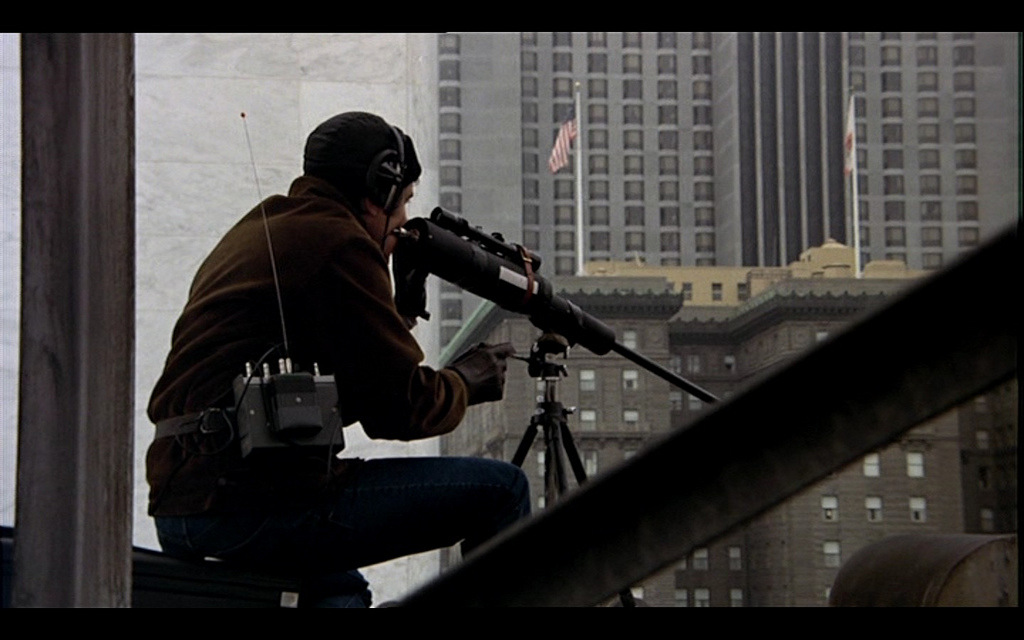
The Microphone as Weapon: Long-range surveillance in The Conversation (Screen capture by pablosanz )
Akin to John Cage’s forays into the anechoic chamber—which opened up new realms of previously ignored and unheard sounds to the artist—evidence produced by various recorders confirmed that there were audible shadow worlds operating underneath power’s prettier public face. In addition to such unnerving domestic politics, the use of the tape recorder in The Conversation also mirrored shifting Cold War policies. No longer a blunt tool of coercion as it was in Blackboard Jungle or a technology of intimacy like in Touch of Evil, the tape recorder is instead an anonymous precision instrument of consent, performing its work in the hidden underbelly of windowless vans, grimy warehouses, and bland, spartan apartments, all key settings in The Conversation.

Harry Caul (Gene Hackman) in The Conversation (screen capture by pablosanz)
At the film’s center is “the best bugger on the West Coast” Harry Caul (Gene Hackman), a surveillance expert who feels that he is more machine than man, an analog Bartleby the Scrivener. “I don’t care what they’re talking about,” he growls about his human subjects, “I just want a nice, fat recording.” While hard at work splicing and cleaning up some surveillance tapes, Caul overhears a simple phrase that will eventually be his undoing: “he’d kill us if he got the chance.” Chasing him through fitful dreams and into confessional booths, the haunting phrase causes Caul to doubt his mission. He begins asking uncomfortable questions—who is paying him? To what end?—and goes on the hunt, obsessively rewinding the tape again and again trying to make some sense out of the voices he has captured as if their recorded traces were technological tea leaves. However, the faith he places in the tape recorder and in its ability to isolate, clean up, and amplify the truth is his ultimate undoing, causing him to ignore the human flaws of his own listening ear.
.
.
And in a supporting role. . .
Admittedly, this film has nothing to do with Walter Murch (that I know of), but I wanted to end with some lighter fare and a *perfect* preview for Part Three of “Play it Again (and Again), Sam” coming on August 15th, which focuses on 1980s films.
 Ferris Bueller’s Day Off (Paramount, 1986, Director John Hughes): There have been some great recent analyses of the silver anniversary of this John Hughes flick—I especially dug Alan Siegel’s “Get Over ‘Ferris Bueller’ Everyone” for The Atlantic—but all of these posts missed a critical attraction of the film: Ferris’s ease with new technology (part of the 1980’s “invisible knapsack”of race and class privilege). Let’s give credit where credit is due: the tool that enabled Ferris Bueller (Matthew Broderick) to have his fabled day off was, in fact, the tape recorder. First, Ferris’s crew rigs up microcassette messages between Sloane Peterson (Mia Sara) and Cameron Frye’s (Alan Ruck) answering machines to throw the sniveling Principal Rooney (Jeffrey Jones) off their trail: one weepily attests to the death of Sloane’s grandmother, while the other purports to be the funeral home. And who can forget the mannequin rigged up to a tape loop of snorts and snores designed to fool Ferris’s mom (Cindy Pickett) into thinking that he is deep in sickness-induced slumber. Personal recording technology was part and parcel of Ferris Bueller’s über-privileged white suburban teen resistance to the conveyor belt of contemporary American life. Before the kids at school took up a collection to “Save Ferris,” Bueller was already using the recorder to save himself.


Share this:


Current Top Posts





April 2021

January 2020

November 2019

October 2019

August 2019

April 2014

November 2017

March 2015

December 2017

October 2015
 Sounding Out!
Recent Comments