
Sounding Out! Podcast #54: The Sound of Magic
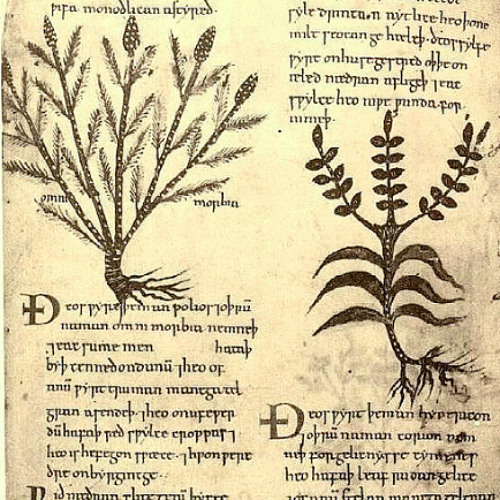
 Each of the essays in this month’s “Medieval Sound” forum focuses on sound as it, according to Steve Goodman’s essay “The Ontology of Vibrational Force,” in The Sound Studies Reader, “comes to the rescue of thought rather than the inverse, forcing it to vibrate, loosening up its organized or petrified body (70). These investigations into medieval sound lend themselves to a variety of presentation methods loosening up the “petrified body” of academic presentation. Each essay challenges concepts of how to hear the Middle Ages and how the sounds of the Middle Ages continue to echo in our own soundscapes.
The posts and podcast in this series begins an ongoing conversation about medieval sound in Sounding Out!. Our opening gambit in April 2016, “Multimodality and Lyric Sound,” reframes how we consider the lyric from England to Spain, from the twelfth through the sixteenth centuries, pushing ideas of openness, flexibility, and productive creativity. We will post several follow-ups throughout the rest of 2016 focusing on “Remediating Medieval Sound.” And, HEAR YE!, in April 2017, look for a second series on Aural Ecologies of noise! –Guest Editors Dorothy Kim and Christopher Roman
—
CLICK HERE TO DOWNLOAD: The Sound of Magic
SUBSCRIBE TO THE SERIES VIA ITUNES
ADD OUR PODCASTS TO YOUR STITCHER FAVORITES PLAYLIST
Medieval charms run the gamut from offering protection for journeys (travel was often perilous) to warding your cattle from thieves (the runic letter for ‘cattle’ also means ‘wealth’) to various kinds of healing for people, animals and even the earth. Many of them include verses that are meant to be sung.
What is the sound of magic? How do you sing it properly without notation? Does it affect the efficacy of the charm if you sing it wrong?
‘Sing ðis gealdor’ Sing this charm the Anglo-Saxon texts command. The words are even linked as ‘galdorsangas’ incantations, but the doom-and-gloom 11th century preacher Archbishop Wulfstan uses that term in the pejorative sense of things to avoid, lumping it together with ‘sorceries’ as things to avoid. In its time the right way of singing was understood but, as is the case about much of the social context, we have lost the specifics.
How to recreate an Anglo-Saxon charm in a modern sound file then? If you’re going to do it right, how do you capture the magic in a way that’s true to the source material and yet accessible to a modern audience (even if it’s just my students)? I was determined to do it and do it right.
—
K. A. Laity is the author of the novels White Rabbit, Knight of the White Hart, A Cut-Throat Business, Lush Situation, Owl Stretching, Pelzmantel, The Mangrove Legacy, Chastity Flame and the collections Unquiet Dreams and Unikirja, as well as editor of Weird Noir, Noir Carnival and Drag Noir, writer of other stories, plays and essays. Her stories tend to slip across genres and categories, but all display intelligence and humour. Myths and fairy tales influence much of her writing. The short stories in Dreambook [originally Unikirja] found their inspiration from The Kalevala, Kanteletar, and other Finnish myths and legends: the stories won the 2005 Eureka Short Story Fellowship and a 2006 Finlandia Foundation grant.
Dr. Laity teaches medieval literature, film, digital humanities and popular culture at the College of Saint Rose, though she was at NUI Galway as a Fulbright scholar for the 2011-2 academic year.
—
REWIND!…If you liked this post, you may also dig:
‘A Clateryng of Knokkes’: Multimodality and Performativity in “The Blacksmith’s Lament”–Katherine Jager
Mouthing the Passion: Richard Rolle’s Soundscapes–Christopher Roman
EPISODE LI: Creating New Words from Old Sounds–Marcella Ernest, Candace Gala, Leslie Harper, and Daryn McKenny
Share this:

Sounding Out! Podcast #53: H. Cecilia Suhr’s “From Ancient Soul to Ether”
CLICK HERE TO DOWNLOAD: H. Cecilia Suhr’s “From Ancient Soul to Ether”
SUBSCRIBE TO THE SERIES VIA ITUNES
ADD OUR PODCASTS TO YOUR STITCHER FAVORITES PLAYLIST
Cecilia Suhr’s sound art piece, From Ancient Soul to Ether, reflects on how sound can describe beings from the past, present and future in simultaneous coexistence. From the vibrational level of the earth to the futuristic murmurs of aliens and robots, from the sound of blossoming plants to that of technological advancement, this recording captures the timeless and paradoxical interweaving of contradictory sounds. For instance: harmony vs. disharmony, past vs. future, human vs. machine, time vs. timelessness. In juxtaposing these contradictions, From Ancient Soul to Ether captures the sound of all things in harmony. The sounds of multiple dimensions and eras blend and dissolve together, creating one cohesive sound in an attempt to represent being without judgement, being without discrimination, and being amongst the ideology and difference of all things. Here Suhr expresses how the energy fields from all dimensions evokes not just the here and now, but also eternity.
Note: The violin in this recording is specifically tuned to 432 HZ as opposed 440 HZ. I was first introduced to 432 HZ tuning by Simone Vitale, a voice yoga teacher, sound healer, and musician based in Germany. 432 HZ is a specific tuning method that seeks alignment with the universal frequencies and harmonies.
—
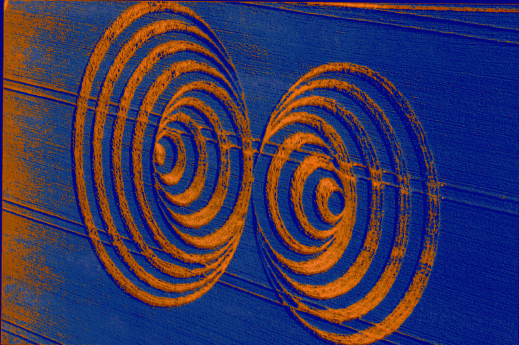
Featured Image: “crop circle Windmill Hill – fusion” by Ian Burt @Flickr CC BY.
—
H. Cecilia Suhr (www.ceciliasuhr.com) is an Assistant Professor in the Department of Media, Journalism and Film at Miami University-Hamilton and Affiliate Faculty in the Department of Art at Miami University, Oxford, Ohio. Starting from August 2016, She will be an Associate Professor in a new department called Humanities and Creative Arts at Miami University Hamilton while maintaining her current ties at Oxford campus. She is also a three-time award-winning interdisciplinary and multimedia artist whose work spans paintings, digital art, video art, sonic art, and music. Her work has been exhibited in New York City, Washington, D.C., Los Angeles, Cincinnati/West Chester, OH, Fort Thomas/NewPort Kentucky, Laurel, Maryland, and internationally in cities such as Moscow, London, Seoul and Tokyo. It has been publicly collected by the Marina Tsvetaeva House Museum in Moscow, NamSeoul University, Sisters of St. Paul of Charities, and KT Korea. She is the author of two academic books–Social Media and Music: The Digital Field of Cultural Production (Peter Lang Press, 2012) and Evaluation and Credentialing in Digital Music Communities (MIT Press, 2014)–and an editor and contributing author of Online Evaluation of Creativity and the Arts (Routledge Press, 2014). In 2012, she was the recipient of a MacArthur Foundation Research Award for Digital Media and Learning.
—
REWIND!…If you liked this post, you may also dig:
SO! Podcast #34: Sonia Li’s “Whale”–Sonia Li
SO! Podcast #13: Sounding Shakespeare in S(e)oul–Brooke A. Carlson
SO! Podcast #10: Interview with Theremin Master Eric Ross–Aaron Trammell
Share this:


Current Top Posts





April 2021

January 2020

November 2019

October 2019

August 2019

April 2014

November 2017

March 2015

December 2017

October 2015
 Sounding Out!
Recent Comments