
Sounding Out! Podcast #57: The Reykjavik Sound Walk

CLICK HERE TO DOWNLOAD: The Reykjavik Sound Walk
SUBSCRIBE TO THE SERIES VIA ITUNES
ADD OUR PODCASTS TO YOUR STITCHER FAVORITES PLAYLIST
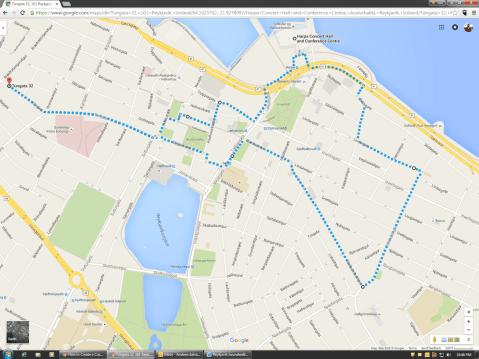
Standing in front of our rented apartment in Túngata, a residential street just a few blocks from central Reykjavík, I am struck by the stillness of the city that surrounds me. Having lived most of my life in the densely-populated suburbs of northern New Jersey, my experience of urban soundscapes has typically been frenetic and noisy. Here, even the busiest parts of town seem subdued. It’s a pleasant contrast. At 8AM on a weekday, the quietness is eerily enveloping, broken only occasionally by a gust of arctic wind, a passing car, or a neighbor closing her door and setting off for work.
Quiet tranquility and natural beauty have attracted a growing number of tourists to Iceland in recent years, my wife and I included. With only 330,000 people inhabiting an area roughly the size of Kentucky (and two-thirds of those settled in and around Reykjavík), one needn’t venture far out into Iceland’s otherworldly landscape to feel far removed from civilization – like exploring a distant planet. While the island may be still now, the belated realization that Iceland’s bizarre terrain, its vast lava fields, meandering fissures, and Dr. Seuss rock formations are the result of earth-shattering eruptions – like Eyjafjallajökull in 2010, Bárðarbunga in 2014-15, or the more recent rumblings around Katla – can be a little unnerving. Travelling through the Icelandic countryside, one imagines the thundering cracks, seething magma, and the infernal growl of the awesome geophysical forces that churned up these vast panoramas.
To a certain extent, the absence of sound here heightens a sense of the sublimity of the world around us; that from certain perspectives, nature is fundamentally ineffable – incapable of being fully represented by language, data, or art. Sound, I think, can complicate this experience. On the one hand, the extraordinary sounds of earthquakes and volcanic eruptions, of great storms, or the roiling of heavy seas, contribute to the overwhelming experience of the grand and fantastic. On the other, these sounds, like perhaps the everyday noise of a busy street corner, may also break the spell by yielding up the audibly familiar. Wandering around Reykjavík at this early hour, a settlement that has clung defiantly to a desolate rock in the North Atlantic for over 1000 years, I become acutely aware of each new sound to disrupt the ethereal silence. Each of these, even the most mundane and urban, seems to take on larger significance and intention as audible signs of the ways in which human beings have forged order and meaning from a wild and indifferent world.
But for now, all remains quiet, and the island’s primordial silence seems to reach even into the capital itself. Of course, Reykjavík is a vibrant international city resonating with the familiar sounds of urban life. But at certain times the quietness that seems to subsume everything else – a subtle reminder of the relatively small scale and frailty of the human compared to the geological.
Soon enough however, as I walk up Túngata there’s a siren in the distance, and the neighborhood begins to echo with the sounds of children playing in the yard at Landakotsskóli, one of Iceland’s oldest schools. I follow the street as it arcs towards the city center, passing several foreign embassies and the imposing gothic edifice of Dómkirkja Krists Konungs. A few other cars motor past and there’s a brief gust of cold wind, but these are momentary disruptions. Soon enough the world returns to the now-familiar stillness.

Grafitti in Reykjavik. Image by Rog01 @Flickr CC-BY-NC-SA.
But the sounds of morning traffic pick up a bit as I walk further down the hill – the rush of passing cars, the groan of a utility truck turning off a side street, and the muffled sounds of a radio floating from a car window. At its end, Túngata bends to the left at the bottom of the hill, where I see a large excursion bus stopped in front of a hotel, and a knot of tourists quietly talking nearby. It’s time for morning pickups, and the idling of these busses, and the hushed, expectant voices of day-trippers outside hotels and guesthouses around the city turn out to be common vignettes along my morning walk. They’re a reminder of the vast growth in tourism this year, which is expected to increase 29% over 2015 to 1.6 million foreign visitors.
Continuing straight onto Kirkjustrӕti, I pass the Alþingishúsið (Parliament House) on my right, and Austurvӧllur, a large public square on my left. The place is relatively quiet now. The cafes lining Vallarstrӕti and Pósthússtrӕti are closed, and there are only a handful of people walking through the square. Later on, the cafes will be buzzing with patrons enjoying the balmy (for Iceland) weather and the long hours of sunlight.
But aside from the nightlife, Austurvӧllur’s proximity to Parliament means that historically it’s been a focal point of political protest in Reykjavík. Two months before our visit, some 24,000 people crowded into this space to demand the resignation of Prime Minister Sigmundur Davíð Gunnlaugsson, who was revealed by the Panama Papers to have undisclosed connections with an offshore shell company with interest in failed Iceland banks. Walking past the square today, I can only imagine the chants, claps, whistles, shouts, barricade-banging, and yogurt-throwing of Icelanders expressing their collective frustration with corrupt officials.

Construction in Reykjavik. Image by Patrick Rasenberg @Flickr CC BY-NC.
This morning however, apart from the early morning sound of chirping birds and pedestrian commuters, there’s a bit of construction going on here – I can hear a few landscapers and a pair of contractors clanking and clunking as they lay out equipment for work on a building next to the Alþingishúsið. From these men and others I pass along this stretch of road, I hear the hushed and slightly groggy speech of early morning. The talk is all in Icelandic of course, a language whose place and street names I valiantly try to pronounce when I visit. Icelandic is a notoriously difficult language for foreigners in general, and its tongue-twisting staccato and subtle consonants, not to mention its intimidating alphabet, usually leave my mouth sounding a bit too awkwardly Jersey (as you can hear for yourself in this podcast!).
Continuing on my walk, I follow Pósthússtrӕti as it threads around Dómkirkjan and out to Lӕkjargata, the main avenue in this section of town. Here, the soundscape is more typically urban. The sound of trucks and cars passing, a bus groaning into gear as it pulls out into traffic, the multi-lingual chatter of pedestrians at a crosswalk, a group of teenage volunteers chatting in Icelandic as they do groundskeeping work near the Stjórnarráðið government offices, all speak the language of a city’s morning routine.

Street art in Reykjavik. Image by Toni Syvänen @Flickr CC BY-NC-SA.
Bankastrӕti, the main commercial district, is also coming to life. It’s still early, and most shops are closed, but heading east up the street, I hear a few snatches of conversations in Icelandic and American English – and there seems to be more of the latter than I remember from the last time we visited, testament to Iceland’s growing attraction for U.S. tourists. All along Bankastrӕti, the sounds of lively conversation, music, and the clinking of tableware floats out of open doors as people pop in and out of cafes and restaurants for breakfast and morning coffee. As I bear right on Skólavӧrðustigur and up the hill towards Hallgrímskirkja – the Lutheran church that dominates the city skyline like an art deco rocket ship – these sounds start to thin out again. Apart from a passing car or pedestrian, and the occasional rumbling of a tour bus or ATV, I am left in the comforting hush of a Reykjavík morning.
At the top of the hill, the large stone plaza before Hallgrímskirkja echoes with the clattering sounds of workers hammering at the roof of a nearby building, as the great green statue of Leifur Erikíksson silently watches on. I turn left on Frakkastígur and head downhill towards Faxa Bay, which looms in the middle distance. Frakkastígur turns out to be the noisiest stretch of my walk: there’s the roofers; the slapping of lanyards on the flagpoles that surround Hallgrímskirkja; the busy bakery where I buy morning croissants surrounded by Beatles music, the English and Icelandic chatter of customers, and the pounding, rolling, and cutting of dough; and finally the two large construction sites that I pass between Laugavegur and Hverfisgata streets. Here, the motoring of earthmovers, the shrieking of a circular saw, and the pounding of a massive pile driver jar the neighborhood with an intense mechanized racket.
I’ve noticed a fair amount of construction around Reykjavík this trip. The skyline bristles with cranes. It’s another marker of the booming tourism industry, and its complicated place in the Icelandic economy. Since the financial collapse of 2008, there’s been pent-up demand for residential housing. But with the local construction industry strained from the current spate of hotel building, it’s been difficult to find builders to work on residential projects. What I hear around me is a sign that Iceland’s economy has improved, but it’s also a reminder that improvement sometimes makes life more difficult for local residents.

Sculpture on the shore of Reykjavik. Image by Ainhoa Sánchez Sierra @Flickr CC-BY-NC-SA.
The sounds of heavy construction fade as I wind my way down to the bay and cross over Sӕbraut to the promenade that lines the shore. Like any highway, at this point in the morning Sӕbraut fairly hums with commuter traffic; here, the ambient sound of suburbanites making the morning drive to work, complete with attendant sound of brakes, horns, and Icelandic drive-time radio mix with the rushing sound of wind rolling off the waterfront. Walking along the promenade now, I pass a few joggers and bicyclists as a walk over to Harpa, the newly-built glass and steel concert hall that is home to the Icelandic Symphony Orchestra and which, every autumn, becomes a focal point of the week-long Iceland Airwaves music festival. It’s this annual event, I muse, that should be the subject of a future sound walk (for me or someone else) – five days in which Reykjavík pulsates with the sound and music of dozens of bands playing formal and informal shows at venues, cafes, bookstores, and basements around the city.
From a large dig site next to Harpa (the possible site of yet another hotel), I cross back over Sӕbraut to the clicking sounds of a crossing signal for blind pedestrians. I pass Bӕjarins Beztu Pylsur (The Best Hot Dog in Town), which is closed for the morning, and walk back into the city center, which is by now clearly awake and buzzing with locals and tourists. After stopping in a 24-hour supermarket for some morning milk, I walk east on Austurstrӕti past the Laundromat Café and other restaurants that are now busy serving the breakfast crowd.
Up through Ingólfstorg square (which appears to double as a skate park, but is right now a stopping point for a walking tour group), south on Aðalstrӕti, and around the turn by the Reykjavík Settlement Museum, I’m soon walking back up through the quiet neighborhood lining Túngata.
—
Featured Image by SambaClub | Camisetas com conteúdo (a t-shirt site) @Flickr CC BY.
—
Andrew J. Salvati is a Media Studies Ph.D. candidate at Rutgers University. His interests include the history of television and media technologies, theory and philosophy of history, and representations of history in media contexts. Additional interests include play, authenticity, the sublime, and the absurd. Andrew has co-authored a book chapter with colleague Jonathan Bullinger titled “Selective Authenticity and the Playable Past” in the recent edited volume Playing With the Past (2013), and has written a recent blog post for Play the Past titled “The Play of History.”
—
REWIND!…If you liked this post, you may also dig:
SO! Podcast #37: The Edison Soundwalk–Frank Bridges
This is What it Sounds Like……..On Prince and Interpretive Freedom–Benjamin Tausig
Soundwalking New Brunswick, NJ and Davis, CA–Aaron Trammell
Share this:

Listen to the Sound of My Voice

Betrayal
I first realized there was a problem with my voice on the first day of tenth grade English class. The teacher, Mrs. C, had a formidable reputation of strictness and high standards. She had us sit in alphabetical order row after row, and then insisted on calling roll aloud while she sat at her desk. Each name emerged as both a command and a threat in her firm voice.
“Kelly Barfield?”
“Here,” I mumbled quietly. I was a Honor Roll student with consistent good grades, all A’s and one B on each report card, yet I was shy and softspoken in classes. This was an excellent way to make teachers amiable but largely go unnoticed. The softness of my voice made me less visible and less recognizable.
Mrs. C repeated my name. Caught off guard, I repeated “here” a little more loudly. She rose to her feet to get a better look at me. I knew what she saw: a petite girl with long ash blonde hair, big brown eyes, and overalls embroidered with white daisies on the bib. When her gaze finally met mine, Mrs. C frowned at me and cleared her throat loudly. I curled into my desk, hoping to disappear.

“Lincoln High School 9-16-2007 008” by Flickr user Paul Horst, CC BY-NC 2.0
“Miss Barfield, did you hear me call your name twice? In this class, when I call roll, you respond.” I gave a quick nod, but Mrs. C wasn’t finished: “We use our strong voices in here, not our girly, breathy ones.” My cheeks flushed red while Mrs. C droned on about confidence and classroom expectations.
“Do you understand me?”
I stammered a “yes.” Mrs. C turned her attention back to the roll call. Her harsh words rang in my ears. I sank low in my chair, humiliated and angry. I couldn’t help that I sounded girly: I was, in fact, a girl. This was the way my voice sounded. It was not an attempt to sound like the dumb blonde she appeared to think I was.
That day I decided that I would never speak up in her class. Forget the Honor Roll. If the sound of my voice was such a problem, then my mouth would remain firmly shut in this class and all of my others. I would never speak up again.

“Listen” by Flickr user lambda_x, CC BY-ND 2.0
My vow to stop speaking lived a short life. I enjoyed Mrs. C’s serious fixation on diagramming sentences and her attempts to show sophomores that literature offered ideas and worlds we didn’t quite know. At first, I spoke up with hesitation and fear of the inevitable dismissal, but I continued to speak. Becoming louder became my method to seem confident, even when I felt anything but.
Throughout high school, my voice emerged again and again as a problem. Despite the increased volume, my voice still sounded tremulous, squeaky, hesitant, and shrill to my own ears. Other girls had these steady, warm voices that encouraged others to listen to them. Some had higher voices that were melodic and lovely. I craved a lower, more resonant voice, but I was stuck with what I had. In drama club, our director scolded me with increasing frustration about my tendency to end my lines in the form of a question. My nerves materialized as upspeak. The more he yelled at me, the more pronounced the habit became. He eventually gave up, disgusted by my inability to control my vocal patterns.

By Dvortygirl, Mysid [GFDL (http://www.gnu.org/copyleft/fdl.html) or CC-BY-SA-3.0 (http://creativecommons.org/licenses/by-sa/3.0/)%5D, via Wikimedia Commons
Meanwhile, at a big state university in my native Florida, I learned quickly that a Southern accent marks you as a dumb redneck from some rural town that no one had heard of. Students in my classes asked me to say particular words and then giggled at my pronunciations. “You sound like a Southern belle,” one student noted. This was not really a compliment. According to my peers, Southern belles didn’t have a place in the classroom. Southern belles didn’t easily match up with “college student. As a working-class girl from a trailer park, I learned that I surely didn’t sound like a college student should. I worked desperately to rid myself of any hint of twang. I dropped y’all and reckon.
I listened carefully to how other students talked. I mimicked their speech patterns by being more abrupt and deadpan, slowly killing my drawl. When I finally removed all traces of my hometown from my voice, my friends both from home and from college explained that now I sounded like an extra from Clueless. My voice was all Valley girl. I was smarter, they noted with humor, than I sounded and looked. My voice now alternated between high-pitched and fried. Occasionally, it would squeak or crack. I thought I sounded too feminine and too much like an airhead, even when I avidly tried not to. I began to hate the sound of my voice.
My voice betrayed me because it refused to sound like I thought I needed it to. It refused to sound like anyone but me.
When I started teaching and receiving student evaluations, my voice became the target for students to express their displeasure with the course and me. According to students, my voice was too high and grating. Screechy, even: one student said my voice was at a frequency that only bats could hear. In every set of evaluations, a handful of students declared that I sounded annoying. This experience, however, was not something I alone faced. Women professors and lecturers routinely face gender bias in teaching evaluations. According to the interactive chart, Gender Language in Teaching Evaluations, female professors are more likely to be called “annoying” than their male counterparts in all 25 disciplines evaluated. The sound of my voice was only part of the problem, but I couldn’t help but wonder if how I sounded was an obstacle to what I was teaching them.
Once again, I tried to fix my problematic voice. I lowered it. I listened to NPR hosts in my search for a smooth, accentless, and educated sound, and I attempted to create a sound more like them. I practiced pronouncing words like they did. I modulated my volume. I paid careful attention to the length of my vowels. I avoided my natural drawl. None of my attempts seemed to last. Some days, I dreaded lecturing in my courses. I had to speak, but I didn’t want to. I wondered if my students listened, but I wondered more about what they heard.
Sound
Public Domain, https://commons.wikimedia.org/w/index.php?curid=1393933
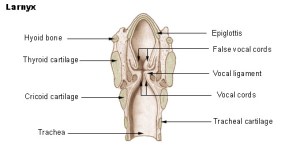
The sound of your voice is a distinct trait of each human being, created by your lungs, the length of your vocal cords, and your larnyx. Your lungs provide the air pressure to vibrate your vocal cords. The muscles of your larnyx adjust both the length and the tension of the cords to provide pitch and tone. Your voice is how you sound beyond the resonances that you hear when you speak. It is dependent on both the length and thickness of the vocal cords. Biology determines your pitch and tone. Your pitch is a result of the rate at which your vocal cords vibrate. The faster the rate, the higher your voice. Women tend to have shorter cords than men, which makes our voices higher.
Emotion also alters pitch. Fright, excitement, and nervousness all make your voice sound higher. Nerves would make a teenage girl have an even higher voice than she normally would. Her anxious adult self would too. Her voice would seem tinny because her larnyx clenched her vocal cords tight. Perhaps this is the only sound she can make. Perhaps she is trying to communicate with bats because they at least would attempt to listen.
Biology, the body, gives us the voices we have. Biology doesn’t care if we like the ways in which we sound. Biology might not care, but culture is the real asshole. Culture marks a voice as weak, grating, shrill, or hard to listen to.

“Speak” by Flickr user Megara Tegal, CC BY-NC-ND 2.0
My attempts to change my voice were always destined to fail. I fought against my body and lost. I couldn’t have won even if I tried harder. My vocal cords are determined that my voice would be high, so it is. The culture around me, however, taught me to hate myself for it. Voice and body seem to cast aspersions on intelligence or credentials. It’s the routineness of it all that wears on me. I expect the reactions now.
I wonder if I’m drawn to the quietness of writing because I don’t have to hear myself speak. I crave the silence while simultaneously bristling at it. Why is my voice a problem that I must resolve to placate others? How can I get others to hear me and not the stereotypes that have chased me for years?
Fury
My silence has become fruitful. The words I don’t say appear on the page of an essay, a post, or an article. I type them up. I read aloud what I first refused to say. I wince as I hear my voice reciting my words. I listen carefully to the cadence and tone. This separation of words and voice is why writing appeals to me. I can say what I want to say without the sound of my voice causing things to go awry.
People can read what I write, yet they can’t dismiss my voice by its sound. Instead, they read what I have to say. They imagine my voice; my actual sound can’t bother them. But, they aren’t really hearing me. They just have my words on the page. They don’t know how I wrap the sound around them. They don’t hear me.
Rebecca Solnit, in “Men Explain Things to Me,” writes “Credibility is a basic survival tool.” Solnit continues that to be credible is to be audible. We must be heard to for our credibility to be realized. This right to speak is crucial to Solnit. Too many women have been silenced. Too many men refuse to listen. To speak is essential “to survival, to dignity, and to liberty.”

“Listen” by Flickr user Emily Flores, CC BY-ND 2.0
I agree with her. I underline her words. I say them aloud. The more I engage with her argument, the more I worry. What about our right to be heard? When women speak, do people listen? Women can speak and speak and speak and never be heard. Our words dismissed because of gender and sound. Being able to speak is not enough, we need to be heard.
We get caught up in the power of speaking, but we forget that there’s power in listening too. Listening is political. It is act of compassion and empathy. When we listen, we make space for other people, their stories, their voices. We grant them room to be. We let them inhabit our world, and for a moment, we inhabit theirs. Yes, we need to be able to speak, but the world also needs to be ready to listen us.
We need to be listened to. Will you hear me? Will you hear us? Will you grant us room to be?
When I think of times I’ve been silenced and of the times I haven’t been heard, I feel the sharp pain of exclusion, of realizing that my personhood didn’t matter because of how I sounded. I remember the burning anger because no one would listen. I think of the way that silence and the policing of how I sound made me feel small, unimportant, or disposable. As a teenager, a college student, and a grown woman, I wanted to be heard, but couldn’t figure out exactly how to make that happen. I blamed my voice for a problem that wasn’t its fault. My voice wasn’t the problem at all; the problem was the failure of others to listen.
“listen” by Flickr user Jay Morrison, CC BY-NC-ND 2.0
Loss
While writing this essay on my voice, I almost lost mine, not once but twice. I caught a cold and then the flu. My throat ached, and I found it difficult to swallow. A stuffy nose gave my voice a muted quality, but then, it sounded lower and huskier. I could hear the congestion disrupting the timber of my words. My voice blipped in and out as I were radio finding and losing signal. It hurt to speak, so I was quiet.
“You sound awful,” my husband said in passing. He was right. My voice sounded unfamiliar and monstrous. I tested out this version of my voice. It was rougher and almost masculine. I can’t decide if this is the stronger, more authoritative voice I wanted all along or some crude mockery of what I can never really have. I couldn’t sing along with my favorite songs because my voice breaks at the higher register. I wheezed out words. I croaked my way through conversations. “Are you sick?” my daughter asked, “You don’t sound like you.”
Her passing comment stuck with me. You don’t sound like you. Suddenly, I missed the sound of my voice. I disliked this alien version of it. I craved that problematic voice that I’ve tried to change over the years. I wanted my voice to return.
After twenty years, I decided to acknowledge the sound of me, even if others don’t. I want to be heard, and I’m done trying to make anyone listen.
—
Featured image: “Speak” by Flickr user Ash Zing, CC BY-NC-ND 2.0
—
Kelly Baker is a freelance writer with a religious studies PhD who covers religion, higher education, gender, labor, motherhood, and popular culture. She’s also an essayist, historian, and reporter. You can find her writing at the Chronicle for Higher Education‘s Vitae project, Women in Higher Education, Killing the Buddha, and Sacred Matters. She’s also written for The Atlantic, Bearings, The Rumpus, The Manifest-Station, Religion Dispatches, Christian Century’s Then & Now, Washington Post, and Brain, Child. She’s on Twitter at @kelly_j_baker and at her website.
—
REWIND!…If you liked this post, you may also dig:
Vocal Gender and the Gendered Soundscape: At the Intersection of Gender Studies and Sound Studies — Christine Ehrick
On Sound and Pleasure: Meditations on the Human Voice– Yvon Bonefant
As Loud As I Want To Be: Gender, Loudness, and Respectability Politics — Liana Silva
Share this:


Current Top Posts





April 2021

January 2020

November 2019

October 2019

August 2019

April 2014

November 2017

March 2015

December 2017

October 2015
 Sounding Out!
Recent Comments