
A Medieval Music Box: the Cantigas de Santa María as Sound Technology in the Age of Alfonso X

 Each of the essays in this month’s “Medieval Sound” forum focuses on sound as it, according to Steve Goodman’s essay “The Ontology of Vibrational Force,” in The Sound Studies Reader, “comes to the rescue of thought rather than the inverse, forcing it to vibrate, loosening up its organized or petrified body (70). These investigations into medieval sound lend themselves to a variety of presentation methods loosening up the “petrified body” of academic presentation. Each essay challenges concepts of how to hear the Middle Ages and how the sounds of the Middle Ages continue to echo in our own soundscapes.
The posts in this series begins an ongoing conversation about medieval sound in Sounding Out!. Our opening gambit in April 2016, “Multimodality and Lyric Sound,” reframes how we consider the lyric from England to Spain, from the twelfth through the sixteenth centuries, pushing ideas of openness, flexibility, and productive creativity. We will post several follow-ups throughout the rest of 2016 focusing on “Remediating Medieval Sound.” And, HEAR YE!, in April 2017, look for a second series on Aural Ecologies of noise! –Guest Editors Dorothy Kim and Christopher Roman
–
At a first glance, one might think the sounds of the Middles Ages unrecoverable from the fragmented yet abundant ruins of the past. The voices, noises, melodies seem lost to the present, casting the efforts to reconstruct matters of medieval sound as speculation. However, medieval peoples actually preserved copious traces of their efforts to produce the thing closest to contemporary sound recordings: comments, writings, treatises, music notation, verbal descriptions, music instruments and even architectural design in the name of sound. Testaments of such efforts– forgotten amplifiers resisting time’s erasure–appear in the form of one of the greatest and revolutionary accomplishments of the ten centuries comprising the Middle Ages: the development of the codex. Coupled with the meticulous treatment of writing, the codex ushered in a number of innovations slowly introduced in matters of script, binding, development of materials, the re-thinking of the function and design of the library, and others. During this expansive time, the topic of memory was linked to writing and its repositories as supportive instruments in an active way (Carruthers). Key to our discussion here, these developments greatly assisted melody, rhythm, the production of music in general, particularly through the slow creation of the written devices and symbols that eventually turned into music notation.
Alfonso X, King of Castile in the 13th century, set to participate in the stream of cultural reflections and productions about music and sound in the Middle Ages. One of his main works, the Cantigas de Santa María (sourced from here and here), is an awe-inspiring cultural monument, not only for its representation of monarchical values in Castile, but because it provides evidence of all of the efforts toward the careful attention to writing and music, and their links to matters of religious devotion. Among the topics carefully interwoven in the visual, written and musical registers of the Cantigas is a depiction of the culture of the kingdom of Castile and the Iberian Peninsula in the 13th century. Alfonso’s representations of Christians, Jews and Moors as part of the population affected by the presence and constant intervention of the Virgin sets his codices apart as unique examples of what some critics have proposed to see as the world of convivencia, a form of social organization in which collaboration and tolerance between peoples belonging to different cultural frames took place (Américo Castro).

A depiction of Alfonso’s scriptorium.
The Cantigas de Santa María is better defined as the cluster of four extant manuscripts, written in Galician-Portuguese, that display similar functions, design, topics, and organization (Fernández). As a whole, the Cantigas is the concerted effort to produce a body of materials for devotion to the Virgin Mary on behalf of King Alfonso, a multimedia, multidimensional, and a discursively multivalent groups of codices or manuscripts each organized in what John E. Keller calls the threefold method: lyrics/poetry, miniatures, and music notation. Of the extant codices, the Codex that is best known for being the most finished—as well as for the richness of the work of miniatures—is the Codex Rico, the basic codex from which I use examples in this article.
While there are plenty of critical comments and approaches to the Cantigas in terms of its poetic composition and content, as well as its miniatures or illustrations, the most puzzling element of its study remains its “sound.” There have been several efforts to analyze the music notation and tradition in the Cantigas from different viewpoints. Julián Ribera and Higinio Anglés, for example, attempted to produce a transcription of its music notation. Others, such as Hendrik van der Werf, made great efforts to analyze the particularities of the music notation and the interpretation of rhythm. However, musicologists maintain that we still need better working tools to interpret the music with full consideration of the information in the codices, as well as the points of contact and variations of music and lyrics from one of the codices to the other (Ferreira). As we work toward coordinating such a project, we still have several elements to work with to hear and interpret sound in the Cantigas.
To listen to the Cantigas, the reader/spectator/listener can begin by addressing the codices’ composition and construction. The texts not only offer a vast repertory of songs with music notation, but they also make use of miniatures to comment on the topics of sound and music. The codices are self-reflexive, which means that they make constant reference to their own construction and production. In this way, the texts challenge the reader/spectator/listener to consider the multiple layers of construction and meaning. For example, consider the definitions and views of sound and music exposed by the Cantigas. Here, the word “cantiga” is usually understood as either a song or short poem set to music, mostly about love, following the vocabulary of medieval courtly tradition (Parkinson). By the 12th century, the kingdoms to the north of the Iberian Peninsula had developed a lyrical form associated with courtly tradition known as the Cantigas d’amigo, written in Galician Portuguese, and linked to the troubadour tradition. The Cantigas appear to follow this tradition directly, suggesting the title references the form as well as the content of its lyrics. Therefore, the title Cantigas refers to the poetical conventions structuring the expression of devotion to a lady—most of the poems follow a particular structure of stanzas followed by a refrain—and it also signals the sound of such devotion.

A codex. Image borrowed from e-codices @Flickr CC BY-NC.
So how to describe the sound of the cantigas? What would the medieval reader/spectator of the codex understand just by looking at the music notation, poetic structures, illustrations and miracles about the role of sound, music, and voice as well?
For one thing, the miracles, miniatures or illustrations—as well as the music notation from one cantiga to the other—supply an excess of information. The codices present Jewish characters, heavy hints of the influence of Hispanic-Arabic poetic and music traditions (such as “rhythmic patterns from the muwashshah,” according to Manuel Pedro Ferreira, miracles from the Provençal tradition, Galician-Portuguese poetic structures and music, troubadour topics, the identification of melodies from secular traditions, profane music, and religious motifs. All of these together suggest that the reader/spectator/listener of the cantigas would have been expected to know at least a little of each of these elements.
The contemporary identification of these layers of information has led Cantigas scholars to hypothesize on the possible performance of its music. Research shows agreement on the folowing: the expression of clear melodic lines; the use of mensural notation (the system for European vocal polyphonic music used from the later part of the 13th century until about 1600); the interpretation of rhythm depending on the poetic structure and melodies of each poem; the use of melismas—runs of notes made from one syllable—and their function in performance; and the impossibility of interpreting the use of pitch. This last feature renders any attempt to reconstruct and perform the full range of the codices’ music virtually impossible. Any contemporary performance works as an exercise of imagination, an active effort to fill in the blanks of what may be described as an ambitious and extensive archive of and about music in the Iberian Peninsula of the 13th century.

Cantiga 8.
In the meantime, prospective listeners of the Cantigas’ music may still reflect on how it comments and represents the function of music and sound: from love and religious devotion, to entertainment, spiritual transformation. Its authors represent music as both skill and gift. Furthermore, as the following brief and striking examples show, many other sounds are encoded in the texts: voices, screams, streams, demands, prayer and cries. Cantiga 8 is about a Minstrel from Rocamadour who dedicates his songs to a statue of the Virgin Mary (fols. 15r-15v). He prays to her that she may give him a candle from the church. The Virgin is so pleased with his dedication that she makes a candle to rest on his “viola” (fiddle). A monk, unbelieving of the miracle, takes the candle away and accuses the minstrel of using magic. The miracle takes place for a second time, causing the monk to repent and join the minstrel and others in devotion. This may seem like a simple story of the values of faith communities, however the Cantigas underscores the role sound plays in devotion, through the minstrel’s voice and performance with his music instrument:
“que mui ben cantar sabía / e mui mellor vïolar ( fol. 15r, line 10).
(“…as he knew how to sing very well / and to fiddle even better”)
Moreover, the disbelieving monk is described as having understood his error as “aqueste miragre viu” (by “seeing” this miracle) and “entendeu que muit errara,” which may be translated as “understanding that he was in error.” However, in Portuguese, the verb “entender” (to understand) is also associated with the notion of understanding through auditory perception.

Cantiga 89.
Another example of the role of sound in Alfonso’s project is found in Cantiga 89 (fols. 130r-131r). This cantiga is about a Jewish woman who experiences a difficult childbirth. In the middle of the delivery of her baby, she hears a voice asking her to pray to the Virgin. As she moans and cries, she finds the strength to pray aloud to request the Virgin’s help. The poem stresses the quality of the sound of the laboring woman in the description of her suffering:
“Ela assi jazendo / que era mais morta ca viva / braadand’e gemendo/ echamando / sse mui cativa, / con tan gran door esquiva” (fol. 130v, lines 20-25).
(As she lay in this condition/ for she was more dead than alive / screaming and moaning / calling herself unfortunate / with great pain).
The Virgin helps the Jewish woman, who decides to convert to Christianity at the end of the cantiga. The text underscores the role of voice in both the spiritual intervention of the Virgin, but also in the human experience of pain and prayer.
Lastly, Cantiga 103, is about a monk who listened to a bird’s song for three hundred years (fols. 147v-148v). The monk asks the Virgin to let him glimpse paradise before dying. After hearing his prayer, however, the Virgin grants him not a view of paradise, but the sensation of its sounds:
“Tan toste que acababa ouv’o o mong’ a oraçon, / oyu ha passarinna cantar log’ en tan bon son, / que sse escaeceu seendo e catando sempr/ alá” ( fol. 148r, lines 23-25).
(“As soon as he finished his prayer / he heard a small bird sing with such a nice song / that he forgot about everything else remaining in the place forever”)
Three hundred years pass, and suddenly the monk remembers to return to his monastery. He finds everything there transformed. After telling his story, everyone shares the wonder of the miracle praising the Virgin. This text suggests a different appreciation of “paradise” not through the notion of “vision” but through aurality, the description of the spiritual well being as a sonic experience.
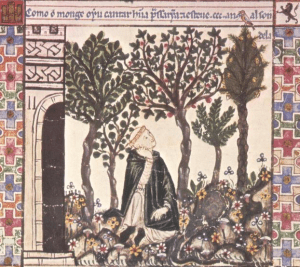
Cantiga 103.
This small sampling from cantigas underscores the value of voice, noise, and music as part of human experience, as central in the experience of religious devotion, and as transformative for the communities represented in the codices. King Alfonso strove to create a library containing all the knowledge available to his world. Additionally, he strove to participate actively in—and innovate—contemporary forms of knowledge production. In many ways, the Cantigas, function as a music box, its folios documenting multiple forms of sonic information, making available the experiences, values, soundscapes, and medieval ways of hearing/listening, or the aurality of the Middle Ages.
—
Featured image “girl laugh #10” by danor sutrazman @Flickr CC BY.
—
Marla Pagán-Mattos earned her doctorate in Comparative Literature and Literary Theory at the University of Pennsylvania. Her research interests include medieval literature, Iberian medieval history and literature, literary theory, and sound culture. She has taught at the University of Pennsylvania, Haverford College, and is currently teaching in the Department of Comparative Literature at the University of Puerto Rico.
—
 REWIND! . . .If you liked this post, you may also dig:
Introduction: Medieval Sound–Dorothy Kim and Christopher Roman
“Playing the Medieval Lyric”: Remixing, Sampling and Remediating “Head Like a Hole” and “Call Me Maybe”–Dorothy Kim
Mouthing the Passion: Richard Rolle’s Soundscapes–Christopher Roman
Share this:

Mouthing the Passion: Richard Rolle’s Soundscapes

Each of the essays in this month’s “Medieval Sound” forum focuses on sound as it, according to Steve Goodman’s essay “The Ontology of Vibrational Force,” in The Sound Studies Reader, “comes to the rescue of thought rather than the inverse, forcing it to vibrate, loosening up its organized or petrified body (70). These investigations into medieval sound lend themselves to a variety of presentation methods loosening up the “petrified body” of academic presentation. Each essay challenges concepts of how to hear the Middle Ages and how the sounds of the Middle Ages continue to echo in our own soundscapes.
The posts in this series begins an ongoing conversation about medieval sound in Sounding Out!. Our opening gambit in April 2016, “Multimodality and Lyric Sound,” reframes how we consider the lyric from England to Spain, from the twelfth through the sixteenth centuries, pushing ideas of openness, flexibility, and productive creativity. We will post several follow-ups throughout the rest of 2016 focusing on “Remediating Medieval Sound.” And, HEAR YE!, in April 2017, look for a second series on Aural Ecologies of noise! –Guest Editors Dorothy Kim and Christopher Roman
—
A soundscape is an aural-based landscape, an auditory environment that surrounds a listener and constructs space. In 2009 the composer, John Luther Adams, created a music installation in Alaska that experiments with the boundaries of soundscape. Utilizing geological, meteorological, and magnetic data, Adams tuned and transformed the sounds of the landscape into electronic sound.
In his “Forward” to John Luther Adams’s composer journals compiled as The Place Where You Go to Listen, New Yorker music critic, Alex Ross comments that Adams’s work with composing with the atmospheric, geological, and ecological sounds of Alaska reveals a forbiddingly complex creation that contains a probably irresolvable philosophical contradiction. On the one hand, it lacks a will of its own; it is at the mercy of its data streams, the humors of the earth. On the other hand, it is a deeply personal work, whose material reflects Adams’s long-standing preoccupation with multiple systems of tuning, his fascination with slow-motion formal-processes, his love of foggy masses of sound in which many events unfold at independent tempos (x).
Thinking with Adam’s project and considering how sound surrounds us and can be tuned and transformed, as well as brought to the forefront of our sense perception, I turn to the medieval hermit, Richard Rolle, and his work with canor in his lyrics. In what follows, I consider the enmeshed ecology divine lyrics may invoke, and how the body—as an instrument—may experiment with, mimic, and contemplate divine sounds.

If hills could sing. Photo of Juneau Alaska by Ian D. Keating @Flickr CC BY.
In Rolle’s work, the experience of song, or canor, is one of the highest mystical gifts. As with John Luther Adams, sound unfolds in ways both translatable and ineffable. Canor creates a kind of being, one that creates place and, then, surpasses it. As he writes in the Incendium Amoris at the moment of his receiving the gifts of God:
I heard, above my head it seemed, the joyful ring of psalmody, or perhaps I should say, the singing […] I became aware of a symphony of song, and in myself I sense a corresponding harmony at one wholly delectable and heavenly (93).
In this initial receipt of canor, Rolle is made aware of aural space and the way that it is mimicked in his own biology. The space of the sacred church is transformed into an eternal space that resonates harmonically with God. In this, his first mystical experience, the musical song he hears above him transforms him internally: “my thinking turned into melodious song and my meditations became a poem, and my very prayers and psalms took up the same sound” (93). This transformation erases the boundaries between hearing external song and the translation of the internal song, and tunes Rolle into the ecology of sound, as Adams phrases it in The Place Where You Go to Listen, a “totality of the sound, the larger wholeness of the music” (1). Rolle’s body becomes a musical instrument beyond its initial sound capabilities and it resonates with the chapel space itself to become a larger harmonious work. Harmony in the form of these mystically experienced, enmeshed vibrations suggests both a local and cosmic allusion to complex systems of divine transcendence and immanence.
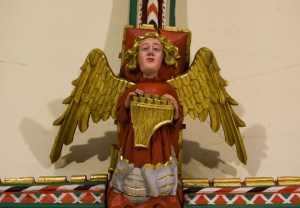
Detail of an angel with a musical instrument at All Saints’ Church on North Street in York. Image by Lawrence OP @Flickr CC BY-NC-SA.
By invoking the sounds of the Passion, conflating time and sound, and experimenting with the mouth of the lyricist to perform divine sounds, Rolle attempts to capture the panoply of emotion, action, and object surrounding his mystical experience and devotion by singing it. Invoking a queer temporality, Rolle weaves past and present, sound and sight, Jesus and singer, into an immersive, divine soundscape. The song reveals that there is no outside in the connection between the body as instrument and the God-sound.
The making of the divine into song for Rolle is a praxis, an active way to reconsider the relationship between God and man beyond visualization. Rolle’s use of the lyric is an ecological thought, what Tomothy Morton dubs a “reading practice” in The Ecological Thought that
makes you aware of the shape and size of the space around you (some forms, such as yodeling, do this deliberately). The poem organizes space […]. We will soon be accustomed to wondering what any text says about the environment even if no animals or trees or mountains appear in it (11).
In contemplating a lasting Love in , Rolle considers the gap between love and life, or, more specifically a love that is a lasting life and a love that quickly fades. This becoming-love must be separated out from other kinds of love that separate the singer from the community. Can love manifest itself in sound? Rolle exemplifies love’s abundance in the fire that “sloken may na thing” in “A Song of the Love of Jesus” (6). Love is represented as an excessive fire, one that nothing can put out and, therefore, everything is subsumed in it.
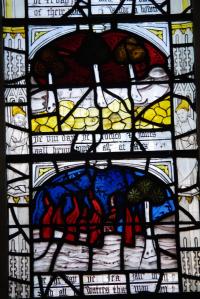
Stained glass depicting burning forests from a Richard Rolle poem at All Saints’ Church on North Street in York. Image by dvdbramhall CC BY-NC-SA.
But it is the sound of fire that Rolle connects with Love’s embrace. Rolle suggests an ecological moment, not in an apocalyptic way, but as a fire that creeps into all crevices. Nothing can “sloken” it—the sibilance of the consonant blend ‘sl’ gestures toward crepitation. It is the sound of fire touching the object as it prepares to consume—to take it into itself—as well as reveal Love’s movement in space. Rolle considers that love is created through the sound of fire (which, in his other works is an emotion he struggles with and not a visual fire).
In the lyric “Song of Love-longing to Jesus,” Rolle addresses the relationship between love and Jesus but rather than meditate on the nature of that love, as in the previous lyric, Rolle meditates on the event that causes that love: the Crucifixion. The lyric is bookended by violent acts. At the beginning, Rolle asks Christ to “take my heart intil þy hand, sett me in stabylte” (4) and “thyrl my sawule with þi spere, þat mykel luf in men has wroght” (6). In both these cases Christ’s hand and spear enter into Rolle in order to affect change. In the first line, it is to settle his heart—a theme that Rolle repeats in many of his writings. The stability of the heart allows it to open so that Christ can take up residence and, in that “indwelling,” the soul and Christ become one.
In the second piercing, the spear pierces the soul and Rolle seems to be implying that this piercing has already been done; the second piercing itself is the action that has opened the human to love. As Jesus was pierced by the lance of the Roman soldier, the soul is pierced by Jesus and in that act, love is made or “wroght.” In the second piercing, the ‘thyrl” becomes an important word because of its relationship between sonic resonance and mouth articulation. The spear pierces the soul and Rolle plays with the mouthing of the word as a kind of reverse piercing. The interdental fricative configuration of the voiced “th” in the word “thyrl” made by scraping the tongue between the teeth to form the word is like the removal of the spear from the wound itself. The lips make a wound shape and the tonguing of wounds reveals the intimacy inimical to the movement of the mouth, to sound out this pain and curl the lips to connect the lyricist with Christ.
The latter event of the poem is the scene of the Crucifixion itself. As Jesus has first pierced Rolle and in that event awoken or caused Love, we can imagine the spear as a brief linking object, something that erases the boundaries between Christ and Rolle. However, the middle third of the poem relates how Rolle lives a life of longing—and the love of Jesus will resolve this longing: “I sytt and syng of lufe-langyng, þat in my hert is bred” (29). The song is a result of the piercing; it is as if the removal of the spear has opened up a new song: that of love-longing. Rolle is lamenting the loss of the spear. The love-longing song, then, fills the hole left by the spear.

Image by .sanden. @Flickr CC BY-NC-SA.
The lyric further explores the soundscape of the Crucifixion. The meditation on the Crucifixion begins with Christ bursting forth. If the first image of the lyric is of Rolle being pierced inwardly, Christ ends the poem with a flowing out: “His bak was in betyng, and spylt hys blessed blode; þe thorn corond þe kyng, þat nailed was on þe rode” (35-36). Notice the repetition of “b” and the “th” consonant blend. The “b”’s recreate the lashes, the “th”’s repeat the piercings (the crown, the hands, the legs). The Passion is captured in two lines of sounds, but Rolle underscores the piercing of Christ as a way to show his overabundance—the flowing out of Christ in the lyric is another way to remove the boundary between singer and Christ—Christ also becomes the song as He is bound with the flowing rhyming words: fode/stode/blode/rode mimic the promise of the Passion.
Let us look closely at this stanza’s rhyme. The first and third, fode and blode, refer to the Eucharist and wine. It is out of the second and forth words: stode and rode from which we get that Eucharistic event. Jesus is beaten and Crucified; the Eucharistic feast of body and blood (or “aungel fode”) are a reminder of that event. In other words, Rolle has contained the temporal connection between Eucharist and Crucifixion in four rhyming words and the lyric becomes a witness to the sound of this event.
Rolle’s experiments with the mouthing of sound and the queer temporality of sound in his lyrics reveal Rolle’s attempt to capture canor textually. To sing God is an attempt at harmony with the divine.
—
Featured image from a mural in the Dominican friars’ chapel in the Angelicum, Rome. Photo by Lawrence OP @Flickr CC BY-NC-SA.
—
Christopher Roman is Associate Professor of English at Kent State University His first book Domestic Mysticism in Julian of Norwich and Margery Kempe deals with the creation of queer families within mystical theology. His forthcoming book Queering Richard Rolle deals with the intersection of queer theory and theology in the work of the hermit, Richard Rolle. His research also deal with quantum theory and Bede, ecocritical theory, and medieval soundscapes. He has published on medieval anchorites, ethics in Games of Thrones, and death and the animal in the works of Geoffrey Chaucer.
—
REWIND! . . .If you liked this post, you may also dig:
Introduction: Medieval Sound–Dorothy Kim and Christopher Roman
SO! Reads: Isaac Weiner’s Religion Out Loud: Religious Sound, Public Space, and American Pluralism–Jordan Musser
“I Love to Praise His Name”: Shouting as Feminine Disruption, Public Ecstasy, and Audio-Visual Pleasure–Shakira Holt
Share this:


Current Top Posts





April 2021

January 2020

November 2019

October 2019

August 2019

April 2014

November 2017

March 2015

December 2017

October 2015
 Sounding Out!
Recent Comments