
A Series of Mistakes: Nullsleep and the Art of 8-bit Composition

8-bit rendition of NYC, by Alex Bond.
Three weeks ago I got to meet one of my musical heroes. I went to an 8-bit game design workshop at NYU focused around programming games for developing nations. It was organized into a series of tutorials, each focusing on a different element of the game design process. The tutorial on music design was hosted by 8bitpeople’s Nullsleep, Jeremiah Johnson, one of my two favorite chiptune artists! As he instructed the room on the finer points of using the Famitracker software to script authentic 8-bit music, I was struck by some of the nuance in his process. Creativity is a messy and fluid endeavor where mistakes and successes remain ambiguous until they can be contextualized within a final draft.
When Jeremiah programmed the Famitracker, his instrument, I watched as he pushed notes around, made arbitrary decisions and deliberately turned his attention from some tasks which became too arduous. His demo was still awesome, but I was struck by how unstructured his creative process seemed. Famitracker is a music scripting instrument, the notes are organized and prearranged, despite this formal quality there remains a good deal of negotiation between the artist and its interface. I have forever stereotyped music composition as a fairly sterile and surgical art, far away from the authentic feedback between an artist and their instrument. I always had imagined live music as the moment of the authentic, and pigeonholed studio compositions as somehow stale. Watching Jeremiah work helped me to see that all artists hold a unique relationship to their instrument no matter how mechanical, electronic, or mundane that instrument might seem. Even static compositions bring with them history, negotiation and risk. These were liberating ideas, when it came time for me to compose a song on Famitracker, I was able to rip in and rapidly sift ideas from my mind to the canvas.
Eventually, I tried to program in a portamento effect (think: keyboard intro,The Cars, “My Best Friend’s Girl”), and needed some help. Jeremiah came over and started to fiddle with the options, but he was having trouble getting it to work as well. It took about five minutes of trial and error before we figured out how to get the effect just right. These mistakes, bad notes, even misspelled words are all part of the creative process and they inscribe themselves into the larger work, even if they only remain in spirit. Understanding these hiccups and nuances let me view composition from a new perspective where I could recognize all of the skirmishes and textures which have been made invisible in the final product. Live music is often constructed as a space of possibility, where these odd textures and negotiations are given the opportunity to appear. How is this presumption challenged if studio compositions can be read as a series of mistakes leading to an arbitrary but coherent whole?
My big song is called Clever Fishies (Click to hear it!) it will be the soundtrack to a game called Math Shark.
Check out Nullsleep’s Her Lazer Light Eyes to hear why I’m so psyched!
AT


Share this:

Re: Chuck Klosterman – “Tomorrow Rarely Knows”
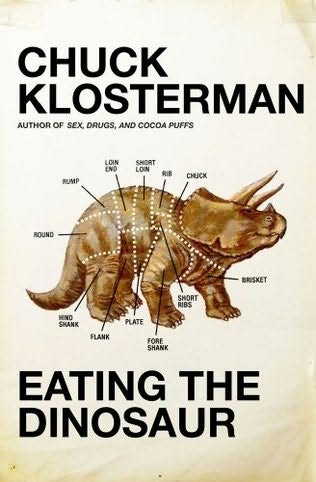 In Chuck Klosterman’s latest compilation of essays, Eating The Dinosaur, he pens an article entitled “Tomorrow Rarely Knows.” It is somewhat of a refresher course in time travel critique; geek-bait, essentially, designed to engross and compel sci-fi aficionados like myself. Although Klosterman is a critic of pop-culture, he is always at his best when writing about music. Therefore the most salient question posed by Klosterman here, is embedded within a footnote about Chuck Berry’s “Jonny B. Goode” halfway through the essay. Considering Back to the Future, Klosterman writes about how Michael J. Fox refers to “Johnny B. Goode,” as an “oldie.” Riffing on this idea he explains that in 1985 a twenty-seven year old rock song did qualify as an “oldie,” where paradoxically now no one would dare refer to Back to the Future, a twenty-four year old movie, an “oldie.” From this logic, Klosterman synthesizes:
“What seems to be happening is a dramatic increase in cultural memory: As culture accelerates, the distance between historical events feels smaller. The gap between 2010 and 2000 will seem far smaller than the gap between 1980 and 1970, which already seemed far smaller than the gap between 1950 and 1940.” (pg. 58)
Klosterman articulates two premises here, (1) There exists a cultural phenomenon in which people remember time in the past moving more slowly than it does in the present, and (2) This phenomenon occurs because culture accelerates. I take issue with the second premise – although I am uncertain of exactly what Klosterman means when he claims that culture is “accelerating,” I am confident that every possible explanation carries within it a set of presuppositions which are by their very nature determinist, teleological and ethnocentric. Most troubling is the idea that culture is ‘going’ somewhere, all progress is good progress. Culture is a metaphor used to describe a forever malleable set of material phenomenon, by constructing it as a quantifiable thing, Chuck projects a number of contemptible perspectives upon it.
Premise one however, is a much more interesting site for contemplation. Re-articulated: Why do some people remember time in the past as moving more slowly than it does in the present? My gut instinct is to argue that there is now a peculiar regime of nostalgia which delights in the rapid re-appropriation and re-articulation of all tangible media artifacts. Because recent changes in technology have made it so much easier to record, edit, splice, erase, duplicate, and distribute all media forms, we now live in a world where we are inundated by representations of the past all the time. This constant inundation is indicative of a growing cultural familiarity with past media ephemera and the subsequent changes in cultural bias. Do people even use the term “oldie,” anymore? Instead, descriptors like “retro” are used to accentuate the “cool” in instances of convergence-necromacy.
It is interesting that Klosterman constructs cultural memory through the ways that people remember music. It is therefore important to historicize the practice of listening within the history of audio technology. The 1980s historically mark the widespread dissemination of recording technology to the consumer market. This denotes a mnemonic shift, akin to the invention of writing or the printing press (Although I would argue that the printing press has more in common with the popularization of the Internet as a DIY publishing outlet). The cultural shift in language from “oldies” to “retro” has more to do with the sense of audio empowerment consumers have gained in the last twenty-four than Klosterman’s theory of cultural acceleration. It’s a shame also, Eating the Dinosaur contains Chuck’s best writing since Sex, Drugs and Cocoa Puffs.
AT


Share this:


Current Top Posts





April 2021

January 2020

November 2019

October 2019

August 2019

April 2014

November 2017

March 2015

December 2017

October 2015
 Sounding Out!
Recent Comments