Archive | Language RSS for this section

SO! Amplifies: Anne Le Troter’s “Bulleted List”
SO! Amplifies. . .a highly-curated, rolling mini-post series by which we editors hip you to cultural makers and organizations doing work we really really dig.  You’re welcome!

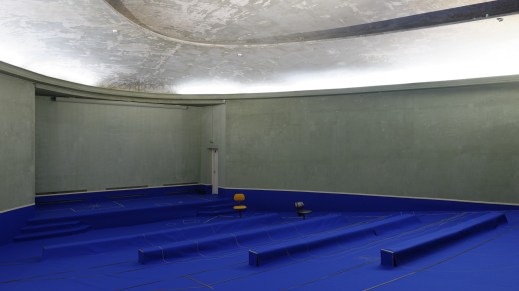
Nestled deep in a corner of Paris’ Palais de Tokyo, Anne Le Troter’s sound piece “Bulleted List” invites the museum’s visitors to explore the social similarities that people verbally express in response to cold calls. Le Troter’s first solo show to be on display in Paris, the work invites the audience to sit inside a modified cinema amphitheater as the sounds of recorded people answering survey queries echo throughout the sloped room. The seating arrangement inside the exhibition mirrors the cubicle-style setup of a call center, though each “station” consists solely of an outline designating where to sit and a coordinating amplifier. Both the questions and answers in the sound piece are produced by real survey callers; each voice sounds polished, poised and mechanized from years of vocal experience, revealing the automated nature that comes with the territory of making a scripted call. The result of each recorded voice unto the listener is akin to standing in the center of a symphony, with vocal patterns as punctuated as a visual, typographic list.

At the Palais de Tokyo I set up a play of light, a new element in my work, which gives visitors a time reference, even if they arrive half way through. Each broadcast is incidentally interspersed with a long silence to emphasize the idea of a session. This determines the attention span given to a work. The collective listening situation I find especially interesting because it reveals a set of patterns of behaviour, a whole language of bodies and eyes between the spectators. These micro-actions, just like the mental paratext of visitors and pollsters (those words that are not uttered but which ring out in our heads when we think or write), swell the work.  –Anne Le Troter, interview with Raphael Brunel
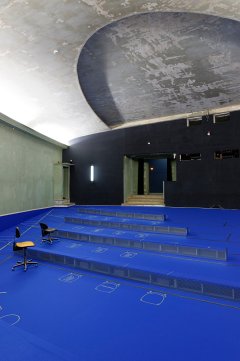
Still of Anne Le Troter’s “Bulleted List” at the Palais de Tokyo, image by author

The progression of sounds in the exhibition follow a distinct, if not choppy routine, with a clearly enunciated polling question asked — “What is your relationship status?” for example — followed by equally simplistic answers — “widowed,” “married” and “couple,” to note a few.   Reflective of the exhibition’s timely concurrence with the French presidential election, each of the questions asked in the sound piece culminates in a political questionnaire, with the same questions and answers being traded back and forth between people in all areas of the political spectrum — indicating that there are fewer differences between the various polling demographics and how they express their opinions than what appears at first glance.

“Bulleted List” opened at the Palais de Tokyo on Feb. 3, 2017, and will close on May 8.

Anne Le Troter was born in 1985 and currently lives in Paris. She graduated from the Geneva School of Art and Design in 2012, and her first solo shows were held at the Arnaud Deschin Gallery (Paris, 2016), BF15 (Lyon, 2015), Espace Crosnier (Geneva, 2015) and Espace Quark (Geneva, 2014). In 2016, she was awarded the Grand Prix at the 61st Salon de Montrouge.

Featured Image: Still of Anne Le Troter’s “Bulleted List” taken by the author

Shauna Bahssin is a sophomore at Binghamton University who double-majors in English and art history. She currently serves as the copy desk chief for the student newspaper, Pipe Dream, and has written for its news and arts and culture sections in the past. Outside of the paper, she is involved with the university’s fundraising initiatives through the Binghamton Telefund, and she hopes to work within the field of arts development and advancement after she graduates.

REWIND!…If you liked this post, you may also dig:

SO! Amplifies: Shizu Saldamando’s OUROBOROS

SO! Amplifies: Mendi+Keith Obadike and Sounding Race in America

Sound and Curation; or, Cruisin’ through the galleries, posing as an audiophiliac–reina alejandra prado

On Ventriloquism, Dummies, and Trump’s Voice

A few weeks ago, I wrote my dissertation’s epilogue on Trump as a ventriloquist’s dummy without a ventriloquist. At that point I was still ignorantly assuming that things wouldn’t go the way they did. I looked back at these words yesterday and was struck by what still resonated and what I got so, so wrong.
 .
***
Even a dummy can hear that the bygone “America” invoked by the current U.S. Republican presidential candidate Donald Trump’s popular slogan “Make America Great Again” is a resonant echo of the “America” lambasted by Richard and Willie’s radical vinyl ventriloquism in the era of the U.S. Bicentennial forty years ago. This fantasy “America”—as the black ventriloquist duo, alongside their inspiration Richard Pryor, pointed out in 1976—conveniently guts U.S. history, eliding the nation’s enduring legacies of genocide and slavery and shilling the myth of the country’s originary whiteness.
.

It is not, however, Trump’s campaign slogan that ultimately captivates the audiences—that “galvanizes the base,” as it were—of the much beloved and much ridiculed businessman, reality television star, and now, non-metaphorical politician. Rather, Trump’s appeal seems to stem from his propensity for “saying what we all want to say but can’t say.”  Indeed, Trump has positioned himself as a “voice,” as the voice, that will finally speak out against the “politically correct” discourse that has silenced “the American people”: “The forgotten men and women of our country—people who work hard but no longer have a voice: I am your voice,” he declared at the close of the 2016 Republican National Convention. The real estate mogul-cum-TV-star-cum-politician is famous for speaking off-script, for “telling it like it is,” for staging the vocalization of things that, in Jeff Dunham’s words, “you could never say out loud.”
 .
As my dissertation “Anachronism Effects: Ventriloquism and Popular Media” shows, Trump’s celebrated ability to speak the allegedly unspeakable is a key function of the ventriloquist’s dummy (a function that, it should go without saying, has been put to varying ends). What distinguishes Trump from the usual political puppets, however, is the absence of a discernible ventriloquist. For unlike George W. Bush, who was constantly relegated to Vice President Dick Cheney’s knee during the seemingly endless period of the former’s dubious presidential career, Trump appears beholden to no one, a horror movie ventriloquist’s dummy that uncannily operates on its own, like Corky Withers’ Fats.
.

As a dummy without a ventriloquist, Trump can, and does, make a point of accusing his rivals of dummification. At the RNC, he framed Hillary Clinton as “a ‘puppet’ of corporations and elites…[sure to] ‘keep our rigged system in place.’”  Paradoxically, this kind of accusation is extremely effective amongst his supporters, who, ironically, love him for exemplifying the puppet’s freedom to spout whatever invective comes to mind. Surely the politician’s words matter, but my own feeling is that it matters less what Trump says and more that he has cultivated the appearance of saying something, really anything, that otherwise cannot be said.
 .
A close examination of his actual language reveals that there is still so much left unsaid by this high-profile dummy, so much that remains implicit within the chaotic, yet fundamentally interpretable, stream of consciousness that appears to constitute his discourse (for a discussion of the codedness of Trumpean language, see Chris A. Smith, “How Politicians Talk About Race and Gender Without Talking About Race and Gender”).   After all, like Dunham, Trump will name “Mexicans,” “immigrants,” and “Muslims,” as personae non grata in his “America,” but there are other groups he fails to indict as vociferously. Indeed, there are still things that this dummy “can’t say,” confirming the fact that “political correctness” informs Trump’s language just as much as it does many other politicians’. What differentiates him from the rest of the lot is the reigning fantasy, held by those on the left as well as on the right, that his strings have been cut, that he performs as freely and divinely as a Kleistian marionette.

The powerful fantasy of unbridled speech that attends to Trump has equally captivated Democrats and Republicans, liberals and conservatives, those on the supposedly opposite poles of our dual-party system. This is why liberal arguments whose heft hinges on the things Trump has said, citing their lack of logic, their fascistic bent, et cetera, will have utterly no bearing on the man’s popularity. Trump’s pull arises from his vocalization’s appearance as unfettered. And Trump well knows this, which is why he flouts teleprompts and cues, debate preparation, and “party lines.” His act may, as ventriloquist acts often do, end up going badly. My point, however, is that its allure is less about language and more about voice.

In a recent Washington Post article in early 2016, journalist Kevin Guo analyzed Trump’s accent, writing that
Trump’s supporters often praise how the politician gives voice to harsh truths. But that voice itself, that unmistakable instrument, has been a noteworthy element of Trump’s populist image. Though he grew up in privilege…Trump never shed his Queens accent. Today, that accent helps him summon the stereotype of the blunt, no-nonsense New Yorker.
The reporter has a point, that Trump’s accent, his New York inflection, makes him sound no-bullshit, even pragmatic, in spite of the politician’s immense wealth and privilege. Yet the analysis only goes so far. For the “forgotten” Americans to whose unspeakable longings Trump claims to give voice are largely not New Yorkers with Queens accents. (As an aside: Bernie Sanders undoubtedly also emits New York-accented speech, and though the two politicians’ bases have had some overlap, they generally have not appealed to the same constituencies.)
 .
Trump’s effectiveness, then, lies not in his language or even his “no-nonsense” accent, but in what communications scholar Jennifer Mercieca has identified as the rhetorical strategy of “paralipsis” in “How Donald Trump Gets Away With Saying Things Other Candidates Can’t.”  Writes Mercieca, “paralipsis…enables [Trump] to publicly say things he can later disavow,” later defining the Greek term as “(para, ‘side’ and leipein, ‘to leave’)…leave to the side.”  Once again, we must observe that “leaving to the side” is precisely what ventriloquism enacts, placing dummy alongside ventriloquist so that the former can say what the latter “can’t.” In Mercieca’s reading, Trump is both ventriloquist and dummy, able to speak the unspeakable in one voice and disavow that spoken unspeakable in a voice materially identical to the first.
 .
That Trumpism is ventriloquism, and not just in the metaphorical sense, has not gone lost on Terry Fator, who, as an actual ventriloquist and a proud Trump supporter, has been open about his appreciation of the politician’s artistry. “I’m a huge Trump fan,” he crowed on Fox News in May of 2016, affirming that he and his wife will vote for the politician come the 2016 presidential election. Fator appeared alongside a new puppet—a larger-than-life, toupee-crowned Trump dummy he recently added to his Vegas repertoire.
.

“With somebody as colorful as Trump,” the ventriloquist began, “—and I don’t do anything derogatory,” he continued, cutting himself off mid-sentence, as Trump himself might have done. “It’s all fun,” Fator went on, “it’s like, you know, the hair,” he said, then doffing the puppet’s orange mop. “I don’t really do political humor,” he continued, “but really it’s how does Trump feel about something…. So I’m not making a political statement in my show; I’m letting Trump say what he feels about something….” After a few moments’ more banter with anchor Sean Hannity, Fator let Trump “say what he feels,” which amounted, quite simply, to the phrase “I’m gonna make Mexico pay for it!,” at which point Fator had the puppet sing a few bars from Pink Floyd’s “The Wall.”
 .
Awkwardly, and for a few moments too long, Hannity laughed. The dummy hadn’t said much of “what he felt” about anything. He’d simply repeated Trump’s speech, like a broken record.
 Featured Image: Screen Capture by SO! Ed. JS
Sarah Kessler is a recent Ph.D. in Comparative Literature at the University of California, Irvine.  She received an M.A. in Modern Studies from the University of Wisconsin-Milwaukee in 2008. Kessler’s writing on art, film, and media has appeared in artforum.com, the Brooklyn Rail, In These Times, and Public Books, among other publications, and she has held editorial positions at Triple Canopy and Afterall: A Journal of Art, Context and Enquiry

tape reelREWIND!…If you liked this post, you may also dig:

Karaoke and Ventriloquism: Echoes and Divergences--Sarah Kessler and Karen Tongson

“Hearing Queerly: NBC’s ‘The Voice’”-Karen Tongson

Sound and Sanity: Rallying Against “The Voice”–Mark Brantner