
Listening to the City of Light: An interview with Sound Recordist Des Coulam

How should we take account of, question, describe what happens every day and recurs every day: the banal, the quotidian, the obvious, the common, the ordinary, the infra-ordinaire, the background noise, the habitual?
I’m meeting with the British sound recordist Des Coulam at the brasserie La Coupole on the Boulevard de Montparnasse in Paris. “Just imagine…this place opened in 1927. If you installed a microphone in the middle of this room in 1927 and if it was still there today, how many interesting things could you have recorded in this place? It just begs belief, doesn’t it? François Mitterrand, Picasso, Ford Maddox Ford, Beauvoir, Man Ray, they were all here. They all echo in these walls.”
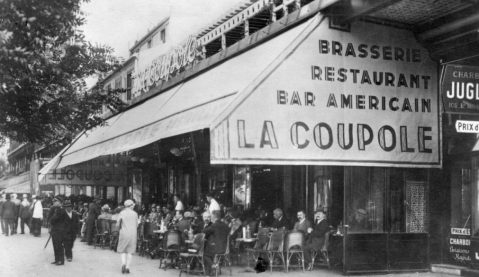
Early photo of La Coupole, date unknown
The sound inside La Coupole by Des Coulam
Des Coulam has been capturing the urban soundscape of Paris for almost ten years. Paris is a city full of mirrors, replicating itself through various mediums. A great archive of the city and its streets, boulevards, arcades and cafés has been written, painted, filmed and photographed throughout the 19th and 20th centuries. However, its aural history is less documented.
“All the archival sounds you find of Paris are adjunct to pictures, so you’ve got television pictures, you’ve got film, you’ve got very few actual recordings of Paris, and I wanted to capture the contemporary soundscape of the city and archive it for future generations to explore, study and enjoy,” explains Coulam. “It’s only on the last few seconds on our historical clock that we’ve been able to capture and archive sounds, so most of our sonic heritage is passed by completely unrecorded. We can get an idea of what nineteenth, eighteenth, and seventeenth century sounds were like from literature and from art in some cases. But the fact is we can’t actually listen to them. All the sounds we hear came from somebody’s imagination.”
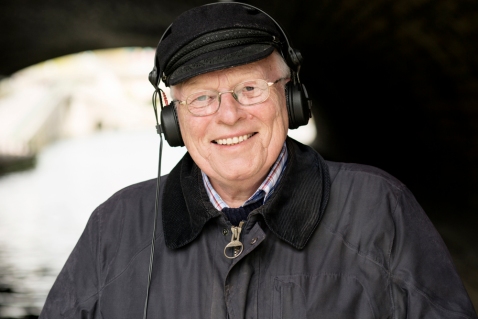
Des Coulam, Image courtesy of interviewee.
Coulam’s methodical approach and commitment to the task of recording the sounds of Paris, almost on a daily basis, is helping to create the first comprehensive sound archive of the city. These sounds constitute the Paris Soundscapes Collection and are being archived in the British Library of London.
“Memorable recordings are not limited by your equipment, only by your imagination”
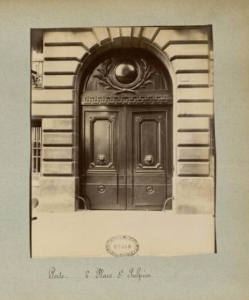
Porte 6, Saint Surplice, Courtesy of Interviewer
“And people forget that,” laments Coulam. “I mean, listening is an art and it’s an art that must be learned. You have to practice, practice, practice to listen. But once you master the art it opens up an all-new world. Because for me, if you give sounds the opportunity to breathe and to speak, they all have a story to tell. We walk along the street and hear a sound and you think: what is that? And you can create a story the sound is telling you. You might hear one of these big Parisian doors bang. What’s behind that door? How many interesting people have walked through that door? And you start to see or experience the place differently.”
Sounds inside l’Eglise Saint-Gervais-Saint-Protais (w/creaking wooden door) by Des Coulam
Des Coulam is of the opinion that the ability to tune into sounds with an inquisitive and imaginative mind can provide better recordings than the most expensive equipment. It’s a skill that he has been developing for over 50 years. “I can tell you the exact day. It was the 25th of December, 1958 when I woke up on Christmas morning and found a tape recorder. And if you had asked me to write a list of 100 things I wanted for Christmas, the tape recorder would not have featured in it. But there it was and I fell in love with it instantly and stayed in love with it ever since. It turned something on in my head that stayed with me all my life. I was 10 years old and now I’m almost 70 years old…I don’t know what I would do without it. I would probably just curl up and die or something…Because now it consumes all of my life. I work seven days a week, but it never feels like work. It’s just fun.”
An aural flâneur in a changing city
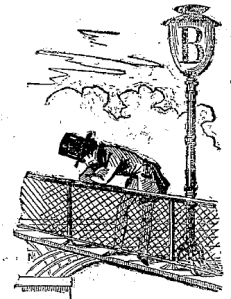
Image from Louis Huart, Physiologie du flâneur (1841)
“Some of my best recordings have come serendipitously when they are not planned.” Most of the time Coulam doesn’t adhere to a strict pathway through the streets of Paris. He follows the background city sounds as someone who follows a river stream. He describes himself as an aural flâneur. The term flâneur (stroller, idler, walker) dates back to the 16th century and was made popular by Walter Benjamin in his 1935 essay “Paris, Capital of the Nineteenth Century” in The Arcades Project. “I’m doing exactly what the 19th century flâneurs did. Observing, that’s all I do. But I observe through sound rather than visually,” says Coulam. “The one thing the flâneur had was time. They had the time to stroll around the streets and observe the everyday life. But in my case I observe listening.” According to Aimée Boutin, the author of City of Noise: Sound and Nineteenth-Century Paris, it is in the writings of Balzac, Louis Huart and Victor Fournel that the flâneur emerges as an attentive listener, an eavesdropper and collector of stories who views the city as a musical score and as a cacophonous/harmonious concert.
19th century images of the flâneur predominately evoke a white male figure of means and privilege who observes and listens to the city from a position of detachment towards the crowd. He is invested in his own anonymity and imagines himself cultivating a sense of neutrality and “objectivity.” Coulam’s active listening practices depart from this perspective by challenging his perspectives and owning the subjectivity of the recording and archiving process. “The way you hear sound changes depending on the circumstances and also the way you interpret sound is different. You and I could walk down the same street and hear it differently. I can walk down the same street twice and hear it differently. There are lots of sounds that I will hear and there are lots of sounds that I won’t hear.” In a recent blog entry Coulam writes that while being “aware that sounds don’t exist in a vacuum, I am always thinking about the social, cultural and historical context of the sounds I find and that has taught me how to explore and appreciate the rich history, complexity and diversity that is Paris.”
Besides his own recordings of the Parisian soundscapes, Coulam has been adding new aural narratives of the city in the series “Paris – A Personal View” inviting guests who live in Paris to visit a place in the city that has a special meaning for them. In this series, Coulam often features the city of the contemporary flâneuse, a radically different form of flâneurie through the steps of the walking woman. In the audio bellow, Monique Wells, an expert on African Diaspora in Paris and founder of the non-profit association Les Amis de Beauford Delaney, explores her favorite place in the city – the Jardin du Luxembourg.
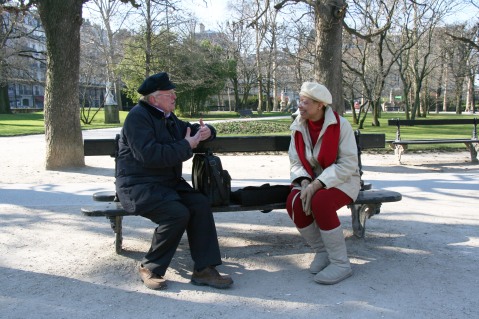
Des Coulam and Dr. Monique Wells, image courtesy of interviewee
Monique Wells, Jardin du Luxembourg, “Paris – A Personal View” Series by Des Coulam
This is a particular time to be listening to the city as a new plan to expand the metropolis of Paris is on its way. “Paris is on the cusp of a huge change. If we look at the history of Paris, it is a history of circles. So you get start with the Romans who invaded and camped out on the Île de la Cité. What did they do? They built a wall around it. And over the years as Paris expanded more walls have been built around the city until today. Now, you’ve got this wall of traffic – the périphérique – and everything within that is Paris and everything without is the suburbs. Nicolas Sarkozy decided, when he was president, that he was going to demolish this invisible wall between Paris and the suburbs. So he gave birth to the Greater Paris Project which is now going ahead. So over the next 10, 20 or 30 years the visual landscape of the city will change and also its sound landscape. And this is a perfect time to capture that change. I won’t live long enough to see it all but I’m already seeing some of it. And what you have right now is that some sounds of Paris are actually disappearing, some are about to disappear, some have stayed remarkably the same and new sounds have appeared.”
Sounds around the Pont National (near Boulevard Périphérique) by Des Coulam
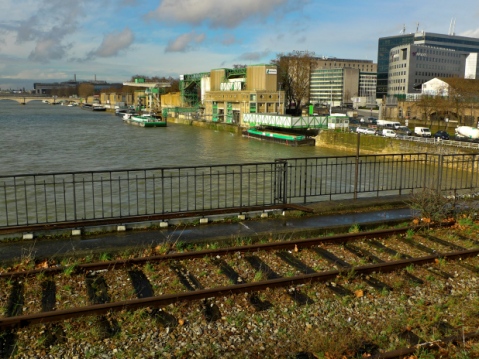
Pont National by Des Coulam
The Vanishing Sounds of Paris
The changes in the visual landscape of Paris and the modernization of its infrastructures will cause a significant change in its soundscape. For instance, Coulam dedicates a lot of his time to recording the changes of the subterranean and aerial soundscape of the Parisian metro lines. “The sounds of the Metro are changing dramatically. If you imagine the sounds of the Paris Metro, you immediately get this picture of the sort of 1950s black and white film, you can hear the sounds of the train rattling over the lines. It’s gone, it’s all completely gone. The last of those trains disappeared in 2012. And I knew this was happening so I recorded a lot of metro line 5 where the old trains were. So I’ve got a stack of recordings of those because nobody else was doing it.”
Sounds of Line 5 at Quai de la Rapée by Des Coulam
“That lovely rattle, these clanking rattling sounds. Just what you imagine it to be!” The old trains on line 5 are now being replaced by modern models with a quieter sound. Also, the trams that covered the city in the 1930s were later substituted by motorized buses. “There are no trams in the center of the city but you’ve got them on the periphery now. There are 8 tram lines. On a lot of the routes they actually go through lot of pains to reduce the amount of noise the tram makes by putting grass down between the tram lines to absorb the sound. So that’s a completely different soundscape than you would have had in this case in the 1930s.”
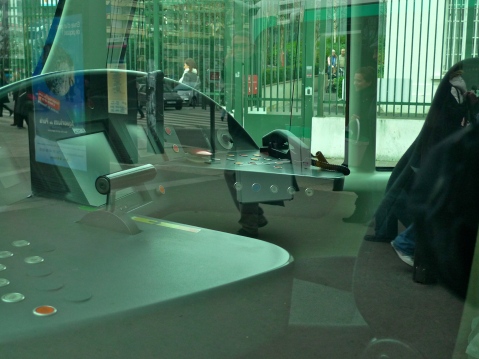
Tram by Des Coulam
Inside a tram on Line T2 from the station Henri Farman to Porte de Versailles by Des Coulam
Coulam has been recording the sounds of the Gare du Nord, one of the six main railway stations in Paris, that is going through some transformations right now. A sign outside the station in the construction zone promises “a brighter and more practically designed hall for enlightened travelling”. The distinctive soundscape of the Gare will certainly change. A new type of pavement is enough to alter the echoing sounds made by footsteps and rolling suitcases.
Inside the Gare du Nord; October 2016
“But on a more human level,” says Coulam, “the street criers, the vagabond man, the knife grinders, people like that who used to come around shouting in the street are completing gone. The only thing you find now are the market traders in the market stores, but you don’t find any of these tradesmen in the streets of Paris.”
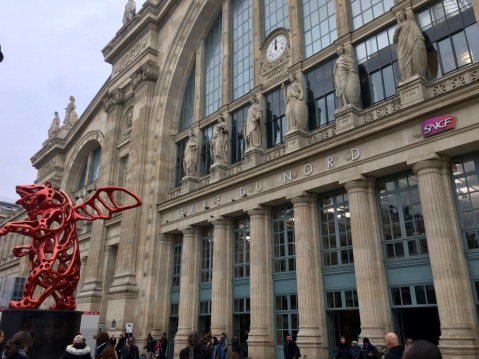
Gare du Nord by Des Coulam
“An attempt to exhaust a place in Paris” in sound
“The only time you really notice the urban soundscape is when isn’t there,” remarks Coulam. On the day we meet, Montparnasse is eerily quiet. There is little traffic and only a few pedestrians are strolling along the Boulevard. “The soundscape you hear is not the normal Montparnasse because this is August and everybody is away on holiday, so you are immediately struck by the relative quiet around here.” It might be difficult to find places of quiet in a city like Paris during the other eleven months of the year.
But even the noise, the chatter and the rumble are important parts of the urban soundscape. “The biggest challenge I face recording the soundscape of Paris is the sound of traffic, and I long ago decided that you couldn’t ignore it. And in a sense, why should you? Because it’s an integral part of the soundscape, so to ignore it is a sort of cheating, really. So, I decided to embrace it and I started to deliberately record traffic and it was absolutely fascinating!”
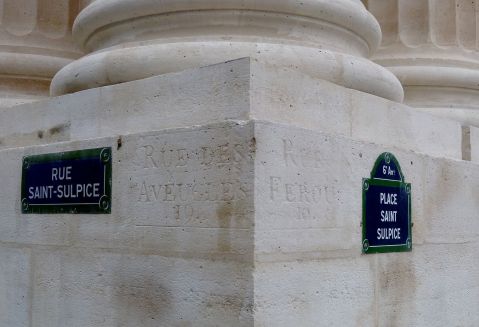
Place Saint Sulpice, courtesy of Wikicommons
The author and filmmaker George Perec once sat down for three days in Saint-Sulpice Square to write down all the non-events around him. “What happens, when nothing happens other than the weather, people, cars, and clouds?” asked Perec. In the same vein, Coulam continues recording the sounds that constitute the backdrop to everyday life and through attentive listening, he weaves the sound tapestry of the city of Paris. “You sit on a Parisian green bench in a busy narrow pavé street and just let the street walk past you. You will hear fabulous sounds.”
“An attempt to exhaust a place in Paris” in sound (Café de la Mairie, Place Saint-Sulpice) by Des Coulam
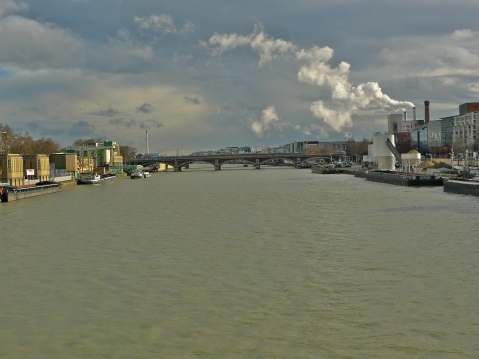
Pont National from the Pont de Tolbiac by Des Coulam
You can hear Des Coulam’s collection of Parisian soundscapes at Soundlandscape or follow him on twitter.
—
Featured Image: Line 5 at Quai de la Rapacca, Image by Des Coulam
—
Carlo Patrão is a Portuguese radio artist and producer of the show Zepelim. His radio work began as a member of the Portuguese freeform station Radio Universidade de Coimbra (RUC). In his pieces, he aims to explore the diverse possibilities of radiophonic space through the medium of sound collage. He has participated in projects like Basic.fm, Radio Boredcast, and his work has been featured in several international sound festivals and has also been commissioned by Radio Arts (UK). He is currently working on a radio show for the Portuguese national public radio station RTP. In addition to his work in radio, he has a master’s in clinical psychology
—
 REWIND! . . .If you liked this post, you may also dig:
Playing with Bits, Pieces, and Lightning Bolts: An Interview with Sound Artist Andrea Parkins — Maile Colbert
(Sound)Walking Through Smithfield Square in Dublin— Linda O’Keeffe
Sounding Our Utopia: An Interview With Mileece— Maile Colbert
Share this:

A Medieval Music Box: the Cantigas de Santa María as Sound Technology in the Age of Alfonso X

 Each of the essays in this month’s “Medieval Sound” forum focuses on sound as it, according to Steve Goodman’s essay “The Ontology of Vibrational Force,” in The Sound Studies Reader, “comes to the rescue of thought rather than the inverse, forcing it to vibrate, loosening up its organized or petrified body (70). These investigations into medieval sound lend themselves to a variety of presentation methods loosening up the “petrified body” of academic presentation. Each essay challenges concepts of how to hear the Middle Ages and how the sounds of the Middle Ages continue to echo in our own soundscapes.
The posts in this series begins an ongoing conversation about medieval sound in Sounding Out!. Our opening gambit in April 2016, “Multimodality and Lyric Sound,” reframes how we consider the lyric from England to Spain, from the twelfth through the sixteenth centuries, pushing ideas of openness, flexibility, and productive creativity. We will post several follow-ups throughout the rest of 2016 focusing on “Remediating Medieval Sound.” And, HEAR YE!, in April 2017, look for a second series on Aural Ecologies of noise! –Guest Editors Dorothy Kim and Christopher Roman
–
At a first glance, one might think the sounds of the Middles Ages unrecoverable from the fragmented yet abundant ruins of the past. The voices, noises, melodies seem lost to the present, casting the efforts to reconstruct matters of medieval sound as speculation. However, medieval peoples actually preserved copious traces of their efforts to produce the thing closest to contemporary sound recordings: comments, writings, treatises, music notation, verbal descriptions, music instruments and even architectural design in the name of sound. Testaments of such efforts– forgotten amplifiers resisting time’s erasure–appear in the form of one of the greatest and revolutionary accomplishments of the ten centuries comprising the Middle Ages: the development of the codex. Coupled with the meticulous treatment of writing, the codex ushered in a number of innovations slowly introduced in matters of script, binding, development of materials, the re-thinking of the function and design of the library, and others. During this expansive time, the topic of memory was linked to writing and its repositories as supportive instruments in an active way (Carruthers). Key to our discussion here, these developments greatly assisted melody, rhythm, the production of music in general, particularly through the slow creation of the written devices and symbols that eventually turned into music notation.
Alfonso X, King of Castile in the 13th century, set to participate in the stream of cultural reflections and productions about music and sound in the Middle Ages. One of his main works, the Cantigas de Santa María (sourced from here and here), is an awe-inspiring cultural monument, not only for its representation of monarchical values in Castile, but because it provides evidence of all of the efforts toward the careful attention to writing and music, and their links to matters of religious devotion. Among the topics carefully interwoven in the visual, written and musical registers of the Cantigas is a depiction of the culture of the kingdom of Castile and the Iberian Peninsula in the 13th century. Alfonso’s representations of Christians, Jews and Moors as part of the population affected by the presence and constant intervention of the Virgin sets his codices apart as unique examples of what some critics have proposed to see as the world of convivencia, a form of social organization in which collaboration and tolerance between peoples belonging to different cultural frames took place (Américo Castro).

A depiction of Alfonso’s scriptorium.
The Cantigas de Santa María is better defined as the cluster of four extant manuscripts, written in Galician-Portuguese, that display similar functions, design, topics, and organization (Fernández). As a whole, the Cantigas is the concerted effort to produce a body of materials for devotion to the Virgin Mary on behalf of King Alfonso, a multimedia, multidimensional, and a discursively multivalent groups of codices or manuscripts each organized in what John E. Keller calls the threefold method: lyrics/poetry, miniatures, and music notation. Of the extant codices, the Codex that is best known for being the most finished—as well as for the richness of the work of miniatures—is the Codex Rico, the basic codex from which I use examples in this article.
While there are plenty of critical comments and approaches to the Cantigas in terms of its poetic composition and content, as well as its miniatures or illustrations, the most puzzling element of its study remains its “sound.” There have been several efforts to analyze the music notation and tradition in the Cantigas from different viewpoints. Julián Ribera and Higinio Anglés, for example, attempted to produce a transcription of its music notation. Others, such as Hendrik van der Werf, made great efforts to analyze the particularities of the music notation and the interpretation of rhythm. However, musicologists maintain that we still need better working tools to interpret the music with full consideration of the information in the codices, as well as the points of contact and variations of music and lyrics from one of the codices to the other (Ferreira). As we work toward coordinating such a project, we still have several elements to work with to hear and interpret sound in the Cantigas.
To listen to the Cantigas, the reader/spectator/listener can begin by addressing the codices’ composition and construction. The texts not only offer a vast repertory of songs with music notation, but they also make use of miniatures to comment on the topics of sound and music. The codices are self-reflexive, which means that they make constant reference to their own construction and production. In this way, the texts challenge the reader/spectator/listener to consider the multiple layers of construction and meaning. For example, consider the definitions and views of sound and music exposed by the Cantigas. Here, the word “cantiga” is usually understood as either a song or short poem set to music, mostly about love, following the vocabulary of medieval courtly tradition (Parkinson). By the 12th century, the kingdoms to the north of the Iberian Peninsula had developed a lyrical form associated with courtly tradition known as the Cantigas d’amigo, written in Galician Portuguese, and linked to the troubadour tradition. The Cantigas appear to follow this tradition directly, suggesting the title references the form as well as the content of its lyrics. Therefore, the title Cantigas refers to the poetical conventions structuring the expression of devotion to a lady—most of the poems follow a particular structure of stanzas followed by a refrain—and it also signals the sound of such devotion.

A codex. Image borrowed from e-codices @Flickr CC BY-NC.
So how to describe the sound of the cantigas? What would the medieval reader/spectator of the codex understand just by looking at the music notation, poetic structures, illustrations and miracles about the role of sound, music, and voice as well?
For one thing, the miracles, miniatures or illustrations—as well as the music notation from one cantiga to the other—supply an excess of information. The codices present Jewish characters, heavy hints of the influence of Hispanic-Arabic poetic and music traditions (such as “rhythmic patterns from the muwashshah,” according to Manuel Pedro Ferreira, miracles from the Provençal tradition, Galician-Portuguese poetic structures and music, troubadour topics, the identification of melodies from secular traditions, profane music, and religious motifs. All of these together suggest that the reader/spectator/listener of the cantigas would have been expected to know at least a little of each of these elements.
The contemporary identification of these layers of information has led Cantigas scholars to hypothesize on the possible performance of its music. Research shows agreement on the folowing: the expression of clear melodic lines; the use of mensural notation (the system for European vocal polyphonic music used from the later part of the 13th century until about 1600); the interpretation of rhythm depending on the poetic structure and melodies of each poem; the use of melismas—runs of notes made from one syllable—and their function in performance; and the impossibility of interpreting the use of pitch. This last feature renders any attempt to reconstruct and perform the full range of the codices’ music virtually impossible. Any contemporary performance works as an exercise of imagination, an active effort to fill in the blanks of what may be described as an ambitious and extensive archive of and about music in the Iberian Peninsula of the 13th century.

Cantiga 8.
In the meantime, prospective listeners of the Cantigas’ music may still reflect on how it comments and represents the function of music and sound: from love and religious devotion, to entertainment, spiritual transformation. Its authors represent music as both skill and gift. Furthermore, as the following brief and striking examples show, many other sounds are encoded in the texts: voices, screams, streams, demands, prayer and cries. Cantiga 8 is about a Minstrel from Rocamadour who dedicates his songs to a statue of the Virgin Mary (fols. 15r-15v). He prays to her that she may give him a candle from the church. The Virgin is so pleased with his dedication that she makes a candle to rest on his “viola” (fiddle). A monk, unbelieving of the miracle, takes the candle away and accuses the minstrel of using magic. The miracle takes place for a second time, causing the monk to repent and join the minstrel and others in devotion. This may seem like a simple story of the values of faith communities, however the Cantigas underscores the role sound plays in devotion, through the minstrel’s voice and performance with his music instrument:
“que mui ben cantar sabía / e mui mellor vïolar ( fol. 15r, line 10).
(“…as he knew how to sing very well / and to fiddle even better”)
Moreover, the disbelieving monk is described as having understood his error as “aqueste miragre viu” (by “seeing” this miracle) and “entendeu que muit errara,” which may be translated as “understanding that he was in error.” However, in Portuguese, the verb “entender” (to understand) is also associated with the notion of understanding through auditory perception.

Cantiga 89.
Another example of the role of sound in Alfonso’s project is found in Cantiga 89 (fols. 130r-131r). This cantiga is about a Jewish woman who experiences a difficult childbirth. In the middle of the delivery of her baby, she hears a voice asking her to pray to the Virgin. As she moans and cries, she finds the strength to pray aloud to request the Virgin’s help. The poem stresses the quality of the sound of the laboring woman in the description of her suffering:
“Ela assi jazendo / que era mais morta ca viva / braadand’e gemendo/ echamando / sse mui cativa, / con tan gran door esquiva” (fol. 130v, lines 20-25).
(As she lay in this condition/ for she was more dead than alive / screaming and moaning / calling herself unfortunate / with great pain).
The Virgin helps the Jewish woman, who decides to convert to Christianity at the end of the cantiga. The text underscores the role of voice in both the spiritual intervention of the Virgin, but also in the human experience of pain and prayer.
Lastly, Cantiga 103, is about a monk who listened to a bird’s song for three hundred years (fols. 147v-148v). The monk asks the Virgin to let him glimpse paradise before dying. After hearing his prayer, however, the Virgin grants him not a view of paradise, but the sensation of its sounds:
“Tan toste que acababa ouv’o o mong’ a oraçon, / oyu ha passarinna cantar log’ en tan bon son, / que sse escaeceu seendo e catando sempr/ alá” ( fol. 148r, lines 23-25).
(“As soon as he finished his prayer / he heard a small bird sing with such a nice song / that he forgot about everything else remaining in the place forever”)
Three hundred years pass, and suddenly the monk remembers to return to his monastery. He finds everything there transformed. After telling his story, everyone shares the wonder of the miracle praising the Virgin. This text suggests a different appreciation of “paradise” not through the notion of “vision” but through aurality, the description of the spiritual well being as a sonic experience.

Cantiga 103.
This small sampling from cantigas underscores the value of voice, noise, and music as part of human experience, as central in the experience of religious devotion, and as transformative for the communities represented in the codices. King Alfonso strove to create a library containing all the knowledge available to his world. Additionally, he strove to participate actively in—and innovate—contemporary forms of knowledge production. In many ways, the Cantigas, function as a music box, its folios documenting multiple forms of sonic information, making available the experiences, values, soundscapes, and medieval ways of hearing/listening, or the aurality of the Middle Ages.
—
Featured image “girl laugh #10” by danor sutrazman @Flickr CC BY.
—
Marla Pagán-Mattos earned her doctorate in Comparative Literature and Literary Theory at the University of Pennsylvania. Her research interests include medieval literature, Iberian medieval history and literature, literary theory, and sound culture. She has taught at the University of Pennsylvania, Haverford College, and is currently teaching in the Department of Comparative Literature at the University of Puerto Rico.
—
 REWIND! . . .If you liked this post, you may also dig:
Introduction: Medieval Sound–Dorothy Kim and Christopher Roman
“Playing the Medieval Lyric”: Remixing, Sampling and Remediating “Head Like a Hole” and “Call Me Maybe”–Dorothy Kim
Mouthing the Passion: Richard Rolle’s Soundscapes–Christopher Roman
Share this:


Current Top Posts





April 2021

January 2020

November 2019

October 2019

August 2019

April 2014

November 2017

March 2015

December 2017

October 2015
 Sounding Out!
Recent Comments