
Musical Objects, Variability and Live Electronic Performance

This is part two of a three part series on live Electronic music. To review part one, click here.
In the first part of this series,”Toward a Practical Language for Live Electronic Performance,” I established the language of variability as an index for objectively measuring the quality of musical performances. From this we were able to rethink traditional musical instruments as musical objects with variables that could be used to evaluate performer proficiency, both as a universal for the instrument (proficiency on the trumpet) and within genre and style constraints (proficiency as a Shrill C trumpet player). I propose that this language can be used to describe the performance of electronic music, making it easier to parallel with traditional western forms. Having proven useful with traditional instruments we’ll now see if this language can be used to describe the musical objects of electronic performance.
We’ll start with a DJ set. While not necessarily an instrument, a performed DJ set is a live musical object comprised of a number of variables. First would be the hardware. A vinyl DJ rig consists of at least two turntables, a mixer and a selection of vinyl. A CDJ rig uses two CD decks and a mixer. Serato and other vinyl controller software require only one turntable, a mixer and a laptop. Laptop mixing can be done with or without a controller. One could also do a cassette mix, reel to reel mix, or other hardware format mixing. Critical is a means to combine audio from separate sources into one uniform mix. Some of the other variables involved in this include selection, transitions and effects.
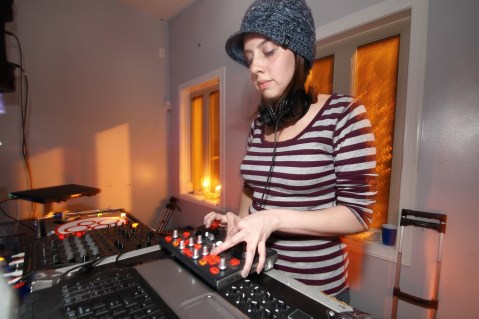
DJ Lush, FORWARD Winter Session 2012, Image by JHG Photography (c)
Because DJ sets are expected to be filled with pre-recorded sounds, the selection of sounds available is as broad as all of the sounds ever recorded. Specific styles of DJ sets, like an ambient DJ set, limit the selection down to a subset of recorded music. The choice of hardware can limit that even more. An all-vinyl DJ set of ambient music presents more of a challenge, in terms of selection, than a laptop set in the same style, because there are fewer ambient records pressed to vinyl than are available in a digital format.
Connected to selections are transitions, which could be said to define a DJ. When thinking of transitions there are two component factors: the playlist and going from one song to another. The playlist is obviously directly tied to the selection; however, even if you select the most popular songs for the style, unless they are put into a logical order, the transitions between them could make the set horrible.
One of the transitional keys to keeping a mix flowing is beat matching. In a turntable DJ set the beat mapping degree of difficulty is high because all of the tempos have to be matched manually by adjusting the speed of the two selections on the spinning turntables. When the tempos are synchronized, transitioning from one to the other is accomplished via a simple crossfade. With digital hardware such as the laptop, Serato and even CDJ setups, there is commonly a way to automatically match beats between selections. This makes the degree of difficulty to beat match in these formats much lower.
Effects, another variable, rely on what’s available through the hardware medium. With the turntable DJ set, the mixer is the primary source of effects and those until recent years have been limited to disc manipulation (e.g. scratching), crossfader, and EQ effects. Many of the non vinyl setups and even some of the vinyl setups now include a variety of digital effects like delay, reverb, sampler, granular effects and more.
With these variables so defined it becomes easier to objectively analyze the expressed variability of a live DJ set. But, while the variables themselves are objective, the value placed on them and even how they are evaluated are not. The language only provides the common ground for analysis and discussion. So the next time you’re at an event and the person next to you says, “this DJ is a hack!” you can say, “well they’ve got a pretty diverse selection with rather seemless transitions, maybe you just don’t like the music,” to which they’ll reply, “yeah, I don’t think I like this music,” which is decent progress in the scheme of things. If we really want to talk about live electronic performance however we will need to move beyond the DJ set to exemplify how this variable language can work to accurately describe the other musical objects which appear at a live electronic performance.

Joe Nice at Reconstrvct in Brooklyn NY on 2-23-2013, Photo by Kyle Rober, Courtesy of Electrogenic
Take for example another electronic instrument: the keyboard. The keyboard itself is a challenging instrument to define; in fact I could argue that the keyboard is itself not actually an instrument but a musical object. It is a component part of a group of instruments commonly referred to as keyboards, but the keyboard itself is not the instrument. What it is is one of the earliest examples of controllerism.
On a piano, typically fingers are used to press keys on the keyboard, which trigger the hammers to hit the strings and produce sound. The range of the instrument travels seven octaves from A0 to C8, and can theoretically have 88 voice polyphony, though in typical that polyphony is limited to the ten fingers. It can play a wide range of dynamics and includes pedals which can be used to modify the sustainabilty of pitches. With a pipe organ, the keyboard controls woodwind instruments with completely different timbre, range, and dynamics; the polyphony increases and the foot pedals can perform radically different functions. The differences from the piano grow even more once we enter the realm where the term “keyboard,” as instrument, is most commonly used: the synthesizer keyboard.
The first glaring difference is that, even if you have an encyclopedia of knowledge about keyboard synthesizers, when you see a performer with one on stage you simply cannot know by seeing what sounds it will produce. Pressing the key on a synthesizer keyboard can produce an infinite number of sounds, which can change not just from song to song, but from second to second and key to key. A performer’s left thumb can produce an entirely different sound than their left index finger. Using a keyboard equipped with a sequencer, the performer’s fingers may not press any keys at all but can still be active in the performance.

Minimoog Voyager Electric Blue, Image by Flickr User harald walker
When the keyboard synthesizer was first introduced, it was being used by traditional piano players in standard band configurations, like a piano or organ, with timbres being limited to one during a song and the performance aspect being limited to fingers pressing keys. Some keyboardists however used the instrument more as a bank for sound effects and textures. They may have been playing the same keys, but one wouldn’t necessarily expect to hear a I IV V chord progression. Rather than listening for the physical dexterity of the player’s fingers, the key to listening to a keyboard in this context was evaluating the sounds produced first and then how they were played to fit into the surrounding musical context.
Could one of these performers be seen as more competent than the other? Possibly. The first performer could be said to be one of the most amazing keyboard players in the piano player sense, but where they aren’t really maximizing the variability potential of the instrument, it could be said they fall short as a keyboard synthesizer performer. The second performer on the other hand may not even know what a I IV V chord progression is and thus be considered incompetent on the keyboard in the piano player sense, but the ways in which they exploit the variable possibilities shows their mastery of the keyboard synthesizer as an instrument.
Well, almost.
While generally speaking there isn’t a set of variables which define the keyboard synthesizer as an instrument, if we think of the keyboard synthesizer as a group of musical instruments, each of the individual types of keyboard synthesizers come with their own set of fixed variables which can be defined. Many of these variables are consistent across the various keyboards but not always in a standard arrangement.
As such, while the umbrella term “keyboard” persists it is perhaps more practical to define the instruments and their players individually. There are Juno 60 players, ARP Odyessy players, MiniMoog players, Crumar Spirit players and more. Naturally an individual player can be well versed in more than one of these instruments and thusly be thought of as a keyboardist, but their ability as a keyboardist would have to be properly contextualized per instrument in their keyboard repertoire. Using the MiniMoog as an example we can show how its variability as an instrument defines it and plays into how a performance on the instrument can be perceived.

Minimoog, Image by Flickr User Francesco Romito
The first variable worth considering when evaluating the MiniMoog is that it is a monophonic instrument. This is radically different from the piano; despite one’s ability to use ten fingers (or other extremity) only one note will sound at one time. The keyboard section of the instrument is only three and a half octaves long, though the range is itself variable. On the left-hand side there is a pitch wheel and a modulation wheel. The pitch wheel can vary the pitch of the currently playing note, while the modulation wheel can alter the actual sound design.
As a monophonic instrument, one does not need to have both hands on the keyboard, as only one note will ever sound at a time. This frees the hands to modify the sound being triggered by the keyboard exemplified via the pitch and modulation wheels, but also available are all of the exposed controls for the sound design. This means that in performance every aspect of the sound design and the triggering can be variable. Of course these changes are limited to what one can do with their hands, but the MiniMoog also features a common function in analog synths, a Control Voltage input. This means that an external source can control either the aspects of the sound design and/or the triggering for the instrument.
Despite this obvious difference from the piano, playing the MiniMoog does not have to be any less of a physical act. A player using their right hand to play the keyboard while modulating the sound with their left, plays with a different level of dexterity than the piano player. The right and left hand are performing different motions; while the right hand uses fingers to press keys as the arm moves it up and down the keyboard, the left hand can be adjusting the pitch or modulation wheels with a pushing action or alternately adjusting the knobs with a turning action. Like patting your head and rubbing your belly, controlling a well-timed filter sweep while simultaneously playing a melody is nowhere near as easy as it sounds.
At the same time playing the MiniMoog doesn’t have to be very physical at all. A sequencer could be responsible for all of the note triggering leaving both hands free to modulate the sound. Similarly the performer may not touch the MiniMoog at all, instead playing the sequencer itself as an intermediary between them and the sound of the instrument. In this case the MiniMoog is not being used as a keyboard, yet it retains its instrument status as all of the sounds are being generated from it, with the sequencer being used as the controller. Despite not having any physical contact with the instrument itself, the performer can still play it.

Minimoog in Live DJ Performance, Image by Fluckr Users Huba and Silica
Taking it one step further – if a performer were to only touch a sequencer at the start of the performance to press play and never touch the instrument, could they still be said to be playing the MiniMoog live? There is little doubt that the MiniMoog is indeed still performing because it does not have the mechanism to play by itself, but requires agency to illicit a sonic response. In this example that agency comes from the sequencer, but that does not eliminate the performer. The sequencer itself has to be programmed in order to provide the instrument with the proper control voltages, and the instrument itself has to be set up sonically with a designed sound receptive to the sequencer’s control. If the performer is not physically manipulating either device however, they are not performing live, the machines are.
From this we can establish the first dichotomy of electronic performance; the layers of variability in an electronic performance can be isolated into two specific categories: physical variability and sonic variability. While these two aspects are also present in traditional instrument performance, they are generally thought to not be mutually exclusive without additional devices. The vibrato of an acoustic guitar is only accomplished by physically modulating the strings to produce the effect. With an electronic instrument however, vibrato can be performed by an LFO controlling the amplitude. That LFO can be controlled physically but there does not have to be a physical motion (such as a knob turn) associated with it in order for it to be a live modulation or performance. The benefit of it running without physical aid is that it frees up the body to be able to control other things, increasing the variability of the performance.
In a situation where all of the aspects of the performance are being controlled by electronic functions, the agency in performance shifts from the artist performing live, to the artists establishing the parameters by which the machines perform live. Is the artist calling this a live performance a hack? Absolutely not, but it’s important that the context of the performance is understood for it to be evaluated. Like evaluating the monophonic MiniMoog performer based on the criteria of the polyphonic pianist, evaluating a machine performance based on physical criteria is unfair.

Daniel Carter on horn during Overcast Radio’s set at EPICENTER: 02, Photo courtesy of Raymond Angelo (c)
In the evaluation of a machine performance, just as with a physical one, variability still plays an important role. At the most base level the machine has to actually be performing and this is best measured by the potential variability of the sound. This gets tricky with digital instruments, as, barring outside influences, it is completely possible to repeat the exact same performance in the digital domain, so that there is no variation between each iteration. But even such cases with a digital sequencer controlling a digital instrument, with no physical interaction, are still a machine performances; they just exhibit very little variability. The performance aspect of the machine only disappears when the possibility for variability is completely removed, at which point the machine is no longer a performance instrument but a playback device as is the case with a CD player playing a backing track. The CD player if not being manipulated physically or by an external control is not a performance instrument as all of the sound contained within it can only be heard as one fixed recorded performance, not live. It is only when these fixed performances are manipulated either physically (ie a DJ set) or by other means, that they go from fixed performances to potentially live ones.

Mala and Hatcha in Detroit, Image by Tom Selekta
From all of this we arrive at four basic distinctions for live electronic performances:
• The electro/mechanical manipulation of fixed sonic performances
• The physical manipulation of electronic instruments
• The mechanized manipulation of electronic instruments
• A hybrid of physical and mechanized manipulation of electronic instruments
These help set up the context for evaluating electronic performances, as before we can determine the quality of a performance we must first be able to distinguish what type of performance we are observing. So far we’ve only dealt with a monophonic instrument, but even with its limitations can see how the potential variability is quite high. As we get into the laptop as a performance instrument that variability increases exponentially.
This is part two of a three part series. In the next part we will begin to exemplify the laptop as performance instrument, using this language to show the breadth of variability available in electronic performance and perhaps show that indeed, where that variability continues to be explored, there is merit to the potential of live electronic music as an extension of jazz.
—
Native Frequencies at the Trocadero 2013, Featured Image Courtesy of Raymond Angelo (C)
—
Primus Luta is a husband and father of three. He is a writer, technologist and an artist exploring the intersection of technology and art, and their philosophical implications. He is a regular guest contributor to the Create Digital Music website, and maintains his own AvantUrb site. Luta is a regular presenter for the Rhythm Incursions Podcast series with his show RIPL. As an artist, he is a founding member of the live electronic music collective Concrète Sound System, which spun off into a record label for the exploratory realms of sound in 2012.
—
 REWIND! . . .If you liked this post, you may also dig:
Experiments in Agent-based Sonic Composition–Andreas Pape
Evoking the Object: Physicality in the Digital Age of Music–-Primus Luta
Sound as Art as Anti-environment–Steven Hammer
Share this:

Sonic Spirituality: Meditations on Eminem’s “Beautiful” and “My Darling”

Guest writer Marcia Alesan Dawkins’s new book on rapper Eminem, Eminem: The Real Slim Shady is now available. We here at Sounding Out! are thrilled, so for this week’s post we asked Dr. Dawkins to give us a glimpse into a side of the notorious rapper that few may have heard: the intersection between artist and spirituality. This comes just in time too, considering Kanye West’s latest release, Yeezus, not to mention Touré’s recent biography of Prince, I Would Die 4 U: Why Prince Became an Icon (2013), which examines the confluence of celebrity and spirituality for a generation of Prince fans. Without further ado, give it up for Dr. Dawkins! Pump it up pump it up pump it up! —Liana M Silva-Ford, Managing Editor
Eminem caught my ear a year before The Slim Shady LP hit record stores in 1999, when I came across a single released by Rawkus Records called “5 Star Generals” (1998) on which he made a guest appearance. I would later learn that this was an old track the rapper recorded for cash while he was unsigned and then forgot. Nevertheless, Em’s first lines about sinning boldly, shooting nuns in Bible class, and damning hell itself hit me like a ton of bricks. I knew that lines like his, which were sure to enrage anyone within earshot, would make him (in)famous.
To my surprise, I learned a year later that my 89-year-old Cuban American grandfather, a poet and a reverend, had been listening to Eminem too. This struck me as strange for two reasons. First, my grandfather wasn’t fluent in English. Second, he’d never expressed much interest in rap music other than commenting that he noticed kids rapping in the parks near his house in Hollis, Queens every now and then. Of course, I knew that many of those boom-box-toting kids were now superstars like Run-DMC and LL Cool J, but my Grandfather didn’t.
When I entered the living room to the sound of Slim Shady, my grandfather sat transfixed. After the song ended, I asked him if he knew what he was hearing. Sitting up in his blue La-Z-Boy recliner he said, “I’m listening to some guy who calls himself Eminem. I can tell he’s probably a heathen and I don’t care. I love what he’s doing with his words.” I was shocked. My grandfather went on to tell me that despite the obvious language and experiential barriers that stood between him and Eminem, he was in awe of the way the rapper was using his voice and his words as instruments. What really got me was when my grandfather said that Eminem’s unapologetic tone reminded him of many preachers’ fiery delivery over the years. I could not believe it. Grandpa’s encounter with Eminem was not just sonic. It was spiritual.
 Fifteen years later I am still listening for what my grandfather heard. In the process, my ears have been captivated by Eminem’s sonic spirituality, open to its every sound. So open, in fact, that I dedicated three chapters in my forthcoming book to understanding how his music can be seen as a dynamic sphere of spiritual activity in terms of guilt-purification-redemption, love-hate, and relationship-awareness. While paying attention to Eminem’s sonic spirituality began as a personal exercise, it now represents an important part of understanding how spirituality operates culturally and is just like sound: recognizable, uncontainable and elusive.
In other words, I’ve finally understood what my grandfather was trying to tell me — how, rather than simply what, he heard in Eminem’s music. Here’s the revelation: sonic spirituality is a listening attitude, a personalized relationship with music that allows us to mark time, experience the intangible, track movement, engage otherness and, in the end, encounter more honest versions of ourselves. Sonic spirituality, then, might be characterized as open instead of closed, exploratory and experimental rather than static. Eminem’s spiritual themes play out in terms of solidarity with the supernatural, a mistrust of organized religion due to its inherent hypocrisy, a desire for redemption from guilt through purification, and an intense personal battle between love and hate. Following are two potent examples of what I’ve found in Eminem’s oeuvre from 2009’s Relapse: Refill, examples that showcase the development of his sonic spirituality over the decade since my grandfather first introduced it to me.
In “Beautiful” (2009), Eminem poses a powerful question: What would you think if you saw someone important, like a government official or celebrity, digging around in the trash? The answer: you’d probably think that this kind of behavior was suitable for beggars only and certainly not for yourself or someone very important. But this is exactly what the rapper does in “Beautiful.” He looks for himself, others, and their fallen world or Eden (aka Detroit, Michigan) and finds everyone and everything in the garbage. In this way, “Beautiful” is a lovely parable. As with any parable, its objective is to illustrate a moral or a spiritual lesson using a simple human relation. The lesson in this case is looking for something or someone that has been lost. In Eminem’s parable, there are seven ideas expressed about how to find what we have lost and develop our spiritual selves along the way: loss (the starting point of humanity’s spiritual condition), light (a force created through words), movement (standing in another person’s shoes), discovery (finding what’s lost in low places), salvation (anyone can be redeemed), connection (exchange traditional religion for a new culture of communication with the supernatural), and celebration (that everyone can be made beautiful again).
These seven images are evoked by the lyrics and music. The slow and deliberate beat invites listeners to connect the subject and object; the song and themselves, the song and the rapper. The release provided as Eminem sings the chorus doesn’t just change the course of the song, but converts the shared loss into an opportunity for discovery, salvation, connection and celebration. Just as the discovery begins, the drums suddenly increase in volume; the bass and guitar begin to cry out as a background harmony in a major key builds and adds to the intensity. The sounds remind us even if we choose to shield our eyes, we cannot shield our ears from the plight of our fellows and that this is a call to action, salvation and celebration. In “Beautiful” Eminem listeners become aware of others’ oppression while remembering that they are no stronger or more beautiful than anyone else. In this way listeners are engaged not just with the sounds, but also with the spirits of the people who produce them in active relationship.
The experiences and encounters inherent in Eminem’s alternative spiritual portrait, “My Darling” (2009), still emphasize the same spiritual themes I pointed out earlier: personal struggles between light and darkness, finding a purpose in suffering, and seeing a connection between societal and supernatural powers. Only this time, the supernatural power belongs to the Devil. Yet, unlike other songs in which Eminem does battle with the Devil or suffers for his sins through eternal damnation, “My Darling” is about a soul living in hell on earth. In this way, “My Darling” is both a lamentation and a dark parable whose moral complements that of “Beautiful.” Eminem shares this moral in “My Darling” through six ideas about what happens when a person is losing his or her battle with the demons he or she carries inside. These ideas are uncertainty (never being sure about redemption), possession (selling one’s soul), darkness (force maintained by the absence of words), harm (effects of love turning to hate), wholeness (spiritual relationships based on labor and exchange rather than on salvation and forgiveness), and lament (mourning one’s losses of self and loved ones).
As in “Beautiful,” the lyrics and the music evoke spiritual elements. The song is set to a minor key, which communicates penitential lamentation, intimate conversation with the Devil, and echoes with sighs of disappointment, divorce and disillusion. Possession, darkness and harm are communicated through call and response between Eminem and the Devil, who hears and accepts Eminem’s invitation and appears in his mirror where he whispers seductively for Eminem to draw close. The increasing intensity and harm of the spiritual exchange between Mathers and the Devil is reflected in their verbal back-and-forth. Their “souls, minds and bodies” are increasingly connected as they exchange more and more words. And the words become more desperate and cruel. At the end of the song, Eminem submits. Listeners come to understand that Eminem and the Devil are one and whole as the Devil’s final solo becomes the pair’s solemn duet. The two have become one spirit through a relationship of exchange and possession.
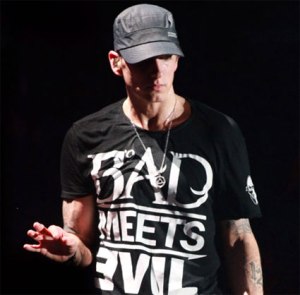
“Eminem, Lil Wayne Named ‘Gods Of Rock’ By GQ” by Flickr usermp3waxx.com, CC-BY-NC-SA-2.0
The recurrence of spiritual themes in Eminem’s soundscape suggests that music is a way to communicate with the other who is both present and hidden. Sometimes the other is God. Sometimes the other is the Devil. Sometimes the other is other people. Sometimes the other is the other within. The tones, rhythmic patters, key changes, intensity and release patterns combine with Eminem’s lyrics to create an experience within which listeners can be still, in which their souls can take refuge, and the other can be encountered. However, though sonic spirituality exists in Eminem’s music, and rumors abound regarding his “born again” status, it cannot be argued that Eminem adheres to a particular religion. Rather, the sonic spiritual element suggests that Eminem communicates a genuine awareness of supernatural powers, guilt-redemption-purification and love-hate that allows him to relate to the world at large. In this way Eminem is one of many artists whose pop culture content carries a strong spiritual dimension that is sonic, confirming results of Chris Rojek’s study, entitled “Celebrity and Religion,” which argues that “celebrity culture is secular society’s rejoinder to the decline of religion and magic” (393).

“DJ Hero party – Eminem 2” by Flickr user monsieurlam, CC-BY-NC-SA-2.0
As “Beautiful” and “My Darling” demonstrate, the spiritual reflections heard in Eminem’s music are not just harmonic, they are also discordant, revealing how conflicted we often are about ourselves and the supernatural. Just as Eminem walks with God in “Beautiful” and dances with the Devil in “My Darling,” audiences listening to his music are able to escape from their own worlds and find temporary refuge in sonic spirituality. This idea didn’t start with Eminem, or with the Judeo-Christian tradition, as many faiths across time and space utilize the power of music to evoke higher powers and acquire spiritual insight through prayers, storytelling, meditation, chanting, mantras, singing, silent vows, etc. But Eminem has added his own unique touch by using his personas Slim Shady and Marshall Mathers to speak with demonic and godly authority, respectively. As Peter Ward writes in Gods Behaving Badly, the spiritual power of Eminem’s music for audiences lies in its representations of a “conflicted and complex self clothed in the metaphors of the divine and reflected back to us” (107). In other words, sonic spirituality is about engaging with something beyond the world around us while grappling with the personas and situations into which we’re immersed. As the music plays we are challenged to develop a listening heart.
The popularity of Eminem’s music supports the conclusion that his brand of sonic spirituality is set to the same rhythm as the hearts of fans that buy and listen to his messages. But his work can also speak to those who consider themselves spiritually committed, even if that commitment is often not manifested in traditional religious activities. In this way the dynamic nature of sonic spirituality manifests as a way of listening that allows for communication and communion through music and language. If the above is true, then we can take Eminem’s claim, expressed via tweet, that “music has the power to heal” as a spiritual declaration. And we can also take a fan’s response to this tweet as an Amen: “All Eminem songs has [sic] a spiritual connection… you have to have the ear to find that for yourself.”
—
Featured Image: “Slim Shady” by Flickr user Walt Jabasco, CC BY-NC-ND 2.0
—
Marcia Alesan Dawkins, PhD is an award-winning writer, speaker, educator, and lecturer at the University of Southern California’s Annenberg School for Communication and Journalism. She is the author of Clearly Invisible: Racial Passing and the Color of Cultural Identity (Baylor UP, 2012) and Eminem: The Real Slim Shady (Praeger, 2013).
Marcia writes about racial passing, mixed race identities, media, popular culture, religion and politics for a variety of high-profile publications. She earned her PhD in communication from USC Annenberg, her master’s degrees in humanities from USC and NYU and her bachelor’s degrees in communication arts and honors from Villanova. Contact: www.marciadawkins.com
—
REWIND! . . .If you liked this post, you may also dig:
The Victoria’s Secret Fashion Show and the Soundtrack of Desire–Marcia Alesan Dawkins
Love and Hip Hop: (Re)Gendering The Debate Over Hip Hop Studies–-Travis Gosa
“I Love to Praise His Name”: Shouting as Feminine Disruption, Public Ecstasy, and Audio-Visual Pleasure—Shakira Holt
Share this:


Current Top Posts





April 2021

January 2020

November 2019

October 2019

August 2019

April 2014

November 2017

March 2015

December 2017

October 2015
 Sounding Out!
Recent Comments