
Sounds Difficult: James Joyce and Modernism’s Recorded Legacy
Today’s post from Damien Keane marks the first in our recurrent series, “Live from the SHC,” which will broadcast the research of this year’s Fellows at Cornell University’s Society for the Humanities, directed by Timothy Murray, whose theme for 2011-2012 is “Sound: Culture, Theory, Practice, Politics.” The Society’s Fellows study a diverse range of sound studies topics: the relationship between sound and urban space, the moment when musical sound enters (and exits) the body, the sound of popular culture in interwar Egypt, the role of sound in constructing pious Muslim communities in secular European countries, and the manipulation of sound by “circuit benders”–to name just a few of the projects being researched up at the A.D. White House (To see the full list of Fellows, click here. To see the slate of SHC courses being taught at Cornell this year, click here). To allow our readers the opportunity to listen in to the goings on at the SHC, Sounding Out!‘s correspondent on the inside, Editor-in-Chief and SHC Fellow Jennifer Stoever, will be curating the online conversation amongst the fellows about their current research (and, of course, their sonic guilty pleasures)–so look (and listen) for it on selected Mondays from now through May 2012. –JS
—-
DOI: https://doi.org/10.59350/vm6y5-0zj13
I began asking my students how many of them had turntables almost nine years ago, when, as a graduate student teaching a course on the twentieth century, I found myself seventy pages into Dracula and having to explain what a phonograph is: then, only one or two hands went up, or half-up, in response to the question. A year ago, when I put this question to students in a course on modernism, fully two-thirds of the thirty-five students in the room raised their hands – although more than a few of them also believed that Steve Jobs had invented the mp3. Even allowing for self-selection and/or misrepresentation on their part, and for a soft form of administrative research and/or miscounting on my part, this swing is quite dramatic.
But what I find intriguing about the uptick is how it tracks with an equally dramatic rise in the use of a kind of allusion in commentaries about the effects of digital media on education. I am referring to those parenthetical asides that so often follow mention of residual technologies such as turntables and albums (e.g. “anyone remember those?”). While these asides are delivered in the manner of a stand-up comic doing material about blind dates or the post office, they serve to euphemize powerful attitudes about technology and what it is to be modern that are even less funny than such shtick, perhaps most directly by assuming the unqualified and unimpeachable newness of the present. Asking if anyone remembers the record player – or the chalkboard or the library or the secretarial staff – takes for granted that you’ve already taken it to the next level, having left off your turntable with parietals and rumble seats.

Which brings me to the gramophone recording that James Joyce made of the ending of Anna Livia Plurabelle, an episode of what would eventually become Finnegans Wake. Joyce had begun publishing pieces of his work in progress in 1924, and the Anna Livia Plurabelle section was by far the most visible of these, having appeared in several variant forms by the turn of the decade. Among these were its publication as a stand-alone, limited edition book in 1928, and the release of the recording that had been made at C.K. Ogden’s Orthological Institute in Cambridge, as a double-sided twelve-inch gramophone disc in 1929. Each did surprisingly well, and in tandem they helped to secure acceptance of Joyce’s formally challenging aesthetic procedures among readers. Indeed, some in the literary field, such as T.S. Eliot, hoped that recordings of authors’ readings would soon supplant, or at least augment, the market for limited and deluxe editions.
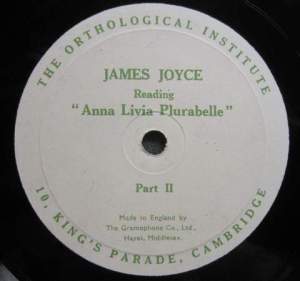
The fact that recordings did not replace books would be of little interest now, were it not for the way that their relationship in 1929 neatly conjures the supposedly defining trait of our own moment: the demise of one media epoch and the emergence of another (and with economic catastrophe at hand, too). Yet it is the gramophone recording – the “new media” format of that past moment – that is considered thoroughly obsolete today. What then can be said about the “listening history” of the recording? How has the sound of Joyce’s recorded reading interacted with perceptions of the readerly difficulty of the text, which, whether rightly or wrongly, are the pre-eminent “mode” through which readers approach Finnegans Wake? Put simply, if reading the text is hard, is listening to a recorded reading of that text hard?
.
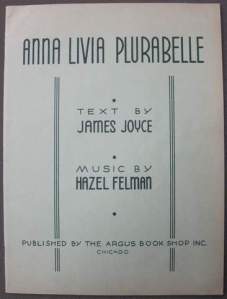
In thinking about these questions, what catches my attention is the slippage between different senses of “difficulty,” between the positive inflections of literary difficulty and the negative connotations of sonic interference. Contemporary listeners tend to emphasize the crackles and pops that compete with the sound of Joyce’s voice and its language, and thereby locate the “difficulty” of the recorded reading in the sound of the recording itself. It is as though the recording medium actually impedes access to Joyce’s language or somehow imposes itself between the listener and his voice – despite the fact that the medium enables this access in the first place. This is to say, the “low” fidelity of the recording of Joyce’s voice simply cannot reproduce the literary experience of Joyce’s prose, that most elusive, or rarified, object of speculation. (Is it the singularity of literature or is it Memorex?) Today’s default reaction to the recorded reading might be juxtaposed to a much earlier response, Hazel Felman’s setting of the very end of the passage for piano and voice, published in 1935. Here is her explanation of the genesis of her composition:
The emotional reaction I experienced on hearing a recording which James Joyce made of the last pages of ANNA LIVIA PLURABELLE was profound. As I listened to the record time and again, the conviction grew upon me that if I could re-create in music the mood that the author creates when he reads the closing chapters of ANNA LIVIA PLURABELLE, I would be justified in translating into a musical idiom what already seemed to be sheer music.
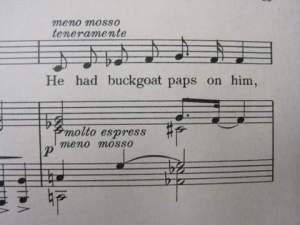
Felman’s response pivots on the aural clarity of the Anna Livia Plurabelle recording – she notes, for example, that D is used as a pedal point in the setting because Joyce’s voice modulates around a pitch of D in the recording – and the “sheer music” she heard there was mediated by that very recording.
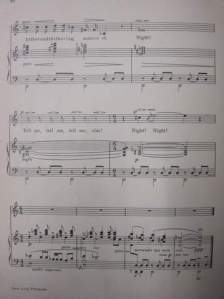
Almost eighty years after Felman, today’s hi-fi listeners more often hear in the recording only a poor realization of Joyce’s text, a judgment that has nothing to do with Joyce’s performance and everything to do with the grossly uneven staking of the recording’s semiotic content against its materiality. Yet we do well to recall that surface noise is just as “modernist” as Joyce’s innovative prose. Why do we always forget that? To ask this question brings us back to turntables and students. (Anyone remember them?)
—
Damien Keane is an assistant professor in the English department at the
State University of New York at Buffalo. He is nearing the completion of
a manuscript entitled Ireland and the Problem of Information.
—
Share this:

Experiments in Agent-based Sonic Composition
John Cage’s “Music of Changes,” which was composed using a random component from the iChing.
.
DOI: https://doi.org/10.59350/3xy24-t0m10
I perform and write music, normally acoustic, and usually for a single guitar, harmonica, and voice. I am traditional in my choice of instruments, they are basically “old” technology. On the other hand, I am also fascinated by the idea of robotics in music. The idea of artificial, autonomous music creators that work alongside human musicians. John Cage used the iChing to make choices about musical form in some of his compositions, including “Music of Changes” above, which has some of that flavor. It is music that is composed, not just performed, by a partially artificial means–by a non-human actor, the iChing.
.
In my work as an economist, I develop autonomous software programs that simulate economic actors in a process called agent-based modeling – the construction of independent pieces of software, which simulate real agents in the world, that interact and form patterns that transcend any single agent’s behavior. Recently I realized that agent-based modeling might be able to be applied to the construction of music: creating individual artificial decision makers which might together construct a piece of music that transcends what any one of them can do.
.
Think of a swarm of bees or a school of fish. Once biologists thought that schools of fish had a `leader fish,’ a single fish that would direct how the school would move. Biologists also once thought that the queen bee was the `leader’ of the hive, that it directed behavior of the bees in the hive. Both of these beliefs have been shown to be false. There is no leader in a school of fish. On the contrary, each fish responds to local information and then the co-ordination which arises on the school level emerges from this system of individual choices. The same with bees…the queen plays a part in the hive, like all the bees play parts, but there is no sense in which she directs the others. There is no bee that is in charge.
.
Here is a video of my colleague Hiroki Sayama’s `Swarm Chemistry’ in action. The specks you see on the screen are individual agents, dumb agents, who react to their environment, which is other local agents. There are no leaders here, there is only group behavior.
.
http://www.youtube.com/watch?v=lcBTk2fqGe4
.
In this clip, you can see the swarms which emerge. The music is incidental in this clip; not a result of the swarm behavior.
.
I have begun an experiment in agent-based sonic composition with the idea of emergent behavior and agent-based modeling in mind. In this video I show my initial foray into this world:
.
.
The agents in this video are small triangles that seek a well, and eventually learn (sometimes more effectively, sometimes less effectively) where that well is. What I have done to add a sonic component is to assign each agent an instrument, and assign the agent’s proximity to the well to the pitch of the note they create.
.
“Random” sounds created by a computer are nothing new. And, frankly, I find them uninteresting. No depth, no humanity. But I think agent-based sonic composition might be something different. These agents are not simply random (although indeed, their behavior has something of a random component, or seemingly random component). They are goal-seeking, they are purposeful, and the sound they generate is a function of their effectiveness and path in pursuing that goal. I think this purposefulness can be heard in the sound the create. There certainly isn’t a melody, but there is a story being told, some kind of struggle being documented.
Swarms, too, are not simply random. Though swarms may be composed of elements have that have randomness in them, they are also structured. If Music is sound with structure, and complex systems is the study of emergent structure, there could be a genuinely interesting music that might emerge from a well-constructed agent-based approach to sonic composition.
.
I’m not convinced what I have is there yet. There are not interesting interactions between these agents, and there is not a structure to their sound that has depth – yet. Perhaps the next step is to tie the goals of the agents more explicitly to music making. Perhaps there can be melodic agent who moves on a predetermined path, and the other agents try to follow that agent, and hence the sound that comes out documents their struggle. Maybe the agents’ notes should be restricted to scales, so that it sounds less chromatic. Or, perhaps, as I suggest in the video, there can be some agents which control rhythm and others that control pitch.
.
To be clear: I wouldn’t just listen to this. I don’t know if I would call it “music” yet. But I think it may get there some day.
—
Andreas Duus Pape: is an economist and a musician. As an economist, he studies microeconomic theory and game theory—that is, the analysis of strategy and the construction of models to understand social phenomena—and the theory of individual choice, including how to forecast the behavior of agents who construct models of social phenomena. As a musician, he plays folk in the tradition of Dylan and Guthrie, blues in the tradition of Williamson and McTell, and country in the tradition of Nelson and Cash. He plays acoustic guitar, harmonica, and voice: although the technology of his musical production is a hundred years old, his ideas are often quite modern, and he covers songs as old as early last century and as recent as this one. Pape is also an assistant Professor in the department of Economics at Binghamton University, where he teaches microeconomic theory at the undergraduate and graduate level. He is a faculty member of the Collective Dynamics of Complex Systems (CoCo) Research Group: http://coco.binghamton.edu and considers complex systems and agent-based modeling to be central to his research
—
Share this:




Current Top Posts





April 2021

January 2020

November 2019

October 2019

August 2019

April 2014

November 2017

March 2015

December 2017

October 2015
 Sounding Out!
Recent Comments