Desiring Medieval Sound

11182237955_3045bdb717_h

Medieval SoundEach of the essays in this month’s “Medieval Sound” forum focuses on sound as it, according to Steve Goodman’s essay “The Ontology of Vibrational Force,” in The Sound Studies Reader“comes to the rescue of thought rather than the inverse, forcing it to vibrate, loosening up its organized or petrified body (70).  These investigations into medieval sound lend themselves to a variety of presentation methods loosening up the “petrified body” of academic presentation. Each essay challenges concepts of how to hear the Middle Ages and how the sounds of the Middle Ages continue to echo in our own soundscapes.

The posts in this series begins an ongoing conversation about medieval sound in Sounding Out!. Our opening gambit in April 2016, “Multimodality and Lyric Sound,” reframes how we consider the lyric from England to Spain, from the twelfth through the sixteenth centuries, pushing ideas of openness, flexibility, and productive creativity. We will post several follow-ups throughout the rest of 2016 focusing on “Remediating Medieval Sound.”  And, HEAR YE!, in April 2017, look for a second series on Aural Ecologies of noise! –Guest Editors Dorothy Kim and Christopher Roman

In fall 2013, The Cloisters’ Fuentidueña Chapel was brimming with bodies in motion, in relation, in sound and in silence, attracting ear and eye away from the hall’s sparse collection of medieval sculpture and fresco to a performance unfolding in its midst. For the first time in its seventy-five year history, The Cloisters presented a work of contemporary art: Janet Cardiff’s Forty-Part Motet (2001), a site-specific virtual performance of Thomas Tallis’s famous sixteenth-century, forty-part motet Spem in alium, played on a continuous fourteen-minute loop through an array of forty high-fidelity speakers.

It was, by all accounts, a resounding success. Reviews in the The Wall Street Journal, The New York Times, The New Yorker, and NPR’s Soundcheck were rhapsodic. The volume of visitors to The Cloisters, which houses most of the Metropolitan Museum of Art’s medieval collection, tripled. On the day I visited, I found myself deeply moved—in part by the music, yes, but also by my weird intimacy with each speaker’s singular human voice, and by the unguarded auditions unfolding all around me. One couple chatted cheerily over the music; a white-haired matron sharply shushed them quiet. Some sat on benches or the apse steps, eyes closed; many travelled from speaker to speaker, lingering. One visitor openly wept. I learned from a museum attendant this was a near daily occurrence.

How could a looped recording of Renaissance polyphony generate such outpourings of enthusiasm and emotion?

By multiplying auditions. By putting bodies in relation. By sculpting space. By dislocating time. By sounding in The Cloisters. By irrupting the Middle Ages. By desiring medieval sound.

Sculpting

John Speed, Nonesuch Palace, 1610

John Speed, Nonesuch Palace, 1610

Cardiff’s installation arranges forty high-fidelity speakers on stands at roughly head height in a large, inwards-facing oval array. Each speaker emits one of the motet’s forty distinct voice parts, individually recorded by singers from the Salisbury Cathedral Choir. Historical evidence suggests that Tallis composed Spem in alium to be performed this way, in the round, high in one of the royal Nonsuch Palace’s octagonal towers, where the work’s eight vocal quintets could imitatively pass musical material around the tower’s circumference, respond antiphonally across its diameter, and bombard the center with forty-voice polyphonic counterpoint. “It was like the composer was a sculptor,” Cardiff explains, “and I wanted to show how sculptural the piece of music was.”

Spem in alium chimes with the whole of Cardiff’s body of artistic work in its abiding interest in the physicality of sound, “in how sound may physically construct a space in a sculptural way and how a viewer may choose a path through this physical yet virtual space.” The language she uses to describe her work here links sound and motion in the sculpting of space: as the sound moves between choirs, variably filling acoustic space with voice, so audiences move among speakers, plotting itineraries according to the physical, visual, and aural push and pull of bodies in relation to other bodies. Moving and being moved are the hammer and chisel Cardiff use to give sounding space its shape.

FortyPartMotet_featured

Inhabitation

Cardiff describes the genesis of Forty-Part Motet in an interview: “When you listen on your stereo it’s so frustrating because you know all these people are there, but you can’t hear them. I just wanted to climb inside and hear them individually.”

Syntactically, what does Cardiff want to climb inside of, so that she might hear voices individually?

The radio—but that would merely eliminate a mediating technology, putting her in the concert hall or cathedral, no closer to the individual voice. The performance—but that would render her a singer, her own voice filling her hearing so she’s unable to attend to the voices of others. No—Cardiff seems to wish to climb inside each singer to hear their voice individually, intimately, as if her own. The motivation driving Forty-Part Motet amounts to a fantasy of transpersonality.

Cardiff employs these same transpersonal tropes to describe her audio walks: dream-like, site-specific, binaural soundworks narrated on a Walkman which seek to create

a surrogate relationship with a viewer… People could get this intimate connection with this virtual person in the audio walks, in the same way they can with Motet…. They hear the sound of my breathing; it’s right at the back of their necks, but not in a creepy way. It’s almost in a natural way; it’s almost in their head.

In Forty-Part Motet, though, this intimacy is in reverse. It’s not another’s voice in our head. It’s us visiting voices in the heads of forty others.

10825637574_1ebc208867_b

Cardiff, “Forty Part Motet” at the Cloisters in NYC, Image by Flickr User Allison Meier

Motet

Latin for “Hope in another,” the incipit of a medieval Sarum rite responsory from the Vulgate Book of Judith, Spem in alium is widely considered Tallis’s greatest work.  The motet is experimentally syncretic in structure and style. It opens with elaborate polyphony frowned upon as too Catholic in the Protestant England of the mid-sixteenth century, when the work was composed and premiered. A point of imitation percolates through four quintets of soprano, alto, tenor, baritone, and bass, until twenty singers voice twenty distinct lines, obscuring any sense of rhythmic pulse and textual intelligibility. This mass of vocal sound passes through the eight total quintets until it completes a full rotation through the choir.

All forty voices enter at once for the first time at the fortieth breve [3:08 in video above]. The quintets then rotate back to where they began, and the mass of forty contrapuntal voices resurges [5:20], made all the more massive by slow harmonic movement between tonic and dominant. We are hit with a sonic welter, nimble and static all at once.

Suddenly, all voices fall silent [5:40]. This is the first of three caesuras in the piece, all of them crucially important: they articulate the motet into distinctly characterized segments, they offer aural contrast to the work’s welters of sound, and they create opportunities for forty-strong choral entries, rare moments where all voices coordinate, where the horizontality of the vocal line temporarily vanishes before vertical harmonic coordination.

Following this first hiatus, Spem in alium adopts a distinctly homophonic and antiphonal style: the text is clear, rhythms readily discerned, as English sacred music responsive to Reformation ideals aspired to be. A transparent voicing on tonic C major precedes the second caesura, whose yawning gap gives onto alien sonority: A major [8:06]. Non-functional, unresolved, otherworldly, the chord hangs across all voices for the span of a breve before shifting mode, C-sharp giving way to C-natural, the motet resuming diatonicity and building momentum towards its final seventeen breves’ worth of full-throated, forty-voice polyphony [9:08].

For a moment, though, Spem in alium cracks open, slowing time, reconfiguring voice. Something utterly other irrupts into audibility, arresting, ephemeral, ravishing—and then is smoothed away.

Temporalities

Carolyn Dinshaw opens her love letter to the amateur medievalist, How Soon is Now?, with an anecdote about a bespectacled young man in a dark blue bathrobe at the fall 2008 Medieval Festival at The Cloisters. “[H]e had glanced around his house and grabbed something that looked like a monk’s robe or that otherwise signified ‘medieval’,” she writes. “The past is present in this intimate, mundane element of undressed everyday life” (2). Dinshaw gives a name to the nonce infolding of past and present that captured her fascination in the figure of this young man: “asynchrony: different time frames or temporal systems colliding in a single moment of now” (5).

It’s no accident that Dinshaw launches her study of medieval and medievalist asynchrony at The Cloisters: the museum building is a patchwork of medieval architectural elements spanning the eleventh- through sixteenth-centuries, lifted wholesale from their European sites and mortared together with modern materials and techniques in a medieval style. In the Fuentidueña Chapel where Forty-Part Motet was installed, for example, a twelfth-century Spanish apse’s mottled limestone abuts neat grids of hewn block and smooth tile that forms the modern nave; the modern structure’s recessed clerestorial apertures emulate the apse’s Romanesque slit windows, permitting only the skinniest vertical bars of light.

The Fuentidueña Chapel, The Cloisters, New York City

The Fuentidueña Chapel, The Cloisters, New York City

Thomas Hoving, former curator of the medieval department and director of the Met, describes two attitudes towards The Cloisters’ amalgamative architecture: critical disdain towards a “hodgepodge of ancient European architectural history, ripped out of context, pasted together to form a dreamlike but haphazard ensemble” (56); and affectionate reverie: “If you dream a little, you can float through time to the eleventh… through [the] twelfth… all the way to the beginning of the sixteenth century” (58).

In many ways, dream is the mental site of asynchrony where memory and vicissitude, anxiety and hope promiscuously mingle. The museum, that consummate heterotopia assembling traces of the past in a single moment of now, likewise manifests asynchrony in physical space. The Cloisters, then, is a dream of the Middle Ages, a locus of temporal heterogeneity we enter after crossing the greenwood of Fort Tryon Park, as if on pilgrimage into the past, still clothed in our everyday life.

14287724275_37993f7d24_b

The Cloisters, NYC, 2014, Image by Flickr User Alex.Palmer

Ghosts

I.

Shortly before Forty-Part Motet was installed at The Cloisters, Janet Cardiff Googled one of her favorite singers from the recording, to see how he was getting on. She found a funeral announcement. “He’s still singing in the choir,” she remarks.

II.

Asynchrony takes “the form of restless ghosts haunting the present” (34).

III.

The press opening for Forty-Part Motet was visited with an apparition:

The Brother entered, listened to the nine-minute motet, and his face glowed… When it was finished, he glided out. Perhaps (Videte miraculum!) he has lived in the Funtedueña Chapel for its thousand-odd years, and appears only for special celebrations.

A photo taken at the event shows a man in a monk’s habit, glasses perched on his nose, his robes a faded shade of blue.

IV.

Cardiff relates the moment she discovered sound as her medium:

I was recording with the tape recorder out in the cemetery. I had a headset on and I was walking around doing research, just recording the names of the people on the headstones… Then I pressed stop and… I hit rewind by mistake, so I had to press play to find out where I was. All of a sudden I heard my voice describing what was in front of me and my footsteps walking… I was electrified. It was really, really incredible.

V.

1557. Spem in alium was probably commissioned by Henry Fitzalan, 12th Earl of Arundel. Alexander Blachly argues for a 1556 premiere, but “that premiere seems not to have occurred—most likely because of the death of Fitzalan’s son and daughter in 1556, and of his wife in 1557.” The motet was probably premiered under Queen Elizabeth in 1559, one year after the death of Queen Mary, its likely original dedicatee, for “a select seated audience of perhaps thirty or forty people”, in an octagonal tower chamber “roughly 25 feet in diameter (almost identical to the 27-foot width of the Fuentidueña Chapel at The Cloisters).”

VI.

“[T]he speakers are a little like the tomb effigies of knights and ladies held in another chapel space of The Cloisters, containing something of the person who lived… [while] an object that also has nothing to do with that person except in memory.” That something is, of course, their voice.

VII.

The performance of Spem in alium runs to about ten minutes. Cardiff’s looped recording runs to fourteen. In those four extra minutes, the singers clear their throat, mutter to themselves, chat idly, moan about last night’s bender, excuse themselves to the loo. In a hall full of murmuring visitors, it’s difficult to tell which voices come from which bodies, or whether voices still come from bodies to begin with. This is the acousmatic situation, as Brian Kane describes it, a phantasmagoria that “[posits a] sphere outside the bounds of the mundane world… manifested in this world only at special or singular moments” (108).

VIII.

Cardiff explains to WNYC’s Studio 360 that “each individual speaker is an individual singer… You realize that, yeah, these are real people” [1:30 in the audio clip below]. Reporter Jamie York goes on to remark that “in some ways, the speakers are more like people than people are” [4:06]: unguarded, approachable, vulnerable, obverses of the brusque, hardened urbanites attending the installation. One visitor draws the obvious conclusion: “What the work does, the position that it puts you in, is really one of a ghost” [6:31].

Studio 360 – Show 1443 Janet Cardiff

.

Desiring

Dinshaw aligns asynchrony with the loving labors of the amateur, reminding us of the word’s etymology, and with amateur forms of knowledge “derived not only from positions of detachment but also… from positions of affect and attachment, from desires to build another kind of world” (6). Cardiff’s work is similarly about affect and attachment, about “space impregnated with memory and desire, expectation” (32), about the active construction of worlds between persons, in that word’s etymological sense. Her soundwork blurs boundaries between presence and absence, inside and outside, the living and the dead, the aesthetic and the everyday; it performs the world’s “slippage between the recording and the recorded, the past and the present, and the confusion of what is memory and what is our present” (35).

What memory does Forty-Part Motet slip us into?

Surely, a fraught one: we take a seat in the towers of Nonsuch Chapel, we exchange pleasantries with that select audience, we hobnob with the Queen. This is the false memory of cultural fantasy, and we do well to interrogate it for what, and who, it includes and excludes.

Yet, we don’t remember, exactly. We did not, cannot perceive the soundwaves that filled the upper room in 1559. We do not sit with that aristocratic audience, stationary at the center of a compass of eight quintets. Rather, we circulate in space and in time, seen and unseen. We are ghosts who enter into relation, body to body, with persons not there, whom we cannot know, and with persons there, whom we come to know in a bed of sound. We oscillate between self and other, a hopeful vibration; we traverse and, in traversing, sculpt the space between singular voice and multiple chorus with our desire-moved bodies. We temporarily become the owners of voices not ours; we are undone and made intimate, in a visible and invisible community of intimates.

9860120396_50dee8f29b_o

“At the cloisters for Janet Cardiff’s 40 part motet,” Image by Flickr User V

Another way of saying this is that Forty-Part Motet slips us into the structure of memory, a structure that resonates in and with the physical structure of The Cloisters, multiplying asynchronies and blurring our quotidian orientations more powerfully than either could manage alone. “We need a non-modern temporal orientation to perceive [temporal] heterogeneity,” to resist modernity’s “subject-object split,” “to explore subjective attachment rather than objective detachment” (183n129). More attachment, Dinshaw implores, and indeed, how else could a looped recording move so many? How else to open the narrow aperture through which a medieval past momentarily irrupts into the present—non-functional, unresolved, otherworldly, in the space of sound?

Featured Image: “Janet Cardiff’s installation ‘The Forty Part Motet’ in the Fuentidueña Chapel” by Flickr User Joe Schultz

Andrew Albin is assistant professor of English at Fordham University at Lincoln Center.  He facilitates the Fordham Medieval Dramatists in their biennial performance of early English drama for public audiences at Fordham and in NYC. Publications include articles on the Chester shepherd’s play in Early Theatre and on Chaucer’s Prioress’s Tale in The Chaucer Review, and a chapter in the edited collection Voice and Voicelessness in Medieval Europe on Richard Rolle’s Melos amoris; Prof. Albin is also currently preparing a multimedia, alliterative English translation of the Melos amoris for publication under the PIMS Mediaeval Sources in Translation series. He has also collaborated in the creation of musical works that have been performed across the United States and in Europe.

tape reelREWIND! . . .If you liked this post, you may also dig:

Sounding Out! Podcast #13: Sounding Shakespeare in S(e)oul— Brooke Carlson

Maile Colbert, Rui Costa, and Jeff Cain’s “Radio Terramoto” — Maile Colbert

Queer Timbres, Queered Elegy: Diamanda Galás’s The Plague Mass and the First Wave of the AIDS Crisis–Airek Beauchamp


‘A Clateryng of Knokkes’: Multimodality and Performativity in “The Blacksmith’s Lament”

Medieval SoundEach of the essays in this month’s “Medieval Sound” forum focuses on sound as it, according to Steve Goodman’s essay “The Ontology of Vibrational Force,” in The Sound Studies Reader“comes to the rescue of thought rather than the inverse, forcing it to vibrate, loosening up its organized or petrified body (70).  These investigations into medieval sound lend themselves to a variety of presentation methods loosening up the “petrified body” of academic presentation. Each essay challenges concepts of how to hear the Middle Ages and how the sounds of the Middle Ages continue to echo in our own soundscapes.

The posts in this series begins an ongoing conversation about medieval sound in Sounding Out!. Our opening gambit in April 2016, “Multimodality and Lyric Sound,” reframes how we consider the lyric from England to Spain, from the twelfth through the sixteenth centuries, pushing ideas of openness, flexibility, and productive creativity. We will post several follow-ups throughout the rest of 2016 focusing on “Remediating Medieval Sound.”  And, HEAR YE!, in April 2017, look for a second series on Aural Ecologies of noise! –Guest Editors Dorothy Kim and Christopher Roman

The “Blacksmith’s Lament” is late medieval alliterative poem that rails against the disruptive, urban sounds of blacksmiths working late into the night. Catalogued by Rossell Hope Robbins in his 1955 Secular Lyrics of the XIV and XV Centuries, and now broadly anthologized, the poem is a 15th century addendum to a largely 13th century Norwich cathedral priory manuscript, now BL Arundel 292. The manuscript is comprised of Latin, French, Anglo-Norman and Middle English texts, and contains bestiaries, prayers, sermons, romances, prophecies, riddles and alliterative poems. As such, Arundel 292 might be categorized as a miscellany, what Ralph Hanna argues in “Miscellenaity and Vernacularity: Conditions of Literary Production in Late Medieval England,” is a kind of bespoke production that “represent[s] defiantly individual impulses—appropriations of works for the use of particular persons in particular situations” (37). Because each text included in a miscellany reflects one person’s desire to inscribe and compile, there are no “customary generic markers;” instead one finds a rich admixture of hands, images, texts, styles, forms, languages, and histories (Hanna 37). I argue that the inclusion of “Blacksmiths” in this miscellany is congruent with the poem’s own odd relationship to sound. In its multimodal blending of the onomatopoetic and the lyric as well as its consideration of manual labor, the “Blacksmith’s Lament” can be understood as an instantiation of specifically masculine medieval identity.

Modern medieval masculinity. Image by David Williss @Flickr CC BY.

Modern medieval masculinity. Image by David Williss @Flickr CC BY.

Multimodality, Presentism and the Medieval Miscellany

The theoretical concept of multimodality is rooted in late 20th-century critique of semiotic systems. As the New London Group argued in “A Pedagogy of Multiliteracies: Designing Social Futures,” “effective citizenship and productive work” in the late 20th and early 21st centuries “now require that we interact effectively using multiple languages, multiple Englishes, and communication patterns that more frequently cross cultural, community and national boundaries” and that we the best way to do so is via methods that accommodate more than mere text (62-64). This engagement with the multiple modes of text, image, and video, among others, makes multimodality an ideal critical tool with which to analyze complex, hybrid compositions.

However, many theories of multimodality privilege a historical lens primarily afforded by 20th and 21st century literacy, dependent as it is on reading and looking (at screens or pages) as opposed to listening (to human voices). Indeed, Jeff Bezemer and Gunther Kress have observed in “Writing Multimodal Texts: A Social Semiotic Account of Designs for Learning” that because images predominate in 21st-century culture, textual “writing is now no longer the central mode of representation in learning materials” (166). In short, writing and images work in tandem to educate. Yet even though they note the different modes of text and image, Bezemer and Kress do not interrogate the fact that both depend on a single sensory ability: sight. Whether or not images have supplanted printed text in pedagogical documents, this assumption of the centrality of visuality as the singular mode of representation—in learning materials and elsewhere—is itself an historical phenomenon—as Walter Ong discusses in Orality and Literacy: The Technologizing of the Word—one dependent on the technology and dominance of print itself.

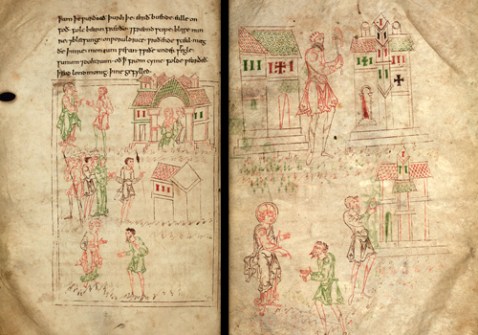
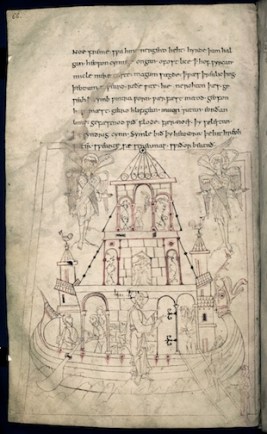
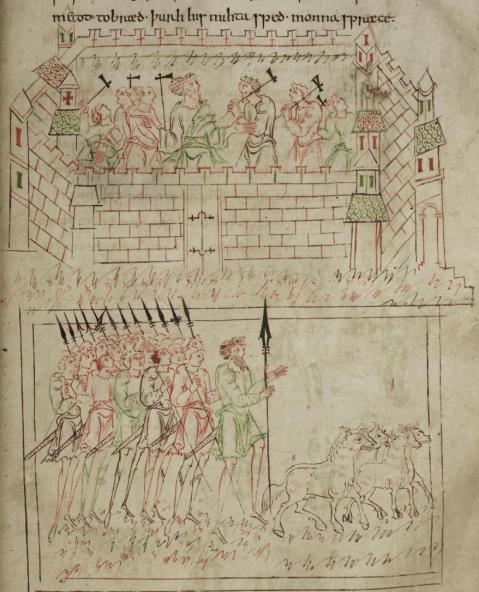
People do not depend only on seeing and reading text. They might also participate actively in “listening communities,” wherein one visually literate person reads aloud a text to a group who listens, ruminates over, and perhaps memorizes that text. Medieval “reading” is in fact an aural practice of recitation, memorization and listening as well as textual examination, a hybrid practice dating to the beginning of the medieval. Evidence of this hybrid practice can be found in the opening folio of Corpus Christi MS 61, which features Chaucer reciting Troilus and Criseyde to a royal audience. Studded with images and illuminations, musical notation and marginalia, medieval manuscripts often offer a complex multimodal relationship between graphics and written text, color and music, the visual and the aural.

An example of an illuminated manuscript. Image by Richard White @Flickr CC BY-NC-ND.

An example of an illuminated manuscript. Image by Richard White @Flickr CC BY-NC-ND.

Long before print or digital media, “reading” manuscripts required a sophisticated multimodal form of interpretation. Arundel 292 is minimally illuminated, but it too must be understood as a flexible, multimodal form composed for a mouth reading aloud the words on the folio page as well as a group of listeners receiving those words. It offers a heterogeneity that mixes languages, genres, images, hands and modes. Indeed, there is little about this miscellaneous manuscript that might be categorized as using exclusively what Kress defines as “formalized, monolingual, monocultural, and rule-governed forms of language,” given its multilingual, multicultural, multi-genre variety of language forms, none of which take precedence over any other.


Onomatopoeia and the Medieval Lyric

The dependence of poetry upon aural and oral performance complicates the relationship between writing, sound, the body, and the intentionality of “design,” or the deliberate visual arrangement of words, images, and ideas. Like other time-bound, performative aesthetic genres such as music, dance, or theater, poetry exists in the moment of its performance as much as it does on the fixed, static page and only peripherally occupies the written mode. Ancient poetry has been preserved by manuscript and print technology, but the roots of the genre include both oral recitation and memorization. Because it depends simultaneously upon the modes of reading, writing and recitation, both historically and into the present day, poetry might be considered quintessentially multimodal. This is particularly true for medieval poetry, given its use of sound-dependent effects such as alliteration, assonance, consonance, onomatopoeia, meter and rhyme.

Figure 2.

Figure 2 is BS MS Arundel 292, reproduced with permission from the British Library

Edmund Reiss has argued that “Blacksmiths” is the “earliest sustained onomatopoetic effort extant in English” in The Art of the Middle English Lyric: Essays in Criticism (167). But for an onomatopoetic poem that so carefully represents in language the sounds of men engaged in physical labor—from their “clateryng of knockes,” to the ringing exertion of iron on iron heard in “tik.tak.hic.hac.tiket.taket.tyk.tak/ lus.bus.lus.das” and the “stark strokes thei stryken on a stelyd stokke”—”Blacksmiths” is surprisingly unconcerned with its own visual appearance on the page. One turns the page in Arundel 292 and suddenly there is a neat chunk of prose with no other visual indication other than faint hashmark that one is looking at poetry. This is not unusual, for as Ardis Butterfield has recently observed in “Why Medieval Lyric?”, in many manuscripts containing lyric poetry or its traces, “there is no visual fanfare; nothing marks [the poetry] out” (322). Medieval scribes instead often use scripture continua—continuous script—to record the lyric, and “Blacksmiths” is no exception (Fig. 1). In short, “Blacksmiths” looks like prose, but sounds like poetry. Its insistent use of alliterative onomatopoeia, furthermore, suggests the poem might gain performative shape if addressed to both the mouth and the ear.

An aurally derived verbal pleasure, onomatopoeia exemplifies poetry’s general obsession with sound and performativity as it depends on the representational delight of hearing sounds that are the very things that they sound like. Onomatopoeia forces us into a strange ontological space in which a word is at once both signifier and sign. The bee buzzes, in other words; it has no other voice than the sound it creates, and we have no other way to describe that sound but to do so literally. This can produce the sounds of children’s babble as well as the more figurative pleasures found in “Blacksmiths.” The mimetic allure of using words that create the very sound of their own meaning is in many ways embedded in language itself. “Blacksmiths” calls our attention to sound, noise and listening, forcing further reflection upon the relationship between what is textually recorded and what is performed.


Blacksmithing and Masculine Poetic Labor

Salter argues persuasively in “A Complaint Against Blacksmiths” that the poem’s appearance in a priory cathedral manuscript suggests that the speaker’s resistance to blacksmithing may be the result of “older religious attitudes” about night labor and rioting (200). But given the fact that “Blacksmiths” is a poem concerned with labor likely written by a man about other men, I wonder if there is room as well for an additional consideration for the discourses of gender and labor that so consumed the late medieval period and how the poem interrogates these notions. While Salter resists categorizing the poem into any clear genre, noting that the poem is so realistic that it is frequently used as historical evidence [note], “Blacksmiths” draws attention to the lyric experiences and emotional expression of a presumably masculine first person speaker and in so doing might be categorized, as Robbins does, as a lyric.

Screen Shot 2016-05-01 at 5.21.10 PM

Beyond a single, reflexive pronoun, “me,” we know nothing about the poet except the evidence of his poetic making—the poem itself. In the poem, there are two literary skills at work. There is narrative exposition and description and there is onomatopoetic mimicry. Both are dependent on verbal artistry and are held together by the tensile patternings of alliteration. Narratively speaking, the poem identifies the blacksmiths by what they look like and what they wield. They are “swarte, smekyd” and “smateryd with smoke,” swarthy dirty men who “spitten and spraulyn and spellyn many spelles,” and “gnauen and gnacchen thei gronys togedyr.” They are addressed pejoratively as “knauene,” and “cammede,” pug nosed knaves, who “blowen here bellewys that al here brayn brestes.” These alliterative lines represent the work of the forge as rhythmic, repetitive, harshly sibilant. Brains might get hyperbolically blown out in blowing the fires needed to produce metal goods, and dissonance is created by the groans and cries and tooth-gnashing of the workmen. The edge of the human blurs into the flame of the forge. Men use “hard” and “heavy hamerys” and “her schankes ben schakeled for the fere flunderys;” they work so long standing near the forge it seems that their ankles are shackled to the sparks. As those fiery images suggests, there is a nightmarish element to the poem. The speaker laments: “sweche dolful a dreme the deuyl it to dryue.” And he uses that infinitive “to dryue” when he begins the poem; the workmen might “dryue me to death with den of here dyntes.” The heavy repetition of the “d” in these lines mirrors the thudding of hammers on hot metal.

Image borrowed from Hasib Wahab @Flickr CC BY-NC-ND.

Image borrowed from Hasib Wahab @Flickr CC BY-NC-ND.

It is only in the second line of the text that the speaker identifies himself. He is “me,” an “I” making a poem and speaking to an implied addressee. And in his use of the first person, he might be understood as having engaged in what A.C. Spearing has called “self-pointing,” those moments in late medieval poetry where the poet identifies himself as a poet, in a meta-commentary on vernacular poetry and its performance. Obviously, the poet does not state his profession in this line. But the fact that he speaks in the first person is significant. His is the voice, and the descriptive rage, that drives the poem. Further, the alliterative matrix of the poem’s lines unmistakably reminds us that this is a poem, a work of art, a made thing. The repetition of alliteration is a bending of ordinary language into something clearly and pointedly artificial, a rhythmic joinery that is obviously not prose, and it requires a certain sonic attention. The speaker expresses his frustration in a pattern of sibilants, voiceless palatal consonants and voiced palatal g’s, as well as hard stops at dental and palatal phonemes. Indeed, the poem mimics the sounds of the smith’s labors, placing their calls and cries and bellows within the poem. The smiths “kongons cryen after col col,” and “huf puf seyth that on haf paf that other.” The poem is ostensibly about the speaker being awoken by the night labor of “Blacksmiths.” “Such noys on nyghtes ne herd men neuer,” he says, hyperbolically. In describing this never-before-experienced problem, the speaker creates a smithing cacophony so loud that it overwhelms his own voice.

Screen Shot 2016-05-01 at 5.20.51 PM

Image borrowed from Hans Splinter @Flickr CC BY.

Image borrowed from Hans Splinter @Flickr CC BY.

The smiths are so loud, so noxious, and I would argue, so much more manly, that they threaten to hijack the poem itself. It is through this sleight of hand, wherein the labors of blacksmithing obscure the poet-cleric’s own small voice, that the speaker makes his implicit argument about masculinity, poetry, and labor. As Kellie Robertson has argued, late medieval writing is concerned with the common profit. Some forms of labor contribute to the common profit while others do not. For the most part, profitable labor is material; it produces actual goods that can be used and sold. And profitable medieval English labor is gendered as almost exclusively masculine, as only men can be masters and authorities. Only men are blacksmiths, and only men are priory scribes. Yet the practice of blacksmithing cannot be separated from materiality. The blacksmiths, however badly skilled the speaker may declaim they are, produce goods to be used for vital purposes. The newly-shod horse will pull the cultour through the fields; the sharp scythe will bring in the harvest; the knife will butcher animals. Moreover, the labor of the blacksmiths is productive even if it is done at night. It can be done as the work demands, all night long if necessary to finish the job. But the clerical poet cannot do scribal work at night without serious consequence. His labor—copying, scraping, blotting, correcting, reading, blotting— depends on daylight, silence, and decent sleep.

The clerical poet, like the speaker of “Blacksmiths,” is engaged in “immaterial labor,” to use Italian Marxist Maurizio Lazzarato’s term, which, as he explains in Radical Thought in Italy: A Potential Politics is “labor that produces the informational and cultural content of the commodity” (133). Clerical poetic labor is abstract, one of inscription, composition and performance. Within the material economy of the later middle ages, poetic labor produces nothing of concrete value. Making, inscribing and reciting poetry, in the words of Harry Bailly, “doost noght elles but despendest tyme” (VII.931). “Blacksmiths” thus asks: what does it mean to make poems—immaterial, multimodal, performative things that are not things at all—from within society where material production is consonant with masculine virility?

The sequestered clerical maker and scribe, scratching away in the silent priory, might have been furious over being disrupted by the athletic, kinesthetic activities of the blacksmiths. The poem might be read as a kind of homosocial lament about what men’s work is and what it means. To write is to not engage in more busily productive, material labor, and the anxiety around what writing is and what it does can also be seen throughout late medieval poetry. The workers make noise and heat deep into the night, producing metal goods. But the maker of the “Blacksmiths” offers a poem that represents the “Blacksmiths”’ loud labor and that also serves as evidence of his own “travaillous stillness,” in the words of Hoccleve (RoP l.1013). In doing so, he calls attention to his own skill as a maker of verse. His labor, however immaterial, can verbally represent noise and sweat and physicality. His prosopoeia is a contribution to the common profit, in that he can make you see and hear the blacksmiths long after their hammers have been laid away. And his hastily composed poem has outlasted even the best-made medieval horseshoe.

Image borrowed from Peter Grima @Flickr CC BY-SA.

Image borrowed from Peter Grima @Flickr CC BY-SA.

To conclude, I’d like to point out that it is no wonder that “Blacksmiths” is set in the dark, and that the speaker himself cannot see his tormentors but only hear them. Because it is out of this darkness that the speaker can name, and in doing so—as Daniel Tiffany observes in Infidel Poetics: Riddles, Nightlife and Substance (97)—call attention to his own aesthetic power. As Martin Heidegger has argued in Poetry, Language, Thought (73), naming is “the lighting of what is,” and I wonder if verbal naming is in itself a wonderful kind of literary power. To name is to point out to another, to claim, to damn. To point out, however obliquely, who you might be and how your work might be remembered.

Featured image “Succor” by Walter A. Aue @Flickr CC BY-NC-ND.

Katharine Jager is a poet and medieval scholar.  She is associate professor of English at the University of Houston-Downtown, where she teaches medieval studies, creative writing, literature, and composition.  Recent publications include essays on aesthetics in Chaucer’s Sir Thopas (Medieval Perspectives) and masculine speech acts in Sir Gawain and the Green Knight (Medieval Feminist Forum, forthcoming); and poetry in such journals as Found Magazine, Friends Journal, The Gettysburg Review, Commonweal and the anthology on the religious lyric Before the Door of God (Yale University Press).  She was for many years co-author with Jessica Barr of the Chaucer chapter for the Year’s Work in English Studies (Oxford), and is currently editing the interdisciplinary volume Vernacular Aesthetics in the Later Middle Ages: Politics, Performativity, and Reception from Literature to Music, to which she is also contributing an essay on lyric aesthetics, manuscript placement and the texts of 1381 (Palgrave’s New Middle Ages series, forthcoming).

tape reelREWIND! . . .If you liked this post, you may also dig:
SO! Podcast #45: Immersion and Synesthesia in Role-Playing Games–Nick Mizer

“HOW YOU SOUND??”: The Poet’s Voice, Aura, and the Challenge of Listening to Poetry–John Hyland

Pretty, Fast, and Loud: The Audible Ali–Tara Betts