
“This is Not a Sound”: The Treachery of Sound in Comic Books
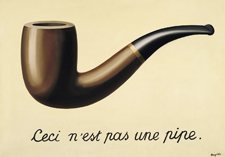
“This is not a pipe.”
In comics theorist Scott McCloud‘s seminal work Understanding Comics (1993), there comes a point following his convoluted description of Magritte’s “The Treachery of Images” where he asks the reader, “Do you hear what I’m saying?” In the next panel he adds, “If you do, have your ears check because no one said a word.” The joke is, of course, that while his comic doppelganger is depicted as talking through the use of word balloons, no words are being spoken. We are reading, not hearing. And yet, sound (or rather, its representation) remains a crucial part of reading and enjoying comic books.
Magritte was trying to get us to think about the treachery of visual representation, while McCloud points us of the treachery of aural representation. A stylized “SPLAT!” is certainly not a sound, but our instinctual understanding of sound helps us to interpret what is otherwise a silent medium in ways beyond the mere the descriptive effect of a sound’s depiction. The way comics use sound can teach us about the function of sound in understanding the visual and textual. As McCloud asserts, comics depend on the reader to create closure between parts of an imagined whole in order for disparate panels to make sense. While it second-nature for the comic reader to interpret the depiction of sound in comics, the closure enacted to make stylized textual elements into “a sound” is a central way that this is enacted.
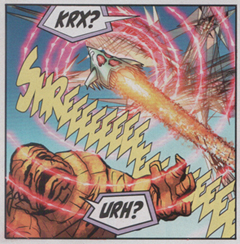
The most famous use of comic sound effect words is probably from the old 1960s Batman TV series—where the “SOCK!” and “BONG!” of superhero and sidekick reinforced the campy aesthetic of the program. It is telling that the Batman-theme (and the fight scenes in general) uses horn flares to emphasize those “POW!” and “BIFF!” moments. The suggestion is that the ostentatious representations of sound that these textual flare sound effect words provide are an empty signifier. There is no sound behind that sound. The weak-sounding slaps and smacks of knuckles on flesh would never suffice for the larger than life world of comic superheroes, and the more out-there comics get the more difficult it is to trace a relationship between the textual/visual representation and any sound in the real world. There is no point of comparison by which to understand the “SHREEEEEE!” of a launching “zirrer” in Kurt Busiek’s Astro City, but only the vague evocation of some loud shrill noise.
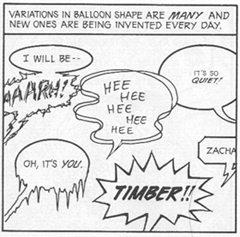 And yet, comic readers not only understand these representations as sound, but there are also a variety of visual clues given that help the reader interpret some quality of those sounds. The most ubiquitous example of sound in comics is, of course, the word balloon—so ubiquitous in fact that it is easy to take for granted the fact that comics have their own conventions for handling and describing sound without recourse to adjectives. The irony is that the shape and texture of word balloons (just like the shape and texture of sound effect words like “BOOM!”) that help to convey the quality of sound become nearly invisible to the reader. Just as any literate person sees a word they know and interprets it for what it is meant to represent and not a collection of individual letters, the dripping icicle-like shape of a word balloon is read as a cold tone or the sharp points of the balloon are read as loud and abrupt.
In her essay “The Comic Book’s Soundtrack” from The Language of Comics (2001), Catherine Khordoc provides a very good overview of the use of sound in comics using the example of Goscinny and Uderzo’s Asterix to provide examples of the various ways word balloons and the implanting of onomatopoeic words directly into the panel image itself are used to represent sounds in comic books. Yet, the function of the representation of sound in comic runs even deeper than simply translating the quality of sound itself; it also serves to help establish timeframes for panels (or sets of panels) and functions in establishing the closure the reader performs in making sense of both individual panels and their context within a sequence of panels. Discrete sounds—whether it’s the “FWOOSH!” of the Human Torch flaming on or long-winded pseudo-scientific explanation of the Negative Zone by Mr. Fantastic—require the passage of time to be intelligible. In order for sounds to be differentiated, they must have some form of beginning, middle and end (or in the parlance of synthesized sound, “attack, decay, sustain, release”). This means that in comics, a medium where space and time merge, representations of sound are crucial to making sense of action, in particular, to the passage of time within a singular panel—for while time can be shown to pass between two or more panels through the process of closure (implicitly understanding the movement or occurrence not depicted between panels that makes them sequential), a singular panel is not necessarily a discrete moment, as an entire conversation can occur within it, requiring readers to perform closure even within the scope of a single panel.
For example, in the second panel below, despite the static image, the passage of time suggested by the conversation about Spider-man’s wounds and payment leads the reader to make sense of the sequence between it and the panel that follows. It is the reader’s understanding that it takes time to talk and listen out loud that helps make the time of the panel apparent.
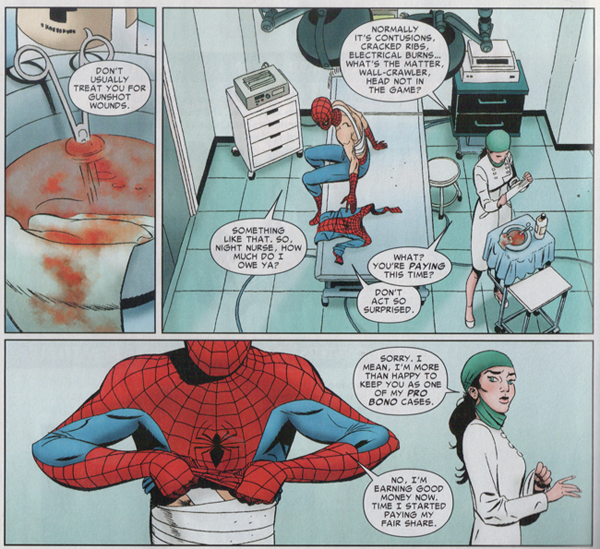
Click to Enlarge.
Perhaps the most telling evidence of the centrality of sound, at least to the superhero comic genre, was Marvel’s decision to include a synopsis and explanation of the action at the end of each issue of the “‘Nuff Said,” “silent” month of comics back in 2001—wherein there was no dialogue or captions.
There is still a lot to consider when it comes to sound in comics—not just the rhetoric of sound or sound as a signifier of time, but sound as identity. Representations of sound in comics can serve as a form of character signature, and I do not mean only famous lines like Superman’s “Up, up and away!” (which really emerged from Superman radio plays), but iconic sounds such as Spider-man’s web-shooters going “THWIPP!” or Wolverine’s claws, “SNIKT!” that over time have come to be more than just descriptive sound-words, but signifiers that are unique for the characters themselves. (See TV Trope’s page on signature sound effects)
In the end, this brief overview will hopefully serve as a starting point in generating more thoughts on not only how our familiarity with sound informs our reading and interpreting of comics, but how this (admittedly) very general idea can be applied to other ostensibly silent and primarily visual media. The use of sound in comics is a perfect example of how the transparency of sound can make it presence and function easy to overlook. Furthermore, the way in which it is used to orient the reader and help provide closure between and within panels, and identify characters clues us in to the importance of its role and the importance of considering where and how else it might function. I, for one, am going to keep thinking on it and looking for examples of in comics and hope that others join their thoughts to the discussion. Until then, as Stan Lee would “say,” Excelsior!


Share this:

Bob Seger, Champion of Misfits
 Bob Seger and the sort of classic rock he performs, embodies and represents, for me (and apparently many others), the relentlessly uncool. Youth, drugs and nonconformity have long been my standards of “rock,” and within this triad, Bob Seger’s formal, cinematic songs, have always come across as a little tired. Osvaldo Oyola wrote specifically last week about these foibles: the stilted piano and canned Chuck Berry riffs sound more like parody than gospel, while the parade of effects on Seger’s voice, also quite derivative, could have also fit on a Bruce Springsteen album (although you could replace the influence of Chuck Berry with that of the quintessentially less cool Phil Spector). Problematically, even though I loathe Seger’s catalog, I love Springsteen’s, this of course has made for some very popular conversations at the bar. In fact, it was last July at a local New Brunswick haunt that I had this conversation last. My friend, who will remain nameless, completely disagreed: Seger was cool, I just couldn’t hear it, in fact I had to see it to believe it.
In order to understand Bob Seger, I needed to watch Mask, a 1985 retelling of The Elephant Man starring Eric Stoltz as the deformed Rocky Dennis and Cher as his mother Rusty Dennis. Mask was released two years after Risky Business, and featured a number of Bob Seger songs predominantly in the soundtrack. These songs uniformly mixed to the foreground, often serving as Rocky’s theme, juxtaposed against an ambient soundtrack of songs by black musicians like Little Richard and Gary US Bonds. These black oldies, “Tutti Frutti” and “Quarter to Three,” are used thematically when Rusty’s friends, a bunch of guys in a motorcycle gang, are partying. Not only is Rocky othered from the kids at school because he is ugly, he is poor, raised by a single mother with a drug addiction. Although whiteness takes center stage in this film, it holds a complex relationship to blackness. Rocky and Rusty are atypically white, finding community only with each other and a super-masculine network of bikers; they are misfits, doing their best to pass in a mainstream and affluent white society.
Bob Seger’s “Katmandu,” is the song which introduces Rocky in the opening credits. It is guilty of the trademark Bob Seger whiteness: more refurbished Chuck Berry and piano so droll it could have been played by a metronome. In the context of Rocky and his struggle to identify with white society however, it paints Seger in a different light. Bob Seger’s uncoolness can be read as a failed attempt to pay homage to black musicians like the aforementioned Little Richard and Gary US Bonds. Instead of suggesting a totalizing narrative of white appropriation, I argue that Bob Seger can be understood as a musician who would never be completely accepted by his heroes or critics. Reflected in the posters on Rocky’s wall and Universal’s contract negotiations with Columbia Records (Bruce Springsteen had been first choice for the soundtrack), Seger was not even cool to the director of the film, Peter Bogdanovich, who refered to his music as “inappropriate.”
Toward the end of the movie, Rocky holds his blind girlfriend for the last time. Her parents, disgusted by his face (but probably also by his shabby clothing), keep the two separate. Contradicting the escape narrative of Springsteen’s “Born to Run,” Rocky evinces the power of fantasy toward coping with discrimination: “We can’t run away Diana. But we can sort of run away in our minds. We can remember camp, the mountains and the Ocean…especially New Year’s Eve” (Mask Part 11 4:40). Like Rocky, Seger can’t run away from his whiteness, even though he may not relate to it, or fully embrace it, it is ever present in his recordings. Songs like “Old Time Rock and Roll,” “Katmandu,” and even “Night Moves” are celebrations of music as a forum of imagination – one where identity, be it black or white, can be reimagined as something else. Though “Old Time Rock and Roll,” will sound forever white, it relates the experience of otherness. Try as he might, Seger has no idea how to sound authentically black, and this is evident through both its celebratory lyrics and contrived arrangement.
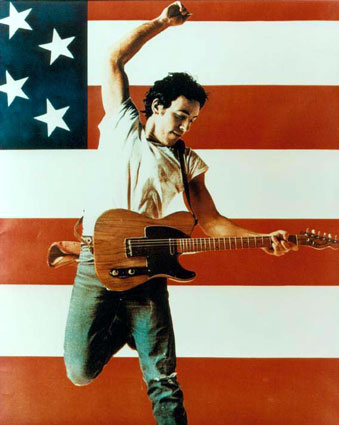 Growing up in a bi-racial household, where, depending on the holiday, my Jewishness could be as visible as my blackness, I feel a strong kinship to figures like Rocky, not completely belonging to any ethnic community. Perhaps this led to a juvenile obsession with Springsteen, who, according to my father, everyone could relate to, regardless of color (he worked at an all-night Jersey Shore diner, the Inkwell, in the early 1970s). Bruce though, was never really misfit, mulatto or poor; whether discussing his working class freehold roots, or his first guitar, his music epitomizes white privilege. Even his stage shows feature Clarence Clemons, The Big (Black) Man, notably subordinate to Bruce, or “The Boss.” Although now, my Bruce phase seems laughable, I wonder if it was also a fantasy of fitting in, of recovering a fantastic and invisible whiteness deep within myself. When he wrote “Old Time Rock and Roll,” was Bob Seger trying to do the same and recover a font of blackness deep within himself? I now see a complex web of identity politics informed by an economic and social history of Rock and Roll, but this holds an uneasy and complex relationship with the part of me that still believes in rock and roll. I was, am, and forever will be the misfit who found an identity in the church of rock and roll. Though the sermons have changed, in high school, Springsteen was the pastor, and I suspect that for my friend at the bar, Seger also conducted service. Even though I could never completely fit in to the rich white world of these artists, I wonder if this speaks to a fundamental affinity. Did Springsteen and Seger ever feel like outcasts, later to find solace in the black cool of Little Richard, Chuck Berry and Fats Domino? In the context of these figures and their music, how could whiteness seem anything but contrived, misfit and ugly – or in truth, is this dialectic really the beat which pushes rock and roll forward?
AT


Share this:


Current Top Posts





April 2021

January 2020

November 2019

October 2019

August 2019

April 2014

November 2017

March 2015

December 2017

October 2015
 Sounding Out!
Recent Comments