
What is a Voice?
 Welcome to Voices Carry. . . a forum meditating on the material production of human voices the social, historical, and political material freighting our voices in various contexts. What are voices? Where do they come from and how are their expressions carried? What information can voices carry? Why, how, and to what end? In today’s post, Alexis Deighton MacIntyre explores society’s interpretations of voicing, sounding and listening. Inspired by Christine Sun Kim and Evelyn Glennie, Alexis advocates for understanding voicing as movement and rhythm instead of strictly articulated sound. – SO! Intern Kaitlyn Liu
The following post is a companion to Alexis’ voicings essay published in the Journal of Interdisciplinary Voice Studies 3.2.
What is a voice, and what does it mean to voice?
Definitions of the voice may be pragmatic: working titles that depend in part on their institutional basis within ethnomusicology, literature, or psychoacoustics, for example.

“Autoscopy of the larynx and trachea” by Flickr user Medical Heritage Library Inc.
Or, to take another strategy, voice is given by an impartial biological framework, a respiratory-laryngeal-oral assembly line. Its product, an acoustic signal, is transmitted via material vibration to an ear, and then a brain. The mind of a listener is this system’s endpoint. Although this functional description may smack of scientific reductionism, the otolaryngeal voice often stands in for embodiment in humanist discourse.
For Adriana Cavarero, the voice means “sonorous articulation[s] that emit from the mouth” (Caverero 2005, 14), involving “breath” and “[w]et membranes and taste buds” (134). Quoting Italo Calvino, she affirms that “a voice involves the throat, saliva.” According to Brandon Labelle, the mouth is “wrapped up in the voice, and the voice in the mouth, so much so that to theorize the performativity of the spoken is to confront the tongue, the teeth, the lips, and the throat” (Labelle 2014, 1). In Labelle’s view, orality is in fact overlooked, “disappearing under the looming notions of vocality” (8), such that his contribution to voice studies is to “remind the voice of its oral chamber” (4). Conclusions such as these inform our subsequent theoretical, methodological, and political theories of both voicing and listening.
Cavarero and Labelle are right to address the erasure of speaking and listening in Western intellectual history. However, to take for granted that voice is always audible sound, always sounded by a certain system, is to make the case for a fragmented brand of vocal embodiment. Rosi Braidotti terms this “organs without bodies”, and her critique of “instrumental denaturalisation,” whereby biotechnology transforms the body “into a factory of detachable pieces,” could also apply to the implicit processes by which discourse delineates the voice (Braidotti 1994, 59).

“Intersectional Souls” by Flickr user Makoto Sasaki
Yet, a priori constructs like “voice is sound” or “sound is [audibly] heard” have not gone unchallenged. For instance, scholars, artists, and musicians who engage with disability or Deafness resist or redefine taxonomies that ignore or distance other ways of voicing, sounding, and listening. Sarah Mayberry Scott blogs in SO! about the work of Christine Sun Kim, for example, whose performative practice reimagines Western musical norms through a Deaf lens. Kim’s uses of subsonic frequencies and face markers are two of many interventions by which she “reclaims sound” from an aural-centric worldview—not just for herself and other Deaf people, but for all bodies. Indeed, Kim invites hearing people to see and feel familiar social and environmental sounds, to rediscover inaudible channels for themselves, a praxis Jeannette DiBernardo Jones calls the “multimodality of hearing deafly” (DiBernardo Jones 2016, 65)
To hear deafly is thus to enter an expanded field of sound. The same is true of voicing deafly. Kim negotiates her audible voice by “trying on” interpreters, “guiding people to become [her] voice”, and by “leasing” out her own or “borrowing” another’s. But there are also features common to both spoken and signed voices that risk being lost to the spotlight of audition.
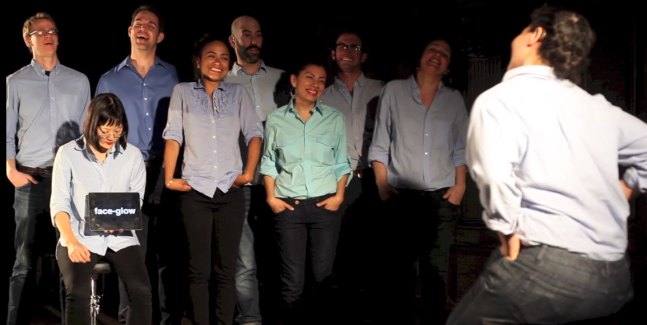
Face Opera with Christine Sun Kim as part of the Calder Foundation’s “They May As Well Have Been Remnants of the Boat”
For instance, spontaneous speech occurs with concurrent face, torso, arm, and hand movements. These voicing actions unfold in tight synchrony with words, sighs, and facial expressions. In the case of beat gestures, the “meaningless” strokes made with the hands, they are in fact temporally precedent to stressed syllables; that is, manual prosody is perceptually paired with vocal prosody, but materialises a fraction of a second earlier. When psychologists subtly perturb gestures in the hand, they record analogous effects in oral production. This hand-mouth network is even more evident in some non-Western hearing cultures that also use sign language, where distinguishing between spoken and gestured dialogue is both impractical and nonsensical. Taken together, it seems that the body distributes the voice, neither knowing nor caring for its own discursive fencings.
If gesture is a proprioception, or action-form, of vocality, haptic sensation is another way to hear. In her vibrational theory of music, Nina Sun Eidsheim argues that sound is not a static noun, but a process, such that the so-called musical object—or, indeed, any sonic figure—resists stable definition, but is rather contingent on the myriad ways of experiencing material pulsation. Via air, water, architecture, or people, the oscillatory basis of Eidsheim’s framework disrupts not only the divisions of labour amongst the Cartesian senses, but also those between sound, sound producer, and listener—unity from propagation. Such vibrations can be all-consuming, rendering the body, in Evelyn Glennie’s words, as “one huge ear.” They can also lurk, near the bass-end of traffic, or remain as a trace, as in dubstep, whose shuddering basslines connote tactility. Alluding to the scene’s origins in Jamaican sound system, the “wub” effect is the auditory fetishization of equipment failure, the resounding noise of a speaker pushed to uncontrolled, uncontainable movement.
In her TED Talk, Kim explains that “in Deaf culture, movement is equivalent to sound.” A feature common to most human movement is rhythm, the temporal patterns that emerge in speaking, walking, chewing, typing, weaving, hammering. As the banality of these actions suggests, rhythm permeates throughout everyday life. We join our rhythms in a process known to cognitive sciences as entrainment. Sunflowers entrain their circadian cycles to anticipate the path of the sun, fireflies entrain their flashes at a rate determined by species membership, and grebes, dolphins, and humans (among other animals) entrain their social actions. Neuroscientists theorize that even our neurons entrain to another’s speech, either spoken or signed. Simply put, entrainment is being together in time with someone, or some entity, sharing in a temporal perspective. So quotidian is the state of being entrained that we may not notice when we fall into step with a friend or anticipate our turn in a conversation. But it would not be possible without rhythm, which is both a shared construct through which we time our gestures sympathetically, and a sign of subjectivity, an identifier, a distinctive feature by which we can recognise ourselves or another.
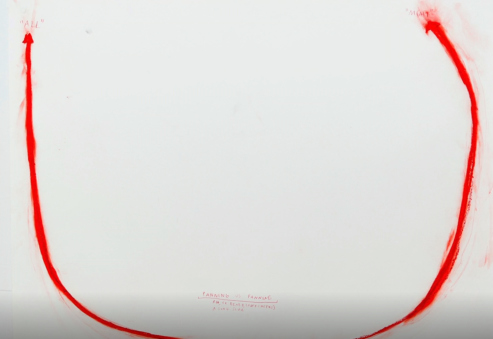
Christine Sun Kim’s musical interpretation of the sign for the words “all night”
Rhythm could therefore form yet another (in)audible nexus within a relational definition of the voice, whose sites could include the larynx, face, hands, cochlea, and on and under the skin, in addition to various inorganic materials. In conversation with John Cage, the hearing composer Robert Ashley considered “time being uppermost as a definition of music,” music that “wouldn’t necessarily involve anything but the presence of people” (Reynolds, 1961). Although Ashley’s “radical redefinition” is stated in temporal terms, the concepts of time, rhythm, and movement are not easily disentangled. Plato explains rhythm as “an order of movement”, while for Jean Luc Nancy, rhythm is the “time of time, the vibration of time itself” (Nancy 2009, 17). As a cycle that is propagated through the medium of entrained bodies, rhythm may well be just another vibration, one suited to Eidsheim’s multisensory groundwork of tactile sound. As with music, the voice need not be “stable, knowable, and defined a priori” (Eidsheim 2015, 22), but dynamic, chimerical, and emergent. Speaking, slinking, signing, swaying—indeed, all our actions, gestures, and locomotions constitute us. Crucially, it is not what we move, but how we move, that is vocal.
_
Featured Image: “Vocal” by Flickr user ArrrRRT eDUarD
_
Alexis Deighton MacIntyre is a musician and PhD candidate in cognitive neuroscience at University College London, where she’s currently researching the control of respiration during rhythmic motor activities, like speech or music. Formerly, she studied cognitive science and music at University of Cambridge and Vancouver Island University. You can follow her on Twitter at @alexisdeighton or read her science blog at https://alexisdmacintyre.wordpress.com/
_
 REWIND! . . .If you liked this post, you may also dig:
The Plasticity of Listening: Deafness and Sound Studies – Steph Ceraso
Re-Orienting Sound Studies’ Aural Fixation: Christine Sun Kim’s “Subjective Loudness” – Sarah Mayberry Scott
Mr. and Mrs. Talking Machine: The Euphonia, the Phonograph, and the Gendering of Nineteenth Century Mechanical Speech – J. Martin Vest
On “The Dream Life of Voice:” A Rerecording of Bernadette Mayer Reading from The Ethics of Sleep – John Melillo
Share this:

Canonization and the Color of Sound Studies

Last December, a renowned sound scholar unexpectedly trolled one of my Facebook posts. In this post I shared a link to my recently published article “Beyond Matter: Object-disoriented Sound Art (2017)”, an original piece rereading of sound art history. With an undocumented charge, the scholar attacked me personally and made a public accusation that I have misinterpreted his work in a few citations. I have followed this much-admired scholar’s work, but I never met him personally. As I closely read and investigated the concerned citations, I found that the three minor occasions when I have cited his work neither aimed at misrepresenting his work (there was little chance), nor were they part of the primary argument and discourse I was developing.
What made him react so abruptly? I have enjoyed reading his work during my research and my way of dealing with him has been respectful, but why couldn’t he respect me in return? Why couldn’t he engage with me in a scholarly manner within the context of a conversation rather than making a thoughtless comment in public aiming to hurt my reputation?
Consider the social positioning. This scholar is a well-established white male senior academic, while I am a young and relatively unknown researcher with a non-white, non-European background, entering an arena of sound studies which is yet closely guarded by the Western, predominantly white, male academics. This social divide cannot be ignored in finding reasons for his outburst. I immediately sensed condescension and entitlement in his behavior.
 This is not new to me. Both my artistic work and a number of my scholarly works have been purposely ignored or undermined in previous occasions, perhaps due to my non-white, non-European background and epistemology. During the assessment of my doctoral dissertation in a well-known Scandinavian University, for example, the three-member committee harshly attacked the very foundations of my project because of my claim that case studies in Indian cinema could produce important new knowledge in the field of sound studies, media art and film history. However, Indian cinema, the largest producer of films in the global industry, is equally a part of world cinema as European and American cinemas, and studying its sound production would indeed add dimensions to the field of sound studies. Their resistance towards my object of study implied that choosing European cinema would immediately make my hypotheses acceptable.
If we take the field of sound studies as both a context for such objection and a case for observation, notable works such as The Oxford Handbook of Sound Studies (2012), The Sound Studies Reader (2012), and Keywords in Sound (2015) have been canonized in the global community of sound researchers by the sheer amount of citations and reviews but have a negligible number of non-White, non-Western contributors. Furthermore, there is a serious lack of representation from the non-White, non-Western scholars and researchers in the bibliographic resources and reference list of these works, which are now considered classics.
 In his essay “On Whiteness and Sound Studies,” Gustavus Stadler lamented that scholars of sound studies are overwhelmingly white, and this racial conservatism is limiting the fields’ research as well as social outreach. It is indeed an act of complacent ignorance not to engage with African and Asian thinkers regarding their sonically rich cultures; indeed, many of their works are available, such as in the Harvard Oriental Series. John Stuart Mill noted, “He who knows only his own side of the case, knows little of that.”
I am inspired by my fellow colleagues and peers (of all colors) and personally grateful to some of them for their sympathetic ears, but as a young researcher I cannot help but be concerned about an unfair social divide upheld in sound studies that I feel must be addressed. In my work, both as a sound artist and sound researcher, I have endeavored to bridge this gap in my capacity. Much work needs to be made in pushing the horizons and shifting the perspectives of the field of sound studies. However, the untoward resistances my kind of young scholars from “other” cultural and intellectual traditions met make it difficult to be read widely, let alone be canonized.
I am discussing here my experiences as a case for critical observation. Throughout the development of my doctoral project, “Audible Absence” in the aforementioned Scandinavian university, I had to face a recurring question in most departmental meetings and seminars: what’s the point in supporting my project in the context of European knowledge production? I suspect this constant questioning of an original research contribution comes from a disdain for a non-Western subject. Also, more often than not, in many scholarly gatherings, I observed a tendency by the white-Western scholars to pigeonhole my work as “southeast Asian studies” or “Indian studies,” identifying it only with mere cultural background, therefore deeming it ancillary to the larger fields of Arts and Humanities within which my research aspires for a general and more universal recognition.
Such divisive and sectarian attitude towards my work has perhaps been aiming to impose identity politics so that an overt sense of difference is underscored. This deliberate production and proliferation of difference has been the tool to marginalize the voice of the “other” in the realm of knowledge formation, which, in actual practice, is yet enjoyed and protected mostly for a certain class, color, and/or race. These social and prejudicial borders have been built on the politics of inclusion and exclusion by what cultural theorist Kandice Chuh calls “avoiding engagement with ‘difference,’ and especially with racialized difference.”

In a recent interview, the renowned professor of psychology at Harvard Steven Pinker has argued that “identity politics is the syndrome in which people’s beliefs and interests are assumed to be determined by their membership in groups, particularly their sex, race, sexual orientation (…) when it spreads beyond the target of combatting discrimination and oppression, it is an enemy of reason and Enlightenment values.” No wonder, the resistance to accepting the scholarly perspectives from non-White scholars and non-Western intellectual traditions has perhaps made the field of sound studies insular to the formation and practicing of new knowledge. The protectionism embedded in encouraging and practicing color and racial difference is a great disservice to humanistic scholarship and enemy of an equal knowledge sharing. With the excuse of tradition and community, the safeguarding of certain groups while ignoring others based on their racial identities has resulted in grave ignorance.
How to engage with such an institutionalized and well-fed “White Canon” coming from outside of it? How to intervene substantially and fruitfully so that the color bias of scholarship is destabilized and there is equal recognition and interest for all intellectual traditions irrespective of color, race, culture and nationality?

Cymatics, Speaker vibrations through milk, Stock Image
As some historians have argued, this so-called “White Canon” is a social and political construct to push the non-White scholarship and knowledge production on the margin. Claimed to be a child of reason and Enlightenment values, the European intellectual tradition was deliberately posed with a “holier than thou” attitude for the imperialist and colonial (mis)adventures Europe had been making in the non-West. In his seminal work Provincializing Europe: Postcolonial Thought and Historical Difference renowned historian Dipesh Chakrabarty states: “In the social sciences, these are invariably thinkers one encounters within the tradition that has come to call itself ‘European’ or ‘Western.’ I am aware that an entity called “the European intellectual tradition” stretching back to the ancient Greeks is a fabrication of relatively recent European history.”
The European intellectual tradition has been a fabrication of a recent history, as Professor Chakrabarty notes. Many postcolonial scholars like Chakrabarty have argued that the writing of this history had deep political and hegemonic implications, which was hard to avoid following the colonization of many part of the non-West by Europeans with violent oppression of other thoughts. Philosopher Bryan W. Van Norden, in his new book Taking Back Philosophy: A Multicultural Manifesto (2017), have claimed that the general disdain, disrespect and ignorance most European scholars have shown to their non-Western counterparts, demonstrates that the European intellectual tradition, which is so obsessed with its communal whiteness and paranoid about the other (non-West), is narrow-minded, unimaginative, and even xenophobic.
Indeed, the most remarkable privilege that white European scholars enjoy—besides, of course, an empowered access to better jobs in the universities and institutional funding–is the entitlement to universal identification and canonization of their work in the respective fields of work, while non-white scholars are all too often pushed into the margins on the excuse of their racial, cultural or mere national identities. The scholars of postmodern studies have stated that the body of scholarship in the Arts and Humanities is biased because the traditional focus of academic studies of Western culture and history has predominantly been on works produced by Western white men. It is no surprise, philosopher Jay Stevenson argues: “[t]raditional literature has been found to have been written by ‘dead white males’ to serve the ideological aims of a conservative and repressive Anglo hegemony […] In an array of reactions against the race, gender, and class biases found to be woven into the tradition of Anglo literature.” Non-white scholars find it much harder to posit their research in the universal canonical consideration; if these scholars are also women-identified and/or queer, it’s even more difficult. This is not only an astoundingly unfair position, but also a dangerous bias.

White acoustic ceiling, image by Flickr User Will Taylor (CC BY-NC-ND 2.0)
In the field of sound studies such biases can be found if looked through the lens of an outsider. The awkward silences in response to a new publication, lack of reviews, reluctance to include in canonized reading lists, repeated refusals by western publishing houses, and a lack of citation in mainstream publications, add to this the sporadic incidents of trolling such as the one that I described in the beginning of this piece – all these that I, and many other scholars who come from other background and intellectual traditions, constantly face, act against the foundation of knowledge production, sharing and scholarship.It is not difficult to observe that this vision has major contradictions with the very reason and Enlightenment values from where the tradition claims to originate. This is a serious charge, but one that tries to explain why the rich philosophical traditions of China, India, Africa, and the Indigenous peoples of the Americas are ignored by almost all philosophy departments in Europe and the larger West.
As my story shows, the paranoia with which the other voices are greeted in the white canonized community reveals how new voices capable of talking in ‘their’ language freak them out. Heard from this perspective, the social media outburst of the scholar mentioned earlier is not surprising. It is a question of privilege that bothers many of the Eurocentric and white-obsessed scholars, who don’t seem to like–or feel that they even have to acknowledge–that the other voices from outside of the protected areas aim to enter the field and eat the proverbial “cake.”My work–among many other (re)emerging Asian, African and other non-Western researchers–does not seek to snatch part of this same limited “cake,” however, but rather aims to build an improved and larger plate and a wider table altogether, capable of hosting a multiplicity of tastes, colors, and splendors, and holding great pleasure in sharing knowledge among ever-curious and open minds.
—
Featured Image: White Baffling Material, Stock Image
—
Budhaditya Chattopadhyay is an Indian-born media artist, researcher, and writer, with a PhD in sound studies from Leiden University, The Netherlands. Prior to his PhD, Chattopadhyay has graduated from the national film school of India specializing in sound, and received a Master of Arts degree in new media from Aarhus University, Denmark researching on sound art. Focussing on sound as his primary medium, Chattopadhyay produces works for installation and live performance broadly dealing with contemporary issues such as climate crisis, human intervention in the environment and ecology, race and migration. Chattopadhyay has received numerous fellowships, residencies and international awards, and his works have been exhibited, performed or presented across the globe. Chattopadhyay has an extensive list of scholarly publication in the areas of contemporary media, cinema and sound studies in leading peer-reviewed journals.Chattopadhyay will be joining the American University of Beirut from 30 August 2018 as a Mellon Postdoctoral Fellow in sound studies.
—
 REWIND! . . .If you liked this post, you may also dig:
My Music and My Message is Powerful: It Shouldn’t be Florence Price or “Nothing”–Samantha Ege
becoming a sound artist: analytic and creative perspectives–Rajna Swaminathan
SO! Amplifies: Mendi+Keith Obadike and Sounding Race in America
Gendered Soundscapes of India, an Introduction –Praseeda Gopinath and Monika Mehta
Share this:


Current Top Posts





April 2021

January 2020

November 2019

October 2019

August 2019

April 2014

November 2017

March 2015

December 2017

October 2015
 Sounding Out!
Recent Comments