
Coconut Clops and Motorcycle Fanfare: What Sounds Medieval?

Series co-editors Dorothy Kim and Christopher Roman
Until the nineteenth century, very little medieval music had been rediscovered, and what little was known was known mainly to specialists. However, the nineteenth-century fascination with the Middle Ages, the Gothic Revival in art and literature, inspired composers to write symphonic works and operas using medieval stories and themes. By the time twentieth-century musicologists began decoding and publishing music from the medieval past, a general consensus as to “what sounds medieval” had already been established in the minds of educated listeners familiar with European art music (see Annette Kreuziger-Herr’s 2005 article “Imagining Medieval Music: A Short History”). Ideas of the medieval constructed in the 19th century via medievalist works of art persisted well into the twentieth, and eventually the imagined medieval sound of Romantic music turned out to be incompatible with the newly discovered historical record.
While Early Music performers in the 1970s and 1980s based their performance styles on historical research, their artistic work was inevitably conceived in relation to existing concert repertoires and standards of performance, as well as ideas about the Middle Ages known by them and by their audiences. A general goal was to create performances that audiences could feel were convincingly accurate to how the music would have sounded in the past. But a sense of authenticity depends not just on the performers’ historical accuracy, but on a complex interaction of experiences and expectations on the part of the audience.
Screen Capture from Monty Python by SO!
Two films, Monty Python and the Holy Grail and Knightriders, play directly with the clash between romantic interpretation of the Middle Ages and historically informed performances of music, for comedic effect. In Music in Films on the Middle Ages: Authenticity vs. Fantasy, John Haines examines six tropes of music in medievalist films: bells, horn calls and trumpet fanfares, court and dance music, minstrels, chant, and warriors on horseback. Haines mentions Monty Python and the Holy Grail several times, but does not discuss any of its music; he does not discuss Knightriders, likely because of its modern setting.
This essay examines the way these two films used music to highlight issues of the real, the historical, and the existence of competing medievalisms central to the understanding of medieval music in modern times. In the director’s commentary for the film Monty Python and the Holy Grail (1975), writer/performer/director Terry Jones had this to say about the film’s music:
Neil Innes had originally written the music for the entire film, and when we showed it, it didn’t really seem to work… we’d all agreed that Neil should go for a very authentic sound, and authentic instruments. The trouble is, it sounded quaint, and when we went to do the read-up I realized that actually you needed kind of mock-heroic music. But of course at that stage, we couldn’t afford to go and record some more music, so the only thing I could do was to go to a music library – I went to DeWolfe’s [a music library that licenses stock music] in London, and spent sort of weeks going through their discs, and sorting out bits of music to put on to it, to give it that sort of … it was just that we realized that if you had sort of music that sounded slightly quaint, because it was on original instruments, and you had all these silly goings-on, it looked comic, the music, instead of actually looking, um, real….
They wanted an “authentic sound,” but what they got didn’t seem real: here is the problem of conflicting expectations in a nutshell. Jones likely meant that the newly composed music, including the sounds of pre-modern instruments, was consciously reminiscent of older music as it was beginning to be known. The song sung by Sir Robin’s minstrels is likely a survival of Innes’ “authentic” score. The singer – Innes himself – sings a minor-mode melody reminiscent of a Tudor-era tune (think “Greensleeves”), accompanied by recorders, some reed instrument, and drum beats. The terms “original instruments” or “authentic instruments” don’t just refer to antique instruments (or copies of antique instruments), they were code for a particular approach to the performance of old music, an approach that was becoming very popular in 1970s Britain (for more on the British Early Music revival, see The Art of Re-Enchantment: Making Early Music in the Modern Age by Nick Wilson).
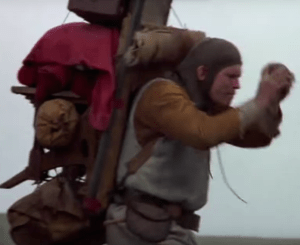
Jones characterized the pre-existing stock music chosen at De Wolfe’s as “mock Heroic,” but there’s really nothing mock about it per se— it’s genuinely heroic-sounding orchestral music, in the romantic post-Wagnerian style of Hollywood film scores, probably written in the 1950s or 1960s. There are brass fanfares when the company sights Camelot in the distance, angelic choirs for the vision of God who speaks to Arthur from the clouds, and especially, there is the wonderful music used when the company is galloping with coconuts. Here they are, approaching the castle of Gui de Lombard
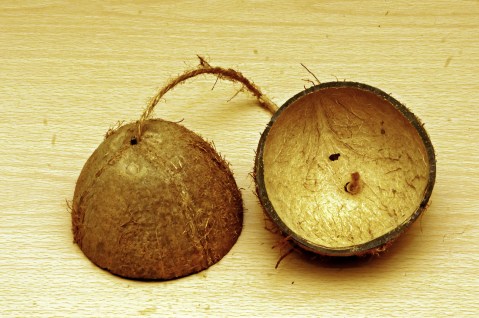
The music for the galloping horses is heard several times during the film, and the contrast between its epic majesty and the sight of King Arthur and his knights not riding horses but rather banging two halves of coconuts together to simulate the sound of hoofbeats enhances the sight gag. The melody consists of four repetitions of the same melody, a strong rhythmic fanfare. The melody itself is made up of two almost identical phrases that each rise and then return down. The rhythm both emphasizes the steady pace and, through its mixture of long and short durations (a so-called “dotted rhythm”), suggests the gait of galloping horses. First we hear percussion, the high-frequency snare drums and lower booming tympani, then the low brass play the melody, harmonized. Higher trumpets join in for the second repeat, with flutes doubling the melody at a higher octave for added brilliance. That combination plays the third repeat, with strings joining for the fourth repeat. The tympani play faster, approaching the fanfare’s final cadence, but it becomes an anti-climax as Patsy, played by Terry Gilliam, can’t really play his long herald’s trumpet. A very knowing joke, as onscreen Hollywood heralds are frequently accompanied by the sound of modern valved trumpets playing chromatic phrases impossible to play on the visible long trumpets.
[The whole piece can be heard here; the part heard repeatedly in the film begins at 1:27:]
In its instrumentation, especially the use of brass and percussion, and the dotted rhythms (long, short, long, short, etc.) suggesting hoofbeats, this fanfare draws on a long tradition of music written to suggest galloping horses, whether ridden by medieval knights or other hunters or warriors. The most famous example is probably the finale to the “William Tell” Overture by Gioachino Rossini (1839). That galloping music influenced many film scores featuring knights on horseback, and it is likely that Terry Jones recognized the style from films he could have seen since the 1950s, such as MGM’s Knights of the Round Table (1953), starring Mel Ferrer as King Arthur and the very wooden Robert Taylor as Sir Lancelot which features music by Miklós Rózsa (1907-1995), who wrote similar music for both medieval knights and Roman charioteers, including trumpets to suggest fanfares and uneven rhythms to suggest hoofbeats.
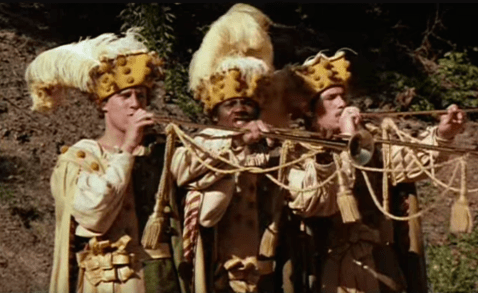
The music in my second example deals directly with the clash between then and now. The 1981 film Knightriders was written and directed by George A. Romero, better known for his horror films (he invented the modern zombie film with 1968’s Night of the Living Dead). Knightriders follows the adventures of a traveling Renaissance-faire troupe of actors who stage jousting tournaments while riding motorcycles; the interactions between the actors come to parallel Arthurian stories. The film revolves around the conflict between modern reality and the desire to live one’s life according to (a modern understanding of) medieval chivalric virtues. This scene shows the troupe’s act: the action is straightforward, but the music is complicated, with the score by Donald Rubenstein using five distinct kinds of music in a theoretically sophisticated manner. In order, we hear: live music played on-screen by visible performers, recorded music played onscreen, and then three musically distinct flavors of underscore music. Watch for a yet another knowing gag about the technical capabilities of heralds blowing straight trumpets, as well as a cameo appearance by the writer Stephen King as a scornful man eating a sandwich.
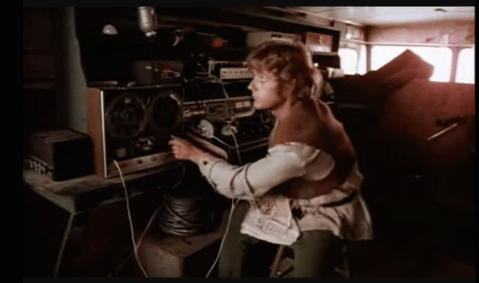
The music performed on-screen functions as part of the scene. The painfully amateur band of minstrels plays a tune from Handel’s oratorio “Judas Maccabeus” (1746), probably known to the squeaky violinist from its use as a Suzuki teaching piece. We can imagine that these musicians are playing the oldest piece of music they know, and in response the audience—both onscreen and offscreen—is led to believe that the rest of the show will be similarly amateurish. The professionally recorded trumpet fanfare demonstrates again how their (and our) musical associations for medieval scenes, especially tournaments, come so strongly from Hollywood. The actors can’t begin to play their instruments, but everyone knows that the heralds and their fanfares are crucial for the scene they’re trying to set.
Screen Capture from Knightriders (1981) by SO!
When King William and Linet take their thrones, we hear underscore music—guitar and fiddle—for the first time; the shift from source music to underscore is done with great subtlety. This music has the informal flavor of folk music, which connects it to the little onscreen band, but now played professionally. The cue is extremely short, but serves as a transition from the real world of the tacky Ren-fest to the imagined world of chivalry and knighthood in some mythical past enacted by the modern-day warriors. The spectacular motorcycle stunts are underscored by more folk-sounding music: again fiddle and guitar, this time playing a fast jig. This music is exciting, as befits the action, but the specific sounds, reminiscent of Irish folk music, do more than just underscore excitement: they begin to move us backwards in time. Folk music reads as traditional, as old, but not ancient. The folk music sounds inhabit an intermediate place, a remembered past between the present and the imagined distant past of the middle ages.
When the individual jousts begin, the underscore music changes again, first to the heroic type of “Hollywood Knights” music, prompting the audience to equate the “real” riders onscreen with their fictional (and filmic) knightly counterparts. This kind of orchestral music, with prominent strings, is used throughout the film for moments of almost magical transformation, suggesting that for believers, such transformation is indeed possible. For the second and third jousts the underscore changes one last time, to trombones playing very archaic-sounding music. Here at last in 1980 is the sound of “authentic instruments” that Terry Jones eschewed back in 1974, and it doesn’t sound quaint at all here, it sounds real. These riders aren’t (just) carnival performers, they are knights at a tournament, risking bodily injury in their quest for personal excellence.

Screen Capture from Knightriders (1981) by SO!
The music in this sequence plays with a basic distinction in film music and film music scholarship: is the music diegetic, that is, part of the film’s story, or nondiegetic, that is, as Robynn J. Stilwell describes in “The Fantastical Gap between Diegetic and Nondiegetic,” in Beyond the Soundtrack, “an element of the cinematic apparatus that represents that world?” (184). The terms were first used by Claudia Gorbman in her pioneering study, Unheard Melodies: Narrative Film Music (1987), and have been a major focus of film music scholarship ever since.
In this sequence, the amateur musicians and the taped fanfare, count as diegetic music, while everything else is nondiegetic. Stilwell points out that border crossings between these two categories are common, but meaningful; she coined the term “fantastical gap,” the gap between what we see and hear and what we hear without seeing, to discuss the liminal (conceptual) space between the two (185-187). Stilwell describes movement from diegetic to nondiegetic as a “trajectory [that] takes on great narrative and experiential import. These moments do not take place randomly; they are important moments of revelation, of symbolism, and of emotional engagement within the film and without” (200). The Knightriders tournament sequence, already liminal as a “play within the play” of the film, traverses the fantastical gap in a way that dramatizes a central question for the performance of Early Music: what happens when modern performances are historically informed, but emotionally unsatisfying? For George Romero, as for Terry Jones, the answer is to give priority to the emotional, drawing on their and their audiences’ expectation for “Hollywood Knights” soundtrack music. Early Music performers in the 1980s made similar choices, merging familiarity and unfamiliarity in exciting ways that unfortunately left them open to criticism that their performances were “inauthentic,” an advertising claim they found themselves defending.
Recorded fanfare in Knightriders, Screen Capture by SO!
The modern performance of surviving pieces of medieval music, recorded in notation, will always enact a kind of medievalism, involving the creative use of material survival from the past. But to understand the goal for the performance of medieval music as historical accuracy alone is to miss an important point. Medievalisms, the creative use of historical material, create meanings for modern audiences, meanings that then help to shape further understanding of the historical past.
The decades since these two films were made and released saw great growth in both artistic approaches to Early Music, and in the skill of performers in playing old instruments and singing in newer, non-Classical styles. Professional recordings enjoyed real commercial success as a sub-genre in Classical music starting in the 1980s, accelerating audiences’ familiarity with the novel sounds of old music re-vivified. The 1990s saw “new age” music and Celtic folk-music sounds added to the mix, while performers in the 2000s have drawn inspiration from Greek Orthodox chant, and continental folk musics. “What sounds medieval” will always be conditioned by what modern performers and listeners imagine “the medieval” to be, and how “the medieval” is understood to be different from later times. As those imaginings are themselves constantly changing, so will their representations in music.
—
Featured Image: “Monty Python Coconuts” by Flickr User Mark Turnauckus
—
Elizabeth Randell Upton is Associate Professor of Musicology at UCLA and the author of Music and Performance in the Later Middle Ages (“The New Middle Ages” series, Palgrave Macmillan, 2013), which examines late fourteenth and early fifteenth century vocal music to discover evidence for the experiences of performers and listeners in the medieval past, recorded in surviving musical notation. Her next book will explore mid-twentieth century Early Music revivals in the UK and US, moving beyond the usual focus on musicological scholarship and classical music traditions to examine Early Music’s interactions with both folk music revivals and popular music.
—
REWIND!…If you liked this post, you may also dig:
Sounding Out! Podcast #54: The Sound of Magic-K.A. Laity
Mouthing the Passion: Richard Rolle’s Soundscapes–Christopher Roman
EPISODE LI: Creating New Words from Old Sounds–Marcella Ernest, Candace Gala, Leslie Harper, and Daryn McKenny
Share this:

SO! Reads: Roshanak Khesti’s Modernity’s Ear

 “I drifted to another place and time,” reminisces drummer and musicologist Mickey Hart in his 2003 book about salvaging indigenous musical traditions, Songcatchers: In Search of the World’s Music. He continues, “Every day I rushed home, put on the sounds of the Pygmies [on the old RCA Victrola], and melted into their very being.” For the Grateful Dead drummer and world music producer, this experience of disorientation would eventually shape his transformation into a “songcatcher,” or one who seeks to preserve the intangible cultural heritage of indigenous music. In Modernity’s Ear: Race and Gender in World Music, author Roshanak Kheshti interrogates the “origin myth” presented by Hart, along with other collective fantasies and historical narratives that urge listening to world music. She argues that we must look beyond the political and economic exploitation of actual musicians to consider the economy of desire in which the conditions of possibility for such exploitation are formed. In contrast to a critical discourse on musical appropriation and exploitation among ethnomusicologists, one that Martin Stokes acknowledges is “marked by an anxious awareness of complexity and complicity” with world music (835), Kheshti deftly tunes into racialized and gendered yearnings for the recorded sounds of others.

Sounds in bodies
Crucial to Kheshti’s argument is her radical proposition for what occurs as, to briefly return to Hart’s aural memories, the sounds of others “melt” into our “very being.” In a crucial maneuver that focuses on how what is being heard is shaped by the embodied experience of listening, Kheshti proposes that “the object [of listening] becomes a part of the self by being taken into the body” (41). Thus when “sound, the listener’s body, escape, and affect fold into one another” (54-56) in the act of listening (a Derrida-derived encounter that Kheshti dubs “invagination”), selfhood is performatively constituted through the aural other. Moreover, the pleasure of imagining the other through listening, writes Kheshti, is not only the hegemonic form of listening within the world music industry but an experience of desire that Western media markets have historically capitalized upon.

“Whispers” by Flickr user Nicola Colella, CC BY-NC-SA 2.0
Given the ways in which listening embodies an economy of desire, Kheshti tells the history of this libidinal economy through a narrative in which modern selfhood is constructed through the racialized and gendered aural other. The Godzilla in this narrative is the World Music Culture Industry (WMCI), an entity conjured by Kheshti in reference to the historical juncture of comparative musicologists in the early twentieth century with the popular music recording industry, a coupling that she argues spawned the globalized product of modern media known as world music. As a set of hybrid musical practices designed by and large for Western media markets, world music is the key object of her inquiry (in contrast to the diversity of musical practices worldwide).
The imagined listener
 Though the book does not proceed chronologically, the first chapter seeks to interweave memory with history by opening with the early twentieth century. Stressing the pioneering role of white female sound archivists, this chapter is crucial for setting up the historical significance of the feminization of listening, a process familiar to readers of Jonathan Sterne, Louise Michele Newman, and William Howland Kenney. Kheshti puts Songcatcher (2000), a feature film about a fictional comparative musicologist who dives into Appalachian country and “discovers” Scottish and Irish ballads thought to have gone extinct, into conversation with the iconic images of Frances Densmore, an ethnologist affiliated with the Bureau of American Ethnology in the 1910s, who famously staged phonographic recordings of the Blackfoot chief, Mountain Chief (Nin-Na-Stoko). The point of convergence between these materials is the gendered and racialized politics of who was sent where to record whose sounds: white female sound archivists, spurned by their male colleagues and sent to the periphery of their respective fields to practice their craft. Once in the field, these comparative musicologists, one fictional and one real, committed acts of racial appropriation and erasure. The song catcher deracinates Appalachia by stripping the region of its Native American and African-American histories in favor of the ‘collective origin fantasy’ that links European and American genealogies, while Densmore, among others, domesticates indigenous sounds in her work for the Bureau.

Frances Densmore recording Mountain Chief. Picture by Harris & Ewing [Public domain], via Wikimedia Commons
Though the book tends to favor intensive re-readings of critical and psychoanalytic theory (from Adorno and Benjamin to Freud and Lacan) over thick ethnographic description, Kheshti touches upon key encounters in this culture industry to explain how listening to world music engenders modernity’s ear. For instance, she transcribes segments from a radio show in Northern California in which the host, a middle-aged white female, discusses what constitutes “African rhythms” with a record label executive. The two banter about this misnomered subject for some length. The host interprets what she is hearing as “African rhythms coming through.” Her visitor, an expert in world music, affirms and clarifies this attribution: “Yeah, absolutely. The rhythm on this particular song… is from a style of music called Afro-beat… that rhythm you’re hearing is definitely African, so, you don’t know nothing, you’re learning” (52). Kheshti interprets this banter as an example of how world music listeners “cherish” the experience of listening to sonic difference as a moment to live out “fantasy and imaginative play” (54), in other words, that the pleasures experienced through aurality have become definitive of twentieth-century modernity.

“world music 2” by Flickr user wayne marshall, CC BY-NC-SA 2.0
In other chapters, she details how record labels fulfill this fantasy through the production of hybrid sound media. The orchestration of these sounds in the studio not only enables the listener to feel “lost” and transcend the contingencies of the listening event, they also “pronounce and suppress presences and absences of all sorts of bodies and grains” (77). Drawing on phenomenological descriptions of her own listening experiences as well as liner notes and other commercial media, she describes how non-Western sounds are encoded as feminine, whereas the synthetic production and digital manipulation of sounds are rendered techno-logically modern and masculine. Racialized and feminized bodies are put to work in constituting the modern cosmopolitan listener. Furthermore, Kheshti argues that market mobility and aesthetic mobility are gendered male and alterity is gendered female in ways that link, for her, to miscegenation. The listening self reproduces dominant forms of heteronormativity in the consumption of modern sound media.
The listening self reproduces dominant forms of heteronormativity in the consumption of modern sound media.
Kheshti offers a radical alternative to these normative listening practices by turning to field recordings taken by Zora Neale Hurston between 1933 and 1939. Trained by Franz Boas in the traditions of nascent cultural anthropology, Hurston is kin to Densmore and those who worked for the Bureau of American Ethnology a few decades earlier. Like them, she goes to record America’s aural others, or “black folk.” But unlike her white foremothers, Hurston does not attempt to splice out the “noise” of the recordings. She “refuses fidelity” (126). Instead of staging field recordings, she made studio recordings of herself performing songs and discussing rituals. When recording her interlocutors, she interrupts, interjects, and poses directorial cues that Kheshti reads as an attempt to resist the desire to faithfully (re)produce an archive of phonographic subjects.

ca. June 1935, Eatonville, Florida, USA — Author and anthropologist Zora Neale Hurston sitting on a porch in Eatonville, Florida with two musicians, Rochelle French and Gabriel Brown. — Image from Stuff Mom Never Told You
Recommended for advanced graduate students and faculty, this virtuosic and tightly rehearsed tour through critical and psychoanalytic theory offers an ambitious and groundbreaking retake on an industry that we thought we understood, perhaps too intimately. Kheshti asks her readers to hold themselves accountable to their own forms of aural pleasure. In so doing, she offers a fresh perspective on the role of embodiment in relation to knowledge production. Rather than embracing somatic methods of inquiry as a welcome challenge to inductive reasoning, she argues that taking pleasure in listening enables the commodification of desire that sustains the world music culture industry.
Kheshti shifts the discussion of world music qua music (aesthetics, history, representation) towards issues of alterity and sound. As such, this book contributes to sound studies by holding the field accountable for difference, and, by inscribing this accountability within the history of the field itself. Indeed, Modernity’s Ear is about how the forces of desire that constitute the modern listening self are enveloped in the aural other as phonographic subject.
—
Featured image: “ear” by Flickr user Leo Reynolds, CC-BY-NC-SA 2.0
—
Shayna Silverstein is an assistant professor of Performance Studies at Northwestern University. Her research generally examines the performative processes of politics, culture, and society in relation to sound and movement in the contemporary Middle East. Her current book project examines the performance tradition of Syrian dabke as a means for the strategic contestation of social class, postcolonial difference, and gender dynamics in contemporary Syria. She has contributed to peer-reviewed journals and several anthologies including The Arab Avant-Garde: Music, Politics, and Modernity, Islam and Popular Culture, the Sublime Frequencies Companion, and Syria: From Reform to Revolt. Previously a Mellon Postdoctoral Fellow in the Penn Humanities Forum, Shayna received her PhD in Ethnomusicology from the University of Chicago and her BA in History from Yale University.
—
REWIND!…If you liked this post, you may also dig:
SO! Reads: Daniela Cascella’s F.M.R.L. (Finding Materials for Remembering and Listening) — Kyle D. Stedman
Lokananta: Sounds of Crisis and Recovery from Indonesia’s National Record Company — Ian Coss
Saving Sound, Sounding Black, Voicing America: John Lomax and the Creation of the “American Voice” — Toniesha L. Taylor
Share this:


Current Top Posts





April 2021

January 2020

November 2019

October 2019

August 2019

April 2014

November 2017

March 2015

December 2017

October 2015
 Sounding Out!
Recent Comments