
The Listening Body in Death

Editors’ note: As a discipline Sound Studies is unique in its scope—under its purview we find the science of acoustics, cultural representation through the auditory, and, to perhaps mis-paraphrase Donna Haraway, emergent ontologies. Not only are we able to see how sound impacts the physical world, but how that impact plays out in bodies and cultural tropes. Most importantly, we are able to imagine new ways of describing, adapting, and revising the aural into aspirant, liberatory ontologies. The essays in this series all aim to push what we know a bit, to question our own knowledges and see where we might be headed. In this series, co-edited by Airek Beauchamp and Jennifer Stoever you will find new takes on sound and embodiment, cultural expression, and what it means to hear. –AB
—
My voice melds with the sound of the water pouring from the hose, as I gently massage the waste, blood, and tears from the body of the deceased. In the act of washing the dead, water is simultaneously sound, spirit, and sensory experience for the deceased and for the washer herself.
Washing the deceased in groups of three, our individual solo voices punctuate space at our own paces and intensities. Our sound soothes and cleanses the deceased as much as our washing. The melodic recitations we provide when gently holding the deceased are the most important components of ritual cleansing before one is buried. We repeatedly sound “Forgiveness, o Teacher [e.g., God]” while exhaling and inhaling. Often we recite the Tekbir—which articulates God’s greatness—adding a melodic architecture to our textured calls for forgiveness.
In washing the dead, we touch the deceased with respect and humility. “Please,” a family member will often beg, “please do not use cold water.” We quickly respond, “of course, this sister is still sensing us.”
Approaching the grieving we smile and gently say, “she is only without breath.” We turn on the water and gently command: “bring me your hand.” And the bereaved joins hands with the washer and feels the warmth of the water. We espouse a tactility exclusively belonging to the washer—as the choreographer and improviser of mourning—with the one who is left alive and in grief.
Our touch and voices alter with each separate experiencing of washing the dead. Because each deceased woman is her own person with her different body and causes of death, no encounter is the same. In the way that we leverage our own bodily movements of lifting and turning the deceased’s body, we actively chose to duet with sounds pouring from the mourning family members in the room. If the mourners are silent, we tend to fill the space with our sound. Our recitations are not only for ritual per se, but exist to offer pleasing sounds to the dead herself.
We recite believing, as Muslims do, that her soul still hears us. While “dead,” she can communicate with all or part of her former body, cooperating with us, the living, as we mediate mourning and prepare her body for burial.
One of the most hard-drawn sensory lines we assume and maintain is the border of death. Death ostensibly marks the end of our constellation of sense experience, engenders the limit of the body, and demarcates the edges of aurality. While we know that hearing remains the last of the senses experienced in dying, scholars of sound studies have yet to extend our exceptional inquiries on hearing, aurality, and listening into posthumous auralities practiced by multiple communities throughout the world. How might sound studies scholars attend to the multi-sensory perceptions and auralities that extend beyond the grey where western epistemological structures end?
As a specialist of Ottoman and Turkish classical musics, I have long been interested in how variant Sunni Islamic practices—themselves rooted in centuries of philosophical debates outside of those generated in “the west”—unsettle categories that many scholars globally assume to be fixed and natural. My current projects have led me to consider the intensity of diverse listening structures attuned to violent thresholds of death in Turkey’s Aegean and Mediterranean seas.
In fall of 2016, my ethnography on listening towards posthumous aurality brought me to Karacaahmet Cemetery in Istanbul, a critically important burial ground of the Ottoman Empire and reportedly the second largest cemetery in the world. Here I was apprenticed to the women of Karacaahmet, practicing Sunni Muslims and official state employees who provide the service of conducting the Islamic rituals of washing the dead. During this time I had the privilege of laying dozens of women and girl-children of all ages, diseases, and accidents to rest with sound.

Walking in Karacaahmet. Istanbul, September 2016. Photograph by the author.
In taking posthumous aurality seriously, I have few paths of translation available to me. I am challenged by normative secular belief structures that we may uncritically reproduce in scholarship. Death is not necessarily the end of aurality. Provincializing western critical theory and engaging ethnographic insight from non-western eschatologies—the areas of theology concerned with death and dying—invites one path for expanding our structures of listening beyond a body’s end.
For decades now, scholars have studied the body not as an accomplished fact but rather as a process. Yet in the body praxis long upheld in Islamic death rituals in Turkey, the vitality, socialization, and subjection of the body does not end in death, but rather passes into an alternate sensory and dialogically sonic realm. Death offers a space akin to what Bohlman and Engelhardt have considered as the sonic emptiness of religious ontologies, or “a space of perception and experience, not of silence and absence.”
Posthumous aurality, as I define and explore it, takes both an ethnographic and a sound studies approach to consider sensory possibilities of death. In this liminal space of mingled bodies—the bodies of the dead, the washers as care laborers, and the deceased’s mourning family members—I listen at a crossroads in which local belief structures mediate and structure sounds, soundings, silences, and voicing.
In Muslim cemeteries in Istanbul, it is believed that there is life in the grave. Death is described in terms of development, progression, pathway, and mere transition from one stage of life to another stage. The barzakh, the barrier of the grave and time spent dwelling posthumously in it, is an interstitial zone entered upon death which the soul can experience pleasure and pain, socialize and commune with others. There exists no necessary binary of life versus death, sound versus silence in these spaces.
The barzakh is a stage of movement, a zone of transference and oscillation. The body is a listening body—its soul communicates and lingers around it, sensing the sounds and touch offered by the washers. Ottoman poetry abounds about such sensings, echoing the understanding the body is a cage and the spirit is incarcerated in it. Artists of the word—with wording historically experienced aurally—narrate the body as wishing for its release (e.g., death) and the possibility of being reunited with its beloved (e.g., the divine) and returning to the earth as soil.
Sonic generosity in the face of death requires washers to engage a modality of listening, touch, and sounding to send an individual to the next realm to await resurrection. Her soul circles the room where we wash her body, listening and participating with us sonically, called back to her body in the grave three times before it is closed.
We believe we hold the body in its second most intimate moment in life, after that of its emergence from the womb. The scent of death fills our nostrils as we sweat to lift the deceased after we finish shrouding her and sprinkling the shroud with rose water. Gently, we ease her into the pine box that transports her to her grave.
And after we are done washing someone—whether we refer to her as “sister,” “aunt,” or “daughter”—we later, in our back tea room, remark upon the grieving of the family members joining us in the room and the discovery of ailments or sores on our sister.

The shoes that we shed at the entrance to our back tea room. Istanbul, October 2016. Photograph by the author.
In these moments of collective sharing, we discover ourselves in our shared similarities with the dead. Wisdom is, after all, listening in tandem with others and recognizing that which is most human in all of us.
In the context of Cairo, Egypt, Charles Hirschkind has beautifully analyzed “the ethical and therapeutic virtues of the ear.” Yet in washing the dead, I produce and engage in a space beyond the pieties maintained by circulating listening structures in particular places. I enter a particular and intimate form of relationality—not a relationship to myself as a subject or the subjection of the dead other, but rather to relationality itself as a form of the sonorous. Jean-Luc Nancy reminds us that the sonorous “outweighs form.” In listening towards posthumous aurality, I am ushered into a unique corporeal and sensorial form of access. Posthumous aurality is simultaneously “mine” and also shared.
Posthumous aurality renders all of our bodies—including that of the literal post-human dead—as capable of being influenced by others in that place. Sharing posthumous auralities in tandem with the washers, the grieving, and the deceased echoes in a space that is indissociably material and spiritual, internal and external, singular and plural.
The critical theories and methodologies of sound studies tend to not center diverse non-western tenets of sensory apparatus espoused by individuals and communities who perceive sound outside of the boundaries of western metaphysics. Posthumous auralities—when translated and mediated linguistically—offers a sound path to understanding the continuations and transformations of sense experience that occur in death. Tuning into posthumous auralities in Turkey’s urban Muslim cemeteries has helped me recover sounds long unheard because they have been relegated to the boundaries of our academic disciplines and the fringes of our very lives.
—
Featured Image: A view from Eyüp Sultan. Istanbul, October 2016. Photograph by the author.
—
Denise Gill is assistant professor of ethnomusicology at Washington University in St. Louis in the Departments of Music; Women, Gender, and Sexuality Studies; and Jewish, Islamic, and Near Eastern Languages and Cultures. Her research has been supported by Fulbright and ACLS. Her book, Melancholic Modalities: Affect, Islam, and Turkish Classical Musicians (Oxford, 2017), introduces methodologies of rhizomatic analysis and bi-aurality for scholars of sound, musical practices, and affect. Her current projects focus on listening structures of death, refugee loss, and acoustemologies of Muslim cemeteries and shrines in Istanbul. A kanun (trapezoidal zither) player, Denise has performed in concert halls in Turkey, the U.S., and throughout major cities in Europe.
—
 REWIND! . . .If you liked this post, you may also dig:
Something’s Got a Hold on Me: ‘Lingering Whispers’ of the Atlantic Slave Trade in Ghana–Sionne Neely
The Amplification of Muted Voices: Notes on a Recitation of the Adhan–David Font-Navarrette
“An Ear-splitting Cry: Gender, Performance, and Representations of Zaghareet in the U.S.“-Meghan Drury
Share this:

SO! Amplifies: Anne Le Troter’s “Bulleted List”
 SO! Amplifies. . .a highly-curated, rolling mini-post series by which we editors hip you to cultural makers and organizations doing work we really really dig. You’re welcome!
—
Nestled deep in a corner of Paris’ Palais de Tokyo, Anne Le Troter’s sound piece “Bulleted List” invites the museum’s visitors to explore the social similarities that people verbally express in response to cold calls. Le Troter’s first solo show to be on display in Paris, the work invites the audience to sit inside a modified cinema amphitheater as the sounds of recorded people answering survey queries echo throughout the sloped room. The seating arrangement inside the exhibition mirrors the cubicle-style setup of a call center, though each “station” consists solely of an outline designating where to sit and a coordinating amplifier. Both the questions and answers in the sound piece are produced by real survey callers; each voice sounds polished, poised and mechanized from years of vocal experience, revealing the automated nature that comes with the territory of making a scripted call. The result of each recorded voice unto the listener is akin to standing in the center of a symphony, with vocal patterns as punctuated as a visual, typographic list.
At the Palais de Tokyo I set up a play of light, a new element in my work, which gives visitors a time reference, even if they arrive half way through. Each broadcast is incidentally interspersed with a long silence to emphasize the idea of a session. This determines the attention span given to a work. The collective listening situation I find especially interesting because it reveals a set of patterns of behaviour, a whole language of bodies and eyes between the spectators. These micro-actions, just like the mental paratext of visitors and pollsters (those words that are not uttered but which ring out in our heads when we think or write), swell the work. –Anne Le Troter, interview with Raphael Brunel
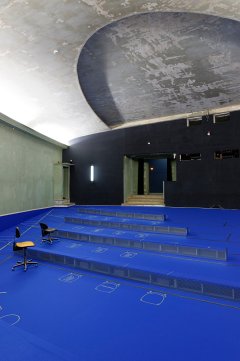
Still of Anne Le Troter’s “Bulleted List” at the Palais de Tokyo, image by author
The progression of sounds in the exhibition follow a distinct, if not choppy routine, with a clearly enunciated polling question asked — “What is your relationship status?” for example — followed by equally simplistic answers — “widowed,” “married” and “couple,” to note a few. Reflective of the exhibition’s timely concurrence with the French presidential election, each of the questions asked in the sound piece culminates in a political questionnaire, with the same questions and answers being traded back and forth between people in all areas of the political spectrum — indicating that there are fewer differences between the various polling demographics and how they express their opinions than what appears at first glance.
“Bulleted List” opened at the Palais de Tokyo on Feb. 3, 2017, and will close on May 8.
Anne Le Troter was born in 1985 and currently lives in Paris. She graduated from the Geneva School of Art and Design in 2012, and her first solo shows were held at the Arnaud Deschin Gallery (Paris, 2016), BF15 (Lyon, 2015), Espace Crosnier (Geneva, 2015) and Espace Quark (Geneva, 2014). In 2016, she was awarded the Grand Prix at the 61st Salon de Montrouge.
—
Featured Image: Still of Anne Le Troter’s “Bulleted List” taken by the author
—
Shauna Bahssin is a sophomore at Binghamton University who double-majors in English and art history. She currently serves as the copy desk chief for the student newspaper, Pipe Dream, and has written for its news and arts and culture sections in the past. Outside of the paper, she is involved with the university’s fundraising initiatives through the Binghamton Telefund, and she hopes to work within the field of arts development and advancement after she graduates.
—
REWIND!…If you liked this post, you may also dig:
SO! Amplifies: Shizu Saldamando’s OUROBOROS
SO! Amplifies: Mendi+Keith Obadike and Sounding Race in America
Sound and Curation; or, Cruisin’ through the galleries, posing as an audiophiliac–reina alejandra prado
Share this:


Current Top Posts





April 2021

January 2020

November 2019

October 2019

August 2019

April 2014

November 2017

March 2015

December 2017

October 2015
 Sounding Out!
Recent Comments