
Sounds of Science: The Mystique of Sonification


DOI: https://doi.org/10.59350/ck7z1-sqv57
Welcome to the final installment of Hearing the UnHeard, Sounding Out!‘s series on what we don’t hear and how this unheard world affects us. The series started out with my post on hearing, large and small, continued with a piece by China Blue on the sounds of catastrophic impacts, and Milton Garcés’ piece on the infrasonic world of volcanoes. To cap it all off, we introduce The Sounds of Science by professor, cellist and interactive media expert, Margaret Schedel.
Dr. Schedel is an Associate Professor of Composition and Computer Music at Stony Brook University. Through her work, she explores the relatively new field of Data Sonification, generating new ways to perceive and interact with information through the use of sound. While everyone is familiar with informatics, graphs and images used to convey complex information, her work explores how we can expand our understanding of even complex scientific information by using our fastest and most emotionally compelling sense, hearing.
– Guest Editor Seth Horowitz
—
With the invention of digital sound, the number of scientific experiments using sound has skyrocketed in the 21st century, and as Sounding Out! readers know, sonification has started to enter the public consciousness as a new and refreshing alternative modality for exploring and understanding many kinds of datasets emerging from research into everything from deep space to the underground. We seem to be in a moment in which “science that sounds” has a special magic, a mystique that relies to some extent on misunderstandings in popular awareness about the processes and potentials of that alternative modality.
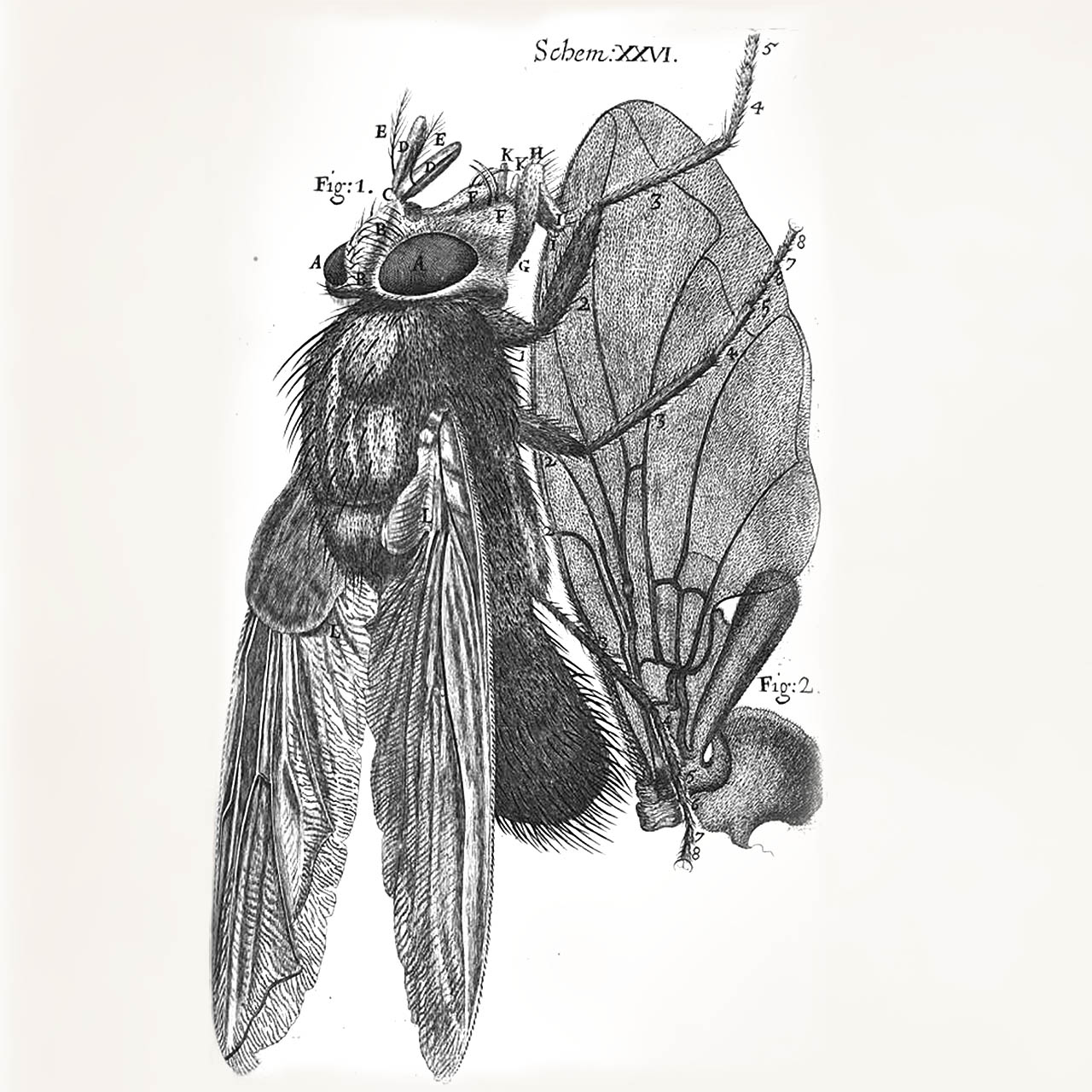
For one thing, using sound to understand scientific phenomena is not actually new. Diarist Samuel Pepys wrote about meeting scientist Robert Hooke in 1666 that “he is able to tell how many strokes a fly makes with her wings (those flies that hum in their flying) by the note that it answers to in musique during their flying.” Unfortunately Hooke never published his findings, leading researchers to speculate on his methods. One popular theory is that he tied strings of varying lengths between a fly and an ear trumpet, recognizing that sympathetic resonance would cause the correct length string to vibrate, thus allowing him to calculate the frequency. Even Galileo used sound, showing the constant acceleration of a ball due to gravity by using an inclined plane with thin moveable frets. By moving the placement of the frets until the clicks created an even tempo he was able to come up with a mathematical equation to describe how time and distance relate when an object falls.
There have also been other scientific advances using sound in the more recent past. The stethoscope was invented in 1816 for auscultation, listening to the sounds of the body. It was later applied to machines—listening for the operation of the technological gear. Underwater sonar was patented in 1913 and is still used to navigate and communicate using hydroacoustic phenomenon. The Geiger Counter was developed in 1928 using principles discovered in 1908; it is unclear exactly when the distinctive sound was added. These are all examples of auditory display [AD]; sonification-generating or manipulating sound by using data is a subset of AD. As the forward to the The Sonification Handbook states, “[Since 1992] Technologies that support AD have matured. AD has been integrated into significant (read “funded” and “respectable”) research initiatives. Some forward thinking universities and research centers have established ongoing AD programs. And the great need to involve the entire human perceptual system in understanding complex data, monitoring processes, and providing effective interfaces has persisted and increased” (Thomas Hermann, Andy Hunt, John G. Neuhoff, Sonification Handbook, iii)
Sonification clearly enables scientists, musicians and the public to interact with data in a very different way, particularly compared to the more numerous techniques involving vision. Indeed, because hearing functions quite differently than vision, sonification offers an alternative kind of understanding of data (sometimes more accurate), which would not be possible using eyes alone. Hearing is multi-directional—our ears don’t have to be pointing at a sound source in order to sense it. Furthermore, the frequency response of our hearing is thousands of times more accurate than our vision. In order to reproduce a moving image the sampling rate (called frame-rate) for film is 24 frames per second, while audio has to be sampled at 44,100 frames per second in order to accurately reproduce sound. In addition, aural perception works on simultaneous time scales—we can take in multiple streams of audio data at once at many different dynamics, while our pupils dilate and contract, limiting how much visual data we can absorb at a single time. Our ears are also amazing at detecting regular patterns over time in data; we hear these patterns as frequency, harmonic relationships, and timbre.
But hearing isn’t simple, either. In the current fascination with sonification, the fact that aesthetic decisions must be made in order to translate data into the auditory domain can be obscured. Headlines such as “Here’s What the Higgs Boson Sounds Like” are much sexier than headlines such as “Here is What One Possible Mapping of Some of the Data We Have Collected from a Scientific Measuring Instrument (which itself has inaccuracies) Into Sound.” To illustrate the complexity of these aesthetic decisions, which are always interior to the sonification process, I focus here on how my collaborators and I have been using sound to understand many kinds of scientific data.
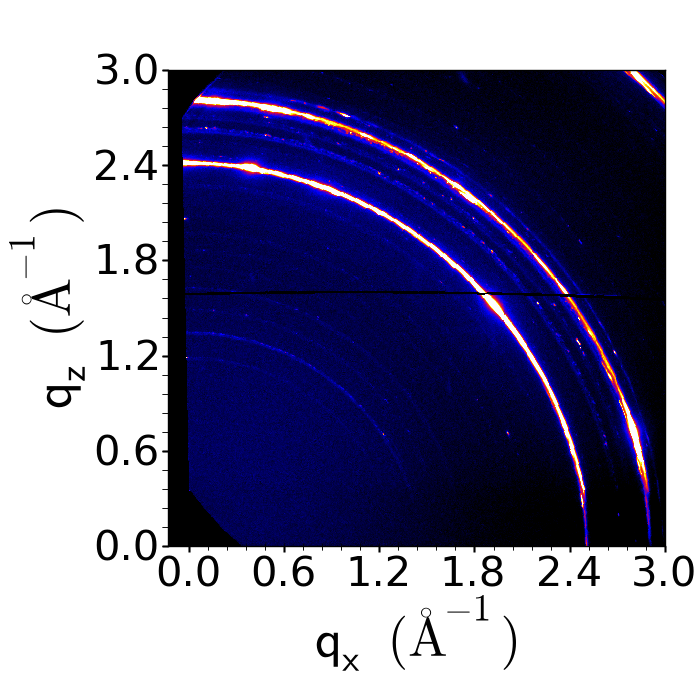
My husband, Kevin Yager, a staff scientist at Brookhaven National Laboratory, works at the Center for Functional Nanomaterials using scattering data from x-rays to probe the structure of matter. One night I asked him how exactly the science of x-ray scattering works. He explained that X-rays “scatter” off of all the atoms/particles in the sample and the intensity is measured by a detector. He can then calculate the structure of the material, using the Fast Fourier Transform (FFT) algorithm. He started to explain FFT to me, but I interrupted him because I use FFT all the time in computer music. The same algorithm he uses to determine the structure of matter, musicians use to separate frequency content from time. When I was researching this post, I found a site for computer music which actually discusses x-ray scattering as a precursor for FFT used in sonic applications.
To date, most sonifications have used data which changes over time – a fly’s wings flapping, a heartbeat, a radiation signature. Except in special cases Kevin’s data does not exist in time – it is a single snapshot. But because data from x-ray scattering is a Fourier Transform of the real-space density distribution, we could use additive synthesis, using multiple simultaneous sine waves, to represent different spatial modes. Using this method, we swept through his data radially, like a clock hand, making timbre-based sonifications from the data by synthesizing sine waves using with the loudness based on the intensity of the scattering data and frequency based on the position.
We played a lot with the settings of the additive synthesis, including the length of the sound, the highest frequency and even the number of frequency bins (going back to the clock metaphor – pretend the clock hand is a ruler – the number of frequency bins would be the number of demarcations on the ruler) arriving eventually at set of optimized variables.
Here is one version of the track we created using 10 frequency bins:
.
Here is one we created using 2000:
.
And here is one we created using 50 frequency bins, which we settled on:
.
On a software synthesizer this would be like the default setting. In the future we hope to have an interactive graphic user interface where sliders control these variables, just like a musician tweaks the sound of a synth, so scientists can bring out, or mask aspects of the data.
To hear what that would be like, here are a few tracks that vary length:
.
.
.
Finally, here is a track we created using different mappings of frequency and intensity:
.
Having these sliders would reinforce to the scientists that we are not creating “the sound of a metallic alloy,” we are creating one sonic representation of the data from the metallic alloy.
It is interesting that such a representation can be vital to scientists. At first, my husband went along with this sonification project as more of a thought experiment rather than something that he thought would actually be useful in the lab, until he heard something distinct about one of those sounds, suggesting that there was a misaligned sample. Once Kevin heard that glitched sound (you can hear it in the video above), he was convinced that sonification was a useful tool for his lab. He and his colleagues are dealing with measurements 1/25,000th the width of a human hair, aiming an X-ray through twenty pieces of equipment to get the beam focused just right. If any piece of equipment is out of kilter, the data can’t be collected. This is where our ears’ non-directionality is useful. The scientist can be working on his/her computer and, using ambient sound, know when a sample is misaligned.

It remains to be seen/heard if the sonifications will be useful to actually understand the material structures. We are currently running an experiment using Mechanical Turk to determine this kind of multi-modal display (using vision and audio) is actually helpful. Basically we are training people on just the images of the scattering data, and testing how well they do, and training another group of people on the images plus the sonification and testing how well they do.
I’m also working with collaborators at Stony Brook University on sonification of data. In one experiment we are using ambisonic (3-dimensional) sound to create a sonic map of the brain to understand drug addiction. Standing in the middle of the ambisonic cube, we hope to find relationships between voxels, a cube of brain tissue—analogous to pixels. When neurons fire in areas of the brain simultaneously there is most likely a causal relationship which can help scientists decode the brain activity of addiction. Computer vision researchers have been searching for these relationships unsuccessfully; we hope that our sonification will allow us to hear associations in distinct parts of the brain which are not easily recognized with sight. We are hoping to leverage the temporal pattern recognition of our auditory system, but we have been running into problems doing the sonification; each slice of data from the FMRI has about 300,000 data points. We have it working with 3,000 data points, but either our programming needs to get more efficient, or we have to get a much more powerful computer in order to work with all of the data.
On another project we are hoping to sonify gait data using smartphones. I’m working with some of my music students and a professor of Physical Therapy, Lisa Muratori, who works on understanding the underlying mechanisms of mobility problems in Parkinsons’ Disease (PD). The physical therapy lab has a digital motion-capture system and a split-belt treadmill for asymmetric stepping—the patients are supported by a harness so they don’t fall. PD is a progressive nervous system disorder characterized by slow movement, rigidity, tremor, and postural instability. Because of degeneration of specific areas of the brain, individuals with PD have difficulty using internally driven cues to initiate and drive movement. However, many studies have demonstrated an almost normal movement pattern when persons with PD are provided external cues, including significant improvements in gait with rhythmic auditory cueing. So far the research with PD and sound has be unidirectional – the patients listen to sound and try to match their gait to the external rhythms from the auditory cues.In our system we will use bio-feedback to sonify data from sensors the patients will wear and feed error messages back to the patient through music. Eventually we hope that patients will be able to adjust their gait by listening to self-generated musical distortions on a smartphone.
As sonification becomes more prevalent, it is important to understand that aesthetic decisions are inevitable and even essential in every kind of data representation. We are so accustomed to looking at visual representations of information—from maps to pie charts—that we may forget that these are also arbitrary transcodings. Even a photograph is not an unambiguous record of reality; the mechanics of the camera and artistic choices of the photographer control the representation. So too, in sonification, do we have considerable latitude. Rather than view these ambiguities as a nuisance, we should embrace them as a freedom that allows us to highlight salient features, or uncover previously invisible patterns.
__
Margaret Anne Schedel is a composer and cellist specializing in the creation and performance of ferociously interactive media. She holds a certificate in Deep Listening with Pauline Oliveros and has studied composition with Mara Helmuth, Cort Lippe and McGregor Boyle. She sits on the boards of 60×60 Dance, the BEAM Foundation, Devotion Gallery, the International Computer Music Association, and Organised Sound. She contributed a chapter to the Cambridge Companion to Electronic Music, and is a joint author of Electronic Music published by Cambridge University Press. She recently edited an issue of Organised Sound on sonification. Her research focuses on gesture in music, and the sustainability of technology in art. She ran SUNY’s first Coursera Massive Open Online Course (MOOC) in 2013. As an Associate Professor of Music at Stony Brook University, she serves as Co-Director of Computer Music and is a core faculty member of cDACT, the consortium for digital art, culture and technology.
—
Featured Image: Dr. Kevin Yager, data measured at X9 beamline, Brookhaven National Lab.
—
Research carried out at the Center for Functional Nanomaterials, Brookhaven National Laboratory, is supported by the U.S. Department of Energy, Office of Basic Energy Sciences, under Contract No. DE-AC02-98CH10886.
—

REWIND! ….. If you liked this post, you might also like:
The Noises of Finance–N. Adriana Knouf
Revising the Future of Music Technology–Aaron Trammell
A Brief History of Auto-Tune–Owen Marshall
—
Share this:

Unsettled Listening: Integrating Film and Place
DOI: https://doi.org/10.59350/bpe7e-n4158
Welcome to the third and final installment of Sculpting the Film Soundtrack, our series about sound in contemporary films. We’ve been focusing on how filmmakers are blurring the boundaries between music, speech, and sound effects – in effect, integrating distinct categories of soundtrack design.
In our first post, Benjamin Wright showed how celebrated composer Hans Zimmer thinks across traditional divisions of labour to integrate film sound design with music composition. Danijela Kulezic-Wilson followed up with an insightful piece on the integration of audio elements in Shane Carruth’s Upstream Color, suggesting how scholars can apply principles of music, like tempo and rhythm, to their analyses of the interactions between a film’s images and sounds. In this final entry, Randolph Jordan, considers another dimension of integration: a film’s sounds and the place where it was produced. In his provocative and insightful reading of the quasi-documentary East Hastings Pharmacy, Jordan, who is completing a post-doctoral post at Simon Fraser University, elaborates on how the concept of “unsettled listening” can clue us into the relationship between a film and its origins of production. You’ll be able to read more about “unsettled listening” in Jordan’s forthcoming book, tentatively titled Reflective Audioviewing: An Acoustic Ecology of the Cinema, to be published by Oxford University Press.
I hope you’ve enjoyed taking in this series as much as I’ve enjoyed editing it with the help of the marvelous folks at SO!. Thanks for reading. — Guest Editor Katherine Spring
—
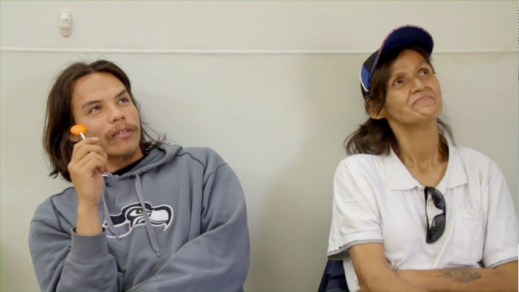
A mother and son of First Nations ancestry sit in the waiting area of a methadone clinic in Vancouver’s Downtown Eastside, their attention directed toward an offscreen TV. A cartoon plays, featuring an instrumental version of “I’ve Been Working on the Railroad” that mingles with the operating sounds of the clinic and ambience from the street outside. The tune is punctuated by a metal clinking sound at the beginning of each bar, calling to mind the sound of driving railway spikes that once echoed just down the street as the City of Vancouver was incorporated as the western terminus of the Canadian Pacific Railway (beginning thus the cycle of state-sanctioned erasure of indigenous title to the land). The familiar voice of Bugs Bunny chimes in: “Uh, what’s all the hubbub, bub?”
.
Hubbub indeed. Let’s unpack it.
The scene appears one third of the way through East Hastings Pharmacy (Antoine Bourges, 2012), a quasi-documentary set entirely within this clinic, staging interactions between methadone patients (played by locals and informed by their real-life experiences) and the resident pharmacist (played by an actress). Vancouver’s Downtown Eastside, dubbed Canada’s “worst neighborhood” for its notorious concentration of transients and public drug use, is also home to the largest community of First Nations peoples within the city limits, a product of the long history of dispossession in the surrounding areas. When the film presents this indigenous pair listening to a Hollywood fabrication of the sounds that marked their loss of title to the city it is a potent juxtaposition, especially given the American infiltration of Vancouver’s mediascape since the 1970s. Long known as “Hollywood North,” Vancouver is more famous as a stand-in for myriad other parts of the world than for representing itself, its regional specificity endlessly overwritten with narratives that hide the city and its indigenous presence from public awareness.

In her essay “Thoughts on Making Places: Hollywood North and the Indigenous City,” filmmaker Kamala Todd stresses how media can assist the process of re-inscribing local stories into Vancouver’s consciousness. East Hastings Pharmacy is one such example, lending some screen time to urban Natives in the 21st Century city. But Todd reminds us that audiences also have a responsibility “to learn the stories of the land” that have been actively erased in dominant media practices, and to bring this knowledge to our experience of the city in all its incarnations (9). Todd’s call resonates with a process that Nicholas Blomley calls “unsettling the city” in his book of the same name. Blomley reveals Vancouver as a site of continual contestation and mobility across generations and cultural groups, and calls for an “unsettled” approach that can account for the multiple overlapping patterns of use that are concealed by “settled” concepts of bounded property. With that in mind, I propose “unsettled listening” as a way of experiencing the city from these multiple positions simultaneously. Rick Altman taught us to hear any given sound event as a narrative by listening for the auditory markers of its propagation through physical space, and recording media, over time (15-31). Unsettled listening invites us to hear through these physical properties of mediatic space to the resonating stories revealed by the overlapping and contradictory histories and patterns of use to which these spaces are put, all too often unacknowledged in the wake of settler colonialism.
East Hastings Pharmacy provides a great opportunity to begin the practice of unsettled listening. The film’s status as an independent production amidst industrial shooting is marked by the intersection of studio-fabricated sound effects and direct sound recording, as in the example described above, and further complicated by the film’s own hybrid of fiction and documentary modes. That speaks to the complexity of overlapping filmmaking practices in Vancouver today, a situation embedded within the intersecting claims to land use and cultural propriety on the streets of Vancouver’s Downtown Eastside. To unsettle listening is to hear all these overlapping situations as forms of resonance that begin with the original context of the televised cartoon and accumulate as they spread through the interior of the clinic and outwards across the surrounding land. So let’s try this out.
.
The cartoon is Falling Hare (Robert Clampett, 1943), a good example of the noted history of cross-departmental integration at The Warner Bros.’ cartoon studios. The scene in question begins at 1:55, and here the metallic clinking sound is just as likely to have been produced by one of music orchestrator Carl Stalling’s percussionists as by sound effects editor Treg Brown. This integration can be heard in the way that the music’s unspoken reference to railway construction charges each clink with the connotation of hammer on spike. However, the image track in Falling Hare doesn’t depict railway construction, but rather a gremlin whacking the nose of a live bomb in an attempt to do away with enemy Bugs seated on top. James Lastra would say (by way of Christian Metz) that the clinking sound is “legible” as hammer on spike for the ease with which the sound can be recognized as emanating from this implied source (126). But this legibility is premised upon a lack of specificity that also allows the sound to become interchangeable with something else, as is the case in this cartoon.

East Hastings Pharmacy capitalizes on this interchangeability by re-inscribing the clinking sound’s railway connotations, first by stripping the original image and then by presenting this sound in the context of the dire social realities of Vancouver’s Downtown Eastside as the city’s sanctioned corral for the markers of urban poverty – and indigeneity – that officials don’t want to spill out across the neighborhood’s increasingly gentrified perimeter.
As one of a string of Warner Bros. cartoons put in the service of WWII propaganda, the Falling Hare soundtrack also resonates with wartime xenophobia and imperialist expansion, branches of the same pathos that leads to the effacing of indigenous culture from the consciousness of colonizing peoples. In Vancouver, this has taken the form of what Jean Barman calls “Erasing Indigenous Indigeneity,” the process of chasing the area’s original peoples off the land while importing aboriginal artifacts from elsewhere to maintain a Native chic deemed safe for immigrant consumption (as when the city paid “homage” to the vacated Squamish residents of downtown Vancouver’s Stanley Park by erecting Kwakiutl totem poles imported from 200km north on Vancouver Island) (26). This is an interchangeability of cultural heritage premised upon a lack of specificity, the same quality that allows “legible” sound effects to become synchretic with a variety of implied sources. And this process is not unlike the interchangeability of urban spaces when shooting Vancouver for Seattle, New York, or Frankfurt, emphasizing generic qualities of globalized urbanization while suppressing recognizable soundmarks from the mix (such as the persistent sound of float plane propellers that populate Vancouver harbour, the grinding and screeching of trains in the downtown railyard, or the regular horn blasts from the local ferry runs just north of the city).
The high-concept legibility of Warner Bros.’ sound effects – used in Falling Hare to play on listener’s expectations to comic effect – is further unsettled by its presentation within the context of documentary sound conventions in East Hastings Pharmacy. Bourges’ film commits to regional specificity in part through the use of location sound recording, which, as Jeffrey K. Ruoff identifies in “Conventions of Documentary Sound,” is particularly valued as a marker of authenticity (27-29). While Bourges stages the action inside the clinic, the film features location recordings of the rich street life audible and visible through the clinic’s windows that proceeds unaffected by the cameras and microphones. This situation is all the more potent when we account for the fact that, in this scene, the location-recorded cartoon soundtrack and ambient sound effects were added in post-production, and so represent a highly conscious attempt to channel the acoustic environment according to the conventions of “authentic” sound in documentary film.
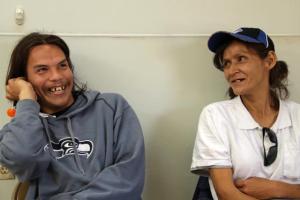
While the film uses location recording as a conscious stylistic choice to evoke documentary convention, it does so to engage meaningfully with the social situation in the Downtown Eastside, underlining Michel Chion’s point that “rendered” film sound – fabricated in studio to evoke the qualities of a particular space – is just as capable of engaging the world authentically (or inauthentically) as “real” sound captured on location (95-98). By presenting this Hollywood cartoon as an embedded element within the soundscape of the clinic, using a provocative mix of location sound and studio fabrication, East Hastings Pharmacy unsettles Hollywood’s usual practice of erasing local specificity, inviting us to think of runaway projects in the context of their foreign spaces of production and the local media practices that sit next to them.
Finally, this intersection of sonic styles points to the complex relationships that exist between the domains of independent and industrial production around Vancouver. In his book Hollywood North, Mike Gasher argues for thinking about filmmaking in British Columbia as a resource industry, pointing to how the provincial government has offered business incentives for foreign film production similar to those in place for activities like logging and fishing. Here we can consider how the local film industry might follow the same unsustainable patterns of extraction as other resource industries, all premised upon willful ignorance of indigenous uses of the land. Yet as David Spaner charts in Dreaming in the Rain, the ability to make independent films in Vancouver has become largely intertwined with the availability of industrial resources in town. Just as Hollywood didn’t erase the independent film, colonization didn’t erase indigenous presence.
East Hastings Pharmacy offers a powerful example of how we can practice unsettled listening on the staged sound of Falling Hare, devoid of local context and connected to the railway only by inference, to reveal a rich integration with regional specificity as the cartoon’s auditory resonances accumulate within its new spaces of propagation. In this way we can hear local media through its transnational network, including the First Nations, to understand the overlaps between seemingly contradictory modes of being within the city. And in so doing, we can also hear through the misrepresentation of the Downtown Eastside as “Canada’s worst neighborhood” to the strength of the community that has long characterized the area for anyone who scratches the surface, an important first step along the path to unsettling the city as a whole.
—
Featured Image: Still from East Hastings Pharmacy
—
Randolph Jordan wanted to be a rock star. Academia seemed a responsible back-up option – until it became clear that landing a professor gig would be harder than topping the Billboard charts. After completing his Ph.D. in the interdisciplinary Humanities program at Concordia University in 2010 he floated around Montreal classrooms on contract appointments before taking up a two-year postdoctoral research fellowship in the School of Communication at Simon Fraser University. There he has been investigating geographical specificity in Vancouver-based film and media by way of sound studies and critical geography, research that will inform the last chapter of his book Reflective Audioviewing: An Acoustic Ecology of the Cinema (now under contract at Oxford University Press). If you can’t find him hammering away at his manuscript, or recording his three young children hammering away at their Mason & Risch, look for him under Vancouver’s Burrard Bridge where he spends his “spare time” gathering film and sound material for his multimedia project Bell Tower of False Creek. Or visit him online here: http://www.randolphjordan.com
—
REWIND!…If you liked this post, you may also dig:
Fade to Black, Old Sport: How Hip Hop Amplifies Baz Luhrmann’s The Great Gatsby– Regina Bradley
Quiet on the Set?: The Artist and the Sound of a Silent Resurgence– April Miller
Play It Again (and Again), Sam: The Tape Recorder in Film (Part Two on Walter Murch)– Jennifer Stoever
—
Share this:




Current Top Posts





April 2021

January 2020

November 2019

October 2019

August 2019

April 2014

November 2017

March 2015

December 2017

October 2015


Recent Comments