
“Happy Homes Have Gramophones” –Gender, Technology, and the Sonic Restaging of Community Before and After the Partition of Bengal


Our listening practices are discursively constructed. In the sonic landscape of India, in particular, the way in which we listen and what we hear are often normative, produced within hegemonic discourses of gender, class, caste, region, and sexuality. . . This forum, Gendered Soundscapes of India, offers snapshots of sound at sites of trans/national production, marketing, filmic and musical texts. Complementing these posts, the accompanying photographs offer glimpses of gendered community formation, homosociality, the pervasiveness of sound technology in India, and the discordant stratified soundscapes of the city. This series opens up for us the question of other contexts in India where sound, gender, and technology might intersect, but, more broadly, it demands that we consider how sound exists differently in Pakistan, Sri Lanka, the Maldives, Bangladesh, Bhutan, Nepal, and Afghanistan. How might we imagine a sonic framework and South Asia from these locations? —Guest Editors Praseeda Gopinath and Monika Mehta
For the full introduction to the forum, click here.
To read all of the posts in the forum, click here.
—
“She compelled respect at once by refusing on any account to be phonographed: perhaps she thought, amongst other things, that if she committed her soul to a broken piece of wax it might get broken…my subsequent experiences showed that it was only too likely,” wrote the British musicologist A.H. Fox-Strangways in 1910 about Indian female singer Chandra Prabha, while remarking on the harsh reactions to the gramophone in India (90). Such deep-rooted discomfort with the gramophone speaks to the cognitive, perceptual and experiential challenges faced by a listener/performer when a new auditory technology substitutes familiar terrains of musical production.
In this post, I revisit the decades prior to and following the 1947 Partition of Bengal, a phase singularly volatile not only in India’s political but also its musical and technological histories. I examine how the introduction of European harmony/polyphony in the aural imaginary of Bengal negotiates ideologies espoused by the nationalists in the (re)constitution of gendered space post-Partition by transforming relations of consumption. The production of gendered domesticity was vitally related to rigid conceptions of physical space and its allocation in colonial Bengal which, further, influenced music reception in ways worth probing.
The auditory regimes prior to the emergence of recording/radio-broadcast typified public modes of listening based on live performances engendering affective flows and presupposed human proximity. This culture of aurality is inextricably tied to communal modes of consumption and performance, be it the high-end salon-tradition of the Bengali modern song, the hard-hitting agitprop strains of the Bengal wing of the IPTA (Indian People’s Theatre Association) or even the stylized elite classical genres. The collective nature of musical practice conjures up traditional connotations of masculine spaces, especially in the case of the elite Bengali household where the gendered ideology of spatial orientation relegated the respectable Bengali woman (bhadramahila) to the interiors of the house (antahpur/andarmahal). The delights of salon-music were to be relished by the man of the house (babu).
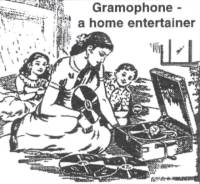
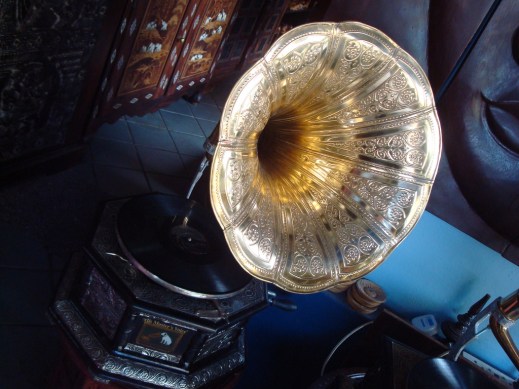
Thus, the communitarian character of musical practice often made it elusive to respectable women. However, the emergence and subsequent sophistication of auditory technologies ushered a radical transformation to such a dynamic by dissociating music from the human performer. Besides leading to the obvious technological alienation in the listener, the privatization of the listening experience was accompanied by a condition of a penetrating solitude and interiority, a state speaking to the voices and /sounds emanating from the phonograph. At the sociological level, the entry of recording technology redefined long-held divisions of domestic space and the gendered dynamics thereof by not only democratizing musical consumption but also forging provisional collectivities of listeners often cutting across gender, class and caste. Besides, traditional associations of musical genres with specific loci- classical music with the salon/concert space for instance- gave way to a more fluid conception of domestic space assuming multiple sonic/musical identities depending on what the gramophone played. The phonographic interface, thus, radically reconfigures listening practices and produces a different paradigm of self, sound, community, and gender.
What is at stake here is not some covert form of linear technological determinism, but a more nuanced detour around auditory-technologies, spaces of consumption, and the affordances thereof that calibrate auditory experience along new registers. What merits contemplation is how (if at all) these technological innovations in the commercial arena complement and usher formal nuances and sonic innovations in the musical works they mediate. The gramophone renders problematic the uncritical conflation of the sonic and visual registers typical of live musical performance and, in the process, sets in motion a unique dynamic of interacting with musical sound. Severed from its visual footholds in live performance, phonographic sounds often provoke the listener to imagine the singing/performing body which, in turn, informs the way the sounds are processed mentally.
Indian music has traditionally been based on a single melody which, in its skeletal grammar, is an individual mode of expression, even when performed by a group. The intrinsic form of Indian and traditional East Asian music in general exhibits a non-harmonic character. The concept of musical harmony proper is considered a European import. European harmony, polyphony, and counterpoint are in their very essences a set of disparate tonal registers forging a gestalt which impresses on the mind of the listener an overarching unity. At an experiential level, the polyphonic form embodies a distinct sonic ontology and a novel dimension, as it were, and thus cannot be reduced to merely a stylistic import. It induces a new auditory condition, a new register of being-in-listening (the lecture snippet from 57:08-.1:02:07 effectively demonstrates the morphing of the basic melody of a song into its polyphonic equivalent). The new auditory condition conjoins the familiarity of the melody with the markedly different yet complementing registers of the polyphony, creating a novel sensation for the uninitiated Bengali listener.
Among the very early records to employ musical polyphony in India were two iconic musical works of the mid-20th century, one devotional in intent– Aham Rudre from Mahishasurmardini (1931) composed by the legendary music director Pankaj Mullick–and the other, a professed experiment in introducing polyphony in Bengali music, Shurer Ei Jharna (1958), by the noted composer Salil Chowdhury.
In the current context, it is important to note how the sonic dimension of musical polyphony in Aham Rudre and Shurer Ei Jharna embodies and substitutes notions of aural communities and restages a communitarian character. Notably, the creation and circulation of these works paralleled the establishment of commercial state-radio in India (1930) and the first microgroove record in Kolkata in 1958 by the Gramophone Company.
The Gramophone Company in Calcutta marketed its records with the Bengali tagline “Shukhi Grihokon Shobhe Gramophone/Happy Homes Have Gramophones,” projecting the phonograph as the symbolic ideal of the domestic idyll and in the process confronting gendered spatial demarcations head-on by invading the auditory horizons of the secluded Bengali women. The striking presence of the gramophone in the iconic Gramophone Scene (1:35:17-1:35:28) in Satyajit Ray’s movie Ghare Baire–set in the backdrop of the 1905 Partition of Bengal–beautifully illustrates the sorority forged by the gramophone which, notably, draws even the marginalized widow Bouthan within its field of influence.
However, the gramophone superseded its commodity-character to serve not only in crass exhibitionism but also as an index of a masculine, elite consumerist culture where “serious music” and musical connoisseurship often became synonymous with the gramophone and recorded sound. A new breed of “record-collectors” came into existence, mainly belonging to the upwardly-mobile/elite classes whose passion for records was their most prominent identity-marker in the domestic realm, occasionally outweighing even their professional concerns.
But even as the radio and phonograph transcended the hitherto gendered character of musical reception by entering the women’s quarters and dissolving time-honored segregations of auditory spaces within the household, it had to contend with a deep-seated psychological discomfort in the listener, a fundamental unease with befriending technology that substituted the human. I argue that the newly insulated character of the radiophonic auditory experience was counteracted by significant efforts, conscious or otherwise, at sonically restaging and reclaiming the community lost in technological mediation.

Given pet notions of musical anthropology and the chronological coincidence between the early uses of harmony and the entry and sophistication of technologically mediated music in Bengal one could, at the risk of slight oversimplification, posit that the import of the harmonic form at this significant juncture sonically compensates the auditory solitude induced by radio/phonograph by recreating a modified and idealized Platonic (Platonic here is used as an allusion to ‘music of the spheres’ to point towards how musical harmony since medieval times has been associated with ideal public) community and restaging it within the confines of the constitutive plurality of the polyphonic mode. As an aside, the initial introduction of polyphony in Shurer Ei Jharna (1958) garnered flak from a large section of the audience who cognized it as a group of amateur performers ‘singing out of key’ (Salil Chowdhury’s lecture from 30:31-31:15). Over the next few decades, however, this form was trans-culturated and seamlessly assimilated within the sonic vocabulary of the Bengali/Indian masses, so much so that without the regular vocal/instrumental counterpoint, commercial songs nowadays are often felt to be lacking hue.
The sonic changes that I have been investigating preceded or followed the Partition of Bengal, which informed the gendered patterns of popular musical consumption. It is well-known that the exigencies of the Partition proved emancipatory for women in that they were exposed to the vagaries of the workplace, leaving the confines of their quarters. It is with an often uncritical celebratory fervor that the Partition is credited with fashioning the independent, self-reliant and educated middle-class Bengali working woman, on occasion emerging as the sole bread-earner of the family. Jasodhara Bagchi says that the “partition accelerated the earlier trends of the twentieth century of abolishing the ‘purdah that had confined the Bengali bhadramahila to her antahpur (private quarters)…The same stroke that brought this flood of uprooted marginalised women to Calcutta also opened the door to many new opportunities for Bengali middle-class Hindu women. They came out of the private domain of domesticity and child rearing to take up public duties.’”(8) Uditi Sen, however, in her revisionist reading of the celebratory impulse argues that “situational aberrations” notwithstanding, the Partition did not lead to “a transformation of social norms or any substantive change of women’s ideal role within the bounds of the family.”(16)
In the aftermath of the Second World War, which had also witnessed the entry of women into the professional/public sphere, the USA launched a propaganda war to restore women to their hearth, revivifying the “cult of the housewife,” deploying films and popular music to promote the trope of the ideal housewife. Redefining domestic spaces as woman’s space had also been in the cards for the Indian state post-Partition, which had to a large extent been governed by patterns of popular media consumption. Arguably, the coincidental emergence of musical harmony and sophistication of private auditory technologies in the years following the Partition contributed to efforts to restore women to their private quarters, by compensating the lost professional community of the self-reliant working woman with the poetic/sonic community embodied by the polyphonic form, in the process enlivening her insipid lived quarters. Popular media technologies often employ innovation in content to revivify clichéd formats; musical harmony coupled with sophisticated audio-reproduction provides a classic instance of inaugurating a new sonic dimension in popular music which provides a powerful and enthralling form of domestic leisure.
Thus, in the context of early 20th century Bengal, the gramophone was a significant import which not only reconfigured perceptual registers and musical cultures but also listening practices by entering the interiors of elite Bengali households. Besides democratizing the listening experience, which till then had largely been restricted to male constituencies, the gramophone privatized musical consumption. It was through the introduction of musical polyphony, which is intrinsically ‘public/ communal’ as regards its sonic character, that this impulse was counteracted. As mentioned earlier, these technical/musical innovations widened the scope and impact of musical performance and arguably contributed to the reconstitution of gendered domestic space post-Partition which points to subtle and complex relations among technology, (musical) genre and gender.
—
Featured Image: Screen Capture from by SO! Ed. Satyajit Ray’s Ghare Baire
—
Ronit Ghosh is a postgraduate student at the Department of Art and Technology, Aalborg University, Denmark. His research interests include aesthetic philosophy, critical sound studies and the sociology of Indian popular music. He has published articles on sound studies in the International Journal on Stereo and Immersive Media and The Rupkatha Journal and has an article forthcoming in the Journal of Sonic Studies. He is a classical violinist and an aspiring music composer.
—
REWIND! . . .If you liked this post, you may also dig:
Tape Hiss, Compression, and the Stubborn Materiality of Sonic Diaspora–Chris Chien
Pushing Play: What Makes the Portable Cassette Recorder Interesting?—Gustavus Stadler
Hearing “Media-Capitalism” in Egypt–Ziad Fahmy
—
Share this:

“People’s lives are at stake”: A conversation about Law, Listening, and Sound between James Parker and Lawrence English

DOI: https://doi.org/10.59350/psewd-cn976
Lawrence English is composer, media artist and curator based in Australia. Working across an eclectic array of aesthetic investigations, English’s work prompts questions of field, perception and memory. He investigates the politics of perception, through live performance and installation, to create works that ponder subtle transformations of space and ask audiences to become aware of that which exists at the edge of perception.
James Parker is a senior lecturer at Melbourne Law School, where he is also Director of the research program ‘Law, Sound and the International’ at the Institute for International Law and the Humanities. James’ research addresses the many relations between law, sound and listening, with a particular focus at the moment on sound’s weaponisation. His monograph Acoustic Jurisprudence: Listening to the Trial of Simon Bikindi (OUP 2015) explores the trial of Simon Bikindi, who was accused by the International Criminal Tribunal for Rwanda of inciting genocide with his songs (30% discount available with the code ALAUTHC4). James is also a music critic and radio broadcaster. He will be co-curating an exhibition and parallel public program on Eavesdropping at the Ian Potter Museum of Art in Melbourne between July and October 2018.
Lawrence English: James, thanks for taking the time to correspond with me. I was interested in having this conversation with you as we’re both interested in sound, but perhaps approaching its potential applications and implications in somewhat different ways. And yet we have a good deal of potential cross over in our sonic interests too. Particularly in the way that meaning is sought and extracted from our engagements with sound. How that meaning is constructed and what is extracted and amplified from those possible, meaningful readings of sound in time and place. I read with great interest your work on acoustic jurisprudence, specifically how you almost build a case for an ontological position that’s relational between sound and the law. I wondered if you could perhaps start with a summary of this framework you’re pushing towards? I am interested to know how it is you have approached this potentiality in the meaning of sound and the challenges that lie in working around an area that is still so diffuse, at least in a legal setting.
James Parker: Let me begin by saying a sincere thank you for the invitation. As a long-time fan of your work, it’s a pleasure. It’s also symptomatic in a way, because – so far at least – the art world has been much more interested in my research than the legal academy. When I’m in a law faculty and I say that my work is about law’s relationship(s) with sound, people are mostly surprised, sometimes they’re interested, but they rarely care very much. I don’t mean this as a slight. It’s just that their first instinct is always that I’m doing something esoteric: that my work doesn’t really ‘apply’ to them as someone interested in refugee law, contract, torts, evidence, genocide, or whatever the case may be. As you point out though, that’s not the way I see it at all. One of the things I’ve tried to show in my work is just how deeply law, sound and listening are bound up with each other. This is true in all sorts of different ways, whether or not the relationship is properly ‘ontological’.
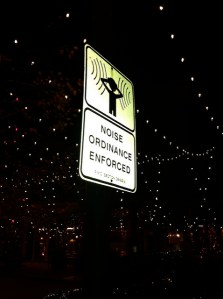
At the most obvious level, the soundscape (both our sonic environment and how we relate to it) is always also a lawscape. Our smartphones, loudspeakers, radios and headsets are all proprietary, as is the music we listen to on them and the audio-formats on which that music is encoded. Law regulates and fails to regulate the volume and acoustic character of our streets, skies, workplaces, bedrooms and battlefields. Courts and legislatures claim to govern the kinds of vocalizations we make – what we can say or sing, where and when – and who gets to listen. As yet another music venue, airport, housing development or logging venture receives approval, new sounds enter the world, others leave it and things are subtly reconstituted as a result.
What’s striking when you look at the legal scholarship, however, is that how sound is conceived for such purposes gets very little attention. There are exceptions: in the fields of copyright and anti-noise regulation particularly. But for the most part, legal thought and practice is content to work with ‘common sense’ assumptions which would be immediately discredited by anyone who spends their time thinking hard about what sound is and does. So as legal academics, legislators, judges, and so on, we need to be much better at attending to law’s ‘sonic imagination’. When an asylum seeker is denied entry to the UK because of the way he pronounces the Arabic word for ‘tomato’ (which actually happened…the artist Lawrence Abu Hamdan has done some fantastic work on this), what set of relations between voice, accent and citizenship is at stake? When a person is accused of inciting genocide with their songs (in this instance a Rwandan musician called Simon Bikindi), what theory or theories of music manifest themselves in the decision-making body’s discourse and in the application of its doctrine? These are really important questions, it seems to me. To put it bluntly: people’s lives are at stake.

Another way of thinking about the law-sound relation would be to think about the role played by sound in legal practice: in courtrooms, legislatures etc. For a singer to be tried for genocide, for instance, his songs must be heard. Audio and audio- video recordings must be entered as evidence and played aloud to the court; a witness or two may sing. How? When? Why? The judicial soundscape is surprisingly diverse, it turns out. Gavels knock (at least in some jurisdictions), oaths are sworn, judgment is pronounced; and all of this increasingly into microphones, through headsets, and transmitted via audio-video link to prisons and elsewhere. This stuff matters. It warrants thinking about.
Outside the courtroom, sound is often the medium of law’s articulation: what materialises it, gives it reality, shape, force and effect. Think of the police car’s siren, for instance, or a device like the LRAD, which I know you’re also interested in. Or in non-secular jurisdictions, we could think equally of the church bells in Christianity, the call to prayer in Islam or the songlines of Aboriginal Australia. The idea that law today is an overwhelmingly textual and visual enterprise is pretty commonplace. But it’s an overstatement. Sound remains a key feature of law’s conduct, transmission and embodiment.

And to bring me back to where I started, I feel like artists and musicians are generally better tuned in to this than us lawyers.
English: Given the fact that the voice, and I suppose I mean both literally and metaphorically, reigns so heavily in the development and execution of the law it’s surprising that the discourses around sound aren’t a little more engaged. That being said, it’s not that surprising really, as I’d argue that until recently the broader conversations around sound and listening have been rather sparse. It’s only really in the past three decades have we started to see a swell of critical writings around these topics. The past decade particularly has produced a wealth of thought that addresses sound.
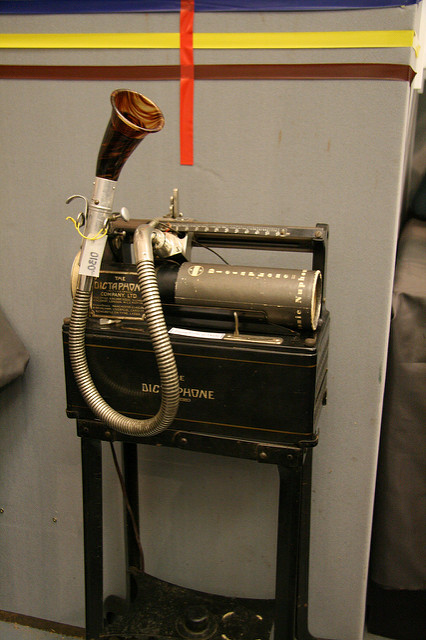
I suppose though that really this situation you describe in the law is tied back into the questions that surround the recognition of sound and the complexities of audition more generally. I can’t help but feel that sound has suffered historically from a lack of theoretical investigation. Partly this is due to the late development of tools that provided the opportunity for sound to linger beyond its moment of utterance. That recognition of the subjectivity of audition, revealed in those first recordings of the phonograph must have been a powerful moment. In that second, suddenly, it was apparent that how we listen, and what it is we extract from a moment to moment encounter with sound is entirely rooted in our agency and intent as a listener. The phonograph’s capturing of audio, by contrast, is without this socio-cultural agency. It’s a receptacle that’s technologically bound in the absolute.
I wonder if part of the anxiety, if that’s the word that could be used, around the way that sound is framed in a legal sense is down to its impermanence. That until quite recently we had to accept the experience of sound, as entirely tethered to that momentary encounter. I sense that the law is slow to adapt to new forms and structures. Where do you perceive the emergence of sound as a concern for law? At what point did the law, start to listen?
Parker: Wow, there’s so much in this question. In relation to your point about voice, of course lawyers do ‘get it’ on some level. If you speak to a practitioner, they’re sure to have an anecdote or two about the sonorous courtroom and the (dark) arts of legal eloquence. You may even get an academic to recognise that a theory of voice is somehow implicit in contemporary languages of democracy, citizenship and participatory politics: this familiar idea that (each of us a little sovereign) together we manifest the collective ‘voice’ of the people. But you’ll be hard pushed to find anyone in the legal academy actually studying any of this (outside the legal academy, I can thoroughly recommend Mladen Dolar’s incredible A Voice and Nothing More, which is excellent – if brief – on the voice’s legal and political dimensions). One explanation, as you say, might be that it’s only relatively recently that a discourse has begun to emerge around sound across the academy: in which case law’s deafness would be symptomatic of a more general inattention to sound and listening. That’s part of the story, I think. But it’s also true that the contemporary legal academy has developed such an obsession with doctrine and the promise of law reform that really any inquiry into law’s material or metaphysical aspects is considered out of the ordinary. In this sense, voice is just one area of neglect amongst many.
As for your points about audio-recording, it’s certainly true that access to recordings makes research on sound easier in some respects. There’s no way I could have written my book on the trial of Simon Bikindi, for instance, without access to the audio-archive of all the hearings. Having said that, I’m pretty suspicious of this idea that the phonograph, or for that matter any recording/reproductive technology could be ‘without agency’ as you put it. It strikes me that the agency of the machine/medium is precisely one of the things we should be attending to.
English: I may have been a little flippant. I agree there’s nothing pure about any technology and we should be suspicious of any claims towards that. It seems daily we’re reminded that our technologies and their relationships with each other pose a certain threat, whether that be privacy through covert recording or potential profiling as suggested by the development of behavioral recognition software with CCTV cameras.
Parker: Not just that. CCTV cameras are being kitted out with listening devices now too. There was a minor controversy about their legality and politics earlier this year in Brisbane in fact.

English: Thinking about sound technologies, at the most basic level, the pattern of the microphone, cardioid, omni and the like, determines a kind of possibility for the articulation of voice, and its surrounds. I think the microphone conveys a very strong political position in that its design lends itself so strongly to the power of singular voice. That has manifest itself in everything from media conferences and our political institutions, through to the inane power plays of ‘lead singers’ in 1980s hard rock. The microphone encourages, both in its physical and acoustic design, a certain singular focus. It’s this singularity that some artists, say those working with field recording, are working against. This has been the case in some of the field recordings I have undertaken over the years. It has been a struggle to address my audition and contrast it with that of the microphone. How is it these two rather distinct fields of audition might be brought into relief? I imagine these implications extend into the courtroom.
Parker: Absolutely. Microphones have been installed in courtrooms for quite a while now, though not necessarily (or at least not exclusively) for the purposes of amplification. Most courts are relatively small, so when mics do appear it’s typically for archival purposes, and especially to assist in the production of trial transcripts. This job used to be done by stenographers, of course, but increasingly it’s automated.
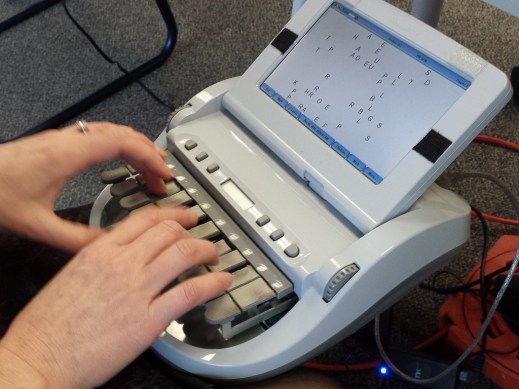
So no, in court, microphones don’t tend to be so solipsistic. In fact, in some instances they can help facilitate really interesting collective speaking and listening practices. At institutions like the International Criminal Tribunal for Rwanda, or for the Former Yugoslavia, for instance, trials are conducted in multiple languages at once, thanks to what’s called ‘simultaneous interpretation’. Perhaps you’re familiar with how this works from the occasional snippets you see of big multi-national conferences on the news, but the technique was first developed at the Nuremberg Trials at the end of WWII.
What happens is that when someone speaks into a microphone – whether it’s a witness, a lawyer or a judge – what they’re saying gets relayed to an interpreter watching and listening on from a soundproof booth. After a second or two’s delay, the interpreter starts translating what they’re saying into the target language. And then everyone else in the courtroom just chooses what language they want to listen to on the receiver connected to their headset. Nuremberg operated in four languages, the ICTR in three. And of course, this system massively affects the nature of courtroom eloquence. Because of the lag between the original and interpreted speech, proceedings move painfully slowly.
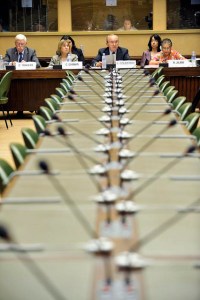
Courtroom speech develops this odd rhythm whereby everyone is constantly pausing mid-sentence and waiting for the interpretation to come through. And the intonation of interpreted speech is obviously totally different from the original too. Not only is a certain amount of expression or emotion necessarily lost along the way, the interpreter will have an accent, they’ll have to interpret speech from both genders, and then – because the interpreter is performing their translation on the fly (this is extraordinarily difficult to do by the way… it takes years of training) – inevitably they end up placing emphasis on odd words, which can make what they say really difficult to follow. As a listener, you have to concentrate extremely hard: learn to listen past the pauses, force yourself to make sense of the stumbling cadence, strange emphasis and lack of emotion.
On one level, this is a shame of course: there’s clearly a ‘loss’ here compared with a trial operating in a single language. But if it weren’t for simultaneous interpretation, these Tribunals couldn’t function at all. You could say the same about the UN as a whole actually.
English: I agree. Though for what it’s worth it does seem as though we’re on a pathway to taking the political and legal dimensions of sound more seriously. Your research is early proof of that, as are cases such as Karen Piper’s suit against the city of Pittsburgh in relation to police use of an LRAD. As far as the LRAD is concerned, along with other emerging technologies like the Hypershield and the Mosquito, it’s as though sound’s capacity for physical violence, and the way this is being harnessed by police and military around the world somehow brings these questions more readily into focus.
Parker: I think that’s right. There’s definitely been a surge of interest in sound’s ‘weaponisation’ recently. In terms of law suits, in addition to the case brought by Karen Piper against the City of Pittsburgh, LRAD use has been litigated in both New York and Toronto, and there was a successful action a couple of years back in relation to a Mosquito installed in a mall in Brisbane.
On the more scholarly end of things, Steve Goodman’s work on ‘sonic warfare’ has quickly become canonical, of course. But I’d also really recommend J. Martin Daughtry’s new book on the role of sound and listening in the most recent Iraq war. Whereas Goodman focuses on the more physiological end of things – sound’s capacity both to cause physical harm (deafness, hearing loss, miscarriages etc) and to produce more subtle autonomic or affective responses (fear, desire and so on) – Daughtry is also concerned with questions of psychology and the ways in which our experience even of weaponised sound is necessarily mediated by our histories as listeners. For Daughtry, the problem of acoustic violence always entails a spectrum between listening and raw exposure.
These scholarly interventions are really important, I think (even though neither Goodman nor Daughtry are interested in drawing out the legal dimensions of their work). Because although it’s true that sound’s capacity to wound provides a certain urgency to the debate around the political and legal dimensions of the contemporary soundscape, it’s important not to allow this to become the only framework for the discussion. And that certainly seems to have happened with the LRAD.
Of course, the LRAD’s capacity to do irreparable physiological harm matters. Karen Piper now has permanent hearing loss, and I’m sure she’s not the only one. But that shouldn’t be where the conversation around this and other similar devices begins and ends. The police and the military have always been able to hurt people. It’s the LRAD’s capacity to coerce and manage the location and movements of bodies by means of sheer acoustic force – and specifically, by exploiting the peculiar sensitivity of the human ear to mid-to-high pitch frequencies at loud volumes – that’s new. To me, the LRAD is at its most politically troubling precisely to the extent that it falls just short of causing injury. Whether or not lasting injury results, those in its way will have been subjected to the ‘sonic dominance’ of the state.
So we should be extremely wary of the discourse of ‘non-lethality’ that is being mobilised by to justify these kinds of technologies: to convince us that they are somehow more humane than the alternatives: the lesser of two evils, more palatable than bullets and batons. The LRAD renders everyone before it mute biology. It erases subjectivity to work directly on the vulnerable ear. And that strikes me as something worthy of our political and legal attention.
English: I couldn’t agree more. These conversations need to push further outward into the blurry unknown edges if we’re to realise any significant development in how the nature of sound is theorised and analysed moving forward into the 21st century. Recently I have been researching the shifting role of the siren, from civil defence to civil assault. I’ve been documenting the civil defence sirens in Los Angeles county and using them as a starting point from which to trace this shift towards a weaponisation of sound. The jolt out of the cold war into the more spectre-like conflicts of this century has been like a rupture and the siren is one of a number of sonic devices that I feel speak to this redirection of how sound’s potential is considered and applied in the everyday.
—
Featured Image: San Francisco 9th Circuit Court of Appeals Jury Box, Image by Flickr User Thomas Hawk, (CC BY-NC-ND 2.0)
—

REWIND! . . .If you liked this post, you may also dig:
Sounding Out! Podcast #60: Standing Rock, Protest, Sound and Power (Part 1)–Marcella Ernest
The Noises of Finance–N. Adriana Knouf
Learning to Listen Beyond Our Ears: Reflecting Upon World Listening Day–Owen Marshall
Beyond the Grandiose and the Seductive: Marie Thompson on Noise
—
Share this:




Current Top Posts





April 2021

January 2020

November 2019

October 2019

August 2019

April 2014

November 2017

March 2015

December 2017

October 2015


Recent Comments