
“This is Not a Sound”: The Treachery of Sound in Comic Books
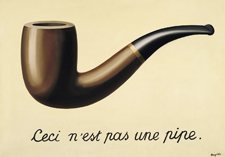
“This is not a pipe.”
In comics theorist Scott McCloud‘s seminal work Understanding Comics (1993), there comes a point following his convoluted description of Magritte’s “The Treachery of Images” where he asks the reader, “Do you hear what I’m saying?” In the next panel he adds, “If you do, have your ears check because no one said a word.” The joke is, of course, that while his comic doppelganger is depicted as talking through the use of word balloons, no words are being spoken. We are reading, not hearing. And yet, sound (or rather, its representation) remains a crucial part of reading and enjoying comic books.
Magritte was trying to get us to think about the treachery of visual representation, while McCloud points us of the treachery of aural representation. A stylized “SPLAT!” is certainly not a sound, but our instinctual understanding of sound helps us to interpret what is otherwise a silent medium in ways beyond the mere the descriptive effect of a sound’s depiction. The way comics use sound can teach us about the function of sound in understanding the visual and textual. As McCloud asserts, comics depend on the reader to create closure between parts of an imagined whole in order for disparate panels to make sense. While it second-nature for the comic reader to interpret the depiction of sound in comics, the closure enacted to make stylized textual elements into “a sound” is a central way that this is enacted.

The most famous use of comic sound effect words is probably from the old 1960s Batman TV series—where the “SOCK!” and “BONG!” of superhero and sidekick reinforced the campy aesthetic of the program. It is telling that the Batman-theme (and the fight scenes in general) uses horn flares to emphasize those “POW!” and “BIFF!” moments. The suggestion is that the ostentatious representations of sound that these textual flare sound effect words provide are an empty signifier. There is no sound behind that sound. The weak-sounding slaps and smacks of knuckles on flesh would never suffice for the larger than life world of comic superheroes, and the more out-there comics get the more difficult it is to trace a relationship between the textual/visual representation and any sound in the real world. There is no point of comparison by which to understand the “SHREEEEEE!” of a launching “zirrer” in Kurt Busiek’s Astro City, but only the vague evocation of some loud shrill noise.
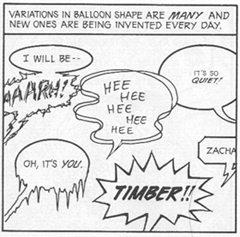 And yet, comic readers not only understand these representations as sound, but there are also a variety of visual clues given that help the reader interpret some quality of those sounds. The most ubiquitous example of sound in comics is, of course, the word balloon—so ubiquitous in fact that it is easy to take for granted the fact that comics have their own conventions for handling and describing sound without recourse to adjectives. The irony is that the shape and texture of word balloons (just like the shape and texture of sound effect words like “BOOM!”) that help to convey the quality of sound become nearly invisible to the reader. Just as any literate person sees a word they know and interprets it for what it is meant to represent and not a collection of individual letters, the dripping icicle-like shape of a word balloon is read as a cold tone or the sharp points of the balloon are read as loud and abrupt.
In her essay “The Comic Book’s Soundtrack” from The Language of Comics (2001), Catherine Khordoc provides a very good overview of the use of sound in comics using the example of Goscinny and Uderzo’s Asterix to provide examples of the various ways word balloons and the implanting of onomatopoeic words directly into the panel image itself are used to represent sounds in comic books. Yet, the function of the representation of sound in comic runs even deeper than simply translating the quality of sound itself; it also serves to help establish timeframes for panels (or sets of panels) and functions in establishing the closure the reader performs in making sense of both individual panels and their context within a sequence of panels. Discrete sounds—whether it’s the “FWOOSH!” of the Human Torch flaming on or long-winded pseudo-scientific explanation of the Negative Zone by Mr. Fantastic—require the passage of time to be intelligible. In order for sounds to be differentiated, they must have some form of beginning, middle and end (or in the parlance of synthesized sound, “attack, decay, sustain, release”). This means that in comics, a medium where space and time merge, representations of sound are crucial to making sense of action, in particular, to the passage of time within a singular panel—for while time can be shown to pass between two or more panels through the process of closure (implicitly understanding the movement or occurrence not depicted between panels that makes them sequential), a singular panel is not necessarily a discrete moment, as an entire conversation can occur within it, requiring readers to perform closure even within the scope of a single panel.
For example, in the second panel below, despite the static image, the passage of time suggested by the conversation about Spider-man’s wounds and payment leads the reader to make sense of the sequence between it and the panel that follows. It is the reader’s understanding that it takes time to talk and listen out loud that helps make the time of the panel apparent.

Click to Enlarge.
Perhaps the most telling evidence of the centrality of sound, at least to the superhero comic genre, was Marvel’s decision to include a synopsis and explanation of the action at the end of each issue of the “‘Nuff Said,” “silent” month of comics back in 2001—wherein there was no dialogue or captions.
There is still a lot to consider when it comes to sound in comics—not just the rhetoric of sound or sound as a signifier of time, but sound as identity. Representations of sound in comics can serve as a form of character signature, and I do not mean only famous lines like Superman’s “Up, up and away!” (which really emerged from Superman radio plays), but iconic sounds such as Spider-man’s web-shooters going “THWIPP!” or Wolverine’s claws, “SNIKT!” that over time have come to be more than just descriptive sound-words, but signifiers that are unique for the characters themselves. (See TV Trope’s page on signature sound effects)
In the end, this brief overview will hopefully serve as a starting point in generating more thoughts on not only how our familiarity with sound informs our reading and interpreting of comics, but how this (admittedly) very general idea can be applied to other ostensibly silent and primarily visual media. The use of sound in comics is a perfect example of how the transparency of sound can make it presence and function easy to overlook. Furthermore, the way in which it is used to orient the reader and help provide closure between and within panels, and identify characters clues us in to the importance of its role and the importance of considering where and how else it might function. I, for one, am going to keep thinking on it and looking for examples of in comics and hope that others join their thoughts to the discussion. Until then, as Stan Lee would “say,” Excelsior!


Share this:

Into the Woods: A Brief History of Wood Paneling on Synthesizers*

Various Species for the Prophet 08, Analogics
*a companion piece of this research, on electronic sounds as lively individuals, is forthcoming in the American Quarterly special issue on sound, September 2011.
Not long ago, while researching the history of synthesized sound—or taking a break to troll for interesting synthesizers for sale online (activities that, for me, inevitably blend together)—I came across a thriving industry of small companies that offer custom-made wood panels to adorn the sides of old and new synths, like Synthwood, Custom Synths, Analogics, and MPCStuff.
As Trevor Pinch and Frank Trocco note in Analog Days, their history of Moog synthesizers, an “analog revival” is underway: “Today in the digital world, there is a longing to get back to what was lost” (9). The music technology magazine Sound on Sound concurs, documenting a renewed interest among electronic music-makers in modular synthesizers like those popularized by Moog and others in the late-1960s. Yet there seems to be more at play with this proliferation of wood customizations than merely nostalgia for analog synths, Hammond organs, and hi-fi cabinetry. How might we interpret this desire to adorn—lovingly, even obsessively—steel-encased machines that produce sound by electronic means, with various species of wood? What does this realm of audio esoterica reveal about material and social aspects of musical instruments, and the workings of contemporary media cultures more broadly?
On Contingency and Faith: Walnut, Purple Felt, and the True Cross
Pinch and Trocco describe the Minimoog as the first synthesizer to become a “classic,” due to its relative ease of use, widespread availability, portability and compact design (214). In the retrospective imaginations of historians and musicians, a significant feature that established its classic design was the walnut wood case on an early generation of Minimoog models.

The Moog Minimoog B (with walnut case), ca. 1970, Audities Foundation
However, Bill Hemsath, an engineer who assembled the first Minimoog prototypes in 1969-70, told Pinch and Trocco that these instruments were assembled from “junk I found in the attic” and an assortment of affordable materials cobbled together in the moment (214). Jim Scott, another engineer who worked on developing the Minimoogs, explained in a 1997 interview: “the reason we made it walnut [was] because Moog had gotten a deal someplace and had a whole barnful.” He noted that “the musicians certainly appreciated the fact that it was made out of walnut,” but eventually the designers “ran out of walnut and started buying something else and slapping paint on it to make it look like walnut.” The various kinds of wood used on models from different years, and the exact start and end dates of the coveted walnut models, remain contested matters among Moog enthusiasts.
Hemsath elaborated on this history in a 1998 interview by making an analogy to “classic” piano design: “There’s a similar story from Steinway. Back when they first got started in the U.S. they used to buy their felts from a feltmaker in Paris… And they got a lot of purple felt because [the supplier] used to be the felt maker for Napoleon’s army, and had a lot left over. So the colored cores in the hammers of those old Steinways were purple because of Napoleon’s army. Well, [the supplier] ran out, and [Steinway] said, red’s fine. They started making pianos with red felt, which is what they have today, and people started complaining, saying, it’s not a real Steinway, it’s not purple.” Like the proverbial purple felt on original Steinway pianos, walnut panels on synthesizers became “classic” because of their association with an originary moment, however happenstance, in the history of a particular instrument, and a limited supply and production run that rendered the material in question relatively rare.
So, a contemporary synthesizer enthusiast’s desire to acquire a “classic” walnut Minimoog, or to commemorate its aesthetic with customized wood panels, is in part an effort to establish a material connection to history. Synthesizer history unfolds in the deep time of technoscience which, as Donna Haraway has argued, often “barely secularize[s]” Judeo-Christian narratives of first and last things, of figural anticipation and fulfillment (9-10). The concern among some synthesizer enthusiasts to possess either the actual wood of an early-model Minimoog, or a faithful substitute for it, indeed resonates with Christian material cultures around relics of the True Cross and next-best artifacts with suitable provenance. A historical conjuncture that is contingent on otherwise unremarkable circumstances (e.g., Bob Moog’s good deal on a barnful of walnut in upstate New York) is marked as an originary or otherwise defining moment (the “invention” of a “classic” synthesizer) for a culture that defines itself as proceeding from it; the former is made to anticipate the latter, and the latter comes to fulfill the former.
Taking Stock: Materialities of Instruments, Sounds, Ecosystems
What kind of wood panels live in my studio? The manual to my Jomox XBase 09 drum machine, from 1999, details that its “steel sheet body” is bookended by “varnished side panels made of alder wood.” Wikipedia‘s pop-anthropological roundup of alder’s “use by humans” includes smoking various foods, treating skin inflammations and tumors, and building electric guitars. Fender Stratocasters have been built with alder since the 1950s. Guitar enthusiasts are notoriously fussy about which type of wood comprises the instrument’s body because of its effect on tone. Scientists, meanwhile, have taken to applying medical imaging techniques to Stradivarius violins, trying to “crack the mystery” of its prized tone. (Some say it’s due to the particular density of slow-growing trees in the Little Ice Age; others conclude it must be the varnish.)

The author
Given these interconnected concerns with instrument materials and the composition of tone, one might venture an etymological connection between timbre—which the Oxford English Dictionary describes as the character or quality of a musical sound depending upon the instrument producing it—and timber, which references “the matter or substance of which anything is built up or composed.” Music scholars often characterize timbre as the materiality of sound. Despite longstanding knowledge of the relationships of timber and timbre among instrument builders and musicians, and possible overlaps in historical applications of these words, placing wood panels on the sides of synthesizers surely has no effect on the resulting tone. Or does it? Audiophiles are prone toward occult-like habits, such as placing a single coin on top of a speaker to absorb vibration; and wood panels may well have subtle effects on the overall stability of an electronic instrument, resulting in barely perceptible sonic artifacts.
My Virus B synthesizer from the late-1990s has darker wood side panels than the Jomox, sort of a faux mahogany. Recently I wrote to Access Music, explaining my research on synthesizer history and inquiring what kind of wood they used. They replied that the B series featured stained beech wood (also commonly used and appreciated for producing smoked German beers and cheeses). Virus volunteered that they “in general do not use any kind of tropical wood for our devices.” Using sustainable wood has become a mandate and marketing concern at the Moog company as well; Moog’s wood “comes primarily from Tennessee. Hardwoods in Tennessee are growing faster than they are being harvested… US hardwoods are a world-wide model of sustained forest management.” Among contemporary synthesizer companies, there is often a selective eco-consciousness; as synthesizer designer Jessica Rylan suggested in our interview for Pink Noises: Women on Electronic Music and Sound (Duke: 2010), it is arguably impossible to build a synthesizer that does not incorporate at least some materials that are toxic in stages of manufacturing and/or disposal.

A Flashstick USB drive that incorporates wood from Berkshire, England
The paradox of dressing up an electronic machine made partly of toxic materials and processes with a sustainable-wood exterior is a fitting metaphor—like a contemporary fig leaf—for how we outwardly express environmentalist concern, despite plenty of contradictions in practice. Wood-adorned electronic devices, in all their glorious contradictions, are especially resonant in this cultural moment; see Asus’s EcoBook, Karvt’s lineup of custom wood skins for MacBooks, and, my favorite, Flashsticks: handmade wood USB “sticks” that combine “the high tech world of computing with the simplicity of the world of nature.” The story of Flashsticks’ handmade creation is a case study in eco-contradiction: the website implies that no trees were harmed in the making of their USB sticks—the company uses locally-sourced, “fallen wood from the previous winter’s storms”—yet we do not hear of the toxic materials that may comprise the drive itself.
Wood panels indeed work to conceal inconvenient truths. As Ruth Schwartz Cowan pointed out, the midcentury aesthetic of hiding household appliances behind wood paneling typified a culture that concealed gendered divisions of domestic labor (205). Lisa Parks has documented the similar recent phenomenon of dressing up cell towers as trees, which obscures the politics of media infrastructure behind a cloak of “nature.”
This is also a story about the mirage of a space between nature and artifice. Retro-culture enthusiasts celebrate that “real cars have fake wood paneling.” Meanwhile, a company called iBackwoods has engineered a “real wood” iPhone case that pays tribute to “timeless style of a wood panel station wagon.” Moog’s new Filtatron application for iPad, a software emulation of the company’s Moogerfooger filter pedal, is rendered authentic by its virtual wood panels. All of these examples reveal the “nature” of wood paneling to be cultural all the way down.

Washington DC - National Museum of American History: America on the Move - Park Forest, Illinois 1950s by Wallyg (via Flickr)
Ultimately, wood paneling might prompt us to recognize the interconnectedness among seemingly divergent materials, environments, and social practices. Consider, as a useful comparison to the climate-forged Stradivarius, the ash baseball bat: cherished by players for its “magical” effects on hitting, and now threatened by a warming climate and killer beetle in its source forests in Pennsylvania. Every synthesizer likewise holds and explodes into an ecosystem, and sometimes sounds like one too. The composer Mira Calix has suggested that analog synthesizers, with their individual quirks that increase with age, are much like wooden instruments; both seem to breathe like “little creatures” and take on a unique character, like a human voice. Our synthesizers, our kin.


Share this:


Current Top Posts





April 2021

January 2020

November 2019

October 2019

August 2019

April 2014

November 2017

March 2015

December 2017

October 2015
 Sounding Out!

Recent Comments