
Optophones and Musical Print

From E.E. Fournier d’Albe, The Moon Element (New York: D. Appleton & Company, 1924), 141.
In 1912, British physicist Edmund Fournier d’Albe built a device that he called the optophone, which converted light into tones. The first model—“the exploring optophone”—was meant to be a travel aid; it converted light into a sound of analogous intensity. A subsequent model, “the reading optophone,” scanned print using lamp-light separated into beams by a perforated disk. The pattern of light reflected back from a given character triggered a corresponding set of tones in a telephone receiver. d’Albe initially worked with 8 beams, producing 8 tones based on a diatonic scale. He settled on 5 notes: lower G, and then middle C, D, E and G. (Sol, do, re, mi, sol.) The optophone became known as a “musical print” machine. It was popularized by Mary Jameson, a blind student who achieved reading speeds of 60 words per minute.
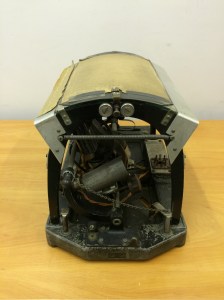
Reading Optophone, held at Blind Veterans UK (formerly St. Dunstan’s). Photographed by the author. With thanks to Robert Baker for helping me search through the storeroom to locate this item, which was previously uncatalogued and “lost” for many years.
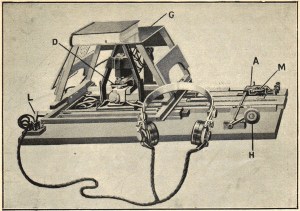
Schematic of optophone from Vetenskapen och livet (1922)
In the field of media studies, the optophone has become renowned through its imaginary repurposings by a number of modernist artists. For one thing, the optophone finds brief mention in Finnegan’s Wake. In turn, Marshall McLuhan credited James Joyce’s novel for being a new medium, turning text into sound. In “New Media as Political Forms,” McLuhan says that Joyce’s own “optophone principle” releases us from “the metallic and rectilinear embrace of the printed page.” More familiar within media studies today, Dada artist Raoul Hausmann patented (London 1935), but did not successfully build, an optophone presumably inspired by d’Albe’s model, which he hoped would be employed in audiovisual performances. This optophone was meant to convert sound into light as well as the reverse. It was part of a broader contemporary impulse to produce color music and synaesthetic art. Hausmann also wrote optophonetic poetry, based on the sounds and rhythms of “pure phonemes” and non-linguistic noises. In response, Francis Picabia painted two optophone portraits in 1921 and 22. Optophone I, below, is composed of lines that might be sound waves, with a pattern that disorders vision.

Francis Picabia, Optophone I (1922)
Theorists have repeatedly located Hausmann’s device at the origin of new media. Authors in the Audiovisuology, Media Archaeology, and Beyond Art: A Third Culture anthologies credit Hausmann’s optophone with bringing-into-being cybernetics, digitization, the CD-ROM, audiovisual experiments in video art, and “primitive computers.” It seems to have escaped notice that d’Albe also used the optophone to create electrical music. In his book, The Moon Element, he writes:

E.E. Fournier d’Albe, The Moon Element (New York: D. Appleton & Company, 1924), 107.
d’Albe’s device is typically portrayed as a historical cul-de-sac, with few users and no real technical influence. Yet optophones continued to be designed for blind people throughout the twentieth century; at least one model has users even today. Musical print machines, or “direct translators,” co-existed with more complex OCR-devices—optical character recognizers that converted printed words into synthetic speech. Both types of reading machine contributed to today’s procedures for scanning and document digitization. Arguably, reading optophones intervened more profoundly into the order of print than did Hausmann’s synaesthetic machine: they not only translated between the senses, they introduced a new symbolic system by which to read. Like braille, later vibrating models proposed that the skin could also read.
In December 1922, the Optophone was brought to the United States from the United Kingdom for a demonstration before a number of educators who worked with blind children; only two schools ordered the device. Reading machine development accelerated in the U.S. around World War II. In his position as chair of the National Defense Research Committee, Vannevar Bush established a Committee on Sensory Devices in 1944, largely for the purpose of rehabilitating blind soldiers. The other options for reading—braille and Talking Books—were relatively scarce and had a high cost of production. Reading machines promised to give blind readers access to magazines and ephemeral print (recipes, signs, mail), which was arguably more important than access to books.
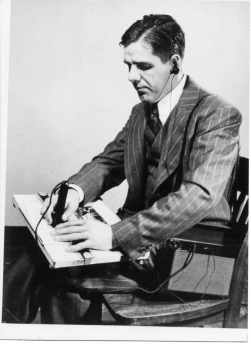
Joe Piechowski with the A-2 reader. Courtesy of Rob Flory.
At RCA (Radio Corporation of America), the television innovator Vladimir Zworykin became involved with this project. Zworykin had visited Fournier d’Albe in London in the 19-teens and seen a demonstration of the optophone. Working with Les Flory and Winthrop Pike, Zworykin built an initial machine known as the A-2 that operated on the same principles, but used a different mechanism for scanning—an electric stylus, which was publicized as “the first pen that reads.” Following the trail of citations for RCA’s “Reading Aid for the Blind” patent (US 2420716A, filed 1944), it is clear that the “pen” became an aid in domains far afield from blindness. It was repurposed as an optical probe for measuring the oxygen content of blood (1958); an “optical system for facsimile scanners” (1972); and, in a patent awarded to Burroughs Corporation in 1964, a light gun. This gun, in turn, found its way into the handheld controls for the first home video game system, produced by Sanders Associates.
The A-2 optophone was tested on three blind research subjects, including ham radio enthusiast Joe Piechowski, who was more of a technical collaborator. According to the reports RCA submitted to the CSD, these readers were able to correlate the “chirping” or “tweeting” sounds of the machine with letters “at random with about eighty percent accuracy” after 60 hours of practice. Close spacing on a printed page made it difficult to differentiate between letters; readers also had difficulty moving the stylus at a steady pace and in a straight line. Piechowski achieved reading speeds of 20 words per minute, which RCA deemed too slow.
Attempts were made to incorporate “human factors” and create a more efficient tonal code, to reduce reading time as well as learning time and confusion between letters. One alternate auditory display was known as the compressed optophone. Rather than generate multiple tones or chords for a single printed letter, which was highly redundant and confusing to the ear, the compressed version identified only certain features of a printed letter: such as the presence of an ascender or descender. Below is a comparison between the tones of the original optophone and the compressed version, recorded by physicist Patrick Nye in 1965. The following eight lower case letters make up the source material: f, i, k, j, p, q, r, z.
Original record in the author’s possession. With thanks to Elaine Nye, who generously tracked down two of her personal copies at the author’s request. The second copy is now held at Haskins Laboratories.

From Patrick Nye, “An Investigation of Audio Outputs for a Reading Machine,” AFB Research Bulletin (July 1965): 30.
Because of the seeming limitations of tonal reading, RCA engineers re-directed their research to add character recognition to the scanning process. This was controversial, direct translators like the optophone being perceived as too difficult because they required blind people to do something akin to learning to read print—learning a symbolic tonal or tactile code. At an earlier moment, braille had been critiqued on similar grounds; many in the blind community have argued that mainstream anxieties about braille sprang from its symbolic difference. Speed, moreover, is relative. Reading machine users protested that direct translators like the optophone were inexpensive to build and already available—why wait for the refinement of OCR and synthetic speech? Nevertheless, between November 1946 and May 1947, Zworykin, Flory, and Pike worked on a prototype “letter reading machine,” today widely considered to be the first successful example of optical character recognition (OCR). Before reliable synthetic speech, this device spelled out words letter by letter using tape recordings. The Letter-Reader was too massive and expensive for personal use, however. It also had an operating speed of 20 words per minute—thus it was hardly an improvement over the A-2 translator.
Haskins Laboratories, another affiliate of the Committee on Sensory Devices, began working on the reading machine problem around the same time, ultimately completing an enormous amount of research into synthetic speech and—as argued by Donald Shankweiler and Carol Fowler—the “speech code” itself. In the 1940s, before workable text-to-speech, researchers at Haskins wanted to determine whether tones or artificial phonemes (“speech-like speech”) were easier to read by ear. They developed a “machine dialect of English,” named wuhzi: “a transliteration of written English which preserved the phonetic patterns of the words.” An example can be played below. The eight source words are: With, Will, Were, From, Been, Have, This, That.
Original record in the author’s possession. From Patrick Nye, “An Investigation of Audio Outputs for a Reading Machine” (1965). With thanks to Elaine Nye.
Based on the results of tests with several human subjects, the Haskins researchers concluded that aural reading via speech-like sounds was necessarily faster than reading musical tones. Like the RCA engineers, they felt that a requirement of these machines should be a fast rate of reading. Minimally, they felt that reading speed should keep pace with rapid speech, at about 200 words per minute.
Funded by the Veterans Administration, members of Mauch Laboratories in Ohio worked on both musical optophones and spelled-speech recognition machines from the 1950s into the 1970s. One of their many devices, the Visotactor, was a direct-translator with vibro-tactile output for four fingers. Another, the Visotoner, was a portable nine-channel optophone. All of the Mauch machines were tested by Harvey Lauer, a technology transfer specialist for the Veterans Administration for over thirty years, himself blind. Below is an excerpt from a Visotoner demonstration, recorded by Lauer in 1971.
Visotoner demonstration. Original 7” open reel tape in author’s possession. With thanks to Harvey Lauer for sharing items from his impressive collection and for collaborating with the author over many years.

Harvey Lauer reading with the Visotactor, a text-to-tactile translator, 1977.
Later on the same tape, Lauer discusses using the Visotoner to read mail, identify currency, check over his own typing, and read printed charts or graphics. He achieved reading speeds of 40 words per minute with the device. Lauer has also told me that he prefers the sound of the Visotoner to that of other optophone models—he compares its sound to Debussy, or the music for dream sequences in films.
Mauch also developed a spelled speech OCR machine called the Cognodictor, which was similar to the RCA model but made use of synthetic speech. In the recording below, Lauer demonstrates this device by reading a print-out about IBM fonts. He simultaneously reads the document with the Visotoner, which reveals glitches in the Cognodictor’s spelling.
Original 7” open reel tape in the author’s possession. With thanks to Harvey Lauer.

The Cognodictor. Glendon Smith and Hans Mauch, “Research and Development in the Field of Reading Machines for the Blind,” Bulletin of Prosthetics Research (Spring 1977): 65.
In 1972, at the request of Lauer and other blind reading machine users, Mauch assembled a stereo-optophone with ten channels, called the Stereotoner. This device was distributed through the VA but never marketed, and most of the documentation exists in audio format, specifically in sets of training tapes that were made for blinded veterans who were the test subjects. Some promotional materials, such as the short video below, were recorded for sighted audiences—presumably teachers, rehabilitation specialists, or funding agencies.
Mauch Stereo Toner from Sounding Out! on Vimeo.
Video courtesy of Harvey Lauer.
Mary Jameson corresponded with Lauer about the stereotoner, via tape and braille, in the 1970s. In the braille letter pictured below she comments, “I think that stereotoner signals are the clearest I have heard.”

Letter courtesy of Harvey Lauer. Transcribed by Shafeka Hashash.
In 1973, with the marketing of the Kurzweil Reader, funding for direct translation optophones ceased. The Kurzweil Reader was advertised as the first machine capable of multi-font OCR; it was made up of a digital computer and flatbed scanner and it could recognize a relatively large number of typefaces. Kurzweil recalls in his book The Age of Spiritual Machines that this technology quickly transferred to Lexis-Nexis as a way to retrieve information from scanned documents. As Lauer explained to me, the abandonment of optophones was a serious problem for people with print disabilities: the Kurzweil Readers were expensive ($10,000-$50,000 each); early models were not portable and were mostly purchased by libraries. Despite being advertised as omnifont readers, they could not in fact recognize most printed material. The very fact of captchas speaks to the continued failures of perfect character recognition by machines. And, as the “familiarization tapes” distributed to blind readers indicate, the early synthetic speech interface was not transparent—training was required to use the Kurzweil machines.
Original cassette in the author’s possession.

Raymond Kurzweil and Kenneth Jernigan with the Kurzweil Reading Machine (NFB, 1977). Courtesy National Federation of the Blind.
Lauer always felt that the ideal reading machine should have both talking OCR and direct-translation capabilities, the latter being used to get a sense of the non-text items on a printed page, or to “preview material and read unusual and degraded print.” Yet the long history of the optophone demonstrates that certain styles of decoding have been more easily naturalized than others—and symbols have increasingly been favored if they bear a close relation to conventional print or speech. Finally, as computers became widely available, the focus for blind readers shifted, as Lauer puts it, “from reading print to gaining access to computers.” Today, many electronic documents continue to be produced without OCR, and thus cannot be translated by screen readers; graphical displays and videos are largely inaccessible; and portable scanners are far from universal, leaving most “ephemeral” print still unreadable.
—
Mara Mills is an Assistant Professor of Media, Culture, and Communication at New York University, working at the intersection of disability studies and media studies. She is currently completing a book titled On the Phone: Deafness and Communication Engineering. Articles from this project can be found in Social Text, differences, the IEEE Annals of the History of Computing, and The Oxford Handbook of Sound Studies. Her second book project, Print Disability and New Reading Formats, examines the reformatting of print over the course of the past century by blind and other print disabled readers, with a focus on Talking Books and electronic reading machines. This research is supported by NSF Award #1354297.
Share this:

The New Wave: On Radio Arts in the UK

 In the UK there has never been much scope for radio art within the realm of public service broadcasting, leading artists to seek funding for their own independent projects, predominantly from the Arts Council of England (ACE) and other state funding bodies and charitable trusts. In this article, the final in Sounding Out!‘s series Radio Art Reflections, I will consider this recent avenue of practice, because its results – in terms of audience composition, artistic output and the wider cultural context of the form – shed light on both the particular context of radio art practice in the UK, and also have implications for the wider struggle for sustainable independent media networks against the diminished imaginative horizons of a public broadcast culture endlessly inured to ‘unavoidable’ cuts and the free market enclosure of the digital commons.
In the name of ‘austerity’ such cuts have been inflicted upon broadcasters worldwide. The loss of key radio arts programmes like Australia’s Listening Room, as discussed in the last post by Colin Black, is by no means the exception, even in an age of expansion in digital spaces. As De Lys stated way back in 2006 it may be considered “[i]ronic that the ‘rationalization’ of radio arts by public broadcasters occurs at the same time that audio arts activity and the creative use of sound are expanding exponentially in community spaces, in galleries, games, and online.” (De Lys, S and Foley, M; 2006, “The Exchange: A Radio-Web Project for Creative Practitioners and Researchers” Convergence; The International Journal of Research into New Media Technologies, 12; 129, Sage)
Elsewhere, institutional affirmation through public broadcasting connects local, national and international art radio broadcasters, as it also empowers two long running international radio art competitions that continue today: the Prix Italia set up by RAI, in 1948, to engage creatives to work with radio and create new works for the medium; and the The Karl Sczuka Prize for Radio Art, established by SWR in Germany in 1955, notable (sadly) for how so few women artists have ever won the awards. For Kersten Glandien, contributing to the Reinventing The Dial symposium back in 2009, the availability of public radio funding in the 80s and 90s enabled a heyday of commissions and festivals, events and prizes (Glandien, K; 2009. Keynote Paper given at Reinventing the Dial Symposium. Canterbury Christ Church University).

No such radio art competition or open call for new radio art work has ever been run by the BBC, highlighting its resistance to the form. At present the BBC runs just one experimental programme that has been on air for 20 years: Between The Ears on BBC Radio 3, which leans towards more narrative-centered features reflecting Black’s issues with ABC’s Soundproof discussed in the last article.
ART STATIONS AND COMMUNITY RADIO IN THE UK
The first experimental art radio station in the UK went on air in Liverpool for a week in 1995, Hearing is Believing on 105.8FM. As Scanner wrote at the time it offered the chance for listeners to hear “sound works, performance and innovative documentaries that would never receive airplay on even the most ‘progressive’ FM bands. Remember, BBC Radio still has problems playing certain works of Stockhausen because they contain randomly-culled shortwave radio signals.”(The Wire, 1995). That inspired the London Musicians Collective to run its own month long arts station in Resonance 107.3FM in 1998. I was part of its action group and then its steering group as the station went full time in 2002.
Tight regulation across public and commercial radio in the UK also meant that artists were late to explore the medium. Trevor Wishart reminisced with me at Radio Without Boundaries about a radio piece he made with the BBC in mind that took over 28 years to be played on the radio in the UK, being not sufficiently ‘musical’ for a music station and not ‘dramatic’ enough to fulfill the conventions of drama.
In this context, community radio has been an important if limited platform and nurturing site for new radio art. There are now over 200 such stations in the U.K. but only two dedicated to the arts community: Resonance FM and Soundart Radio at 102.5 FM, the latter based in Devon since 2006. Soundart Radio exists on a hand-to-mouth basis via small grants to provide training for disadvantaged groups. Resonance FM, by contrast, has achieved regular funding by walking a line between its community status and its avant garde roots. Its success is due largely to its location and the exceptional work of volunteer artists and musicians who have developed innovative programming without budgets.
Arts Council England increased Resonance’s funding as it became a ‘national portfolio organisation’ in 2012. The station may tower over other most community stations, but its yearly funding is still only comparable with that of many regional arts festivals. Moreover, radio art is only a small part of what Resonance broadcasts, and is mostly scheduled as discrete programmes such as Radia, and as less frequent one-off programming such as Remote Performances a collaboration between London Fieldworks, the Live Art Development Agency and ACE, broadcasting 20 live mostly music based performances for a week from Glen Nevis, Lochaber, Scotland.
FUNDING RADIO ARTISTS
Open funding for artists directly from community radio stations is very limited and ad hoc. The Community Media Association was able to offer small commissions for Modulate, an open call to encourage artists to team up with community stations to encourage more arts diversity and address the fact that around “70 per cent of the community radio sector’s programming is music-based” (CapeUK, 2008, p.08). Meanwhile, Art Transmission was a welcome one-off project early this year run by Francis Knight who commissioned three sound artists including Jane Pitt and Xentos Jones to work with young boxers and steam railway enthusiasts to make radio works for the small community station BRFM on the Isle of Sheppey. A recent CapeUK report concluded that Community radio “offers creative and artistic freedom to their contributors unmediated by the editorial control exercised in commercial or public service broadcasting.” (CapeUK, 2008, p.20).

It would be naive to imagine editorial constraints do not exist in the community radio sector. This is perhaps why several British artists have gone it alone to retain autonomy by running their own short durational arts stations as Restricted Service Licenses for projects which run for up to 28 days and can broadcast up to 25 watts, such as Kaffe Matthews Radio Cycle (2003) and Tom McCarthy and INS Calling All Agents (2004), Celestial Radio (2008), Boat Radio (2012), Writtle Calling (2012), Radio Boredcast (2012) and The Dark Outside (2012-14) all funded by The Arts Council. This marks an increasing trend in the UK of artists-curated FM stations.
Grants for the Arts from ACE offers a way for artists to receive funding to make new work. My own group Radio Arts has, through funding from ACE and Kent County Council, been able to recently commission new radio art works for broadcast from Colin Black (AU), Arturas Bumsteinas (LITH), Iris Garelfs (GER), Anna Friz (CAN), Louise Harris (UK),Olivia Humphreys (UK),Langham Research Centre (UK), GX Jupitter- Larsen (US), Carlo Patrao (PORT), Mikey Weinkove (UK),Joaquim Cofreces (Argentina), Esther Johnson (UK), Michael McHugh (UK), Gregory Whitehead (USA), as well as Radio Arts members Genetic Moo, myself and James Backhouse (UK). Radio Arts ran a series of workshops, a radio art showcase exhibition and will be running a forthcoming live event and online gallery and further workshops next year alongside broadcasts of the new works to be heard on eight partner stations in four countries.
However, such work can only continue with further funding. For me it is important to move away from the current creative commons ethos, where no one is ever paid to participate. We should allow sound and radio artists to gain a fee to produce new radio work, particularly as the Artist Network in the UK is campaigning for artists to be paid in galleries.
MICROBROADCSTING AND ARTS SPACES
Another interesting area which has taken off from Japanese radio artist Tetsuo Kogowa is micro broadcasting, the use of small range transmitters allowing artists to broadcast in a localized space of up to one watt, without the need for a license, either by building the transmitters or buying them readymade. These work well for radio installation and have allowed me to continuously play works as discrete stations and produce surround works allowing a different voice or sound to emanate from each radio in the installation. For eight years, mostly unfunded, I worked on Switch Off a PhD radio art project documented on my blog creating eight different fictional stations as micro broadcast installations each imaging a future use for FM when it has been abandoned in the UK these works explored radio art practice from a post digital perspective.
.
Micro broadcasting these works proved to be a very liberating way of sharing radio art work in galleries and outside of conventional radio broadcasts and allowed me to really experiment without constraint, whilst the web has brought me closer with other international artists and communities to share practice and projects. Having used radios as a readymades for multiple and surround installations my experience has led me to new ways of thinking about installation work such as a bespoke transmitting book Spiritual Radio 2014, which broadcasts itself and awaits the listener to find its frequency.
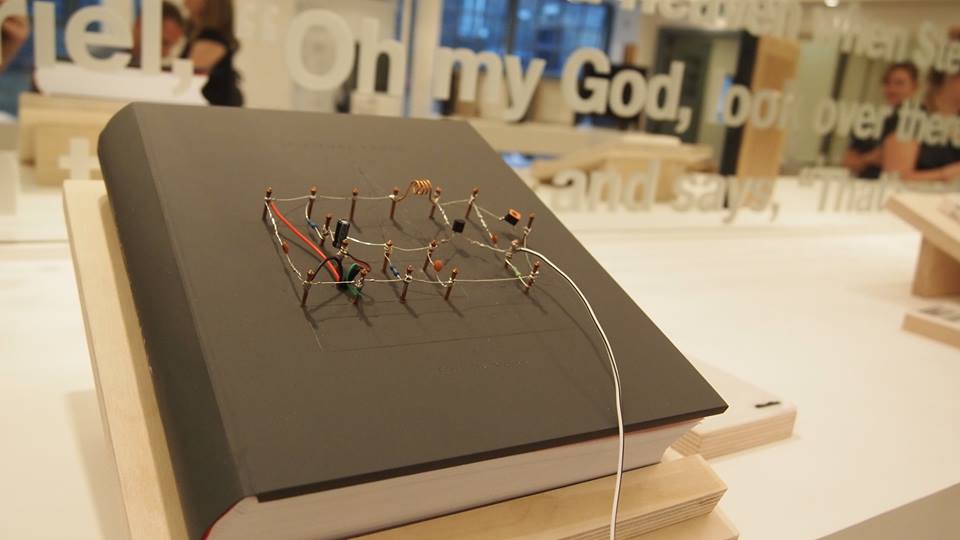
Magz Hall Spiritual Radio (2014) Whitechapel Gallery London
Following this line, many online arts stations have been set up by galleries and arts spaces, often as temporary projects. Online arts station Basic FM started in 2011, and was a project of Newcastle independent cinema Pixel Palace having hosted Vicki Bennett’s Radio Boredcast at the AV Festival (2012). It “presented an audio gallery that exhibited the work of those making interesting noise: sound collage, found sound, spoken word, discourse, dialogue and discussion, musique concrète or original, remixed and detourned musics” (Basic FM, 2014, website). Run by one part-time member of staff and funded by the Arts Council to run for thirty months until 30th Sept 2014 Basic FM did not carry on due to lack of further funding, a real loss after it steadily building up its reputation as the third full time arts station in the UK.
It seems that in the UK the lack of artistic airspace on public and community radio has been sidestepped by radio artists who have forged their own stations to redefine public space in myriad forms. And there are possibilities in the future. The latest temporary UK arts station call comes from the well regarded CCA Gallery Glasgow Radiophrenia next year, while London’s Tate Britain is currently running a family programme Radiocity and its community programmes have commissioned myself and Jim Backhouse from Radio Arts to run a series of workshops called Reclaim the Waves from the end of February, working with the local Westminster community to document the changing city and produce a participatory radio installation for exhibition.

—
Magz Hall is a sound, radio artist and founder of Radio Arts an artist led group who promote radio art. Her work has been exhibited in the British Museum, the Sainsbury Centre, MACBA Barcelona, Denmark, Italy, Germany, Norway, Morocco, Canada and the USA and broadcast internationally. Her ambisonic soundtrack of Hong Kong Airport at the British Museum was described as “extraordinary and rich.” Radio Mind (2012) an “intriguing and beautiful work” was commissioned by the Lightworks Festival. Her most recent work Spiritual Radio (2014) “looks like a hardback on life support” (TLS) was commissioned for ‘Unbinding the Book’a touring exhibition. A senior lecturer at Canterbury Christ Church University and a founder of London’s arts station Resonance FM, she has just completed a practice based PhD on radio art at CRISAP, LCC, University of the Arts London entitled Radio After Radio: Redefiningradioart in the light of new media technology through expanded practice.
—
Images courtesy of the artist.
—

REWIND! . . .If you liked this post, you may also dig:
Sound and Curation — Santaperversa
From Kitschy to Classy: Reviving the TR-808 — Ian Dunham
Revising the Future of Music Technology — Aaron Trammell
Share this:


Current Top Posts





April 2021

January 2020

November 2019

October 2019

August 2019

April 2014

November 2017

March 2015

December 2017

October 2015
 Sounding Out!
Recent Comments