
Play it Again (and Again), Sam: The Tape Recorder in Film (Part One on Noir)
 Being a teacher, I can’t resist giving out a summer reading list. Being a researcher, I can’t help but want to share the projects that I am working on–which right now includes excavating the cultural history of the magnetic tape recorder in the United States. So, in honor of the Summer Solstice tomorrow (marking the official start of the season) I compiled a three-part summer series for Sounding Out! that does both: “Play it Again (and Again) Sam: The Tape Recorder in Film.”
My summer sound studies A-V list encourages you to fill your idle hours watching the “top 6” featured appearances of the magnetic tape recorder in film, in chronological order (2 each month, with a bonus “supporting role” nod rounding out each post). Not only will “Play it Again (And Again) Sam” help you beef up your cinema buff credentials, but it will trace a little-known history, asking you to consider how the recorder tangled its thin brown plastic tape so effectively into the warp and weft of our twentieth-century lives. You’ll find that my “top 6” list reveals much more human desire than technological determinism; the representations I examine express a complex mixture of fear and fascination, optimism and regret, change and stasis. Often a tool of the powerful, sometimes a weapon of the weak, the tape recorder was a cold war domestic product that could never truly be domesticated. As you will see in this spoiler-free three part series, interactions with the tape recorder remixed America’s workplaces, schools, homes, public spaces and private moments, ultimately shifting how the world was heard (and heard again and again).
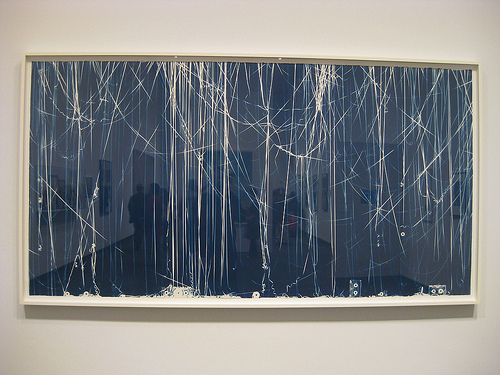
Memento (Soul II Soul) 2008 by Christian Marclay, Photo by Nathan Bowers
So, load up your Netflix queue, shake up your Jiffy Pop, and take a much-needed couch-break from the heat and humidity with these oh-so-cool black-and-whites from the 1940s and 1950s. Of course, we can’t start our films without some “Coming Attractions”: look for part two on July 18th (spotlight on Walter Murch) and part three (the 1980s) on August 15th.
1. Double Indemnity (Paramount, 1944, Directed by Billy Wilder)
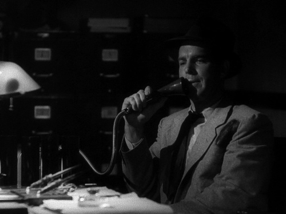
Walter Neff (Fred MacMurray) speaks his sordid tale into the dictaphone
Okay, so it is actually a dictaphone that appears in this film and the tormented insurance salesman Walter Neff (Fred MacMurry) is “putting it on wax” rather than magnetic tape, but this once ubiquitous, now long forgotten recording device has such a haunting presence and a structuring role in this grim noir confessional that, like Neff himself, I am suddenly willing to break my own rules. Outside of femme fatale Phyllis Dietrichson’s (Barbara Stanwyck) elaborately sculptured coiffure, the key image of Double Indemnity is Neff’s lips murmuring his murderous late night confessions into the dictaphone’s horn, a physical and metaphorical stand in for the ear of his hardnosed boss (and the true object of his desire) claims investigator Barton Keyes (Edward G. Robinson).
The dictaphone was Billy Wilder (director/screenwriter) and Raymond Chandler’s (screenwriter) deliberate addition to the filmscript; James M. Cain’s 1943 novella was essentially Neff’s scrawled confession to the reader of his almost-perfect plot to kill Phyllis’s husband and reap double insurance rewards. The introduction of the dictaphone transformed the standard noir flashback voiceover into an even-more intimate exchange of anxious aspiration, guilty pleasure, and homosocial desire channeled through Neff’s tense vocal grain and fierce grip on the machine’s cord. A familiar office machine made strange by Neff’s late-night admissions, the dictaphone mediates the entire film, transforming the audience into eavesdroppers, listening in to an act of recording made for Keyes’s ears only. After stumbling into his office and jamming a cylinder into the machine, Neff begins, sternly: “Office memorandum. ‘Walter Neff to Barton Keyes, Claims Manager, Los Angeles, July 16, 1938. Dear Keyes: I suppose you’ll call this a confession when you hear it. Well, I don’t like the word ‘confession.’ I just want to set you right about something you couldn’t see because it was smack up against your nose.” Sound, in the form of Neff’s heated breath pressed through the dictaphone’s curves and into our waiting ears, is the perfect device to exorcise the unseen desire in a film that tests the boundaries of darkness.
..
2. Blackboard Jungle (MGM, 1955, Directed by Richard Brooks)

Screen Capture by JSA
Most people remember Blackboard Jungle for its seductive visual representations of juvenile delinquency, stoked by the sound of Bill Haley and the Comet’s “Rock Around the Clock,” the song (written in 1952, recorded in 1954) that opened and closed the film (and became a smash hit as a result, as I discussed in a previous archival blog post here). I’d like to add an often-overlooked image to the film’s legacy, that of teacher Mr. Dadier (Glenn Ford) plunking a bulky case down on his desk and triumphantly announcing “This is a tape recorder!” A cutting edge device at the time—magnetic tape was only introduced in the states after World War II, largely through the efforts of Bing Crosby and Les Paul—Dadier’s recorder is part and parcel of the technological milieu of the 1950s, which evoked positivistic fascination with “progress” even as it was shaped by existent fears and inequalities.
At the point of almost giving up on his surly working class, ethnic, inner-city students to seek a cushy job in the segregated suburbs, Dadier brings in the reel-to-reel as a Hail Mary attempt to quell his students’ noise and remake them into good Cold War citizens once and for all. As he tells them, “We all talk, but nobody listens.” From the moment he enters the classroom, the students continue to defy the white male authority embodied in Dadier and housed in his machine—“Did you bring your cosmetics to school, Chief?” taunts one student (Gregory Miller, played by Sydney Poitier)—and they undermine his assignment by selecting the “noisiest” student in the class to make a recording: Puerto Rican Student Pete Morales. As I have discussed on this blog and in print, the concept of “noise” has a racialized edge, particularly in the 1950s, when Cold War cosmologies of colorblindness and “enemies within” ruled the day. Sound was an efficient way to separate “Us” from “them”—the noisy dissident from the quiet citizen—without making explicit reference to visual markers of race. And, let me tell you, Morales’s obscene, heavily-accented speech—peppered with “stinkin’”s, 14 of them in total—really makes Dadier’s spools spin. To hear more on the tape recorder in 1950’s American life and this film, see my essay “Reproducing U.S. Citizenship in a Blackboard Jungle: Race, Cold War Liberalism and the Tape Recorder” forthcoming in the American Quarterly special issue on sound (September 2011).
[youtube=http://www.youtube.com/watch?v=tr7n9Wxmcf4]..
And. . .in a supporting role:
Kiss Me Deadly (Parklane Pictures, 1955, Directed by Robert Aldrich)

Hammer Screens His Calls: Screen Capture by Michael Leddy
The byzantine stairwalks and gingerbread Victorians of Los Angeles’s defunct Bunker Hill neighborhood are not the only ghosts you will encounter in the noir classic Kiss Me Deadly. Our first glimpse of Mike Hammer’s (Ralph Meeker) space-age Wilshire Boulevard bachelor pad includes a shot of his wall mounted, reel-to-reel answering machine, quite a technological marvel in 1955; it would be over 15 years before Phone Mate introduced the first commercially viable home model in 1971. His recorder manages to look both ridiculously large yet streamlined–and to twenty-first century audiences, old yet futuristic. However, it also allows the hunted, haunted private detective to take just a little more control of his tailspin of a life. After the jarring ring of a telephone call, the spools spin, and a sultry female voice intones: “This is Crestview 5-4124. Mister Hammer, whom you are calling, is not available at present. If you wish to leave a record of your call, please state your message at the sound of the tone.” His back inevitably against the wall, Hammer brings a suave tension to an act that has now become mundane: call screening. Removing the small surprise of who’s on the line, Hammer uses his recorder to listen just a step ahead, pacing an increasingly mysterious world given over to the dangerous riddle of the “whatsit” that leaves so many in the morgue by the film’s end. For a more general take on sound in this film (with a brief mention of Mike Hammer’s tape recorder), see Noira-Blanchè-Rougi’s November 2009 blog post, “The Use of Sound in Kiss Me Deadly.”


Share this:

“This is Not a Sound”: The Treachery of Sound in Comic Books
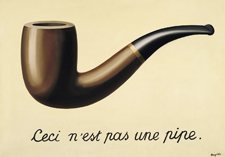
“This is not a pipe.”
In comics theorist Scott McCloud‘s seminal work Understanding Comics (1993), there comes a point following his convoluted description of Magritte’s “The Treachery of Images” where he asks the reader, “Do you hear what I’m saying?” In the next panel he adds, “If you do, have your ears check because no one said a word.” The joke is, of course, that while his comic doppelganger is depicted as talking through the use of word balloons, no words are being spoken. We are reading, not hearing. And yet, sound (or rather, its representation) remains a crucial part of reading and enjoying comic books.
Magritte was trying to get us to think about the treachery of visual representation, while McCloud points us of the treachery of aural representation. A stylized “SPLAT!” is certainly not a sound, but our instinctual understanding of sound helps us to interpret what is otherwise a silent medium in ways beyond the mere the descriptive effect of a sound’s depiction. The way comics use sound can teach us about the function of sound in understanding the visual and textual. As McCloud asserts, comics depend on the reader to create closure between parts of an imagined whole in order for disparate panels to make sense. While it second-nature for the comic reader to interpret the depiction of sound in comics, the closure enacted to make stylized textual elements into “a sound” is a central way that this is enacted.
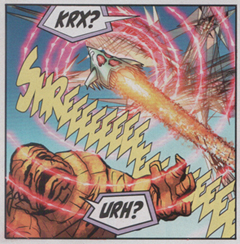
The most famous use of comic sound effect words is probably from the old 1960s Batman TV series—where the “SOCK!” and “BONG!” of superhero and sidekick reinforced the campy aesthetic of the program. It is telling that the Batman-theme (and the fight scenes in general) uses horn flares to emphasize those “POW!” and “BIFF!” moments. The suggestion is that the ostentatious representations of sound that these textual flare sound effect words provide are an empty signifier. There is no sound behind that sound. The weak-sounding slaps and smacks of knuckles on flesh would never suffice for the larger than life world of comic superheroes, and the more out-there comics get the more difficult it is to trace a relationship between the textual/visual representation and any sound in the real world. There is no point of comparison by which to understand the “SHREEEEEE!” of a launching “zirrer” in Kurt Busiek’s Astro City, but only the vague evocation of some loud shrill noise.
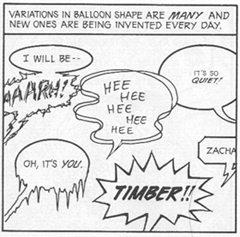 And yet, comic readers not only understand these representations as sound, but there are also a variety of visual clues given that help the reader interpret some quality of those sounds. The most ubiquitous example of sound in comics is, of course, the word balloon—so ubiquitous in fact that it is easy to take for granted the fact that comics have their own conventions for handling and describing sound without recourse to adjectives. The irony is that the shape and texture of word balloons (just like the shape and texture of sound effect words like “BOOM!”) that help to convey the quality of sound become nearly invisible to the reader. Just as any literate person sees a word they know and interprets it for what it is meant to represent and not a collection of individual letters, the dripping icicle-like shape of a word balloon is read as a cold tone or the sharp points of the balloon are read as loud and abrupt.
In her essay “The Comic Book’s Soundtrack” from The Language of Comics (2001), Catherine Khordoc provides a very good overview of the use of sound in comics using the example of Goscinny and Uderzo’s Asterix to provide examples of the various ways word balloons and the implanting of onomatopoeic words directly into the panel image itself are used to represent sounds in comic books. Yet, the function of the representation of sound in comic runs even deeper than simply translating the quality of sound itself; it also serves to help establish timeframes for panels (or sets of panels) and functions in establishing the closure the reader performs in making sense of both individual panels and their context within a sequence of panels. Discrete sounds—whether it’s the “FWOOSH!” of the Human Torch flaming on or long-winded pseudo-scientific explanation of the Negative Zone by Mr. Fantastic—require the passage of time to be intelligible. In order for sounds to be differentiated, they must have some form of beginning, middle and end (or in the parlance of synthesized sound, “attack, decay, sustain, release”). This means that in comics, a medium where space and time merge, representations of sound are crucial to making sense of action, in particular, to the passage of time within a singular panel—for while time can be shown to pass between two or more panels through the process of closure (implicitly understanding the movement or occurrence not depicted between panels that makes them sequential), a singular panel is not necessarily a discrete moment, as an entire conversation can occur within it, requiring readers to perform closure even within the scope of a single panel.
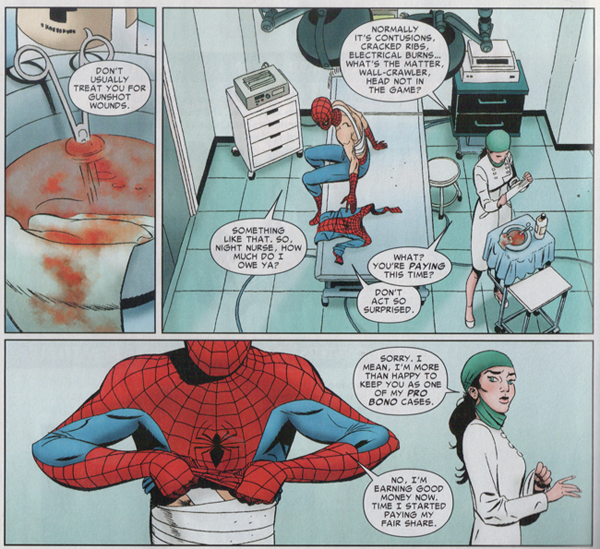
For example, in the second panel below, despite the static image, the passage of time suggested by the conversation about Spider-man’s wounds and payment leads the reader to make sense of the sequence between it and the panel that follows. It is the reader’s understanding that it takes time to talk and listen out loud that helps make the time of the panel apparent.
Click to Enlarge.
Perhaps the most telling evidence of the centrality of sound, at least to the superhero comic genre, was Marvel’s decision to include a synopsis and explanation of the action at the end of each issue of the “‘Nuff Said,” “silent” month of comics back in 2001—wherein there was no dialogue or captions.
There is still a lot to consider when it comes to sound in comics—not just the rhetoric of sound or sound as a signifier of time, but sound as identity. Representations of sound in comics can serve as a form of character signature, and I do not mean only famous lines like Superman’s “Up, up and away!” (which really emerged from Superman radio plays), but iconic sounds such as Spider-man’s web-shooters going “THWIPP!” or Wolverine’s claws, “SNIKT!” that over time have come to be more than just descriptive sound-words, but signifiers that are unique for the characters themselves. (See TV Trope’s page on signature sound effects)
In the end, this brief overview will hopefully serve as a starting point in generating more thoughts on not only how our familiarity with sound informs our reading and interpreting of comics, but how this (admittedly) very general idea can be applied to other ostensibly silent and primarily visual media. The use of sound in comics is a perfect example of how the transparency of sound can make it presence and function easy to overlook. Furthermore, the way in which it is used to orient the reader and help provide closure between and within panels, and identify characters clues us in to the importance of its role and the importance of considering where and how else it might function. I, for one, am going to keep thinking on it and looking for examples of in comics and hope that others join their thoughts to the discussion. Until then, as Stan Lee would “say,” Excelsior!


Share this:


Current Top Posts





April 2021

January 2020

November 2019

October 2019

August 2019

April 2014

November 2017

March 2015

December 2017

October 2015
 Sounding Out!
Recent Comments