
Mukbang Cooks, Chews, and Heals
 Welcome to Next Gen sound studies! In the month of November, you will be treated to the future. . . today! In this series, we will share excellent work from undergraduates, along with the pedagogy that inspired them. You’ll read voice biographies, check out blog assignments, listen to podcasts, and read detailed histories that will inspire and invigorate. Bet. –JS
Today’s post comes from Binghamton University junior David Lee, former student in SO! Editor-in-Chief J. Stoever’s English 380W “How We Listen,” an introductory, upper-division sound studies course at Binghamton University, with a typical enrollment of 45 students. This assignment asked students to
write one researched, multimedia blog post on our class WordPress in the style of Sounding Out! on a sound studies topic of interest to you (approximately 1500 words). Your post should involve an issue involving power and social identity, use our in-class readings as a springboard and quotes and analyzes at least 2 in the post, relate our course topic at hand to a contemporary event, conversation, or issue and includes evidence of research of that topic (3-5 quotations/links to credible online sources), include audio, visual, and/or audio-visual elements as a key part of your analysis (this can include recordings, still photos, you tube clips, videos, etc.) and follow SO!’s submission guidelines on form, style, tone, and content: (https://soundstudiesblog.com/to-blog-2/).
For the full assignment sheet, click How We Listen_Final Blog Assignment For the grading rubric, click Blog Assignment Grading Rubric (1). For the full Fall 2018 syllabus, click english-380w_how-we-listen_fall-2018
—
Mukbang is the newest wave in trends for ASMR; it is an online audiovisual broadcast in which the host enjoys his/her food while interacting with the audience. Adopted from Korea, Mukbang’s literal translation is a portmanteau—it is a combination of two Korean words: “mukja” (let’s eat) and “bangsong” (broadcast). The first time I watched these eating broadcasts was in 2018, before major surgery. Prior to the surgery, I could not eat for twenty-four hours. It came to the point where I was so hungry that I would chew up the meat and spit it out and I would make a mental list of foods that I wanted to eat after the surgery. In an effort to satisfy my hunger, I watched a lot of videos on the Tasty network and stumbled upon Mukbangs. I had heard of the term prior to that day but had never watched the videos myself. The experience could be expressed as an oxymoron: sweet torture. I remember salivating uncontrollably but at the same time watching someone eat began to ease my own stomach.
In recent years Mukbang has blown up on streaming sites like Youtube, and has been met with a subsequent huge audience growth. Mukbang was most notably referenced in the company’s Youtube Rewind 2018 video:
Interestingly, Mukbangs have only been considered ASMR once they were adopted by American content creators. According to journalist Matthew Sedacca, viewers explain that they experience what they call a “braingasm”, described as a tingling sensation down one’s spine from the sounds of cooking and eating. The sizzling sounds of the broth or the slurping sounds of noodles are what is said to relax the listeners. In Touch the Sound, Evelyn Glennie communicates that to hear is to also touch. Likewise, the viewers experience a sensation of touch from the audio and visual elements that the video stimulates. The sounds of food that many associate with tingling, pleasant sensation can also provide viewers with a sense of comfort and reassurance.
In today’s busy society, it is hard to have a formal meal with our family and friends, so oftentimes we are found eating alone. Watching Mukbangs can mitigate the feeling of loneliness through the presence of what Steve Connor calls the vocalic body, so while we are eating alone, the presence of another is real and felt. According to Connor, “[t]he principle of the vocalic body is simple. Voices are produced by bodies: but can also themselves produce bodies. The vocalic body is the idea—which can take the form of dream, fantasy, ideal, theological doctrine, or hallucination—of a surrogate or secondary body, a projection of a new way of having or being a body, formed and sustained out of the autonomous operations of the voice” (35). The voice in these videos takes the form of a body sitting next to us, eating and talking to us.
Simply put, viewers are watching another individual enjoy his/her meal, but Mukbangs have a greater social implication. The rise in popularity of Mukbangs coincide with the rapid technological advancements occurring in society and the shift in entertainment focus on streamable content. Eating is a routine and everyday experience, so Mukbangs portray a vital aspect of life where viewers can passively watch while experiencing the sensory feeling that sound evokes. When the host visually and audibly enjoys his/her meal the viewers can feel the presence of a body ,which accounts for the chills down one’s spine characteristic of ASMR videos. As this phenomenon demonstrates, sound can lessen feelings of loneliness by bringing the audience a sense of human comfort.

“the cook has to eat alone” by Flickr user Joseph Choi, CC BY 2.0
Mukbangs are also helpful to those who have restrictions in their diet. For someone who may be deadly allergic to shellfish, he/she can imagine that experience by watching another person enjoy the dish. While it is not the same as twisting off the claws of a lobster and eating the meat, watching and listening to another person do just that allows the viewer to be a part of that experience. Moreover, a deadly food allergy may keep someone from sharing a communal meal with friends; the sounds of a Mukbang video could recreate that experience. Lastly, and no less important, Mukbangs act in opposition to the unrealistic beauty standards of society; while society’s expectations push us to always keep our figure, a Mukbanger’s response is to eat senselessly. Therefore, Mukbangs embody our fantasies; we live vicariously through the broadcaster.
Mukbangs have introduced a new format for cooking shows. Rather than emphasizing cheesy background music and eccentric hosts on cable tv, Mukbangs strip all these effects away, so that viewers can truly appreciate the essence of cooking in the kitchen: it’s not just about what the dish tastes like in the end, but also the auditory experience. On cooking shows, a lot of the focus ends up on what the plate looks like, or what steps go in what order—it is a visual experience, in general. When it comes to Mukbangs, people watching the videos get to enjoy the relaxing sounds of cooking, and the focus is not on copying the recipe: Sedacca states, “with ASMR it becomes more about the sound than the taste.” The alternate format promotes cooking to a larger audience instead of gearing towards stay-at-home moms. Mukbang cooking videos tend to be more of a minimalist everyday perspective rather than displaying cooking as a luxurious commodity. Mukbangs show us that it is no longer about becoming the cook, but appreciating the cooking being done, and the sound adds to the intimacy of the event. With Mukbangs it is as if your mom were cooking in the kitchen.
In doing so, Mukbangs can also advocate for cultural awareness, as viewers are exposed to different foods that the host enjoys. By seeing a host they trust enjoy foreign food, it encourages the viewer to possibly try that food or visit that country in the future. A popular example of this would be when kpop idol Hwasa from group Mamamoo went on a South Korean tv show called I Live Alone and ate gopchang (cattle intestines) at a nearby restaurant. After the video went viral, the Korean BBQ restaurant industry exploded within a day, so much so, that the dish was reportedly sold out in all of Seoul, Korea.
As for me, nowadays I watch Mukbangs when I miss home. Now that I am away at college, many of my meals consist of dining hall food. Where I go to school, Korean restaurants are scarce and do not taste the same as home. There is something about a well-cooked Korean meal that Korean restaurants at school cannot replicate. So, when I am away at college, I often watch Korean Mukbangs to tap into the comfort of home, through sound and images.
Mukbang watchers have an array of audience members; people watch it to lose weight, for ASMR, or simply when they are eating alone. Mukbangs challenge social norms; although it may be rude to slurp spaghetti noodles in public, Mukbang is evidence that some people enjoy those exact sounds. Likewise, as more people begin to live individualistic lives, the eating broadcasts make up for this difference in human interaction. For those trying to lose weight, Mukbangs offer the option of seeing someone “eat their feelings” without you yourself having to overindulge or feel guilt.
More importantly, Mukbang is a relevant example that listening can be a tactile experience: through vibrations and also from sensations through the body. It challenges the listening audience to be present and appreciate the essence of food, and cooking as a sustaining artform. The aforementioned is especially true for cooking shows where the audience listens for the calming sounds that come with cooking instead of listening to what seems like a sales pitch to best copy the recipe. Mukbang makes cooking and, consequently, eating into healing activities instead of something that is reserved solely for those who have the time. Mukbangs are making a social difference by promoting Korean culture, spreading cultural awareness through food, and helping to lessen the feeling of loneliness. While Mukbangs were previously seen as fetishized or weird they are now challenging our preconceived notions on how, what, and with who we should enjoy food.
—
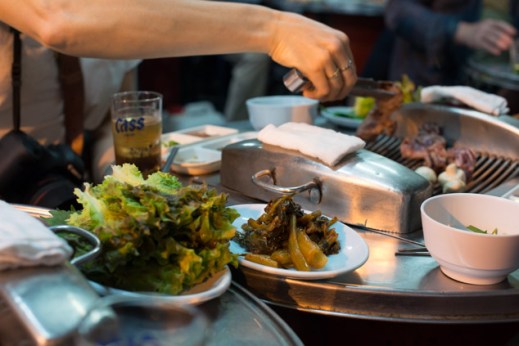
Featured image: “Korean Food – Korean Kimchi and BBQ Cooking Meat (Creative Commons)” by Flickr user Sous Chef, CC BY 2.0
—
David Lee is a Korean American Junior at Binghamton University studying Finance and Marketing. In his free time he likes to read, work out, or watch TV. He is an avid fan of Game of Thrones, Rick and Morty, and Got7.
—
 REWIND! . . .If you liked this post, you may also dig:
Sounding Out Podcast #14: Interview with Meme Librarian Amanda Brennan — Aaron Trammell
Listening to Whisperers: Performance, ASMR Community, and Fetish on Youtube — Joshua Hudelson
Toward A Civically Engaged Sound Studies, or ReSounding Binghamton–Jennifer Stoever
Share this:

TiK ToK: Post-Crash Party Pop, Compulsory Presentism and the 2008 Financial Collapse
As pundits increasingly speculate about the likelihood and character of another recession, I’m thinking about the one from which we’re still recovering. Specifically, I’m thinking about a certain strain of American pop music—or a certain sentiment within pop music—that it seems to me accelerated and concentrated just after the 2008 financial collapse. This strain, which obviously co-existed with many other developments in popular music at the time, takes party songs and adds to them two interconnected narrative elements: on the one hand, partying is cranked up, escalated in one or multiple ways, moving the music beyond a party anthem and into something new. On the other hand, the rationale for such a move consistently derives from an attitude of compulsory presentism, in which the future is characterized as unknown, irrelevant, or is otherwise disavowed.
In the American context, the popular (and, I argue, misguided) take on the music of the great recession is that we didn’t have any—in other words, because no one was directly singing about the crisis, there was no music that responded to it. But this is an extremely limited way of understanding how music and socio-political life interact. In this post, I consider specifically American notions of mainstream party culture to argue that the strain of party music described above and below is the music of the crash, not because it literally speaks about it but because it reflects a certain attitude expressed and experienced by those at the front of both popular music listening at the time and the collapse itself: the graduating classes of 2008-2012.
By “party music” I do not mean (exclusively) music to which people party; rather, I am trying to trace what happens to music that is about partying during the crash. When I say that these songs transform from being party anthems into “something new,” what I mean is that in their extremeness, both the represented parties and the organizing affect of these parties reflect an urgency, a crisis, or a lack of choice condition. In short, what I’m calling “Post-Crash Party Music” (PCPP) responds to the 2008 financial collapse and the broader context of climate devastation by instituting a compulsory presentism that manifests through a frenetic, extreme, nihilistic celebration, a never-ending party that is also the last party (before the end of the world).
I’ll briefly mention two prime examples, both from what might be the peak year of this trend, 2010. First, Ke$ha’s single “(and #1 on Billboard’s Year-end Hot 100), “TiK ToK” sees Ke$ha brushing her teeth with a bottle of whiskey, while the last line in the chorus reveals why this is happening: Ke$ha sings, “The party don’t stop, no,” implying that the song’s narration picks up in a moment that could be any moment, an eternal present that is non-distinguishable from any other moment.
This line captures both of the defining characteristics of PCPP: 1) the party is extreme because 2) it never ends, or is always presently occurring. Although there are multiple ways of creating the eternal present that the party represents, each song in this category is invested in denying both past and future in a way that makes the presentist attitude of the partygoers a mandatory condition. This requirement is what makes PCPP more extreme, narratively, than party pop of previous eras.
As a second example, take The Black Eyed Peas’ quintessential party anthem “I Gotta Feeling.” Throughout most of the song, listeners are set up to experience what sounds like a fairly typical party jam: although the Black Eyed Peas render this joyous, optimistic track as perhaps more formally ‘perfect’ or effective than many of its competitors, it still follows a standard EDM format and a fairly conventional sentiment.
However, near the end of the track, as if responding to the pop-culture/post-crash landscape by afterthought, the Black Eyed Peas very casually disclose that the night that has all along been referenced as “tonight” is in fact every night: “Monday, Tuesday, Wednesday and Thursday/Friday, Saturday, Saturday to Sunday/Get, get, get, get, get with us, you know what we say, say/Party every day, p-p-p/Party every day, p-p-p [repeat 10x]…”
Party anthems of one kind or another have been with us for a long time. But I would argue that something else is going on here. The traditional ambition to party until the sun comes up or to party all night has been eclipsed by a more extreme goal, which is to never stop partying at all. In this new space, the time of day or the day of the week is irrelevant; time itself evaporates in the indistinguishable space of an everlasting present.
My argument here is that this music–specifically in its insistence on a party’s ceaselessness–represents almost the complete opposite of its expressed sentiments: that is, rather than rapturous or celebratory moods, PCPP reflects widespread existential and economic anxiety that is shared among the entire millennial generation, but which was acutely present for the classes that graduated college between 2008 and 2012. Its insistence on partying forever is indicative of this generation’s awareness that the future is bleak.
Economically, we know that this cohort will live with repercussions of the financial collapse for the rest of their lives. (See for instance: “Bad News for the Class of 2008”; “This Is What the Recession Did to Millennials”; “A Decade Later Many college grads from the Great Recession are still trying to catch up”; “2008 was a terrible year to graduate college”; “2008: Ten Years After the Crash, We Are Still Living in the World It Brutally Remade”; and the pithily-titled but quite thorough “Millennials are Screwed”.) Existentially, while the millennials were not the first to cognize and politically articulate the stakes of the unfolding climate crisis, they are, as a “young generation,” perhaps the first identifiable group who will most certainly face its longterm consequences. Rather than simply distract us from these realities, PCPP is predicated on our understanding of those realities. In the face of these circumstances and more, is it any wonder that the affective (if not conscious) response was to live it up while there was still time?
I am not arguing that PCPP harbors any ambitions to address any such anxieties; on the contrary, this music is, on its face, also an example of the much broader genre of neoliberal corporate pop music, a commodity that aims to utilize listener sentiments to maximize profit. That is why PCPP cuts across or includes such racial and gender diversity in its performers, and why it also corresponds to broader trends in pop that elevate and glamorize conspicuous, over-the-top consumption, the kinds of caricatured displays of spending-power that are hallmarks of PCPP as well as other mainstream genres. The discourse of an endless party is also a really good one in which to promote consumption―especially consumption that is taken to the extreme, or is justified through the logic of embracing “life” while we can.
No, from the perspective of the music industry, this music is not about anxiety but is, like all corporate music, still about including as many listener-customers as possible in the cross-branded spectacle of neoliberal pop. Instead, my claim is that this music, however inadvertently, resonates with listeners in a particular, affective way, and in the encounter between neoliberal pop music and a group of anxious American listeners, an accelerated sentiment emerges and spins itself out. We are still consuming, but endlessly so; and that very ceaselessness speaks to a deeper existential dread at the heart of our voracious appetites.
Emerging from this resonance between extreme party music and extreme anxiety are several traceable tropes, each expressing the ambition to party forever. For instance, the “don’t stop” imperative is often paired with the seemingly paradoxical sentiment that “we only have tonight”; but insofar as the end of that night heralds a return to reality (the post-crash landscape) one solution is to simply refuse to stop the party. In this way, the night can “last forever” within the space of the music. Taken together, the PCPP ethos can be summarized by the phrase, as a colleague recently put it, “right now forever.”
There is a specific construction at work here that allows PCPP to impose its presentist timespace: the forever-now is not extended out of joy, but rather out of necessity. By acknowledging that our time (out there) is limited, it constructs a space (in here) that resists normative flows of temporality. PCPP simply disallows temporality into its consciousness–it refuses to acknowledge the existence of a past and especially not a future. Here the “compulsory” element of its presentism emerges: it is compulsory both because within the affective space of the music, the rules do not allow temporality to exist, and because, when our futures have been irrevocably damaged, the present is, in effect, all that we will be allowed to experience.
There are many more examples from this period, all riffing on the same nihilistic affect: “Tomorrow doesn’t matter when you’re moving your feet” (Pixie Lott, “All About Tonight”); “This is how we live/every single night/take that bottle to the head and let me see you fly” (Far East Movement, “Like a G6”, 2010); “Still feelin’ myself I’m like outta control/Can’t stop now more shots let’s go” (Flo Rida, “Club Can’t Handle Me”, 2010). In this context, assurances from Lady Gaga that “It’s gonna be ok” if we “Just Dance” seem less hopeful and more ironic, as if born from denial.
Surely, some of these songs take up the “don’t stop” imperative simply by virtue of its ubiquitous circulation through a pop-culture economy (Junior Senior’s 2003 “Move Your Feet” comes to mind here). I am not arguing that any song that expresses such a generic utterance be considered a part of this post-crash formation; what it takes to qualify, it seems to me, is a distortion whereby the generic affect is pumped so full that it breaks something, a process that sometimes introduces a dark subtext into the music, but which no matter what displays elements of excess that go beyond the pale of a celebratory dance tune. Eddie Murphy’s “girl” wants to “Party All the Time”, but this alone doesn’t qualify the tune as an anxiety anthem because it is a source of hurt and stress for the speaker’s character—ceaseless partying here is sublimated into a narrative about a certain romantic relationship. What distinguishes PCPP, on the other hand, is the sense (however vague) that the “don’t stop” imperative is urgent, and meant to protect us from the world that is waiting outside the club.
PCPP differs in this way from other genres that consciously articulate a dissatisfaction (of whatever kind) with contemporary conditions. The millennial nihilism of an everlasting party is not the same as Gen X’s cynical malaise, which had more to do with resistance to meaningless corporate employment than it did the prospects of no employment at all. PCPP is not punk-rock anarchism nor grunge’s serious grappling with the consequences of capitalism on people’s mental health. PCPP is purely affective, a manic/cathartic punishment-therapy that does not need to denotatively speak of what’s happening in the world because that world is always already experienced in an extreme way. PCPP responds by dialing up the party to a degree of fervor that is correspondingly intense, able to drown out the noise, and it achieves this effect by turning parties into a paradox that is both time-limited and never-ending.
It is true that I have mostly focused on lyrics in this argument. But first of all, other factors also contribute to the sense of PCPP as existential: see for instance the music video for Britney Spears’ “Till the World Ends” (2011), which literalizes the argument I’m making by representing people dancing as the planet crumbles. Likewise, the music video for LMFAO’s “Party Rock Anthem” (2011) casts the band’s beat as a contagion that has afflicted the “whole world,” compelling them to dance ceaselessly in a way that resonates appropriately with post-apocalyptic genres.
Second of all, the “music itself” never exists in isolation from the lyrics or indeed from any other element of a tune. What I would argue that the sounds and formal elements of these songs contributes to the PCPP ethos is a sense of tension and paradox: namely, the paradox between the stated dream of an unending party, and the reality that underlies said dream. It is, physically and otherwise, impossible to keep dancing indefinitely, a fact reflected in the form of this music, which still follows EDM rules of build-up and release, those forms that give one’s body time to rest and appropriate places to feel the natural climax of a song. The tension between the music (which corresponds to the body) and the lyrics (which aim into the afterlife) is the central contradiction that makes PCPP so e/affective.
Thus, the PCPP genre or sentiment, which flashes brightly from 2009-2012, meets its death in and through the track that most comprehensively embodies it: Miley Cyrus’s “We Can’t Stop” (2013). In this deeply melancholic hit, PCPP is followed to its logical conclusion: those who at first refused to stop partying are now entirely incapable of doing so even if they wanted. This is the most extreme version of the PCPP worldview, so extreme that it spread into the music, inverting the entire affect from pumped-up party jam to down-tempo lament, a lament with almost no temporality even in its form.
Although my reading of “We Can’t Stop” differs from Robin James’s, her description perfectly captures the way that song’s form finally achieves the same presentism that PCPP’s lyrics always established, a closed world of “now”. In her 2015 book Resilience and Melancholy, James writes,
Just as the lyrics suggest that the ‘we’ is caught in a feedback loop it can’t stop, the music keeps spuriously cycling through verses and choruses without moving forward or backward…In other words, time isn’t a line, it’s Zeno’s paradox; not a pro- or re-gress but involution (177-178).
If anything, this formal stagnation or inverted affect brings “We Can’t Stop” into the space of the trap music it plays at, and constitutes one of the many ways in which the song cannot sustain its contradictions. As Kemi Adeyemi makes clear, trap music certainly has to do with partying; but its intersections with neoliberal capitalism are particular to Black lives in a way that is wholly different from Cyrus’ attempted deployment. Thus, reaching to trap for a PCPP affect has the devastating effect of exploding the entire sentiment.
In other words, “We Can’t Stop” exposes all the lies that PCPP, in its heyday, furthered: the idea that the party could continue indefinitely, and (by extension) so too could the “fairy tales of eternal economic growth” and the supposed post-racial utopia opened up by neoliberal capitalism. “We Can’t Stop” gives sound to these fictions, through its own form and in various ways: from its well-documented appropriation of Black culture, to the untenable contradiction at the heart of its sentiments. “We can do what we want” but we also “can’t stop.”
Rather than hearing this tune as “painfully dull” (180), this song has always been morbidly fascinating to me, a bleak statement about our inability to move past the moment in which we’re caught. In other words, our presentism is now also compulsory because we’ve gotten so used to it that we can no longer imagine a future at all, or at least not one in which catastrophe doesn’t occur; nor can we imagine the solutions that would help us when it does. Instead, we have the iPhone 11 and self-driving cars. Instead, we have an inverted yield curve and predictions of another (perpetually recurring) market crisis. Instead, we have billionaires doubling down, grabbing every last resource they can from the planet in order to insulate themselves from the effects they have created, a final and pathological shopping spree. Seen from that perspective, while it marked the end of PCPP as a trend, “We Can’t Stop” remains striking as both indictment and prophecy.
—
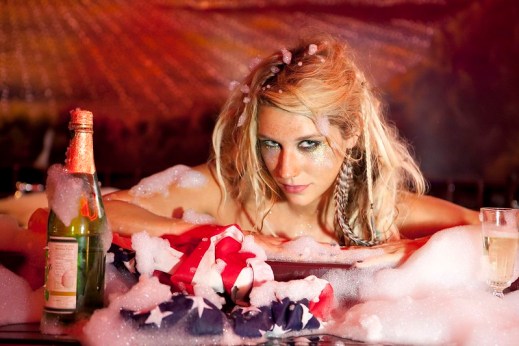
Featured Image: Culture Project 1: Ke$ha by Flickr User HyundaiCardWeb (CC BY-NC-ND 2.0)
—
Dan DiPiero is a musician and Visiting Assistant Professor of American Studies at Miami University of Ohio, where he teaches American popular culture and music history. His current book project investigates the relationship between improvisation in music and in everyday life through a series of nested comparisons, including case studies on the music of Eric Dolphy, John Cage, and contemporary Norwegian free improvisers, Mr. K. His work has appeared in Critical Studies in Improvisation/Études critiques en improvisation, the collection Rancière and Music (forthcoming, Edinburgh University Press), and boundary 2 online. He plays the drums.
—
 REWIND! . . .If you liked this post, you may also dig:
In Search of Politics Itself, or What We Mean When We Say Music (and Music Writing) is “Too Political”–Elizabeth Newton
Poptimism and Popular Feminism–Robin James
Benefit Concerts and the Sound of Self-Care in Pop Music–Justin Adams Burton
Straight Leanin’: Sounding Black Life at the Intersection of Hip-hop and Big Pharma–Kemi Adeyemi
Share this:


Current Top Posts





April 2021

January 2020

November 2019

October 2019

August 2019

April 2014

November 2017

March 2015

December 2017

October 2015
 Sounding Out!
Recent Comments