
The Love Below (the Mason Dixon Line): OutKast’s Rejection at the 1995 Source Awards

DOI: https://doi.org/10.59350/nm2e2-a4458
During his acceptance speech at 2017’s Golden Globe awards, actor and rapper Donald “Childish Gambino” Glover thanked the black people of the city of Atlanta for “being alive,” and the Atlanta trap rap group Migos for their single “Bad and Boujee.” As the camera panned out into the crowd, it showed dominantly white faces full of confusion and polite yet uncomfortable laughter. These audience members seemed unfamiliar with Migos and with categorizing a “black” Atlanta (and South) separate from the pop culture hub we know as Atlanta today. Glover’s speech re-affirmed the sentiments of Outkast’s Andre “3000” Benjamin over twenty years’ prior at the 1995 Source Awards, that the (black) South got something to say.
As I’ve argued previously, Andre and Big Boi’s acceptance speech at the Source Awards was the springboard for what I call the “hip hop south,” the social-cultural experiences that frame southern blackness after the Civil Rights Movement. The declaration “the South got something to say”—and the booing that ensued—is important to engaging how southerners see and hear themselves in a contemporary landscape. The Source Award’s dominantly New York audience booing both jolts the ear and affirms hip hop’s hyper-regional focus in the early to mid 1990s. The booing crowd identifies hip hop as northeastern, urban, and rigidly masculine, an aesthetic that was a daunting task for non-northeastern performers to try and break through. Even celebrated west coast artists like Snoop Dogg, who menacingly and repeatedly asked the crowd “you don’t love us?” during the show, struggled with the challenge of being recognized – and respected – by northeast hip hop enthusiasts.

The 1995 Source Awards proved to be the climax of the beef instigated by both West Coast Death Row Records and East Coast Bad Boy Records, the bitter lyrical and personal battle between Tupac Shakur and Notorious B.I.G., and OutKast, a Southern act, chosen as “Best New Rap Group.” The crowd’s increasingly despondent sonic rejection of hip hop outside of New York foregrounds my reading of OutKast’s acceptance speech as blatant and unforgiving southern black protest, a rallying cry that carves a space for the hip hop south to come into existence.
A recap of that night, in which Christopher “Kid” Reid and Salt-N-Pepa presented OutKast their award. Upbeat and playful, Kid says “ladies help me out” to announce the winner, but there is a distinctive drop in their enthusiasm when naming OutKast the winner of the category. The inflection in their voices signifies shock and even disappointment, with Kid quickly trying to be diplomatic by shouting out OutKast’s frequent collaborators and label mates Goodie Mob. The negative reaction from the crowd was immediate, with sharp and continuous booing.
Big Boi starts his acceptance speech, dropping a few colloquial words immediately recognizable as proper hip hop – “word” and “what’s up?” Over a growingly irritated crowd, Big Boi acknowledges that he is in New York, “y’alls city,” and tries to show respect to the New York rappers by crediting them as “original emcees.” Big Boi recognizes he is an outsider, his southern drawl long and clear in his pronunciation of “south” as “souf,” yet attempts to be diplomatic and respectful of New York. There is also a recognition that where he is from, Atlanta, is also a city: his statement, “y’alls city,” is not only a recognition of his being an outsider but a proclamation that he, too, comes from a city—except it’s a different city.
Big Boi’s embrace of Atlanta as urban challenges previous cultural narratives of southerners as incapable of maneuvering within an urban setting. Because of a long-standing and comfortable assumption that the American south was incapable of anything urban (i.e. mass transit, tall buildings, bustling neighborhoods and other forms of communities), beliefs about southerners’ perspectives remained aligned with rural – read ‘country’ and ‘backward’ – sensibilities incapable of functioning within an urban cultural setting. These sensibilities often played out in longhand form via literature or in popular black music, with focus on dialect and language standing in as a signifier of regional and cultural distinction.

Consider Rudolph Fisher’s southern protagonist King Solomon Gillis from the short story “City of Refuge” (1925). Fisher’s characterization of Gillis, a black man from rural North Carolina, is one of naiveté and awe for not only New York and its sounds, but the premise of city life in general. In the opening of the story Fisher describes Gillis’s ride on the subway as “terrifying,” with “strange and terrible sounds.” References to the bang and clank of the subway doors and the close proximity of each train as “distant thunder” is particularly striking, a subtle sonic nod to Gillis’ rural southernness and his inability to articulate the subway system outside of his limited southern experiences. The references to “heat,” “oppression,” and “suffocation” also lend premise to southern weather, a well as the belief of the American south as an unending repetition of slavery and its effects.
It is important to point out that Gillis certainly isn’t a fearful man in the literal sense: his reason for migrating to Harlem was out of necessity and desperation after shooting a white man back home to avoid being lynched. Yet Fisher’s attention to sound presents Gillis as an outsider. Further, Fisher describes Gillis as “Jonah emerging from the whale,” both a biblical allusion to triumph over a difficult situation as well as a rebirth, the possibility of a new life and new purpose. This can be connected to the biblical reckoning of southern black folks migrating out of the south for social-economic change and advancement.
Still, southern black folks emerging in the city is not an easy transition, with Gillis’ train ride and his discomfort with the sounds it produces symbolizing the move from one difficult landscape to another. Although Gillis ultimately is confronted with the brutality he was trying to avoid in North Carolina, his repetitive proclamation, “they even got cullud policemans!” amplified his southernness and naiveté. Fisher’s intentional use of written dialect enhances the repetitiveness of the impact of seeing black police officers, which blots out the characteristic of region but not white supremacy as a whole. Gillis’s acceptance of black police officers blurred the binaries of the Great Migration as a testament to black folks not only looking for social-economic change outside of the American South, a terroristic space for blacks, but the unfortunate anxiety of those deciding to remain in the south, complacent in the lack of social equality.
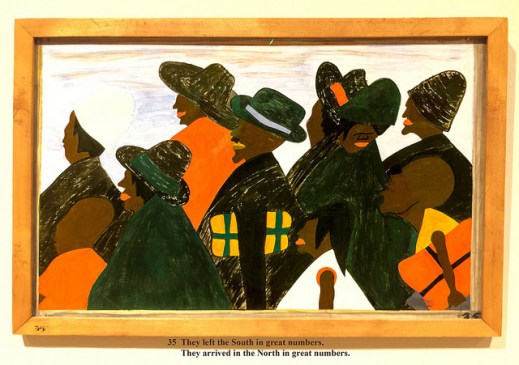
Seventy years later Big Boi, a Georgian, returns to New York with the confidence of both rural and southern sensibilities outside of the immediately recognizable urban trope embodied by New York. Big Boi’s full embrace of being “cullud,” in both the linguistic and cultural elements that Fisher’s long-hand dialect represented as authentic southernness, is jarring because his intentional embrace of southern blackness as othered anchors his approach to rap music. Big Boi does not posture the south as a space or place in need of escape or reposturing. Rather, the hyper-awareness from both Big Boi and Andre in front of the dominantly New York crowd ruptures the accepted narrative of the south as needing saving by non-southern counterparts. Big Boi’s speech forces the audience to de-romanticize their notions of northeastern supremacy and recognize the south as capable of hip hop. Their direct booing is a sonic representation of that discomfort.
From this perspective, André’s now iconic remarks from the acceptance speech further emphasized Big Boi’s departure from reckoning with northeastern hip hop as the standard. He stumbles in his speech, possibly because of nerves or irritation, and, like Big Boi, must talk over the crowd. André speaks about having the “demo tape and don’t nobody wanna hear it,” a double signifier of not only being rejected for his southernness but also the difficulty of breaking into the music industry. André’s frustration with being unheard as a southerner can also be extended into the actual production of the tape by OutKast’s production team Organized Noize, who drew from southern musical influences like funk, blues, and gospel to ground their beats. Andre’s call-to-arms, “the south got something to say,” rallied other southern rappers to self-validate their own music. It is important to note that André’s rally called to the entire south, not just Atlanta. This is significant in thinking about southern experiences as non-monolithic, the aural-cultural possibilities of multiple Souths and their various intersections using hip hop aesthetics.

OutKast moves past their rejection at the Source Awards via their second album ATLiens (Atlanta aliens), which offered an equal rejection of hip hop culture’s binaries. The album’s use of ‘otherworldly’ sonic signifiers i.e. synthesizers and pockets of silence that sounded like space travel – embodied their deliberate isolation from mainstream hip hop culture. Still, OutKast didn’t forget their rejection, sampling their acceptance speech in the final track from their third album Aquemini titled “Chonkyfire.” The brazen and hazy riffs of an electric guitar guide the song, with the recording from the source appearing at the end of the track. There is a deliberate slowing down of the track, with both the accompaniment and the recording becoming increasingly muddled. After André’s declaration “the south got something to say,” the track begins to crawl to its end, a sonic signifier of not only the end of the album but also the end of OutKast’s concern with bi-coastal hip hop expectations. Sampling their denial at the Source Awards was a full-circle moment for their music and identities. It was a reminder that the South was a legitimate hip hop cultural space.
In this contemporary moment, there is less focus and interest in establishing regional identities in hip hop. The dominance of social media collapses a specific need to carve up hip hop spaces per physical parameters. Sonically, there is an intriguing phenomenon occurring where rappers from across the country are borrowing from southern hip hop aesthetics, whether it be the drawl, bass kicks, or lyrical performance. Although our focus on social media has seemingly collapsed the physical need to differentiate region and identity, geographical aesthethics remain central to our listening practices. With this in mind, OutKast’s initial rejection from then mainstream hip hop in favor of sonic and cultural reckonings of southern blackness keep them central to conversations about how the Hip Hop South continues to ebb and weave within and outside the parameters of hip hop culture. Their rejection of hip hop’s stage solidified their place on it.
—
Featured Image “Big Boi I” by Flickr user Matt Perich (CC BY 2.0)
—
Regina N. Bradley, Ph.D is an instructor of English and Interdisciplinary Studies at Kennesaw State University. She earned her Ph.D in African American Literature at Florida State University in 2013. Regina writes about post-Civil Rights African American literature, the contemporary U.S. South, pop culture, race and sound, and Hip Hop. Her current book project explores how critical hip hop (culture) sensibilities can be used to navigate race and identity politics in this supposedly postracial moment of American history. Also known as Red Clay Scholar, a nod to her Georgia upbringing, Regina maintains a blog and personal website and can also be reached on Twitter at @redclayscholar.
—

REWIND! . . .If you liked this post, you may also dig:
Caterpillars and Concrete Roses in a Mad City: Kendrick Lamar’s “Mortal Man” Interview with Tupac Shakur—Regina Bradley
I Been On: BaddieBey and Beyoncé’s Sonic Masculinity — Regina Bradley
The (Magic) Upper Room: Sonic Pleasure Politics in Southern Hip Hop—Regina Bradley
—
Share this:

Playing with the Past in the Imagined Middle Ages: Music and Soundscape in Video Games

DOI: https://doi.org/10.59350/s68q1-37217
Each of the essays in our “Medieval Sound” forum focuses on sound as it, according to Steve Goodman’s essay “The Ontology of Vibrational Force,” in The Sound Studies Reader, “comes to the rescue of thought rather than the inverse, forcing it to vibrate, loosening up its organized or petrified body (70). These investigations into medieval sound lend themselves to a variety of presentation methods loosening up the “petrified body” of academic presentation. Each essay challenges concepts of how to hear the Middle Ages and how the sounds of the Middle Ages continue to echo in our own soundscapes.
Read all the previous posts here, and, HEAR YE!, in April 2017, look for a second series on Aural Ecologies of noise! –Guest Editors Dorothy Kim and Christopher Roman
–
Freed though they have been from the historiographical pit of the Dark Ages, the Middle Ages inevitably slip ever further into the past. Nonetheless, they have never been easier to visit. We have but to open our computers or turn on our televisions to be transported into the past. As any good Sci-fi show will tell you, we must be careful when we travel into the past; we can change things.
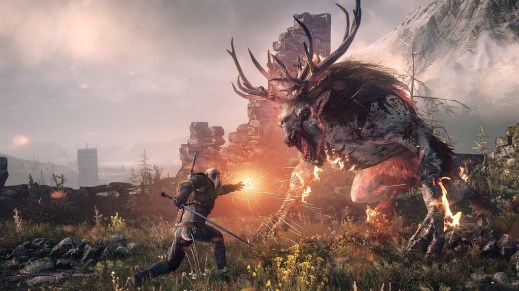
The medium on which I wish to focus – videogame – relies precisely upon on this ability to affect change. It takes aspects of filmic medievalism but must also confront an intrinsic interactivity. This interactive capacity may seem to authenticate further the experience of the past by creating a rich and responsive world but it also frees aspects of narrative agency from the control of game designers, composers, and sound engineers. In this article, I will demonstrate some of the ways in which issues of space/place, identity, orientalism/otherness, and the norms of the medium itself can play out. In recomposing the past – be that with a nod to authenticity, within the realms of historical metafiction, or even the imagined (neo-)medievalism of the fantasy genre – videogames create something that sits between the past and present that nonetheless has a profound effect on the public conception of the medieval soundscape. My focus here is on CD Projekt Red’s high-fantasy game The Witcher III: Wild Hunt, addressing not only the musical score but also wider aspects of soundscape such as vocal accent, foley, and manipulation of the aural field.
.
The genre of fantasy could be described as medievalist in origin and aesthetic, taking clear inspiration from the medieval world and often using it, or a close approximation, as a geographical, historical, and cultural setting. Many of the more fantastical elements of fantasy too are drawn from medieval bestiaries and the genre of the medieval romance. The late Umberto Eco popularised the term neo-medievalism, albeit in a rather pejorative sense and in opposition to ‘responsible philological study’, to describe this interaction between medieval history and the fantastical. Perhaps due to the rather negative associations of neo-medievalism, both terms tend to be used somewhat interchangeably today.
A divide could perhaps be suggested as to whether medieval aspects are presented as unproblematic and nostalgic, or treated in a more critical and distanced manner. For instance, David Marshall defines neo-medievalism as ‘a self-conscious, ahistorical, non-nostalgic imagining or reuse of the historical Middle Ages that selectively appropriates iconic images…to construct a presentist space that disrupts traditional depictions of the medieval.’ In contrast, Kim Selling notes of medievalism that, after the breakdown of modernist historical metanarratives, the pre-modern world of the medieval offers a ‘rich, satisfying, and authentic’ counterpoint to the ‘profound social, spiritual, and political dislocation’ of postmodernism. From this viewpoint, the world of medievalist fantasy offers pure escapism back to a world in which old certainties can be re-asserted; perhaps, as Elkins notes, a reaction against the rationalistic, anti-heroic, materialist, and empiricist bent of modern society.
Regardless of the author’s framing of ‘the medieval’, it offers many narrative advantages. As Kim Selling has noted, in placing an imagined world in a simplified version of the Western European Middle Ages, the fantasy author can make use of narrative shorthands. The world of kings, queens, knights, peasants, dragons, magic, witches, and elves is already known from myth and fairy tale. These aspects require no explanation but rather build upon a tradition of understood western folkloric conventions – conventions that can also imply certain types of social structure.
The Witcher is certainly situated in a simplified medieval Europe (see the similarity between the coasts of Poland and Nilfgaard) and it clearly occupies a world with presentist concerns. More than this, its extreme use of narrative indeterminacy betrays a staunch adherence to postmodern concepts of storytelling and a distinct anti-heroic edge. The player navigates a world of many shades of grey, often choosing the lesser of many evils. They make decisions – which often result in unintended consequences – based on their own morality and desired outcomes. This said, perhaps the question of whether it could be defined as medievalist or neo-medievalist depends on the actions of the player and precisely the kind of narrative they construct.
An early example of unintended consequences and choosing the lesser of many evils
The visual world inhabited by The Witcher certainly relies on appropriating iconic images; the analogue aural world on appropriating iconic sounds, accents, and musical ideas as the player continuously explores regions with distinct identities, social structures, urban/pastoral settings, and religions. The rational, urban, and merchantile world of Oxenfurt (a city famous for its world-class university with a crest clearly based on that of the University of Cambridge and a name that hints at the university town of Oxford’s medieval etymology) and Novigrad are clearly at odds with the rural peasant life of the Velen wastelands or the Celtic imagery of the Skellige isles.

The landscape and soundscape of Oxenfurt
The landscape and soundscape of Novigrad
The landscape and soundscape of Velen (with multiple examples of the ‘combat music’)
The landscape and soundscape of Skellige (with the ‘combat music’ adapted for this area)
Like much medievalist fantasy the tension between rationalism and the fantastical is one of the central elements of dramatic tension. As the great cities of this world grow and the expansionist Nilfgaardian Empire press forward, the pre-modern world of The Witcher shrinks. Allied to the spread of rationalism, we also see the ‘Church of the Eternal Fire’ (an identifiable stand-in for Christianity) seek to eradicate magic, non-human populations, and more identifiably ‘pagan’ religions. The architecture of its buildings invite comparison with European sacred architecture and its witch hunters and inquisitions with particularly regrettable episodes of European history.
The Temple of the Eternal Fire burning people at the stake
Just as the visuals employ iconic imagery to imply certain ideas, the soundscape’s most important function is to provide the aural analogue of this. One aspect is the score. Within this, individual musical stems are layered in response to player actions. As the composer Marcin Przybylowicz noted in a recent interview with the Tech Times ‘[t]he cues (that were interactive) are divided into smaller layers, which come together, in the case of a combat cue, only when we are dealing with a very powerful enemy. If the enemy is small … only the first layer of the piece will play’. These layers are re-orchestrated in each area so as to preserve its aural identity. In a separate interview with IC-Radio.de, Przybylowicz notes:
No Mans (sic.) Land [Velen] is a war ravaged land… It’s also full of slavic references, pagan beliefs etc. …. Then, there’s Novigrad – the biggest city in northern kingdoms. … I decided music in Novigrad should be more civilized – that’s why there are lots of string instruments playing there (dulcimer, bouzouki, guitars, lutes, cimbalom etc.), and overall tone of the music is lighter, [and] reminds [me] a bit music of [the] Renaissance. Finally, [the] Skellige Isles – [a] region with Celtic, Scottish and Norse references, that had to be reflected in music as well. Use of bagpipes, flutes and Scandinavian folk instruments corresponds with that setting. On top of that, I had to think how it would all work together. That’s where our themes come in … We use those themes in every major location …. [and] we reorchestrate them with instruments corresponding to a particular region.
Combat music in Velen and Skellige respectively. Note how both utilise the orchestration of their own respective areas to alter the main theme and how additional layers are added to the music depending on the intensity of the fighting.
In viewing the different medievalisms on offer in this game, a comparison of the three areas mentioned above is instructive. The Skellige isles, an archipelago which looks curiously like Scottish islands, are occupied by inhabitants with Irish accents. As can be heard in the videos above, the clearly Celtic-influenced music of this area supports this association and the relative lack of diegetic music in this area, combined with natural sounds (the sea, wind, storms) combine to give a sense that the music is a part of the geography. Celtic folk music as a shorthand for the Middle Ages is nothing new. Simon Nugent has noted the tendency of many historically-situated films to draw on Celtic influence. His work has shown that the creation of ‘Celtic’ folk has little to do with a discrete geographical area or with historical accuracy but rather is a modern marketing creation that plays on associations with nature and an escape from modernity. This is precisely the case in The Witcher where, rather than utilising a real historical Celtic medieval repertory, it instead draws on aural cues from the popular medievalism of the filmic soundscape tradition, filtered through the need for an indeterminate score. This ‘packaging’ brings with it associations of an ‘authentic’ Celtic folk tradition as a remnant of the ‘true folk tradition’ that once existed for everyday people elsewhere.
We can perhaps see a link to the works of fantasy writers such as Gael Baudino and Patricia Kennealy-Morrison who turn to pagan Celtic sources as an alternative to what they perceive as the medieval Christian degradation of women, as Jane Tolmey has noted. This association between pagan prehistory, matriarchy, and freedom for women seems a common theme in the popular conception of the past, echoed by theorists such as Albert Classen. The fact that Skellige evokes a recognisably ‘Celtic’ soundscape (relying heavily on the Polish Folk band Percival who collaborated on both new works and who took several from a previous album which were then adapted for indeterminate playback) therefore comes with many associations, drawn almost entirely from the filmic soundscape tradition. This is a pre-modern, pagan land; a land with an authentic peasant class: roughhewn but honest. This Celtic imagery and soundscape also offers a counterpoint to the sexual politics of other areas. Women can more easily participate in areas which might otherwise be seen as male-dominated: depending on the actions of the player, a woman may rule Skellige. A matriarchal class of priestesses govern the region’s predominant religion in stark contrast to the male Priests in other areas. The soundscape here is therefore absolutely crucial to the identity of this area. In creating a Celtic sonic identity – equal part music and accent – the game designers have created a rich culture that need only be hinted at to be understood.
By contrast, the urban world of Novigrad and Oxenfurt is far less folk-influenced. Unlike the other areas of the game, it does not draw so heavily on either the pre-existent or newly composed music of Percival, make such explicit use of folk instrumentation, and seems far more closely related to a Renaissance dance music tradition. The urban/pastrol divide is enhanced by the sounds of a busy city compared to the sounds of nature and the frequent cries of the townsfolk give a sense of bustling urban life (this time with accents from the North of England – compare HBO’s Game of Thrones).
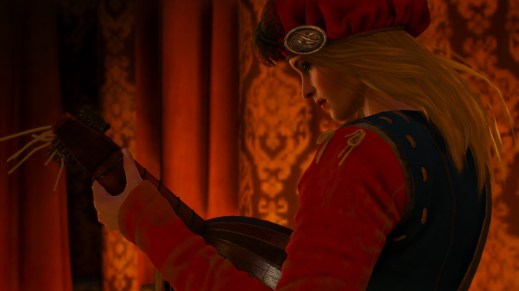
Compared to the wind instruments and female vocals of Skellige, percussion and plucked/struck strings predominate. There is indeed more of a Renaissance feel in an area already touched by modernity. Most notably, there is more diegetic music in these two cities. We frequently see and hear small Renaissance dance bands, using period instruments, entertaining crowds (watch from around 3:45 of the above video of Novigrad for an example; note how diegetic music slowly enters the soundtrack as they are approached). Perhaps the most significant diegetic moment, however, is the song by the Trobaritz Priscilla. The audio and visuals are surprisingly well matched, and the tuning of the lute adds emphasis to the fact of live performance. As a video cut-scene, this is one of few moments in the game where the player has no ability to affect their environs and must simply watch and listen.
Priscilla’s song
Far more so than in other areas, the music in Novigrad and Oxenfurt is for and by people. This is in marked contrast to the soundscapes found on Skellige and in Velen where the music is almost purely non-diegetic. In contrast to the pre-Christian matriarchal associations of the priestesses of Skellige is the aural handling of the Temple of the Eternal Fire in Novigrad and its male priests. As Adam Whittaker has recently identified, there is a clear link between musicological discourse on purely vocal performance in Christian sacred space in Early Music, and its representation on screen. Male a capella voices, and a ‘chanting’ vocal style (again hinting at plainchant, rather than using pre-existent chant music), are often used to denote the aural identity of a church. Precisely this kind of vocal delivery is added to the soundtrack as the player moves closer to the Temple of the Eternal Fire, explicitly linking this Christian association with the aural presence of the Temple. The contrast with the female-dominated vocals elsewhere enhances the distinction and re-enforces the links between the ostensibly pre-Christian worlds of Skellige and Velen and the Christian associations made in Novigrad.
Approaching the Temple of the Eternal Fire
The music of the Velen wasteland and the neighbouring White Orchard, like Skellige, is more folk influenced, yet clearly distinct. Gone are the Celtic folk influences; instead, this area fuses a cinematic pastoral idyll (again laden with nature sounds and with a peasantry speaking with West Country accents – compare the idyllic ‘Shire’ in Peter Jackson’s The Lord of the Rings) with a dark and sinister undertone which draws on the ‘otherness’ of many non-western and folk instruments, particularly the kemenche, electric cello, hurdy gurdy, bowed gusli, gheychak, and the bowed yaylı – the vast majority of which only enter the soundscape in this area. The use of the medieval as a source of dangerous and primitive ‘otherness’ is common at the moment (evidinced, for instance, by the many recent descriptions in the West of the so-called Islamic State as ‘medieval’) and draws on modernist thought which characterized the middle ages as a period of dark and dangerous alterity between the glories of antiquity and the Renaissance.
That the soundscape of The Witcher draws on competing categorisations of the medieval as ‘dangerous’ and ‘pastoral’ says much about the mutability of medievalisms. Musically, this ‘otherness’ can be expressed as a kind of orientalism, both exotic and dangerous, and the microtonal inflections and use of glissandi here give a sinister undertone to what is otherwise a quintessentially pastoral film score. This area has one of the most memorable parts of the entire soundtrack ‘Ladies of the Wood’, underscoring a genuinely horrific narrative and visuals (some of the consequences of which are shown in the first video of this post with a lengthier section of the music given below). The exotic instrumentation combined with the driving repetition, at odds with an audio usually so responsive to the player’s actions, makes the experience unsettling and claustrophobic.
Ladies of the Wood
Taken together, these very distinctive sound worlds serve to demonstrate some of the many medieval soundscapes which permeate our collective consciousness. In utilising iconic aural cues, composers and sound designers in a neo-medievalist tradition can conjure up particular cultural and social structures with ease, taking many of the shorthands which have emerged from the TV and film traditions in recent years. The indeterminacy inherent to videogame, and the common response of using audio stems, means that the soundscape moves far beyond what is possible in TV and film. However, it also makes problematic the concept of using real, historically-informed music from the period being invoked which would not be able to respond to the interactivity of the world. In The Witcher, the decisions we make effect the world around us, including its soundscape. The effect is crucial both to helping to conjure the world of The Witcher and to helping us feel immersed in it – perhaps paradoxically this may make the soundworld invoked seem more authentic even if it simultaneously reduces the possibility of using ‘authentic’ historical repertoire.
—
Featured image by Carlos Santos @YouTube CC BY.
—
James Cook is a University Teacher in Music at the University of Sheffield. His work focuses on the musical period that falls neatly between the Middle Ages and the Renaissance. In particular, the ways that musical cultures in this period interact and how expatriate groups (merchants, clergy, and nobility) imported and used music. Some of his work (like this essay) concerns the representation of early music on stage and screen, be that the use of ‘real’ early music in multimedia productions, the imaginative re-scoring of historical dramas, or even the popular medievalism of the fantasy genre.
—

REWIND! . . .If you liked this post, you may also dig:
Sounding Out! Podcast #49: Sound and Sexuality in Video Games – Milena Droumeva and Aaron Trammell
Sounding Out! Podcast #29: Game Audio Notes I: Growing Sounds for Sim Cell–Leonard J. Paul
Papa Sangre and the Construction of Immersion in Audio Games— Enongo Lumumba-Kasongo
The Dark Side of Game Audio: The Sounds of Mimetic Control and Affective Conditioning – Aaron Trammell
—
Share this:




Current Top Posts





April 2021

January 2020

November 2019

October 2019

August 2019

April 2014

November 2017

March 2015

December 2017

October 2015


Recent Comments