
Unlearning Black Sound in Black Artistry: Examining the Quiet in Solange’s A Seat At the Table

Editors’ note: As an interdisciplinary field, sound studies is unique in its scope—under its purview we find the science of acoustics, cultural representation through the auditory, and, to perhaps mis-paraphrase Donna Haraway, emergent ontologies. Not only are we able to see how sound impacts the physical world, but how that impact plays out in bodies and cultural tropes. Most importantly, we are able to imagine new ways of describing, adapting, and revising the aural into aspirant, liberatory ontologies. The essays in this series all aim to push what we know a bit, to question our own knowledges and see where we might be headed. In this series, co-edited by Airek Beauchamp and Jennifer Stoever you will find new takes on sound and embodiment, cultural expression, and what it means to hear. –AB
—
DOI: https://doi.org/10.59350/1m8hp-chf19
On May 18th, 2017, Solange Knowles took viewers on an expedition as she glided, danced and “agonized” in a “joyful praise break” on the floor of New York City’s Guggenheim museum. Drawing from the museum’s narrative of introspection and multi-sensory connection, Solange’s performance of “An Ode To. . .” prompted viewers to relearn and reorient the melodies of A Seat at the Table (2016). Solange’s performance in this setting hearkened listeners to new concepts and emotions in the record they didn’t catch before as they consumed it. This begs the question– what other sonic elements have we neglected to identify in A Seat at the Table? And why?
A Seat at the Table integrates topics like race, depression, and empowerment. Although the younger sister of powerhouse Beyoncé Knowles, Solange has managed to carve out her own legion of dedicated listeners from her infusion of Minnie Ripperton-esque vocals, hip-hop production and Gil Scott-Heron storytelling. Thematically, the album incorporates issues of Black Lives Matter and cultural self-preservation. However, Solange weaves personal elements such as vulnerability, futurism and paternity throughout the record as well, which buoy the album to praise but are hardly discussed in the album’s many reviews. Instead, writers and listeners have largely focused on resistance, anger and reactionary concepts.

Because Solange is a black women, historical signifiers of black embodiment influence both the listeners’ senses and consumption of her album. Solange’s intimate moments and reveals are shrouded by the limitation of black sound to the disruptive, angry or depressive. Such masking demands a listening praxis akin to what sound artist Christine Sun Kim describes as “unlearning.” “I’m trying to unlearn what I’ve been taught by others,” she said in an interview about her work, “and trying to find my own definition of both sound and silence.” This unlearning and re-imagination of sound is a difficult transformation considering how sound is influenced by our racialized, gendered, and religious histories.
Consider the contemporary rhetoric of black sound. Black outcry and screaming is a banal American, banal soundscape. Blackness is grieving. Blackness tiptoes near death. Captivity is a breath away. Black Lives Matter leans on the Civil Rights Movement often sonically. Dr. J Marion Sims, both his medical torture of enslaved women and the widespread belief that black people are inured to pain, still haunts our research methodologies, medical practice and our daily lives. This ushering of strife consumes black life into a sound that bleeds—an aural transfer both material and metaphoric—black sound is never personal, individualized or singular, and such historical misperceptions influences black sound studies. The Western artistic critique of black sound and black artistry overwhelmingly focuses on the reaction of whiteness, black resistance, and little else—because supposedly—there is nothing notable about blackness in and of itself.
For example, revisit the 1968 Olympic photo of Tommie Smith, John Carlos and Peter Norman as they stand on the platform with their medals. What do you see in this photo? Perhaps nationalism, masculinity, aggression, or anger from their bodily gesture to the Black Panther Party Movement? What do you hear in the photo—what is its decibel? An outcry? A rebellious yell? desperate scream?

But what other nuances are in the photo? What other critiques are masked by this proscribed sound? In The Sovereignty of Quiet (2012), Kevin Quashie invites us to:
Look again, closely, at the pictures from that day and you can see something more than the certainty of public assertiveness. See, for example, how the severity of Smith’s salute is balanced by the yielding of Carlos’s raised arm. And then notice how the sharpness of their gesture is complemented by one telling detail: that their heads are bowed as if in prayer, that Smith, in fact, has his eyes closed. The effect of their bowed heads is to suggest intimacy…How is it that they are largely icons of resistance, and that vulnerability and interiority are not among all things we are encouraged to read on their image? (Quashie 2-3).
Because of racialized history, we have limited our conceptualization of blackness in literature, film and other mediums. We only hear blackness as it pertains to resistance, grief, and anger—the reaction to whiteness. Black people are verbs instead of nouns. The ’68 Olympic photo is particularly special as it captures the steadfast Western influence that infects our synesthesia because of political and social histories. Moreover, such defects are even internalized in the black artist. As an identity, Quashie argues that “blackness is always supposed to tell us something about race or racism, or about America, or violence, struggle and triumph or poverty and hopefulness (4). Sonically this means blackness in contemporary discourse is critiqued by its decibel of resistance. We cannot read or hear blackness without integrating white pain.
Much like typical readings of the ’68 olympic photo, Solange’s album cover might elicit themes of self-esteem, black-nationalism or even aggression. However, Solange quietly sounds her life transition and personal vulnerability, via her photo, if we would hear it.

But confining view of blackness as pain and resistance prevents us—including those who are black-identifying—from noticing and celebrating vulnerability, grace, and the interiority. Quashie describes interiority as the “inner reservoir of thoughts, feelings, desires, fears, ambitions that shape a human self. . .[it is] expansive, voluptuous, creative; impulsive…more akin to hunger, memory forgetting, the edges of all the humanness one has” (20-21). It’s the tender part of identity shown through subtlety—the desires and dreams spoken through prayer. It’s Martin Luther King Jr. tapping his feet to Coltrane or Tupac Shakur watching dancers to perfect his plié—it’s the soft falsetto Solange uses in her album that bolsters emotional healing and draws avian imagery.
Asking what quiet can bring to our personal, cultural, historical and political understandings of blackness does not signal the imposition of respectability politics or desire for post-racialism. Rather, Quashie’s theory considers how whiteness has constructed and limited our senses as it relates to blackness. Blackness will remain in resistance because of systemic oppression but there is so more to black life. The element of analysis and the sensorium itself needs expansion.
Subsequently, Solange Knowles’ recent album innovatively captures resistance but centers other aspects of black sonic experience: individualization—the nuances of interiority regarding mental health, paternity and forgiveness.
The first track of the song, “Rise,” flutters an anthem of well-being:
Fall in your ways so you can crumble.
Fall in your ways so you can sleep at night.
Fall in your ways so you can wake up and rise
Her tone and pitch is sweet, light and matter-of-fact. The repetition and delivery is similar to a lullaby —reminiscent of Langston Hughes’s poem “Mother to Son”—a soft plea to rest, welcome weariness and any conflict with authenticity but to also travel with a straight back and head looking forward. Fall in your ways… At the 1.11 mark, there is a break of silence in the song; thereafter, the synthesizer yawns into melody with a futuristic twang. This Afrofuturistic moment—the study of blackness as it relates to space, technology, art and futurism— continues later with the production and lyrical content with “Borderline (An Ode To Self Care).” Notably, “Rise” introduces the sonic atmosphere of the record through Solange’s honeyed tonal drops and leaps when she sings “So you can sleep at night.” Her delivery mimics a bird within a thermal lift—her voice calling the plight of the Flying African—the myth that Igbo people escaped slavery by flying back to Africa at night. “Fall in your ways” whispers the discovery and preservation of one’s interiority. Rise emphasizes inner, restorative practice.
Solange also highlights interiority through her album interludes, mostly narrated by Master P, rapper and owner of No Limit Records. This also relates to her inclusion of paternity alongside maternity—a bright distinction considering her identification with black womanhood and the historical racist exclusion of black fathers in the home (e.g. the Moynihan Report and welfare polices). Solange notes the importance of her father and Master P’s presence with an interview with her sister:
I remember reading or hearing things about Master P that reminded me so much of Dad growing up. And I wanted a voice throughout the record that represented empowerment and independence, the voice of someone who never gave in, even when it was easy to lose sight of everything that he built.
Thus the precursor to each song draws from Master P’s embodiment of kinship, lineage and esteem, traits the teenaged-Solange admired and later internalizes into her interiority.
Through these interludes, Solange redresses Master P’s sonic history, particularly his famous rap catch phrase. As he explains in the interlude “Pedestals“:
I never cried or nothing, and that’s where the, ‘Make ’em say uhh uhh,’ that’s like my pain…that’s my battle cry.
Solange spotlights Master P’s quiet–and accompanying tonal signature—while showing its relation to “louder” elements of masculinization and coping. P’s insoluble moan is a staple throughout his songs and a signature in other No Limit artists’s songs as well.
No longer limited to its “loudness” or flattened to party anthem accompaniment—as this song and sound has all too often been characterized—P’s “battle cry” calls out, sounding a communal harkening of empathy and relation.
. . .uhh uhh. . .
In tracks such as Don’t Touch My Hair, Solange makes Black Lives Matter a key sonic element in her album, but as with her rendering of Master P, in a way that “unlearns” previous assumptions and limitations and reveals how the Black Lives Matter Movement and network is pigeon-holed by American racial ideology and its accompanying sonic constriction. While the catalyst for the movement was white supremacy and police brutality, the movement’s guiding principles also highlight interiority-infused concepts of loving engagement, empathy, and restorative justice. Patrisse Cullors, co-founder of the network, has been vocal about the movement’s integration of the arts and the reimagination of blackness. The focus on black outcry and white sirens muffles the movement’s quiet. The consequences of ignoring the interiority dismisses the whole, black self.
Belying a similar dynamic, many listeners have pinned “Don’t Touch My Hair” as a declaration to whiteness, but considering Solange’s point of view, lyrics and gentle sonic value, makes the meaning of the stretch far wider.
As Solange divulges through the sound of the Mardi Gras trumpet that blares throughout the chorus and changes in volume and texture after the quiet interlude ends at 3:34, black hair is spiritual. As the trumpets blasts in hosannas in gospel celebration, the track also sounds honor, adoration, tribute and preservation in the thick of American, racialized fixation.
The unlearning of confined sensory orientation that Solange’s A Seat at The Table and “An Ode To. . .” demands unveils a progression to time travel, what Michelle Commander’s recent book calls Afro-Atlantic Flight. Solange further incorporates such spiritual, diasporic flight with her homage to Parliament-Funkadelic artist Junie Morrison–who passed just a few months after the record came out–in her futuristic track, “Junie,” punctuated with the light, avian melisma, one of her sonic signatures on the record:
Let’s go to moonlight, then they will never find
Let’s go to home, free from the mother mind.Come on along, along, along, along, along, along, along
—
Featured Image of Solange by Flickr User Greg Chow (CC BY-NC-ND 2.0)
—
Kimberly Williams oversees a Black Cultural Center at Virginia Tech where her work includes advocacy, policy, programming and bloodletting. She received her M.F.A. in poetry at Cornell University where she also became a Callaloo Oxford University fellow. Her thesis studied the sonic flight from the Stono Rebellion into contemporary dance and household rhythm. You can find her work in Gulf Coast, Callaloo, Drunken Boat and more. At night, you can catch her watching 90s live performances of Michael Jackson or Nine Inch Nails.
—

REWIND! . . .If you liked this post, you may also dig:
The Listening Body in Death –Denise Gill
Black Mourning, Black Movement(s): Savion Glover’s Dance for Amiri Baraka –Kristin Moriah
Moonlight’s Orchestral Manoeuvers: A duet by Shakira Holt and Christopher Chien
How not to listen to Lemonade: music criticism and epistemic violence–Robin James
Share this:

SANDRA BLAND: #SayHerName Loud or Not at All
DOI: https://doi.org/10.59350/rfz76-2d642
It is customary that whenever I go to my Nana’s house I turn the car speakers as low as possible. She has super hearing. Sometimes I forget, and the following conversation takes place:
“What’s up Nana Boo?”
“I heard you before you got the house, girl. I told you about playing your music too loud.”
“It wasn’t too loud.”
“I heard you before I saw you.”
“Yes ma’am. I’m sorry.”
“Don’t bring attention to yourself.”
Don’t bring attention to yourself.
Physically this is impossible. I am a black woman over six feet tall. My laugh sounds like an exploding mouse. I squeak loudly and speak quickly when I get excited. I like knock in my trunk and bass in my music. Don’t bring attention to yourself. I frequently heard this warning as a girl and well into my adult life. I rarely take it as a slight on my grandmother’s account – though she is the master of throwing parasol shade. She spoke to me with a quiet urgency in her warning. In the wake of the murders of Jordan Davis, Sandra Bland, and other black lives that vigilantes and mainstream media deemed irrelevant, I understand her warning better from the perspective of sound.
As a loud, squeaky black woman I am especially attuned to how my sonic footprint plays into how I live and if I should die. As a black woman, the bulk of my threat is associated with my loudness. My blackness sonically and culturally codes me as threatening due to the volume of my voice. This is amplified, as a southern black woman. I exist and dare to thrive in a country that historically and socially tries to deflate my agency and urgency. The clarity of my sentiments, the establishment of my frustration, and the worth of my social and cultural interventions are connected to how others hear my voice. It is not what I say but how I say it.

Black women navigate multiple codes of sonic respectability on a daily basis. Their sonic presence is seldom recognized as acceptable by society. Classrooms, homesites, corporate spaces, kitchen tables, and social media require a different tone and volume level in order to gain access and establish one’s credibility. Like other facets of their existence, the way(s) black women are expected to sound in public and private spaces is blurry. What connects these spaces together is a patriarchal and racially condescending paradigm of black women’s believed inferiority. A black women’s successful assimilation into American society is grounded in her ability to master varying degrees of quiet and silence. For black women, any type of disruptive pushback against cultural norms is largely sonic in nature. A grunt, shout, sigh, or sucking teeth instigates some type of resistance. Toning these sonic forms of pushback—basically, silencing themselves—is seen as the way to assimilate into mainstream American society.
In what follows I look at the tape of Sandra Bland’s arrest from this past summer to consider what happens when black women speak up and speak out, when they dare to be heard. As the #SayherName movement attests, black women cannot express sonically major and minor touchstones of black womanhood – joy, pleasure, anger, grief – without being deemed threatening. These sonic expressions force awareness of the complexity of black women’s experiences. In the case of Sandra Bland, I posit that the video of her arrest is not a video of her disrespecting authority but rather shows her sonic response to officer Brian Encinia’s inferred authority as a police officer. I read her loud and open interrogation of Encinia’s actions as an example of what I deem sonic disrespectability: the use of sound and volume to contest oppression in the shape of dictating how black women should or should not act.
The sonic altercation in the video (see full-length version here) sets the stage for Encinia’s physical reprimand of Bland, a college graduate from Prairie View A&M who hailed from Chicago. Bland is not physically threatening—i.e. she emphatically states she’s wearing a maxi dress—but her escalating voice startles and even intimidates Encinia. Bland is angry and frustrated at Encinia’s refusal and to answer her questions about why she was pulled over. Encinia’s responses to Bland’s sonic hostility are telling of his inability to recognize and cope with her anger. In fact, he refuses to answer her questions, and she repeats them over and over again while he barks orders. Encinia states later in the dashboard camera that Bland kicks him and thus forces him to physically restrain her. However, Bland’s vocal assertion of her agency is more jarring than her physical response to Encinia’s misuse of power.
The dashboard camera footage is indicative of their vocal sparring match. Encinia’s voice starts calm and even. He explains to Bland he pulled her over for failure to indicate a lane change. Bland’s responses are initially low and nearly inaudible. However, after Encinia asks Bland if she is “okay,” her responses are much louder. She does not just follow orders but expresses her displeasure in sonic ways, while she stays in the car. His tone shifts when Bland refuses to extinguish her cigarette. Encinia then threatens to pull her out of the car for disobedience. He begins to yell at her. Bland then voices her pleasure in taking Encinia and his complaint to court. “Let’s take this to court. . .I can’t wait! Ooooh I can’t wait!” Bland’s pleasure in taking Encinia to court is an expression of her belief in her own agency. The act of voicing that pleasure is particularly striking because it challenges an understanding of courts and the justice system as hyperwhite and incapable of recognizing her need for justice. Her voice is clear, loud, and recognizably angry.
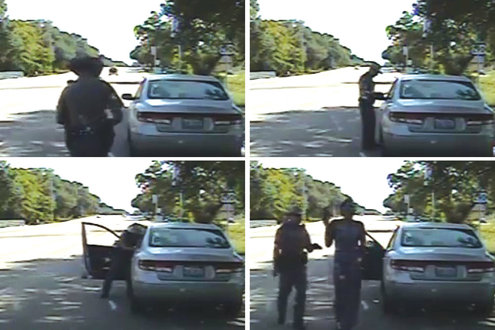
Her voice crescendos throughout the video, signifying her growing anxiety, tension at the situation, and anger for being under arrest. However, Bland’s voice begins to crack. Her sighs and grunts signify upon her disapproval of Encinia’s treatment of her physical body and rights. Once handcuffed, Bland’s voice is very high-pitched and pained, a sonic signifier of submission and Encinia’s re-affirmation of authority. She then is quiet and a conversation between Encinia and another officer is heard across the footage.
Many critiques of Bland center around her ‘distasteful’ use of language. One critic in particular described the altercation as “an African American woman had too much mouth with the wrong person and at the wrong time.” The assumption in those critiques is that she was not properly angry. Instead of a blind obedience of Enicnia’s inferred authority (read: superiority), she questions him and his inability to justify his actions. Sandra Bland’s sonic dis-respectability (dare I say, ratchet), is a direct pushback against the cultural and social norms of not only rural Southern society but the mainstream American (inferred) belief of southern black folks’ blind respectability of white authority and law enforcement.
Although Bland was a graduate of a southern HBCU, I do not want to assume that Bland possessed the social sensibilities that upheld this unstated social practice of blindly obeying white authority. Her death runs parallel to those of Emmett Till and Mary Turner. The circumstances of Till’s death swirled around his alleged whistling at a white woman – read as a sonic signifier of Till’s black masculine sexuality instead of boyhood – and disregard for white femininity, a protected asset of white men’s authority. Till, from Illinois like Bland, allegedly ignored his cousins’ warnings about the ‘proper protocol’ of interacting with white folks. Mary Turner, a black woman from Valdosta, Georgia, spoke out publicly against the lynching of her husband in 1918. She and her unborn child were also lynched in response to her sonic audacity. Before her death, members of the mob cut open her belly and her unborn baby fell on the ground; it was stomped to death after it gave out a cry. Turner’s voice disrupted white supremacy. Her baby’s lone cry re-emphasized it. Sound grounds much of the racial and gendered violence in the South.
The Southern U.S. emphasizes listening practices as part of social norms and cultural traditions. Listening was an act of survival more so than vocalizing the challenges facing black folks. (Jennifer Stoever’s upcoming book on the sonic color line addresses how advertisements for runaway slaves, for example, mentioned whether they were good listeners, as a way to codify whether they were compliant slaves.). Consider my grandmother’s warning about not bringing attention to myself. In her eyes, by not bringing attention to myself I’m able to remain invisible enough to successfully navigate society’s expectations of my blackness and my womanhood. Silence and listening are tools of survival. Contrarily, Bland’s loud disapproval and emphatic use of curse words registered her blackness and womanhood as threatening. She was coded as less feminine and therefore threatening because of her direct verbal confrontation with Encinia. She was not quiet or polite, especially in the south where quiet is the ultimate and sole form of women’s politeness and respectability. The combination of these multiple representations of black women’s anger invoked Encinia’s hyper-authoritative response to regain control of the situation.
Black folks are increasingly pushing back against “being in their place.” Sandra Bland’s death is rooted in an unnecessarily escalated fear of black women literally speaking their truth to power. In a moment where black women are speaking on multiple wavelengths and levels of volume, it is imperative to single out instances and then implode outdated cultural and social practices of listening.
—
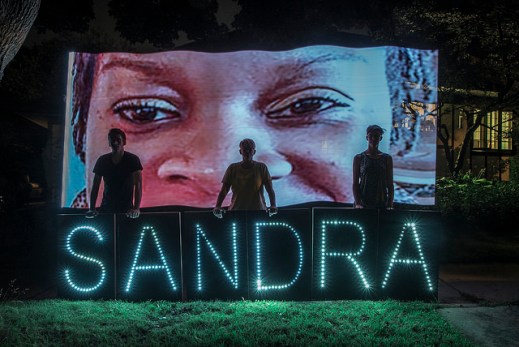
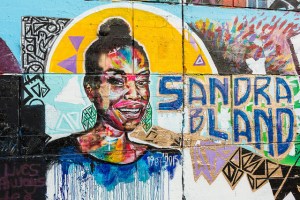
Featured image:”Sandra Bland is Her Name” by Flickr user Light Brigading, CC BY-NC 2.0
—
Regina Bradley is a writer, scholar, and researcher of African American Life and Culture. She is a recipient of the Nasir Jones HipHop Fellowship at Harvard University (Spring 2016) and an Assistant Professor of African American Literature at Armstrong State University. Dr. Bradley’s expertise and research interests include hip hop culture, race and the contemporary U.S. South, and sound studies. Dr. Bradley’s current book project, Chronicling Stankonia: Recognizing America’s Hip Hop South (under contract, UNC Press), explores how hip hop (with emphasis on the southern hip hop duo Outkast) and popular culture update conversations about the American South to include the post-Civil Rights era. Also known as Red Clay Scholar, a nod to her Georgia upbringing, Regina maintains a critically acclaimed blog and personal website – http://www.redclayscholar.com. She is a regular writer for Sounding Out!
—
REWIND! . . .If you liked this post, you may also dig:
I Been On: BaddieBey and Beyoncé’s Sonic Masculinity — Regina Bradley
“President Obama: All Over But the Shouting?” — Jennifer Stoever
Óyeme Voz: U.S. Latin@ & Immigrant Communities Re-Sound Citizenship and Belonging-Nancy Morales
—
Share this:




Current Top Posts





April 2021

January 2020

November 2019

October 2019

August 2019

April 2014

November 2017

March 2015

December 2017

October 2015


Recent Comments