
Summer Soundscapes, East Coast Style
The humid dog days of summer are upon us, and with them their unique soundscape. In central-AC bereft Binghamton,NY, this means the opening of windows from now until the air turns crisp in September, an act whose necessity casts the intimate sounds of my daily life into my neighbor’s homes and invites their sounds into my apartment. You don’t need to be Mrs. Kravitz to pick up on the comings and goings next door; basically, summertime means your biz is in the streets whether you want it to be or not. In my former neighborhood, youthful and well worn, this meant anything from the heated fights of newlyweds—and the equally passionate make-up sessions, stereotypical but true—to bumping music and whose kids go to sleep when. I used to know what video games the guys next door played and how they were progressing, even though I still couldn’t tell you what they looked like.
In wintertime, this heat-necessitated, neighborhood-sanctioned audio voyeurism ends abruptly with the first frost; double-paned windows tell no tales. But for now, the sonic community is vibrant, even in my current neighborhood comprised mainly of retirees: the brush of wind through the trees, the yap of small dogs, the hum-and-drip of wall units, the snarl of lawn mowers and the high-pitched whine of edging equipment—I have learned after trying to work at home a few times that retirees reserve the right to mow any time they damn well please, thank you—and the gossip of family gathered in lawn chair semi-circles two doors down. I knew my next-door-neighbor’s grandchild was visiting two days before she saw me watering my plants and proudly introduced me to the sheepish little one.
I have to say that even after three years of living here, there still a part of me that finds the annual summertime ritual-cum-reality show novel and slightly unnerving.  In my home state of (Southern) California windows are rarely opened unless they have bars on them—people worry that strangers will crawl inside, especially when Robert Downey, Jr. is off the wagon—and I have my dad’s perpetual “we aren’t paying to cool the outside” burned into my brain. Not knowing one’s neighbors is often a badge of pride in SoCal and privacy is treated as a right rather than a financially and technologically-enabled privilege or an unfortunate side effect of paranoia. The closest I have come to such a high degree of sonic intermingling was when I lived in a first-floor studio apartment at the bottom of an air-shaft in an old LA building, where, in addition to overhearing all sorts of drama, I would also find unexpected gifts in my shower: old razors, half-used designer shampoos, crusty loofahs.
This season, however, I was really settling in to the summer soundscape until we finally had our first real heat wave. Temperatures skyrocketed into the 90s and the dew point wasn’t far behind, creating an intense humidity that unleashed a noise the likes of which I have never heard before. . .at least not in this acutely painful way. It was finally warm enough for the people behind us to start SWIMMING in their POOL. Pools are a rarity in the Bing, and I have to say that when it is hot enough for sweat to creep down your back, the sheer torture of hearing splash after splash is enough to push anyone over the edge. But my discomfort with the sound is due to more than simply heat frustrations; it reminds me more than anything that even after three years, I remain a stranger in a strange land. Like sound artist and theorist Tony Schwartz reminded us, “There’s no party so noisy as the one you’re not invited to.” And I feel that intensely with every cannonball and yelp of pleasure that I hear over the back fence. I don’t know my neighbors yet—definitely not well enough for impromptu pool parties—and I don’t know anyone with a pool to holler at on a hot day,  something I took for granted growing up in suburban SoCal, where swimming pools and homies with some kind of access to them, illicit or not, were much more plentiful. While sound has the ability to moor us to particular locations, it can also unmoor us in the same moment. As I hear the slurp of the choppy water against the concrete rim, I am simultaneously stewing in the shade of the neighbor’s giant pool-view blocking white fence—ironically the only shade in our yard—and I am back in 1980s Riverside, playing Marco Polo until my lungs ached from gulping too much smog. The sounds of swimming are so familiar to me that they are completely foreign in this new location and I can’t help but feel a little alien myself as a result.
A friend recently suggested that I should resolve my noise-related tensions the old-fashioned upstate New York way, by knocking on their door, son in tow, with a basket full of tomatoes fresh from our garden. I have long disagreed with the slogan of the Noise Pollution Clearinghouse—“Good Neighbors Keep their Noise to Themselves”—believing that in many occasions, noise is a product of social relations. This instance seems like an excellent test case. Perhaps if good neighbors shared more fresh produce, they would get more pool invites, and all that splashing would blend seamlessly back into the Binghamton summer soundscape. Or, I will pack up the car like usual and continue to be grateful that, unlike SoCal, public pools are still king in these parts.
Sounding Out! would like to hear about your favorite summer sounds. . .and the ones that drive you a little bit crazy. Drop some in our comment box, then adjust the bass and let the Alpine blast. . .
JSA


Share this:

Re: Chuck Klosterman – “Tomorrow Rarely Knows”
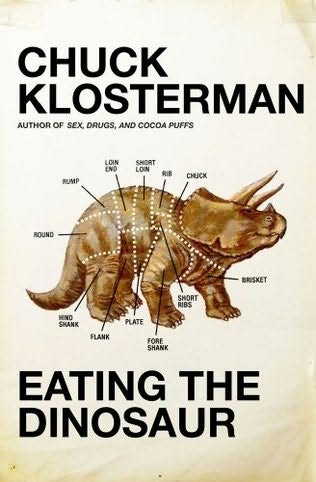 In Chuck Klosterman’s latest compilation of essays, Eating The Dinosaur, he pens an article entitled “Tomorrow Rarely Knows.” It is somewhat of a refresher course in time travel critique; geek-bait, essentially, designed to engross and compel sci-fi aficionados like myself. Although Klosterman is a critic of pop-culture, he is always at his best when writing about music. Therefore the most salient question posed by Klosterman here, is embedded within a footnote about Chuck Berry’s “Jonny B. Goode” halfway through the essay. Considering Back to the Future, Klosterman writes about how Michael J. Fox refers to “Johnny B. Goode,” as an “oldie.” Riffing on this idea he explains that in 1985 a twenty-seven year old rock song did qualify as an “oldie,” where paradoxically now no one would dare refer to Back to the Future, a twenty-four year old movie, an “oldie.” From this logic, Klosterman synthesizes:
“What seems to be happening is a dramatic increase in cultural memory: As culture accelerates, the distance between historical events feels smaller. The gap between 2010 and 2000 will seem far smaller than the gap between 1980 and 1970, which already seemed far smaller than the gap between 1950 and 1940.” (pg. 58)
Klosterman articulates two premises here, (1) There exists a cultural phenomenon in which people remember time in the past moving more slowly than it does in the present, and (2) This phenomenon occurs because culture accelerates. I take issue with the second premise – although I am uncertain of exactly what Klosterman means when he claims that culture is “accelerating,” I am confident that every possible explanation carries within it a set of presuppositions which are by their very nature determinist, teleological and ethnocentric. Most troubling is the idea that culture is ‘going’ somewhere, all progress is good progress. Culture is a metaphor used to describe a forever malleable set of material phenomenon, by constructing it as a quantifiable thing, Chuck projects a number of contemptible perspectives upon it.
Premise one however, is a much more interesting site for contemplation. Re-articulated: Why do some people remember time in the past as moving more slowly than it does in the present? My gut instinct is to argue that there is now a peculiar regime of nostalgia which delights in the rapid re-appropriation and re-articulation of all tangible media artifacts. Because recent changes in technology have made it so much easier to record, edit, splice, erase, duplicate, and distribute all media forms, we now live in a world where we are inundated by representations of the past all the time. This constant inundation is indicative of a growing cultural familiarity with past media ephemera and the subsequent changes in cultural bias. Do people even use the term “oldie,” anymore? Instead, descriptors like “retro” are used to accentuate the “cool” in instances of convergence-necromacy.
It is interesting that Klosterman constructs cultural memory through the ways that people remember music. It is therefore important to historicize the practice of listening within the history of audio technology. The 1980s historically mark the widespread dissemination of recording technology to the consumer market. This denotes a mnemonic shift, akin to the invention of writing or the printing press (Although I would argue that the printing press has more in common with the popularization of the Internet as a DIY publishing outlet). The cultural shift in language from “oldies” to “retro” has more to do with the sense of audio empowerment consumers have gained in the last twenty-four than Klosterman’s theory of cultural acceleration. It’s a shame also, Eating the Dinosaur contains Chuck’s best writing since Sex, Drugs and Cocoa Puffs.
AT


Share this:


Current Top Posts





April 2021

January 2020

November 2019

October 2019

August 2019

April 2014

November 2017

March 2015

December 2017

October 2015
 Sounding Out!
Recent Comments