
Malcolm Gladwell’s Bad Aesthetics

Malcolm Gladwell, who recently wrapped the first season of his podcast Revisionist History, has been on a roll lately. Not a particularly endearing one, though. I’ve been trying to locate his nadir, but it’s not easy with so many options to choose from. Is it in the New Yorker, when he condescendingly exclaims “Of course not!” in response to whether Caster Semenya should be allowed to compete in the 800-meter at the Olympics? He follows up with the assertion that no track-and-field fan disagrees with him, as if the complexity of gender identification is somehow best left to a majority appeal. Or is it in Revisionist History’s Episode 9, “Generous Orthodoxy,” when he chides Princeton students protesting the use of Woodrow Wilson’s name around campus? Calling one student “angry”—a loaded word to lob at a black woman—and surmising she would later “regret her choice of words,” Gladwell advises the students to instead threaten to leave the university if their requests aren’t honored. Why? Because otherwise “every crotchety old Princeton alum” wouldn’t believe they actually care about the university.

For those keeping score, that’s Gladwell, who spent an entire other episode of his podcast lamenting that we don’t “capitalize” people’s educational potential well enough, counseling black students to separate themselves from an Ivy League education as a way to make a point about a pro-segregationist president. Gladwell’s seventh episode, “Hallelujah,” where he discusses musical genius, is not obviously about the kind of systemic inequalities he bumbles in the Semenya and Princeton examples. But the conclusions he draws about genius and the anti-pop aesthetic judgments he claims are informed by the same bad gender and race politics that would put a person’s gender identification in other people’s hands and place the burden of sacrifice on the aggrieved in matters of racial injustice.
The episode “Hallelujah” revolves around two songs that Gladwell argues reached their peak of genius years after they were initially recorded: “Deportees Club” (1984) by Elvis Costello and “Hallelujah” (1984) by Leonard Cohen. In each case, Gladwell asserts that the first recordings were flawed but that they attained a certain beauty in later versions that reveals something about how genius works, though each attained that genius status by different routes. While Costello is responsible for the version of “Deportees Club” that Gladwell loves—he re-recorded it as “Deportee” in 1985 (it wouldn’t be released until 1995 on a re-issue of Goodbye, Cruel World)—“Hallelujah” would peak for Gladwell in a series of covers, most famously by Jeff Buckley (1994), performed by artists other than Cohen. Gladwell’s focus on the process by which a song reaches genius status is a riff on David Galenson’s Old Masters and Young Geniuses theory. Here, Costello and the litany of “Hallelujah” coverers display a process of genius called “experimental innovation,” where the first draft is never the final draft, and genius is only unlocked after years of work. I’ll return to Gladwell’s notion of musical beauty and how it relates to his bad politics momentarily, but I first want to unpack the theory of genius that enthralls him in this episode.
 Galenson’s notion of genius is a binary, where some geniuses (“conceptual innovators”) are very young, decisive artists and others, like the “experimental innovators” responsible for “Deportee” and “Hallelujah,” are endless tinkerers who tend to reach their creative potential later in life. Gladwell uses the same paradigmatic examples that Galenson does to categorize geniuses; conceptual innovators are Pablo Picasso, while experimental innovators are Paul Cézanne. Curiously, Gladwell notes that this theory of genius may be best exemplified in music, but he doesn’t seem aware that music scholars have already laid out this same broad theory of genius with easy comps: Mozart the young genius and Beethoven the old master. Moreover, Gladwell doesn’t seem aware that this is a lousy theory of genius.
I’ve written elsewhere about genius myths, and there’s a rabbit hole of problematic ideas out there about classical music genius that run from benignly self-serving to violently racist. One critique is particularly useful for pushing back against Gladwell, as it highlights the gender and race problems with Gladwell’s approach to genius. Tia DeNora’s Beethoven and the Construction of Genius (1994) is a painstaking deconstruction of Beethoven’s genius. While DeNora’s argument includes a number of moving parts, it can be summarized as a demonstration of the way “genius” isn’t so much innate talent as it is a combination of several social and political ideals intersecting with a person’s talents or insights.
It was the 90s, when postmodernity crested in musicology, and the aim of DeNora’s analysis is quintessentially postmodern: undo the Great White Man myth to make room for other kinds of histories and notions of genius to be accommodated. If we understand Beethoven’s genius to be firmly rooted in a number of social and political attitudes—including the reflexive belief that only a white man could be a genius—that tipped in his favor, then we can understand that history isn’t telling us that only men or only white people can be geniuses; rather, history is showing its biases. This sort of deconstruction doesn’t really move the academic needle now—most college freshmen can articulate the Great White Man critique—largely due to the work of DeNora and other deconstructionists who effectively cleared the space for us to build other kinds of scholarship on top of their work.

“Pop!Tech 2008 – Malcolm Gladwell” by Flickr user Pop!Tech, CC BY 2.0
Alas, though, the 90s truly must be all the rage right now, because Gladwell is wading right back into Great White Man territory. To be clear, he isn’t doing it on purpose, for whatever that’s worth. In Episode 9, the one where he counsels the black Princeton students to threaten to leave the school, he performs a whole Great White Man rant to establish his credibility as A Guy Who Gets It. But beyond understanding that there are too many things named after white men, Gladwell doesn’t indicate that he knows what the rub really is, that the name on a building or School is a tiny piece of a much bigger, systemic problem of race and gender. Perhaps unsurprisingly, then, his ideas about musical genius betray his own tendency to set up hierarchies where Great White Men are always on top. So excuse me while I pump some air in my Reeboks, hitch up my Guess jeans, and douse myself in CK1; we have some 90s theory to attend to.
Gladwell doesn’t—and perhaps can’t—articulate what’s genius about the versions of “Deportee” and “Hallelujah” he reveres, and his assessment of the originals is similarly vague. About 1984’s “Deportees Club,” he exclaims, “Oh, god, It’s awful!” For Cohen’s 1984 “Hallelujah,” Gladwell borrows a line from Michael Barthel, who could’ve just as well been describing Gladwell’s podcast: “The entire performance is so hyperserious that it’s almost satire.” [Historiographic aside: Barthel, who is now a researcher for the Pew Research Center, seems to be the under-cited source for the “Hallelujah” history in both Gladwell’s podcast and Alan Light’s book on the song]. Gladwell may suffer a poverty of aesthetic language to describe what is or isn’t good about these songs, but by considering what he does and doesn’t like—what counts as genius or not for him—we can understand where his aesthetic allegiances lie.

Screenshot of Leonard Cohen’s “Hallelujah” video on YouTube
Gladwell finds beauty in music whose emotional content is as stripped down as the acoustic guitar textures on the later recordings of “Deportee” and “Hallelujah.” The line he quotes from Barthel misses the point: Barthel likes the satirical nature of the original “Hallelujah” and finds the famous Buckley version—which becomes something of an ürtext for all the covers that came after it—an unfortunate telescoping of emotional range, a “Hallelujah” that only knows lament instead of the many “holy, broken, profane, transcendent” hallelujahs Cohen first explored. But all those hallelujahs, along with the “angry, loud, and upsetting” original “Deportees Club,” don’t seem to suit Gladwell, who prefers versions of the songs where both the emotional and musical content are as straightforward as possible.

Screenshot from Jeff Buckley’s video for “Hallelujah”
That Gladwell is drawn to the versions of Buckley’s “Hallelujah” and Costello’s later “Deportee” that feature an acoustic singer-songwriter coffeehouse vibe isn’t a coincidence. The villain in his account of genius is pop. Noting that both songs were initially recorded in 1984, he reminds us that year’s “biggest album” was Michael Jackson’s “Thriller,” “pop music glossed to perfection…not a single stray note or emotion on that record.” “Thriller” was the final single from an album two years old, and it peaked at #4 on the Billboard Hot 100, so Gladwell’s definition of “biggest album” is suspect, but he’s looking for “the antithesis of ‘Deportee’ and ‘Hallelujah,’” so I’ll engage on his terms and zero in on his aesthetics by figuring out what he thinks is wrong with pop music like “Thriller.”
Gladwell offers a couple other assessments of pop aesthetics in his description of producers. Clive Langer and Alan Winstanley, who co-produced the Goodbye, Cruel World album “Deporteees Club” appeared on, are the ill-fitting pop perfectionists who try to harness Costello’s sound but only manage to screw it up. Trevor Horn is the guy spending four weeks—“a month,” Gladwell bemoans—shaping a snare sound for Frankie Goes to Hollywood’s “Two Tribes” (1983). Whether it’s Langer and Winstanley, Horn, or Quincy Jones (who Gladwell doesn’t name but who produced “Thriller”), Gladwell has no space for the behind-the-glass work of sound design and sonic processing in his aesthetics of genius. He argues, citing Costello’s own assessment, that glossy pop perfection couldn’t capture the “dark, emotional, bitter songs, gritty and spare,” pouring out of Costello. For Gladwell, pop music production is the villain because it short circuits the true, raw emotion that he finds beautiful.
The problem with Gladwell’s aesthetics is that he’s mistaking his taste for genius, then reverse-manufacturing an explanation of genius that privileges a specifically white masculine mode of expression. “Glossy pop perfection,” in his estimation, covers up something beautiful, obscuring real emotion. But directly sharing one’s emotions—whether musically or politically—is more acceptable for some than for others. We need look no further than Gladwell for proof. If you’re Elvis Costello or Jeff Buckley singing laments? You’re a genius. If you’re a black woman protesting Woodrow Wilson at Princeton? You’re “angry.”
![Joe Mabel [GFDL (http://www.gnu.org/copyleft/fdl.html) or CC BY-SA 3.0 (http://creativecommons.org/licenses/by-sa/3.0)], via Wikimedia Commons](https://commons.wikimedia.org/wiki/File:Janelle_Mon%C3%A1e_12.jpg)
Joe Mabel [GFDL (http://www.gnu.org/copyleft/fdl.html) or CC BY-SA 3.0 (http://creativecommons.org/licenses/by-sa/3.0)%5D, via Wikimedia Commons
Gladwell’s bad aesthetics, his refusal to recognize beauty in pop music, is also bad politics. By holding up an aesthetic that prizes stripped-down, straightforward emotionality, a form of expression available to some but not others, Gladwell ends up in the same Great White Man genius bind DeNora and others unraveled in the postmodern 90s. So I’ll sum it up with a 90s phrase: genius is always already political. Denora argues—and Gladwell inadvertently demonstrates—that labeling artists as genius relies on politically volatile aesthetic judgments that reinforce existing power hierarchies, in this case along the lines of race and gender. Like his response to Princeton students and his armchair adjudication of Semenya’s gender identity, Gladwell’s theory of musical genius proves to be less a revision of history and more a revival of history’s worst politics.
—
Featured image: “Malcolm Gladwell” by Flickr user Ed Schipul, CC BY-SA 2.0
—
Justin D Burton is Assistant Professor of Music at Rider University, and a regular writer at Sounding Out!. His research revolves around critical race and gender theory in hip hop and pop, and his current book project is called Posthuman Pop. He is co-editor with Ali Colleen Neff of the Journal of Popular Music Studies 27:4, “Sounding Global Southernness,” and with Jason Lee Oakes of the Oxford Handbook of Hip Hop Music Studies (2017). You can catch him atjustindburton.com and on Twitter @justindburton. His favorite rapper is Right Said Fred.
—
 REWIND! . . .If you liked this post, you may also dig:
Pop’s Chill Thrills Aren’t So Cheap-Robin James
Trap Irony: Where Aesthetics Become Politics-Justin D. Burton
This is What It Sounds Like . . . . . . . . On Prince (1958-2016) and Interpretive Freedom-Ben Tausig
Share this:

A Manifesto, or Sounding Out!’s 51st Podcast!!!

This week, Sounding Out! dropped its 51st podcast episode. As the curator and producer, I thought it necessary to commemorate the occasion with some fanfare. I want to shout from the hilltops about how proud I am that our little podcast has turned 51!
Erm…at least I’m posting about it.
Also, I want to clear the air a little about what it is that we do. I’ve received feedback here and there over the years about the sound of our podcasts, that we sound “different” and/or “inconsistent,” that we need to normalize the sound a bit: hello out there, audiophiles! Today, I want to say, once and for all, that our sound is intentional and that we are proud of it, hiss, distortion, and all! We think what some hear as “imperfections” are all part of what sets us apart from the ever-growing pack of podcasters. SO!’s podcast has sounded different since we MacGyvered our first episode from an epic talk, a few great ideas, and a rogue tape recorder at River Read Books in Binghamton, NY in April, 2011.
The Sounding Out! Podcast began as a series of conversations within the editorial team back in 2011. We knew that the blog was “talking the talk” in new, excellent, and often provocative ways, but that something was missing to keep pushing the form into the red, not just the content. We knew we needed something more—a little snap, crackle, and pop, if you will—a way to show how Sounding Out! was always listening, and a way for thinkers, artists, provocateurs, and more to engage with sound more directly. In 2011, podcasts were accumulating in the shadows waiting to lunge forth to center stage. They seemed really cool, but there were relatively few, and fewer still (if any at all) on the topic of sound studies. Even though we knew that podcasts were going to be a big thing eventually, we had no idea that they would blow up so quickly.
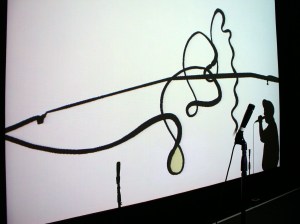
Image by Sandor Weisz @Flickr CC BY-NC.
While we flipped around many ideas, we decided to put our energies behind what was then an occasional series of podcasts that allowed us to capture important yet fleeting moments—too quick and dirty to really transcribe. While our our initial vision for the podcast was to capture these rare and powerful moments, over the past 5 years we have kept this mission consistent while evolving to better accommodate artists and theorists alike. During that time we have hosted mystics and librarians, shared fieldwork from São Paolo, Brazil to Lodi, Ohio, interviewed theremin players and visionaries. See the full list of episodes here. Even though our content has been wide ranging and eclectic, we’ve made it a point to privilege access and immediacy in all of our episodes.
As I listen back to the past five years, I realize that our contribution to the fields of sound studies and podcasting has not just been in terms of who we broadcast and what we amplify, but through the sound of our podcasts themselves. Our podcasts don’t sound perfect. They’re spiritually aligned by the raw production ethic of bands like The Minutemen, who always privileged the emotive qualities of immediacy, access, and intimacy over the brooding qualities of studio production. Particularly because we founded the podcast upon these same principles, I have strived to prioritize radical visions and ideas and to amplify new voices above all else. I want each podcast to arrive in your queue like a wrapped gift—topic, content, production, and sound all equally mysterious. Some of our podcasts were recorded on cellphones and others were recorded in high-end studios and recording booths. Our 51st anniversary isn’t the perfect occasion, either. But, hey, we’re proud of these audible distortions.
“The Minutemen: #1 Hit Song”
So what do I mean that our podcast sounds different? Well, I mean two things: First, we sound different than what episodic radio sounds like. Our DIY—or, more accurately, we will help you “Do It Yourself”—ethics deliberately dial back radio’s genre conventions: smooth identifiable hosts, heavy compression, sound-proof rooms with the latest in equipment. We encourage and construct our podcast with a deliberate sonic diversity, providing little sonic consistency from episode to episode in order to challenge regimes of production that threaten to make all recordings sound the same. We have many many different announcers and hosts; for this podcast to be the space of radical discourse that we intend, it’s important to cast our net wide. This isn’t to say that we don’t care about “quality,” but rather that we define quality differently. Rather than an audiophilic emphasis on the sorts of tone found most frequently in microphone technique, sound booths, and—when all else fails—postproduction, we believe that a “quality” podcast—particularly one about sound—should explore sounds that we rarely hear and allow its artists freedom over how they present their work.
I curate our podcast as a sonic refuge from the invisible regime of auditory production that has slowly constricted and strangled radio this past century. And I’m proud to share podcasts that have been recorded on in impromptu circumstances, Episode XXXIX: Soundwalking Davis, CA and New Brunswick, NJ, for example. We want artists to show more than they tell; Episode XII: Animal Transcriptions, Listening to the Lab of Ornathology is a perfect example of this. Here Jonathan Skinner’s brilliant exploration of animal sounds perfectly balances sound and interview and invites listeners to compare sounds to speech, and vice versa. Another example of this ethic is film professor Monteith Mccollum’s remix of the original War of the Worlds broadcast. Although Mccollum offers some commentary at the start of the recording, what follows is a unique and dazzling sonic experience. Giving radical ideas both the space and platform to be heard is this podcast’s mission. So far, so good!
The second way our podcast sounds different has to do with our deliberate curatorial resistance to consistency between our episodes. When programs bend to the whims of genre conventions, creativity is all but snuffed out. For our podcast to excel as a form for sharing visions, ideas, and experiments, we must allow our composers, authors, and auditors the freedom to explore sonic space. We celebrate Sounding Out!’s anniversary annually with a series of mixes hand-picked by our stable of authors (Listen to years 1, 2, 3, 4, 5, and 6 here!), we’ve entertained interviews, panels, and sound art alike. You may have missed it, but we even have an episode diving into the work of ambient sound in a Dungeons and Dragons game.

Behind the scenes, we look NOTHING like this. Image borrowed from fr4dd @Flickr CC BY.
While I do think about the sound of our podcast aesthetically—I used to run a music production studio out from the trunk of my car—we do not cultivate a DIY anything-goes ethic strictly for a “cool factor” or just for its own sake. Rather, we have calibrated our different sonic approach in deliberate defiance of styles of production which are all too frequently celebrated within the cultures of straight white men. (Check out SO! Editor-in-Chief Jennifer Lynn Stoever’s epic three-part treatise on the tape recorder in popular film to glean some sense of the tape-recorder’s role as an instrument of masculine control. Part 1, Part 2, Part 3). The standards of taste which have long governed the domain of radio production (and audio production, as a whole) are historically connected to the communities of practice which have occupied invisible yet powerful roles as audio producers, engineers, critics, and marketers.
As Jonathan Sterne explains in MP3, the science of audio fidelity has historical roots within a corporate logic that privileges sounds that are easily shared through telephone cables. “AT&T encountered hearing as an economic problem once its options for extracting additional profit through price were limited,” Sterne says, “Among other strategies, it sought to learn which frequencies could be excluded from the market for telephone signals” (14). In other words, the entire craft of audio engineering has historical roots in privileging sounds that make money above all else. Not only this, but the standards of fidelity cultivated by engineers allow them to gatekeep and demand money at the outset, blocking access to the means of production. These standards are more often than not embedded within the cultures of listening and sales fostered by the radio industry. Fortunately, podcasts have been able to challenge many of these genre tropes, We’re proud to contribute to this momentum and to propel it forward as we continue our series. And we’re not stopping! Up on deck in 2016 we have some amazing compositional sound art, more from Marcella Ernest’s trek to uncover lost sounds, and some notes on a forthcoming project in archiving one city’s local music scene.

BOOM!!!!! Image by Jamie McCaffrey CC @Flickr BY-NC.
So, in the spirit of Sounding Out!’s annual blog-o-versary we’re popping the cork for our podcast’s 50th episode with a few of the milestones we hit this past five years.
We found a theme song. This was a small but important step in our development. What would a podcast about sound be without some kind of awesome anthem representing it? (Nothing, that’s what!) We need to officially thank the members of Hunchback (Miranda, Mike, Jay, and Craig) for donating their song “Feeling Blind” to our podcast. Hunchback was a legendary horror-surf band from the NJ basement scene who endeavored to produce highly visceral sonic experiences of the highest caliber in their songwriting. You can still find a ton of their recordings on the internet. Thanks, crew!
 We got listed on iTunes and Stitcher. It bears mentioning that quite a bit of technical muscle is involved in establishing a podcast. We would have gotten nowhere without Andreas Duus Pape’s help and guidance during our earliest moments. Andreas was instrumental in opening up the hood of the podcast and making it purr. Not only did he donate his time to plug us into iTunes’ network of podcasts, but he also shared some excellent philosophical thoughts on the topic. You can listen here and read them here.
We went monthly. Originally we had conceived the podcast as more a haphazard, occasional treat for our readers. Slowly but surely as demand and interest grew, we began to carve out a more regular calendar space for our podcast. First we switched to a bi-monthly format, and then we started with monthly broadcasts. Can’t slow this beat down.
We are the sonic archive of a sound art conference. That’s right, we featured sonic mixdowns of the entire Tuned City of Brussels sound art festival. Over the course of the festivals three days, we featured daily mixdowns of the prior day’s key sounds and moments. Each mixdown is brilliant and a testiment to the raw passion of our podcast contributors. They worked round the clock to produce such an amazing series. Check out the night before, and days 1, 2, and 3.
 We produced a LOT of soundwalks. If you’re a listener you know that we love our soundwalks. We’re proud to be host to play host to a variety of soundwalks from cities around the world. Last month’s Yoshiwara soundwalk by Gretchen Ju challenged listeners to critically engage with the city’s fraught history of sex work. Other contributors in our soundwalk series like James Hodges have considered how the ambient music of big box stores and shopping malls are part of the architecture of commerce. Finally others like Frank Bridges have taken us to the edge of history and soundwalked the grounds of Thomas Edison’s workshop in Edison, NJ. No matter what the locale, our soundwalks are part of our podcast’s signature.
We found a regular contributor. Regular contributors are the heart and soul of Sounding Out! They lead the conversation on sound and work to bring you the best, most interesting content. For these reasons we’re proud to announce that Marcella Ernest will be joining our podcast as a regular contributor with her series “Searching for Lost Sounds.” Marcella will be interviewing a variety of sonic practitioners in an effort to give voice to the voiceless. Her most recent entry in the series was posted last Thursday. You can listen here.
We’re going to keep it coming. That’s our promise to you! We’ll be producing great content as long as you’re listening. Take a moment to subscribe to our iTunes or Stitcher accounts and also explore our Episode Guide to see if you missed anything this past 5 years. It’s been a rewarding adventure so far and we guarantee that we’ve already got some great content lined up in the coming months.

Image by Sandor Weisz @Flickr CC BY-NC.
–
Aaron Trammell is a Provost’s Postdoctoral Scholar for Faculty Diversity in Informatics and Digital Knowledge at the Annenberg School for Communication and Journalism at the University of Southern California. He earned his doctorate from the Rutgers University School of Communication and Information in 2015. Aaron’s research is focused on revealing historical connections between games, play, and the United States military-industrial complex. He is interested in how military ideologies become integrated into game design and how these perspectives are negotiated within the imaginations of players. He is the Co-Editor-in-Chief of the journal Analog Game Studies and the Multimedia Editor of Sounding Out!
–
Featured image is “Roscoe Considers Recording a Podcast” by zoomar @Flickr CC BY-NC.
—
 REWIND! . . .If you liked this post, you may also dig:
Sounding Out! Podcast #1: Peter DiCola at River Read Books – Peter DiCola
It’s Our Blog-O-Versary — Jennifer Lynn Stoever
Sounding Out! Podcast #51: Creating New Words from Old Sounds – Marcella Ernest
Share this:


Current Top Posts





April 2021

January 2020

November 2019

October 2019

August 2019

April 2014

November 2017

March 2015

December 2017

October 2015
 Sounding Out!
Recent Comments