
Misophonia: Towards a Taxonomy of Annoyance

 This is the second post in Sounding Out!’s 4th annual July forum on listening in observation of World Listening Day on July 18th, 2015. World Listening Day is a time to think about the impacts we have on our auditory environments and, in turn, their effects on us. For Sounding Out! World Listening Day necessitates discussions of the politics of listening and listening, and, as Carlo Patrão shares today, an examination of sounds that disturb, annoy, and threaten our mental health and well being. –Editor-in-Chief JS
An important factor in coming to dislike certain sounds is the extent to which they are considered meaningful. The noise of the roaring sea, for example, is not far from white radio noise (…) We still seek meaning in nature and therefore the roaring of the sea is a blissful sound. Torben Sangild, The Aesthetics of Noise
When hearing bodily sounds, we often react with discomfort, irritation, or even shame. The sounds of the body remind us of its fallible and vulnerable nature, calling to mind French surgeon René Leriche’s statement that “health is life lived in the silence of the organs” (1936). The mind rests when the inner works of the body are forgotten. Socially, sounds coming from the organic functions of the body such as chewing, lip smacking, breathing, sniffling, coughing, sneezing or slurping are considered annoying and perceived as intrusions. A recent study by Trevor Cox suggests that our reactions of disgust towards sounds of bodily excretions and secretions may be socially-learned and vary according to whether it is considered acceptable or unacceptable to make such sounds in public.

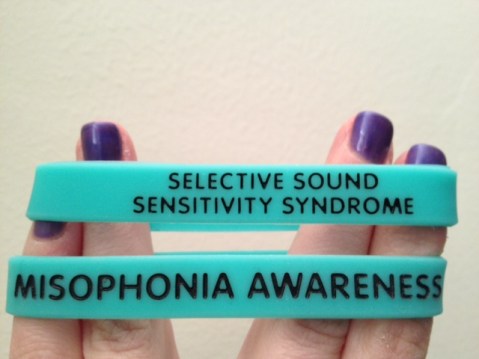
However, for people suffering from a condition called Misophonia, these bodily sounds aren’t simply annoying, rather they become sudden triggers of aggressive impulses and involuntary fight or flight responses. Misophonia, meaning hatred of sound, is a chronic condition characterized by highly negative emotional responses to auditory triggers, which include repetitive and social sounds produced by another person, like hearing someone eating an apple, crunching chips, slurping on a soup spoon or even breathing.
The consequences of Misophonia can be very troublesome, leading to social isolation or the continuous avoidance of certain places and situations such as family dinners, the workplace and recreational activities like going to the cinema. While rate of occurrence of new cases of Misophonia in the population is still under investigation, the fast growing number of online communities gathered around the dislike of certain sounds may indicate that this condition is more common than previously thought.
But why do people with Misophonia feel such strong reactions to trigger sounds? This fundamental question remains up for debate. Some audiologists suggest these heightened emotional responses can be explained by hyperconnectivity between the auditory, limbic and autonomic nervous systems. However, we continue to lack a comprehensive theoretical model to understand Misophonia, as well as an effective treatment to help sufferers of Misophonia cope with intrusive sound triggers.
The Art of Annoyance: is it possible to reframe misophonic trigger sounds as misophonic music?
Between 1966 and 1967, John Cage and Morton Feldman recorded four open-ended radio conversations, called Radio Happenings (WBAI, NYC). Among many topics, Feldman and Cage address the problem of being constantly intruded upon by unpleasant sounds. Feldman narrates his annoyance with the sounds blasted from several radios on a trip to the beach. Cage’s commentary on the growing annoyance of his friend reveals a shift of perception in dealing with unwanted sounds:
Well, you know how I adjusted to that problem of the radio in the environment (…) I simply made a piece using radios. Now, whenever I hear radios – even a single one, not just twelve at a time, as you must have heard on the beach, at least – I think, “Well, they’re just playing my piece.-– John Cage, Radio Happenings.
Cage proposes a remedy via appropriation of environmental intrusions. The negative emotional charge associated with them is neutralized. Sound intrusions no longer exist as absolute external entities trying to intrude their way in. They become part of the self. Ultimately, there are no sonic intrusions, as the entire field of sound is desirable for composition.
Cage’s immersive compositional anticipated an important strategy to build resilience towards aversive sound: exposure-based cognitive-behavioral therapy, which proposes a gradual immersion in trigger sounds. And I suggest we can mine the history of avant-garde practice to productively further the idea of immersion; in the realms of sound poetry, utterance based music, Fluxus events and many other sound art practices, bodily sounds have consistently been exalted as source of composition and performance. Much like Cage did with what he perceived as intrusive radio sounds, by performing chewing, coughs, slurps and hiccups, assembling snores and nose whistles, and singing the poetics of throat clearing, we may be able to elevate our body awareness and challenge the way we perceive unwanted sounds. In what follows, I sample these works with an ear toward misophonia, discussing their interventions in the often jarring world of everyday irritation.
Oral Oddities
As pointed out by Nancy Perloff, while the avant-garde progressively expanded to incorporate the entire scope of sound into composition, sound poetry followed a similar course by playing with the non-semantic proprieties of language and exploring new vocal techniques. The Russian avant-garde (zaum), the Italian futurists (parole in libertà) and the German Dada (Hugo Ball’s verse ohne Worte) built the foundations of a new oral hyper-expression of the body through moans, clicks, hisses, hums, whooshes, whizzes, spits, and breaths.
Henri Chopin, Les Pirouettes Vocales Pour Les Pirouettements Vocaux
Sound poets like Henri Chopin created uncanny sonic textures by only using ‘vocal micro-particles’, revealing a sounding body that can be violent and intrusive. François Dufrêne and Gil J Wolman brought forward more raw and glottal performances.
Bridging the gap between the Schwitter’s Dada-constructivism and a contemporary approach to sound poetry, Jaap Blonk’s inventive vocal performances cover a wide range of mouth sounds. In the same vein, Paul Dutton explores the limits of his voice, glottis, tongue, lips and nose as the medium for compositions — as can be heard on the record Mouth Pieces: Solo Soundsinging.
Paul Dutton, Lips Is, Mouth Pieces: Solo Soundsinging
Fluxus: Eat, Chew, Burp, Cough, Perform!
The Event is a metarealistic trigger: it makes the viewer’s or user’s experience special. (…) Rather than convey their own emotional world abstractly, Fluxus artists directed their audiences’ attention to concrete everyday stuff addressing aesthetic metareality in the broadest sense. Hannah Higgins, Fluxus Experience
The emergence of Fluxus is strongly linked to Cage’s 1957-59 class at New School for Social Research in NYC. George Bretch’s Event Score was one of the best known innovations to emerge from these classes. The Event Score was a performance technique drawn from short instructions that framed everyday life actions as minimal performances. Daily acts like chewing, coughing, licking, eating or preparing food were considered by themselves ready-made works of art. Many Fluxus artists such as Shigeko Kubota, Yoko Ono, Mieko Shiomi, and Alison Knowles saw these activities as forms of social music.
For instance, Alison Knowles produced several famous Fluxus food events such as Make a Salad (1962), Make a Soup (1962), and The Identical Lunch (1967-73).
Also, Mieko Shiomi‘s Shadow Piece No. 3 calls attention to the sound of amplified mastication, while Philip Corner’s piece Carrot Chew Performance is solely centered in the activity of chewing a carrot.
Philip Corner, Carrot Chew Performance, Tellus #24
In Nivea Cream Piece (1962), Alison Knowles invites the performers to rub their hands with cream in front of a microphone, producing a deluge of squeezing sounds:
Alison Knowles – Nivea Cream Piece (1962) – for Oscar (Emmett) Williams
Coughing is a form of love.
 In 1961, the Fluxus artist Yoko Ono composed a 32 minute, 31 second audio recording called Cough Piece, a precursor to her instruction Keep coughing a year (Grapefruit). In this recording, the sound of Ono’s cough emerges periodically from the indistinct background noise. The Cough Piece plays with the concept of time, prolonging the duration of an activity beyond what is considered socially acceptable. While listening to this piece, Yoko Ono brings us close to her body’s automatic reflexes, pulling back the veil of an indistinct inner turmoil. Coughing can be a bodily response to an irritating tickling feeling, troubled breathing, a sore throat or a reaction to foreign particles or microbes. In response, coughing is a way of clearing, a freeing re-flux of air, a way out. Coughing is a form of love.
Yoko Ono – Cough Piece

Sonic Skin
In the work The Ego and the Id (1923), Sigmund Freud stated that the ego is ultimately derived from bodily sensations. The psychoanalyst Didier Anzieu expanded this idea by suggesting that early experiences of sound are crucial to consolidate the infant’s ego. The bath of sounds surrounding the child created by the parent’s voices and their soothing sounds provides a sonorous envelope or an audio-phonic skin that protects the child against ego-assailing noises and helps the creation of the first boundaries between the inside and the external world. The lack of a satisfactory sound envelope may compromise the development of a proper sense of self, leaving it vulnerable to invasions from outside.
It’s no surprise that conditions like Misophonia exist and are very common among us, considering how important our early exposure to sound is in building our sense of self and our sensory limits. For Misophonics, the everyday sounds we make without even thinking about them can be the source of a fractured and disruptive experience that we should not dismiss as the overreactions of a sensitive person. During the month we observe World Listening Day, our discourse usually praises the pleasures of listening and tends to focus on the sounds that soothe rather than annoy. However, conditions like Misophonia show us that there is much more that needs to be said on the subject of unpleasant sound experience. I can’t help but notice a disconnect between the vast exploration of annoying and irritating sounds in the avant-garde and the critical discourse in our sound communities that is dominated by the pleasures of listening. Cage’s call to embrace intrusive sounds urges us to consider all sounds regardless of where they fall on the spectrum of our emotions. For all of us who would consider ourselves philophonics, let’s create a critical discourse that addresses the struggles of listening as much as its pleasures.
—
Thanks to Jennifer Stoever for the thoughtful suggestions.
—
 REWIND! . . .If you liked this post, you may also dig:
Share this:

SO! Amplifies: Josh Shepperd on the Radio Preservation Task Force of the Library of Congress (from FlowTV)

 SO! Amplifies. . .a highly-curated, rolling mini-post series by which we editors hip you to cultural makers and organizations doing work we really really dig. You’re welcome!
Thank you to Josh Sheppard and FlowTV for permission to reprint this excellent call to action.
—
Primary Sources, Primary Sounds: The Radio Preservation Task Force of the Library of Congress
Sound history is cultural history. And a giant part of our history has yet to be preserved, researched, or taught in our classrooms. Our omissions are disproportionately distributed among the local and the liminal, the pastoral and the public, and marginalized and minority experiences. Sound trails continue where paper trails end, and we have an opportunity to provide new insight into the cultural history of the U.S. thanks to recent innovations in sound preservation technology. The Radio Preservation Task Force (RPTF) of the National Recording Preservation Board (NRPB) of the Library of Congress (LOC) is a growing 125-faculty member and 275-archive Digital Humanities initiative working to broaden the historical record by unearthing, mapping, and making available materials that that chronicle experiences neglected in existing historical accounts, such as minority, political, orientation, social advocacy, and educational groups. Perspectives and events that have remained unaddressed by the primary document record will receive new recognition by focusing preservation on the conversational and community building character of noncommercial and local radio history.

Soul Music/Civil Rights Legend DJ Herb Kent at WVON-Chicago
A historical marvel of nation-building, serialization, and aesthetic innovation, radio has also been utilized for multiple purposes beyond entertainment: from education, to a technology of opinion-formation, to a medium for political problem-solving. Much of the early history of the ether consists of distance learning broadcasts, public forums, and civic debates, and in addition to local theatrical and drive time programming the task force is concerned with making these important historical records accessible for the first time. To frame the project in historiographical terms, the RPTF is approaching radio history as a study of what the Birmingham school might call the genealogy of how strategies for circulation of discursive codes, as representations, became central to an expanded concept of the public sphere that included popular culture. If we accept the historiographical argument that content representations are also implementations of discursive, political, and industrial strategies, then radio might be viewed as a medium in which institutional and intellectual projects endeavored to communicate with and persuade community members about a specific perspective or initiative. In this way, radio history has the capacity to reveal the development and dissemination of cultural aspirations and viewpoints, and its consequent archive can be understood as a series of concurrent media advocacies that sought to define conditions of social attunement.
[Reblogged from FlowTV, to continue reading Josh on the RPTF, please click here.]
—
RPTF Logo, courtesy of the author; designed by artist Daniel Murphy (University of Wisconsin-Milwaukee).
—
Josh Shepperd is Assistant Professor of Media Studies at Catholic University in Washington D.C. He teaches courses related to critical, conceptual, and methodological approaches to media studies. He is also actively involved in digital humanities media preservation, and currently serve as the National Research Director of the Radio Preservation Task Force for theNational Recording Preservation Board of the Library of Congress.
—
 REWIND!…If you liked this post, you may also dig:
The New Wave: On Radio Arts in the UK–Magz Hall
SO! Amplifies: Ian Rawes and the London Sound Survey–Ian Rawes
SO! Amplifies: Carleton Gholz and the Detroit Sound Conservancy–Carleton Gholz
Share this:


Current Top Posts





April 2021

January 2020

November 2019

October 2019

August 2019

April 2014

November 2017

March 2015

December 2017

October 2015
 Sounding Out!
Recent Comments