
Unsettled Listening: Integrating Film and Place
 Welcome to the third and final installment of Sculpting the Film Soundtrack, our series about sound in contemporary films. We’ve been focusing on how filmmakers are blurring the boundaries between music, speech, and sound effects – in effect, integrating distinct categories of soundtrack design.
In our first post, Benjamin Wright showed how celebrated composer Hans Zimmer thinks across traditional divisions of labour to integrate film sound design with music composition. Danijela Kulezic-Wilson followed up with an insightful piece on the integration of audio elements in Shane Carruth’s Upstream Color, suggesting how scholars can apply principles of music, like tempo and rhythm, to their analyses of the interactions between a film’s images and sounds. In this final entry, Randolph Jordan, considers another dimension of integration: a film’s sounds and the place where it was produced. In his provocative and insightful reading of the quasi-documentary East Hastings Pharmacy, Jordan, who is completing a post-doctoral post at Simon Fraser University, elaborates on how the concept of “unsettled listening” can clue us into the relationship between a film and its origins of production. You’ll be able to read more about “unsettled listening” in Jordan’s forthcoming book, tentatively titled Reflective Audioviewing: An Acoustic Ecology of the Cinema, to be published by Oxford University Press.
I hope you’ve enjoyed taking in this series as much as I’ve enjoyed editing it with the help of the marvelous folks at SO!. Thanks for reading. — Guest Editor Katherine Spring
—
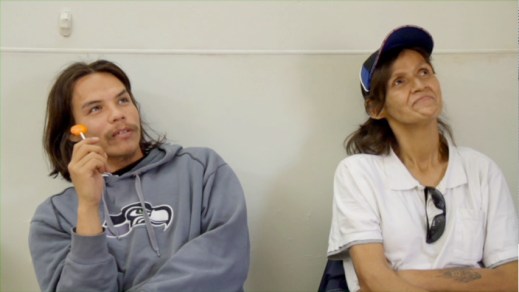
A mother and son of First Nations ancestry sit in the waiting area of a methadone clinic in Vancouver’s Downtown Eastside, their attention directed toward an offscreen TV. A cartoon plays, featuring an instrumental version of “I’ve Been Working on the Railroad” that mingles with the operating sounds of the clinic and ambience from the street outside. The tune is punctuated by a metal clinking sound at the beginning of each bar, calling to mind the sound of driving railway spikes that once echoed just down the street as the City of Vancouver was incorporated as the western terminus of the Canadian Pacific Railway (beginning thus the cycle of state-sanctioned erasure of indigenous title to the land). The familiar voice of Bugs Bunny chimes in: “Uh, what’s all the hubbub, bub?”
.
Hubbub indeed. Let’s unpack it.
The scene appears one third of the way through East Hastings Pharmacy (Antoine Bourges, 2012), a quasi-documentary set entirely within this clinic, staging interactions between methadone patients (played by locals and informed by their real-life experiences) and the resident pharmacist (played by an actress). Vancouver’s Downtown Eastside, dubbed Canada’s “worst neighborhood” for its notorious concentration of transients and public drug use, is also home to the largest community of First Nations peoples within the city limits, a product of the long history of dispossession in the surrounding areas. When the film presents this indigenous pair listening to a Hollywood fabrication of the sounds that marked their loss of title to the city it is a potent juxtaposition, especially given the American infiltration of Vancouver’s mediascape since the 1970s. Long known as “Hollywood North,” Vancouver is more famous as a stand-in for myriad other parts of the world than for representing itself, its regional specificity endlessly overwritten with narratives that hide the city and its indigenous presence from public awareness.
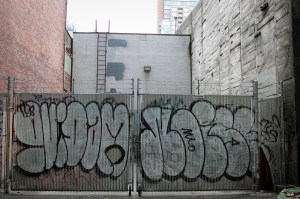
“Quidam + Noise” graffiti in Downtown Vancouver, April 6, 2013, by Flickr User Kevin Krebs
In her essay “Thoughts on Making Places: Hollywood North and the Indigenous City,” filmmaker Kamala Todd stresses how media can assist the process of re-inscribing local stories into Vancouver’s consciousness. East Hastings Pharmacy is one such example, lending some screen time to urban Natives in the 21st Century city. But Todd reminds us that audiences also have a responsibility “to learn the stories of the land” that have been actively erased in dominant media practices, and to bring this knowledge to our experience of the city in all its incarnations (9). Todd’s call resonates with a process that Nicholas Blomley calls “unsettling the city” in his book of the same name. Blomley reveals Vancouver as a site of continual contestation and mobility across generations and cultural groups, and calls for an “unsettled” approach that can account for the multiple overlapping patterns of use that are concealed by “settled” concepts of bounded property. With that in mind, I propose “unsettled listening” as a way of experiencing the city from these multiple positions simultaneously. Rick Altman taught us to hear any given sound event as a narrative by listening for the auditory markers of its propagation through physical space, and recording media, over time (15-31). Unsettled listening invites us to hear through these physical properties of mediatic space to the resonating stories revealed by the overlapping and contradictory histories and patterns of use to which these spaces are put, all too often unacknowledged in the wake of settler colonialism.
East Hastings Pharmacy provides a great opportunity to begin the practice of unsettled listening. The film’s status as an independent production amidst industrial shooting is marked by the intersection of studio-fabricated sound effects and direct sound recording, as in the example described above, and further complicated by the film’s own hybrid of fiction and documentary modes. That speaks to the complexity of overlapping filmmaking practices in Vancouver today, a situation embedded within the intersecting claims to land use and cultural propriety on the streets of Vancouver’s Downtown Eastside. To unsettle listening is to hear all these overlapping situations as forms of resonance that begin with the original context of the televised cartoon and accumulate as they spread through the interior of the clinic and outwards across the surrounding land. So let’s try this out.
.
The cartoon is Falling Hare (Robert Clampett, 1943), a good example of the noted history of cross-departmental integration at The Warner Bros.’ cartoon studios. The scene in question begins at 1:55, and here the metallic clinking sound is just as likely to have been produced by one of music orchestrator Carl Stalling’s percussionists as by sound effects editor Treg Brown. This integration can be heard in the way that the music’s unspoken reference to railway construction charges each clink with the connotation of hammer on spike. However, the image track in Falling Hare doesn’t depict railway construction, but rather a gremlin whacking the nose of a live bomb in an attempt to do away with enemy Bugs seated on top. James Lastra would say (by way of Christian Metz) that the clinking sound is “legible” as hammer on spike for the ease with which the sound can be recognized as emanating from this implied source (126). But this legibility is premised upon a lack of specificity that also allows the sound to become interchangeable with something else, as is the case in this cartoon.

Screen Capture from Falling Hare
East Hastings Pharmacy capitalizes on this interchangeability by re-inscribing the clinking sound’s railway connotations, first by stripping the original image and then by presenting this sound in the context of the dire social realities of Vancouver’s Downtown Eastside as the city’s sanctioned corral for the markers of urban poverty – and indigeneity – that officials don’t want to spill out across the neighborhood’s increasingly gentrified perimeter.
As one of a string of Warner Bros. cartoons put in the service of WWII propaganda, the Falling Hare soundtrack also resonates with wartime xenophobia and imperialist expansion, branches of the same pathos that leads to the effacing of indigenous culture from the consciousness of colonizing peoples. In Vancouver, this has taken the form of what Jean Barman calls “Erasing Indigenous Indigeneity,” the process of chasing the area’s original peoples off the land while importing aboriginal artifacts from elsewhere to maintain a Native chic deemed safe for immigrant consumption (as when the city paid “homage” to the vacated Squamish residents of downtown Vancouver’s Stanley Park by erecting Kwakiutl totem poles imported from 200km north on Vancouver Island) (26). This is an interchangeability of cultural heritage premised upon a lack of specificity, the same quality that allows “legible” sound effects to become synchretic with a variety of implied sources. And this process is not unlike the interchangeability of urban spaces when shooting Vancouver for Seattle, New York, or Frankfurt, emphasizing generic qualities of globalized urbanization while suppressing recognizable soundmarks from the mix (such as the persistent sound of float plane propellers that populate Vancouver harbour, the grinding and screeching of trains in the downtown railyard, or the regular horn blasts from the local ferry runs just north of the city).
The high-concept legibility of Warner Bros.’ sound effects – used in Falling Hare to play on listener’s expectations to comic effect – is further unsettled by its presentation within the context of documentary sound conventions in East Hastings Pharmacy. Bourges’ film commits to regional specificity in part through the use of location sound recording, which, as Jeffrey K. Ruoff identifies in “Conventions of Documentary Sound,” is particularly valued as a marker of authenticity (27-29). While Bourges stages the action inside the clinic, the film features location recordings of the rich street life audible and visible through the clinic’s windows that proceeds unaffected by the cameras and microphones. This situation is all the more potent when we account for the fact that, in this scene, the location-recorded cartoon soundtrack and ambient sound effects were added in post-production, and so represent a highly conscious attempt to channel the acoustic environment according to the conventions of “authentic” sound in documentary film.
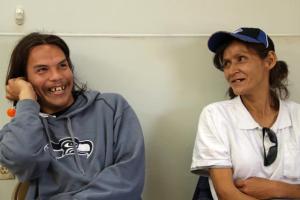
Screen Capture, East Hastings Pharmacy
While the film uses location recording as a conscious stylistic choice to evoke documentary convention, it does so to engage meaningfully with the social situation in the Downtown Eastside, underlining Michel Chion’s point that “rendered” film sound – fabricated in studio to evoke the qualities of a particular space – is just as capable of engaging the world authentically (or inauthentically) as “real” sound captured on location (95-98). By presenting this Hollywood cartoon as an embedded element within the soundscape of the clinic, using a provocative mix of location sound and studio fabrication, East Hastings Pharmacy unsettles Hollywood’s usual practice of erasing local specificity, inviting us to think of runaway projects in the context of their foreign spaces of production and the local media practices that sit next to them.
Finally, this intersection of sonic styles points to the complex relationships that exist between the domains of independent and industrial production around Vancouver. In his book Hollywood North, Mike Gasher argues for thinking about filmmaking in British Columbia as a resource industry, pointing to how the provincial government has offered business incentives for foreign film production similar to those in place for activities like logging and fishing. Here we can consider how the local film industry might follow the same unsustainable patterns of extraction as other resource industries, all premised upon willful ignorance of indigenous uses of the land. Yet as David Spaner charts in Dreaming in the Rain, the ability to make independent films in Vancouver has become largely intertwined with the availability of industrial resources in town. Just as Hollywood didn’t erase the independent film, colonization didn’t erase indigenous presence.
East Hastings Pharmacy offers a powerful example of how we can practice unsettled listening on the staged sound of Falling Hare, devoid of local context and connected to the railway only by inference, to reveal a rich integration with regional specificity as the cartoon’s auditory resonances accumulate within its new spaces of propagation. In this way we can hear local media through its transnational network, including the First Nations, to understand the overlaps between seemingly contradictory modes of being within the city. And in so doing, we can also hear through the misrepresentation of the Downtown Eastside as “Canada’s worst neighborhood” to the strength of the community that has long characterized the area for anyone who scratches the surface, an important first step along the path to unsettling the city as a whole.
—
Featured Image: Still from East Hastings Pharmacy
—
Randolph Jordan wanted to be a rock star. Academia seemed a responsible back-up option – until it became clear that landing a professor gig would be harder than topping the Billboard charts. After completing his Ph.D. in the interdisciplinary Humanities program at Concordia University in 2010 he floated around Montreal classrooms on contract appointments before taking up a two-year postdoctoral research fellowship in the School of Communication at Simon Fraser University. There he has been investigating geographical specificity in Vancouver-based film and media by way of sound studies and critical geography, research that will inform the last chapter of his book Reflective Audioviewing: An Acoustic Ecology of the Cinema (now under contract at Oxford University Press). If you can’t find him hammering away at his manuscript, or recording his three young children hammering away at their Mason & Risch, look for him under Vancouver’s Burrard Bridge where he spends his “spare time” gathering film and sound material for his multimedia project Bell Tower of False Creek. Or visit him online here: http://www.randolphjordan.com
—
 REWIND!…If you liked this post, you may also dig:
Fade to Black, Old Sport: How Hip Hop Amplifies Baz Luhrmann’s The Great Gatsby– Regina Bradley
Quiet on the Set?: The Artist and the Sound of a Silent Resurgence– April Miller
Play It Again (and Again), Sam: The Tape Recorder in Film (Part Two on Walter Murch)– Jennifer Stoever
Share this:

Learning to Listen Beyond Our Ears: Reflecting Upon World Listening Day

World Listening Day took place last week, and as I understand it, it is all about not taking sound for granted – an admirable goal indeed! But it is worth taking a moment to consider what sorts of things we might be taking for granted about sound as a concept when we decide that listening should have its own holiday.
One gets the idea that soundscapes are like giant pandas on Endangered Species Day – precious and beautiful and in need of protection. Or perhaps they are more like office workers on Administrative Professionals’ Day – crucial and commonplace, but underappreciated. Does an annual day of listening imply an interruption of the regularly scheduled three hundred and sixty four days of “looking”? I don’t want to undermine the valuable work of the folks at the World Listening Project, but I’d argue it’s equally important to consider the hazards of taking sound and listening for granted as premises of sensory experience in the first place. As WLD has passed, let us reflect upon ways we can listen beyond our ears.
At least since R. Murray Schafer coined the term, people have been living in a world of soundscapes. Emily Thompson provides a good definition of the central concept of the soundscape as “an aural landscape… simultaneously a physical environment and a way of perceiving that environment; it is both a world and a culture constructed to make sense of that world.”(117) As an historian, Thompson was interested in using the concept of soundscape as a way of describing a particular epoch: the modern “machine age” of the turn of the 20th century.

“Rock Series – Microphones” by Flickr user Stefano Tambalo, CC BY 2.0
Anthropologist Tim Ingold has argued that, though the concept that listening is primarily something that we do within, towards, or to “soundscapes” usefully counterbalanced the conceptual hegemony of sight, it problematically reified sound, focusing on “fixities of surface conformation rather than the flows of the medium” and simplifying our perceptual faculties as “playback devices” that are neatly divided between our eyes, ears, nose, skin, tongue, etc.
Stephan Helmreich took Ingold’s critique a step further, suggesting that soundscape-listening presumes a a particular kind of listener: “emplaced in space, [and] possessed of interior subjectivities that process outside objectivities.” Or, in less concise but hopefully clearer words: When you look at the huge range of ways we experience the world, perhaps we’re limiting ourselves if we confine the way we account for listening experiences with assumptions (however self-evident they might seem to some of us) that we are ‘things in space’ with ‘thinking insides’ that interact with ‘un-thinking outsides.’ Jonathan Sterne and Mitchell Akiyama, in their chapter for the Oxford Handbook of Sound Studies, put it the most bluntly, arguing that
Recent decades of sensory history, anthropology, and cultural studies have rendered banal the argument that the senses are constructed. However, as yet, sound scholars have only begun to reckon with the implications for the dissolution of our object of study as a given prior to our work of analysis.(546)
Here they are referring to the problem of the technological plasticity of the senses suggested by “audification” technologies that make visible things audible and vice-versa. SO!’s Jennifer Stoever-Ackerman has also weighed in on the social contingency of the “listening ear,” invoking Judith Butler to describe it as “a socially-constructed filter that produces but also regulates specific cultural ideas about sound.” In various ways, here, we get the sense that not only is listening a good way to gain new perspectives, but that there are many perspectives one can have concerning the question of what listening itself entails.

“listen (069/365)” by Flickr user Tim Pierce, CC BY 2.0
But interrogating the act of listening and the sounds towards which it is directed is not just about good scholarship and thinking about sound in a properly relational and antiessentialist way. It’s even less about tsk-tsking those who find “sound topics” intrinsically interesting (and thus spend inordinate amounts of time thinking about things like, say, Auto-Tune.) Rather, it’s about taking advantage of listening’s potential as a prying bar for opening up some of those black boxes to which we’ve grown accustomed to consigning our senses. Rather than just celebrating listening practices and acoustic ecologies year after year, we should take the opportunity to consider listening beyond our current conceptions of “listening” and its Western paradigms.
For example, when anthropologist Kathryn Lynn Guerts first tried to understand the sensory language of the West African Anlo-Ewe people, she found a rough but ready-enough translation for “hear” in the verb se or sese. The more she spoke with people about it, however, the more she felt the limitations of her own assumptions about hearing being, simply, the way we sense sounds through our ears. As one of her informants put it, “Sese is hearing – not hearing by the ear but a feeling type of hearing”(185). As it turns out, according to many Anlo-ewe speakers, our ability to hear the sounds of the world around us is by no means an obviously discrete element of some five-part sensorium, but rather a sub-category of a feeling-in-the-body, or seselelame. Geurts traces the ways in which the prefix se combines with other sensory modes, opening up the act of hearing as it goes along: sesetonume, for example, is a category that brings together sensations of “eating, drinking, breathing, regulation of saliva, sexual exchanges, and also speech.” Whereas English speakers are more inclined to contrast speech with listening as an act of expression rather than perception, for the Anlo-Ewe they can be joined together into a single sensory experience.
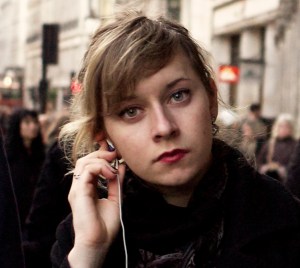
“Listening, Regent Street, London, 17 December 2011” by Flickr user John Perivolaris, CC BY-NC-ND 2.0
The ways of experiencing the world intimated by Geurts’ Anlo-Ewe interlocutors play havoc with conventionally “transitive,” western understandings of what it means to “sense” something (that is, to be a subject sensing an object) let alone what it means to listen. When you listen to something you like, Geurts might suggest to us that liking is part of the listening. Similarly, when you listen to yourself speak, who’s to say the feeling of your tongue against the inside of your mouth isn’t part of that listening? When a scream raises the hairs on the back of your neck, are you listening with your follicles? Are you listening to a song when it is stuck in your head? The force within us that makes us automatically answer “no” to questions of this sort is not a force of our bodies (they felt these things together after all), but a force of social convention. What if we tried to protest our centuries-old sensory sequestration? Give me synaesthesia or give me death!
Indeed, synaesthesia, or the bleeding-together of sensory modes in our everyday phenomenological experience, shows that we should loosen the ear’s hold on the listening act (both in a conceptual and a literal sense – see some of the great work at the intersections of disability studies and sound studies). In The Phenomenology of Perception, Maurice Merleau-Ponty put forth a bold thesis about the basic promiscuity of sensory experience:
Synaesthetic perception is the rule, and we are unaware of it only because scientific knowledge shifts the centre of gravity of experience, so that we have unlearned how to see, hear, and generally speaking, feel, in order to deduce, from our bodily organization and the world as the physicist conceives it, what we are to see, hear and feel. (266)
Merleau-Ponty, it should be said, is not anti-science so much as he’s interested in understanding the separation of the senses as an historical accomplishment. This allows us to think about and carry out the listening act in even more radical ways.
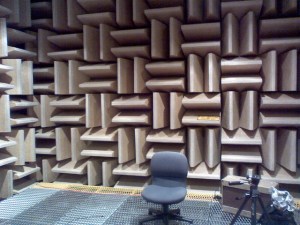
“Listening Room” by Flickr user Consumerist Dot Com, CC BY 2.0
Of course all of this synaesthetic exuberance requires a note to slow down and check our privilege. As Stoever-Ackerman pointed out:
For women and people of color who are just beginning to decolonize the act of listening that casts their alternatives as wrong/aberrant/incorrect—and working on understanding their listening, owning their sensory orientations and communicating them to others, suddenly casting away sound/listening seems a little like moving the ball, no?
To this I would reply: yes, absolutely. It is good to remember that gleefully dismantling categories is by no means always the best way to achieve wider conceptual and social openness in sound studies. There is no reason to think that a synaesthetic agenda couldn’t, in principle, turn fascistic. The point, I think, is to question the tools we use just as rigorously as the work we do with them.
—
Owen Marshall is a PhD candidate in Science and Technology Studies at Cornell University. His dissertation research focuses on the articulation of embodied perceptual skills, technological systems, and economies of affect in the recording studio. He is particularly interested in the history and politics of pitch-time correction, cybernetics, and ideas and practices about sensory-technological attunement in general.
—
Featured image: “” by Flickr user woodleywonderworks, CC-BY-2.0
—
REWIND!…If you liked this post, you may also dig:
Snap, Crackle, Pop: The Sonic Pleasures of Food–Steph Ceraso
“HOW YOU SOUND??”: The Poet’s Voice, Aura, and the Challenge of Listening to Poetry–James Hyland
SO! Amplifies: Eric Leonardson and World Listening Day 18 July 2014–Eric Leonardson
Share this:


Current Top Posts





April 2021

January 2020

November 2019

October 2019

August 2019

April 2014

November 2017

March 2015

December 2017

October 2015
 Sounding Out!
Recent Comments